The
Masked Bookwyrm's Graphic Novel (& TPB) Reviews
The
Masked Bookwyrm's Graphic Novel (& TPB) Reviews
Batman - D (Page Three)
for a complete alphabetical list of ALL reviews start hereA - B - C - D - E - F - G - H - I - J - K - L - M - N - O - P - Q - R - S - T - U - V - W - X - Y - Z
Batman: Death by Design (2012) 108 pages
 Writen by Chip Kidd. Illustrated by Dave Taylor.
Letters: John J. Hill.
Additional notes: sketch gallery.
Rating: * * * * (out of 5)
Number of readings: 2
Reviewed: Dec. 2015
A pre-script: I've re-read this a couple of times and on a visceral level I quite like it. There's a charm and ambition to it for reasons I detail in my review. So even though it has flaws (as I also detail in my review) I have to concede I LIKE it and have boosted the rating from 3.5/5 to 4.
Death by Design is an entirely self-contained Batman graphic novel -- even to the point where it might even be meant as an Elseworlds story. At least there's a bit of retro vibe/design to it all, almost as though a period piece set in the 1930s or 1940s, with seeming old time fashions and designs that seem Art Deco and Steampunkish -- even though I don't think it explicitly says it's not modern times. While Batman's costume seems meant to evoke the look he had in his very earliest published stories.
The plot revolves around Bruce Wayne's plan to tear down a train station first erected by his father. It's regarded as a city landmark, but due to poor workmanship it is crumbling, and he intends to replace it with a brand new construction. But someone seems to be sabotaging the new design, while Bruce (and Batman) must contend with various players: a beautiful society gal spearheading an effort to save the original building; the son of the architect who designed the original building (and who suffered disgrace when it started to fall apart); a reporter covering the saga; a corrupt union boss; and a mysterious vigilante called Exacto (looking very Rocketeer-style retro with goggles and such) who may be a hero or a villain. Oh -- and The Joker crops up, too.
Part of the appeal of Death by Design is it feels like an actual story -- rather than just an excuse for a lot of fight scenes and splash pages. Batman shares page time with Bruce Wayne, allowing the story to feel a bit like a detective/mystery tale as much as a super hero adventure. Although there's death and threat of death, it feels nicely genteel, rather than just being about grotesque serial killers or gritty mob wars as so many Batman stories are. Bruce/Batman is a likeable enough hero, and there's some nuanced scenes and clever, sometimes amusing dialogue (Batman, after inadvertently startling someone he meant to rescue, drily muses he might need to re-think his spooky approach). The backdrop of municipal planning and architecture isn't just window dressing for the fights, but really is integral to the plot (just as plenty of detective series will deliberately root each mystery in a new milieu for the hero to explore) -- yup, a Batman comic where characters actually have conversations about architecture! It lends it a nice sense of sophistication -- without sliding into just being turgid or self-indulgent.
Unfortunately it still fails to entirely fulfil expectations established by the early pages. After a while you realize that even though we've been introduced to a cast of new characters -- there still aren't that many of them, so that they begin to fall neatly into their plot slots (it's no big stretch to guess who Exacto is). It can almost feel a bit as though Kidd was writing as he went, hoping it would all gel into something by the end -- and then it didn't entirely. The reporter turns out not to really have much relevance to anything. A sub-plot about the architect of the original building having gone missing gets revolved in a way that almost feels as though Kidd had forgotten about him and then hastily tried to tie that thread up. As mentioned, The Joker crops up. And though that might be seen as just a marketing conceit, it does add an odd freshness (even though the Joker can be a tiresome cliche, here he provides an unexpected element) adding a wild card to the story since he doesn't seem connected to the existing mystery. But equally, it can feel like he's just there because it's to be expected (including a climax where Batman confronts him in a crumbling building after he kidnapped the woman -- in echoes of the 1989 Batman movie).
Perhaps the biggest demonstration of what I mean about the problem with the plotting is that I hadn't even realized the climax was the climax as I read it. I assumed there was still more to come in the story!
As mentioned there's a deliberate period vibe to the story, from the wardrobes to the technology to the fact that it is presented mostly in black and white (or grey, rather) giving it the look and feel of an old Hollywood movie -- almost as if we are imagining "what if" there had been a big budget, A-list Batman movie at the time (instead of cheap movie serials). One can't decide, though, whether that dictates part of the story. A villainous figure in the story is a corrupt union boss which can seem like a cliche of period noir thrillers -- or can seem like a bit of a reactionary knock against organized labour (after all, free enterprise -- as represented by Bruce Wayne -- is unarguably the good guy).
The art for the book is by Dave Taylor who has a realist yet slightly sketchy style (he boasts that he doesn't actually erase lines, just works over them). His style is more realistic than one sometimes associate with the Gothic flavoured Batman (his Batman looks like a man in a costume) but he nicely captures both the big screen extravagance of the splash pages and the quiet, talking head scenes of the character/detective stuff, all reproduced from his pencils (rather than inked) allowing for shading and texture. And, as mentioned, presented in an atmospheric grey wash as opposed to obvious colours. The first time I recall seeing Taylor's work was on Batman: Legends of the Dark Knight #100 -- also reproduced from his pencils -- and his style remains the same but, arguably, even better.
The result is certainly a likeable, engaging Batman adventure, nicely readable for itself and itself alone. With enough snazzy action scenes to be exciting, but nonetheless with more care paid to characters and the story unfolding than a lot of Batman comics. And eschewing the overt violence and nastiness of so many comics. But, with that said, it does feel as though it doesn't fully live up to the expectations it engenders in the reader, making for a good read -- but not quite the great one it promised to be.
Batman: A Death in the Family (1988) 144 pages
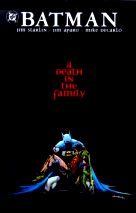 Written
by Jim Starlin. Pencils by Jim Aparo. Inks by Mike DeCarlo.
Written
by Jim Starlin. Pencils by Jim Aparo. Inks by Mike DeCarlo.
Colours: Adrienne Roy. Letters: John Costanza. Editor: Dennis O'Neil.
Reprinting: Batman #426-429 (covers reprinted on back cover)
Additional notes: mock intro by a future historian, analyzing Batman and Robin; afterword by Dennis O'Neil.
Rating: * * * * (out of 5)
Number of readings: 2
This was the controversial storyline in which Jason Todd
-- the second Robin -- was murdered by the Joker.
There's a lot of baggage
that comes with this story (which I hadn't read when it was originally
published over a decade ago). It raised a lot of eyebrows among the general
public as to just what sort of people were writing comics these days.
This was not simply because those writers killed off a well known supporting
character (although the original -- better known -- Robin, Dick Grayson,
remained unscathed) , or the fact that the character in question was a
kid (entertainment in the murder of a minor?), or even the brutal manner
in which he was killed. The controversy stemmed from the fact that DC left
the decision as to whether Jason lived or died up to the fans who could
phone in their votes. In other words, the Batman readership -- many, one
assumes, kids -- were encouraged to decide whether a character lived
or died. Not since the days of the Roman Colliseum had the world experienced
such a questionable spectacle. And the fact that the person in question
was a fictional character didn't tend to mute the disgust many
felt toward DC Comics. Adding to the situation was the fact that the vote
to kill Robin didn't pass by a huge margin -- a lot of fans actually voted
to keep him alive.
As I said, there's a lot of ethical baggage that comes
with this, but I'll put it aside (for the moment) and concentrate
on the story as just that -- a story.
Surprisingly, this turns out to be a pretty decent read.
The first two issues of this four issue story were double-sized,
meaning it's actually a solid, six issue epic. Literally. Those
double-sized issues are broken evenly into 22 page chapters and one can't
help infering that DC had originally planned it as six regular issues but,
maybe feeling they couldn't sustain the publicity machine over six months
(after all, the story was a publicity stunt) decided to make it
four months.
The story has Jason Todd discovering that his birth mother
is still alive and might be one of three women, all of who are currently
living in various parts of the middle east and North Africa (absurd coincidences
play a big part in the ensuing activities -- you either swallow them, or
you might as well not read the book). Meanwhile, Batman is hot on the trail
of the Joker who is also winging his way to the middle east (I warned you
about coincidences). The story is, therefore, comprised of a few smaller
stories -- their quests for the first two women lead Batman and Robin into
adventure and intrigue involving terrorists, but also turn out to be wild
goose chases. Ultimately, you know the third time will turn out to be the
charm. But because all stories take place in, roughly, the same geographical
area, and the Joker weaves in and out, the result is a story that has the
feel of a single epic, while being comprised of three or four smaller stories.
Along the way, Superman even crops up in a supporting part for an issue
or two.
Part of the saga's strength is the removal from Batman's
usual Gotham City stomping grounds. The middle eastern setting adds a fresh
ambience to the saga, and there's a clear attempt to imbue the
series with a grittier, real-world edge, as the Joker eschews his usual
comic book activities of jewel heists and the like in favour of branching
into the world of terrorism, or hijacking famine relief supplies he figures
he can sell on the black market. As the saga moves into its climax, global
politics become central to the story, leading to a showdown at the U.N.
Though I wasn't as comfortable with the idea of Batman breaking up a kiddie
porn ring at the beginning (nothing graphic, of course).
Writer Jim Starlin tells the story well, with a good blend
of mood, introspection, and action. The only other Bat-tale I'd read by
him from that period -- The Cult -- had left me disappointed,
but this is decently written, with good characterization and dialogue.
Jim Aparo, a guy who will no doubt go down in comicbook history as one
of the definitive Bat-artists, aquits himself quite nicely. Aparo is right
at home, and his style is dynamic and comprehensible -- there's nary a
picture or scene anywhere that you need to read twice to figure out what's
going on. His teaming with inker Mike DeCarlo works very well. I had previously
had my reservations about Aparo's looser style from the period, and felt
DeCarlo's rigid, geometric inks weren't the most appropriate for him. I
don't know if I've mellowed, or whether this is just better work, but the
art is particularly strong -- curiously, DeCarlo's inks don't even look
like DeCarlo's usual style. There's also a touch of the influence of comic
strip legend, Milton Caniff, that I'd never recognized in Aparo's art before (though I realize it was there all along).
Of course, just because this is trying for an edgy realism
doesn't mean it altogether succeeds. There's some simplistic plot progression
and lapses in credibility -- even silliness (I mean, just what did
the Iranians intend in the climax?). And one gets the feeling Starlin probably
didn't do a whole lot of research on the region, or his topics. There's
an intriguing plot twist late in the saga, involving Diplomatic Immunity,
but it pushes credibility. But then, comics have also (I believe) misunderstood
the legal definition of Insanity for many, many years, so legal technicalities
are not something you should learn from a Batman comic. There I go, referring
to "comics" again, as if it's the only medium with such problems, when
in fact all of my above criticisms could be applied to many a respected
movie or novel, as well.
Set in the Arab world, peopled by terrorists, it could slide into offensive cliches, but (maybe because of innocent Arab taxi drivers and hotel clerks) you don't really come away feeling Starlin is trying to paint all Arabs as bad guys...anymore than the Joker and his goons represent all Americans. At the same time, the portrayal of Iranians later in the story as just cardboard, illogical villains certainly seams xenophobic (whatever one may think about the Iranian government, then or now). And when Batman at one point refers to an Iranian generically as an Arab, Starlin seems to be blurring the distinction between a government...and a race. Which is troubling.
Another qualm is that once Jason learns he has a "real" (read biological)
mother, the way he just seems to forget about his dead mother -- the woman
who raised him -- seems cold and insensitive.
Emotionally, the story doesn't really succeed as well
as it should. Granted, I wasn't that familiar with Jason Todd, so his death
didn't strike a personal chord with me. But although Jason's death, part
way through, sends a vengeful Batman after the Joker, comic writers like
Starlin seem more comfortable with emotions like anger or revenge, rather
than the more powerful, and heart-wrenching emotion of...grief (O.K., now
I do mean to single out comics writers). Neither Batman, nor Alfred, really
act like they've lost a member of their family. Though, ironically, given
that Jason was killed precisely because a lot of fans didn't like him,
I didn't find him an unsympathetic character here.
But, despite its short comings, despite my moral qualms
and my cynicism, A Death on the Family turns out to be a highly
readable saga -- one that boasts some atypical, even complex plotting and
plot turns. Compared to some other "stunt" stories (The
Death of Superman, for one), this holds up as a story, regardless of
its mythos shaking significance. I even thoroughly enjoyed the old fashioned,
pre-computer, single tone colouring. I like modern comics with their rich,
shaded palates, but sometimes they can be a bit cluttered and overwhelming.
That's the story considered apart from the ethical questions.
Considered with the ethical question, it remains a highly questionable
excercise, as does the excessively brutal manner in which Robin was killed
-- comics, too often, have become a medium of excess. And it's made all
the more distasteful by the way DC Comics (here represented by a closing
editorial by Bat-editor Denny O'Neil) constantly refuses to acknowledge
the legitimacy of their detractors' views, and refuse to accept responsibility
("it wasn't our fault, blame the fans"). Ugh. Though one can sympathize
with O'Neil, who acted as front man on the whole enterprise, but has repeatedly
claimed he voted to keep Robin alive! Adding insult to injury is
a quote on the back from O'Neil saying it would be "sleazy" to bring back
the character. Though Jason remains deceased, DC and O'Neil conjured up
yet another Robin (Tim Drake) just a few
issues later. Yup. Sleazy's the word.
Originally published as one of those economical TPBs DC
used
to put out on conventional newsprint paper for a fantastically modest price,
it has since been re-issued as a more conventional TPB...with an appropriately
inflated price tag.
Batman: Detective Comics, vol. 9: Deface the Face (2019) 124 pages
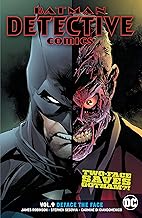 Written by James Robinson. Illustrated by Stephen Segovia, Carmine Di Giandomenico.
Colours: Ivan Plascencia, Allen Passalaqua. Letters: Rob Leigh.
Reprinting: Detective Comics #988-993 (2018) - with covers
Rating: * * 1/2 (out of 5)
Number of readings: 1
Reviewed: April 2024
Just to start: I'm not sure the decision by DC, Marvel, etc. to number collections (this is "volume 9") really serves much purpose for the simple reason that I think they re-start the numbering system everytime there's a re-boot, new creative/editorial team, or just a change in the weather. So, yes, if you were following this era of Bat-comics, you can tell this fits between volume 8 and volume 10 -- but if you're just randomly looking at Batman books on a shelf, I suspect you could buy a volume 8 and a volume 9 only to find, when you got home, that they were from separate runs and had nothing to do with each other!
Anyway, that's just today's entry in: comics make no darn sense!
So onto the story itself...
Although another point I've made before is why collections don't begin with a "previously..." forward? Case in point, this seems to come on the heels of some big conflict that didn't go too well. Batman is licking some emotional wounds and it starts with him intruding into what seems a "simple" murder investigation precisely, he tells Commissioner Jim Gordon, because he needs something back-to-basics to clear his head.
The problem with this is if you don't know what happened before, it can be a bit confusing, as you've clearly missed something dramatic...but equally it's completely irrelevant to the story, and has no impact on the plot or Batman's behaviour. And throughout dialogue drops references to things that are part of the DC mythos without really explaining it to a casual reader, rendering some dialogue weirdly nonsensical. In one scene a character makes referece to "Checkmate" and it seems like a complete non sequitur. An issue or two later Checkmate is referenced again and then you might start to infer it's some (defunct, I guess) superhero team. But in the earlier scene? It's just a word salad.
Anyway, the "simple" murder turns out to be more complicated. Eventually it leads Batman to his arch-foe Two-Face (he doesn't appear for a bit, but I assume the reader knew he was going to get involved from the beginning). But it's not just Two-Face in Gotham, but the terrorist group Kobra. And it turns out that Two-Face (who used to be District Attorney Harvey Dent, after all) wants to stop Kobra, too. So Batman (and Gordon) form an uneasy alliance with Two-Face to try and thwart the Kobra cult's plan.
And to me, I dunno, it all felt a bit tired. Like writer James Robinson was struggling to find inspiration...but couldn't. (Even the "Baman teams with an arch-foe" plot isn't that unusual). Maybe it partly relates to my (oft repeated) complaint about modern comics and their stretched out, multi-issue stories. This might have made a good two-parter: Batman teams with Two-Face against a greater threat, but can he trust Two-Face? But stretched over six issues, there isn't really much here. The plotting is pure comic book cheez in terms of motives, "clues", tropes (which isn't inherently a criticism -- as long as the creators know that's what they're doing). Kobra's master plan feels like Robinson spun a mystery wheel of the "generic super villain schemes" and waited for it to land on one.
Part of the problem with stories like this is there's nothing else going on. Batman barely appears out of costume and there are no soap opera-y sub-threads (romantic interests) or sub-plots that might humanize the character or at least take some of the pressure off the main plot that's carrying every page.
It's a fairly talky script, as if Robinson wants to use it to explore the characters and emotional dilemmas posed by Two-Face -- a former friend of Batman and Gordon both. Without successfully pulling it off. I've read other (older) Two-Face stories that better mined the emotional ambiguity, and made Two-Face a more sympathetic and tragic character. Robinson's take on Two-Face seems a bit odd. He leans into the idea of him having a multiple personality disorder -- Two-Face literally referring to Harvey as a secondary personality -- which I'm not sure is typical for the character. While Robinson kind of shrugs off the familiar dual motif -- there's barely any use of the coin Two-Face normally flips to make decisions! I'd almost wonder if Robinson had originally conceived the plot for another villain entirely.
Robinson is a writer who first started to come to the fore in the 1990s (I believe part of the post-Moore/Gaiman British Invasion of US comics) and I've read some comics by him I like. But a problem I sometimes have had with Robinson over the years is his dialogue. I don't know if that's because he's an Englishman trying to write American dialogue, or what. And I should point out, in comics "bad" dialogue can be an odd label. In a genre that began with "Gee Whiz!" and "Moons of Krypton!", superhero dialogue can be idiosyncratic and follow its own rhythms. But I rarely found the dialogue here effective -- whether the "human" interaction between Batman and Gordon, or Batman and Alfred; or the scenes with Two-Face, or just the superhero dialogue during fights.
The art is like a lot of art in Batman comics I've read in recent years. A kind of House Style, I guess. The artists are undoubtedly talented, and can craft beautiful and striking and detailed "art" -- but the storytelling isn't as strong. Action scenes can be a bit confusing, sometimes it being unclear what you're looking at or how one panel follows from the last. Faces tend to be grimly stoic without much variety in expression or jawlines. The colouring is dark and sombre, a lot of blacks and earth tones that can render it all a bit murky, the foreground and the background just blending into each other. I was recently reading some of the Jim Starlin-Jim Aparo comics from thirty or so years ago: single tone colours, much simpler backgrounds. But the storytelling was often top notch: the action scenes clear and dynamic, generating genuine suspense and tension. The talky/character scenes expressive. (Those comics had their own problems -- not saying they were inherently better. But in terms of visual storytelling, sometimes less can be more).

Batman: Detective (2007) 144 pages.
Written by Paul Dini, with Royal McGraw. Illustrated by Don Kramer, and J.H. Williams III, Joe Benitez, Marcos Marz. Inked by Wayne Faucher, Victor Llamas, Luciana Del Negro.
Colours: John Kalisz. Letters: Jared K. Fletcher, with John J. Hill. Editor: Peter Tomasi.
Reprinting: Detective Comics #821-826 (2006-2007), with covers
Rating: * * * (out of 5)
Number of readings: 1
Batman has gone through a bit of a creative tug-of-war over the last few decades. Often portrayed as a single-minded, one note vigilante (sometimes dismissed as "A$$h__e Batman" by some web reviewers), and his adventures often caught up in multi-title Batman Family crossovers (War Games, Contagion, Bruce Wayne Murderer, etc.). There's a school of thought that says Batman has kind of gone off the creative rails. So every now and then, DC responds to such criticisms, and the recent run on Detective Comics by Paul Dini offers a slightly more sympathetic Batman and, in a bit of Old School conceit, presents a lot of one-off, stand alone adventures.
Oh, yeah, and he also plays up Batman as a detective, not just a knuckle-duster.
Batman: Detective collects the first six issues of this "new era", and sure enough we have six largely stand alone tales -- oh, not isolated from continuity, as familiar foes crop up, and Dini introduces a minor recurring thread in that the Riddler, who not so long ago had been re-invented as a homicidal madman privvy to Batman's secret identity, has since developed amnesia and gone straight...turning his criminal mind for puzzles into the analytical mind of a private detective (resulting in some amusing clashes with Batman over shared investigations).
And the overall result is...okay. Unfortunately, I can't really be more enthused than that after reading this collection (and, indeed, a couple of subsequent Dini scribed issues), even though I'm all for what is the point of the tales -- stand alone stories with beginning, middles and ends; a greater emphasis on mystery and detection; and maybe a slightly kinder gentler tone.
Essentially, this collection can be broken into two types of tales -- 3 detective/mystery tales, and 3 traditional arch foes/super hero tales.
I've said before that detective/mystery stories seem to be something comic book writers do really, really, badly -- whether the mystery is crammed into an 8 page short, or stretched over a 12 part maxi-series. They just seem to have trouble getting the basics.
In this case, Dini offers mysteries where the emphasis is on talk more than action, with the fighting minimal as Batman investigates. But Dini tends to cheat, as killers are often revealed to be people we'd barely met, based on clues that we were never fairly given, and deductions that are more leaps of logic than analytical inferences. I'm in the middle of reading Showcase presents The Elongated Man...and thoroughly enjoying it. In it, the mysteries tend to be a bit haphazard...but it can be forgiven because the stories are short, and the set ups are usually intriguing (even if the denouements are weaker). But stretched out to 22 pages, you kind of need better plotted mysteries. Particularly because that's all there is: Dini offers no on-going sub-plots, no blossoming romance betweern Batman and a love interst, or anything, so he can't fall back on the "the plot-of-the-month is just a fun filler tale" excuse. And the action scenes, themselves, are largely bland and non-descript.
Nor is there a great deal of human emotion: his Batman may not be a one-note fascist...but he's not really anything else, either. He basically just saunters through the tales (and narrates) with a kind of unflappable stoicism.
In one of the superhero/action stories, Batman must protect villainess Poison Ivy from a killer monster plant, before discovering Ivy's own ugly secret. To which Ivy remarks: "You're acting as if I betrayed you. Did you truly believe your efforts...would change me?" But Dini never really gave us any hint of Batman becoming emotionally invested in the case. (And that's ignoring the fact that Ivy seems to ping pong back and forth, depending on the writer, as to whether she's a tragic antagonist...or black hearted villainess)
Other "superhero" focused stories are one where Dr. Phosphorous returns (scripted by pinch hitter McGraw)...and it's an entirely generic example of the "villain-seeks-revenge-by-killing-off-his-enemies-one-by-one" tales. And, I'll admit, I have no idea how this fits into DC's morass of retconned continuity (since Dr. Phosphorous was first introduced into pre-Crisis continuity). The final story has Robin tied up in a car with the Joker while the Joker goes on a vehicular homicide killing spree. It's a story that can leave you mixed. On one hand, it's an off beat concept (basically one scene)...and on the other hand, it is just an excuse for a lot of Joker mayhem, and it too lacks too much in the way of any kind of emotional sub-text (not to mention that Robin has his own comic, so why is this tale being told here?)
As I say, ostensibly, these are largely stand alone tales, but there remains that whole problem in modern comics as to whether they're writing for a committed fan base...or hoping to woo new readers. In one story Batman makes a quick call to Zatanna the Magician for advice...but it's not really explained who she is for the uninitiated (she even refers to herself in the third person, so a casual reader might not realize it's her name). Comics are having enough trouble holding an audience...they really need to be written more reader friendly (as others have said, every comic is potentially some reader's first comic...and could be their last if they find it too confusing in its cryptic references).
Paul Dini came to comics from TV, where he wowed comic fans with his work on Batman: The Animated Series -- the cartoon that was seen as an adult-friendly, and arguably the most true to the spirit of the comic of any filmed version of Batman (from West to Burton). But I'm reminded of a comment I recently read made by Christopher Priest, a comics scribe who, though hit and miss, it's safe to say is one of the more critically acclaimed writers in recent comics, and how he seemed to indicate he was kind of leaving the biz, in part because the new editorial trend seemed to be to embrace the recent influx of "slumming" TV writers (like Dini, Joss Whedon, J. Michael Straczynski, etc.) at the expense of comics writers who made the art form their first and last love. The point is, Dini is not a bad writer compared to comics veterans...but I've yet to read anything by him that made me stand up and shout, either.
The art is strong throughout, reflecting some intriguing stylistic variances, from JH William III almost photorealism to Joe Benitez's Jim Lee-esque stylings on the Poison Ivy tale (with its slightly more cheesecake approach) to Marcos Marz's work on the Dr. Phosphorous tale which looks both vaguely painted...and as if reproduced from the pencils, yet it was neither. But Don Kramer is the principal artist and has a solid, realist style. I'll admit, though I can't really find fault with too much of the art...none of it necessarily excited me either, or made me say: "Man...I have just got to see more by these guys!"
As I said, this is maybe supposed to be a kinder gentler Bat-era...but those terms are defined by Batman's already dark and twisted world. There's still muder and mayhem and grisly atrocities -- more than is perhaps really needed, or warranted given that, in other ways, Dini and company seem to want to go for a (slightly) lighter touch with quips and humour. And scenes of Batman visiting a kinky sex club like something out of CSI seem a tad questionable.
And there's still the eternal problems of super heroes and they're love of brutality. In one story, Batman tracks down a suspect in a homicide -- not even a suspect, more a "person of interest". And we cut to Batman dangling the man from a building, with blood on the man's face. Sure, we don't know what preceded it -- maybe Batman acted in self-defense. But what we see is Batman beating and, essentially, torturing a guy to get information...a guy he has no reason to really view as a serious suspect yet. And Dini and company clearly think this is okay...better yet, is kind of cool ("You show 'im Batman...and remember, it ain't torture -- according to the Bush adminstration -- as long as you stop before organ failure!")
Ahem...still, aside from that momentary political digression on my part, over all, I moderately enjoyed these issues -- I really did -- but, as I say, moderate is the most I can muster. There are some cute bits, some amusing exchanges (particularly when Batman clashes with the reformed Riddler). I was perfectly content breezing through the stories...even as, when I finished them, most left me with a vague sense of dissatisfaction.
(The next sequential TPB in this Dini era is Death and the City.)
Or go to