GRAPHIC NOVEL and TRADE PAPERBACK (TPB) REVIEWS

by The Masked Bookwyrm

Batman - J - L, page 1
Batman-Judge Dredd: Judgment on Gotham  1991 (SC GN) 64 pages

cover by Simon BiselyWritten by Alan Grant, John Wagner. Illustrated and painted by Simon Bisely.
Letters: Todd Klein. Editors: Denny O'Neil, Steve MacManus.

Co-published with Fleetway Publications.

Rating: * * (out of 5)

Number of readings: 1

Mature Readers

Batman meets Judge Dredd (and Judge Anderson) while villain Judge Death meets villain the Scarecrow.

Batman is, of course, a costumed vigilante who lives in modern day Gotham City and is published by DC Comics. British creation Judge Dredd is a draconian police officer/judge/jury all in one who lives in a distant future and was published by Fleetway Publications (and various other companies in the U.S. -- including DC briefly). This company crossover has a Dredd villain, Judge Death (pursued by another Dredd villain, the comic relief Mean Machine) arriving in modern day Gotham City, while Batman gets flung into Dredd's future/alternate reality of Mega-City One. While Judge Death teams up with Batman's foe the Scarecrow in Gotham, Batman gets arrested by Judge Dredd in Mega-City One, eventually escaping with the aid of a more level headed, female judge, Judge Anderson. The two return to Gotham City to tackle the villains who're on a killing spree, with Judge Dredd in pursuit.

Judgment on Gotham (the first of three team-ups between the two) is kind of uneven. Judge Dredd is one of those comics which fans seem to acknowledge is violent and even fascist, but is labelled satirical. And this story is clearly meant to be silly in spots, but that's part of the problem. It's cute, it's even amusing...but it rarely quite becomes funny. Mean Machine is a big guy with a dial on his head that he can adjust to make himself meaner, whose chief tactic is to head butt people. That's kind of absurdly amusing the first couple of times, but wears thin after a while. Still, the story trundles doggedly along for the most part, not being particularly good, not being particularly terrible, but the conventional plot seems like John Wagner and Alan Grant (writers of both Judge Dredd and, in Grant's case, Batman) presumably banged it out over a cup of coffee (before their coffee had time to cool) and doesn't offer any surprises or clever ideas. And the violent climax just kind of drags on and on until, I'll confess, ennui set in.

Even the fish-out-of-water idea is barely explored. Batman doesn't really get a chance to run around Mega-City One, nor does Dredd explore Gotham. You come away not really having much sense of either characters' reality.

There are practical concerns with the story, too. Crossovers, let's face it, are not so much artistic excercises, but commercial ones. Two companies get together, hoping they can tap a new audience. That is, a Batman fan buys it, and gets turned on to Judge Dredd, or vice versa.

But Batman's a bit out of his element in a story that's not meant to be taken seriously. A dramatic character can function in a comedic environment as long as the character can stay in character. But the problem with a satire is that it's not really meant to be held up to analysis. Batman can't comment on what he really thinks of Judge Dredd's reality (other than a brief quip about Dredd being "gestapo"), 'cause it would force Judge Dredd into a more serious corner. As such, Batman has to be a bit of a blank slate, character-wise. Even ability-wise he is underused -- he doesn't escape from jail using his skills or intellect, he is broken out by Judge Anderson.

Judge Dredd fares even less well, appearing in only a few scenes in his own team up! Judge Anderson is featured more.

Wagner and Grant seem far more interested in the villains. More than a third of the pages are devoted to the villains (Judge Death, Scarecrow, Mean Machine) traipsing around with nary a hero in sight -- more pages, in fact, than are devoted to scenes of the heroes without the villains! I'm kind of cool to the idea that villains are more interesting than heroes, particularly when the villains are such motiveless, anarchic characters. And in the case of Judge Death, such a brutally violent character.

Simon Bisely's painted art is another mixed bag, all cartoony distortions, inflated muscles and extraneous lines and paint splotches. Painted comics are always kind of neat, and there's a certain atmosphere at work...but other times it works against any mood, with busy panels that are hard to figure out what's going on. It's certainly not a style that lends itself to subtle facial expressions which would convey emotion or characterization. And he seems to have one (surrealistc) style, meaning his Gotham (with cops driving racing cars and morgues like something out of gothic sci-fi) and Mega-City One look pretty homogeneous, robbing the story of what should be its point: the contrast between Batman and Dredd.

Recommended for mature readers due to violence. There's also a scene where Judge Death shows his willy, if that appeals to ya. Judge Anderson (the pretty, female character) has a couple of racy panels, too, but is draped in shadow. Ultimately, this is for Batman or Judge Dredd completists, but others might prefer to get a sample of these guys elsewhere.

Cover price: $6.95 CDN./ $5.95 USA.


Batman: The Killing Joke - cover by Brian Bolland

Batman: The Killing Joke 1988 (SC GN), 48 pgs.

Written by Alan Moore. Art by Brian Bolland.
Colours: John Higgins. Letters: Richard Starkings. Editor: Denny O'Neil.

Rating: * * (out of 5)

Number of readings: 3

Mature Readers

The Joker, remembering how he was once a normal guy, driven insane by circumstances, sets out to prove it could happen to anyone. He cripples Barbara Gordon (the former Batgirl), and tries to drive her dad, Commissioner Gordon, insane with the crime. Batman eventually catches up with him.

I didn't much care for Batman: The Killing Joke, this definitely-not-for-kids story that most people revere. Firstly, it's not really a Batman story: not in the sense that Bats accomplishes much (he only finds the Joker because the Joker sends him an invitation!) or his character is explored or even that he has many lines. Essentially, it's the Joker's story.

The real problem, though, is that it's emotionally hollow. Alan Moore comes from the generation of writers (in movies, books, and comics) that equates "art" with brutality, where character and story are less important than "pushing the envelope". The Killing Joke is pretty icky...not to mention capable of being interpreted as misogynistic. The two female characters are just there to be brutalized to provide motivation for the male characters. This is particularly disturbing with Barbara Gordon, a long time DC character, whose emotional reaction to her own crippling is never even touched upon. Alan Moore (and co.) obviously consider her personal trauma irrelevant.

The story is awfully thin and never really delivers emotionally, or intellectually, and seem a little like a shaggy dog story in any event. I've never been that impressed with Moore's dialogue, but lines like "you whimpering little smear of slime" don't even warrant a comment. Alan Moore likes to play around with juxtaposition: words to images, images to images. But unlike, say, Frank Miller (at least, at the time), there's little emotional or thematic justification to them. A guy pulling the legs off his seafood dinner is juxtaposed with a doctor tugging on Barbara's paralysed legs. But what's the point, the subtext? At most it's a tasteless gag...and another indication of how Alan Moore and Brian Bolland feel about their female characters.

On the other hand, the story about the "two guys in a lunatic asylum" is memorable (though I'm not convinced it really meant anything).

Brian Bolland's art is O.K., but his "realist" figures can seem a little stiff, robbing the (overlong) action scenes of energy. And his Batman looks like just a guy in a cape...and about as intimidating as Adam West.

I would argue a better, emotionally richer (and better plotted) take on the Batman-Joker relationship, and the Joker's insanity, was J.M. DeMatteis and Joe Staton's Going Sane story line published a few years later in Batman: Legends of the Dark Knight (granted, writer DeMatteis had twice as many pages to play with).

I'm also a bit dismayed by the hypocrisy inherent in a comic like this. It was released as a graphic novel, with a "mature reader" warning, because it contains material inappropriate for a regular comic with its broader-based readership. Fine. Very responsible. Except...the story contains material (the crippling of Barbara Gordon) that has a direct impact on regular Batman comics, meaning, if you were a Bat-fan, you kind of had to buy it. In other words, DC comics protests and says, "Oh no, kids, this isn't for you" and then winks and says, "But if you want your collection to make sense...heh heh." Pretty sleazy. If a comic/graphic novel contains material inappropriate for younger readers, it should be self-contained, and not require younger readers to buy it. Others have been guilty of the same thing (DAREDEVIL: Love and War, for one) but the level of potentially "objectionable" material in Batman: The Killing Joke is so extreme, and the impact on continuity so major, it's the most blatant offender by far.

Still, proving that nothing is sacrosanct in comics, even this story, for all its accolades, has been somewhat nudged aside by later -- different -- Joker origins, including in Lovers and Madmen.

Original cover price: $4.50 CDN./$3.50 USA


Batman: King Tut's Tomb 2010 (SC TPB) 128 pgs.

cover by Garcia-LopezWritten by Nunzio deFilippis & Christina Weird, with Gerry Conway, J.M. DeMatteis. Pencils by Jose Luis Garcia-Lopez. Inks by Kevin Nowlan, others.
Colours/letters: various

Reprinting: Batman: Confidential #26-28, Brave and The Bold #164, 171, Batman #353 (with covers) - 1980-1982, 2009

Rating: * * * (out of 5)

Number of readings: 1

Reviewed: Jan, 2012

I was surprised to realize that King Tut, a recurring villain in the 1960s camp-classic Batman TV series (played by Victor Bruno)...was not actually based on a character from the comic books. Even though I had never come across him in the comics, I always assumed he was some 1950s villain that had simply faded into obscurity. But apparently he had no comic book counterpart...until now.

Finally, after more than four decades, DC Comics decided to give the comic book Batman a King Tut villain...with mixed results.

I mean, right up front: King Tut's Tomb is a perfectly okay, perfectly agreeable, perfectly Old School Batman adventure. Published in the pages of Batman: Confidential (which replaced Batman: Legends of the Dark Knight as a place to tell self-contained Bat-arcs by different creative teams) it boasts art by the great Jose Luis Garcia-Lopez, who has graced Batman a time or two over the years. Garcia-Lopez has a hyper-realist style that, nonetheless, suits Batman's world. That is he's just as at home drawing a bright, daylight character like Superman (and, yeah, DC should tag him for a Superman graphic novel) but nonetheless he's good at capturing Batman's swirling cape and pointy ears. Still, this is definitely more a super hero Batman than a dark, gothic, creature of the night Batman. But the art alone is a big selling point (even if Garcia-Lopez does slide a bit into self-conscious cheesecake, what with a female character who always seems to be in lingerie when we look in on her!)

You might think if they were finally going to create a King Tut after so long it was because they had a pretty snazzy story to tell -- wouldn't you? Instead, it's a pretty minor, pretty generic story. A new costumed villain, dressed as an Egyptian Pharaoh, starts killing members of the board of directors of the museum. It's basically the kind of tale Batman has been doing since 1939 -- except back then it would've been told in about 12 pages!

The added quirk is that King Tut tends to utter riddles during his crimes (a bit of a plot leap, as it's only by coincidence anyone survives to recount the riddles to Batman). Batman at first assumes his old foe, The Riddler, is involved...and then reluctantly teams up with the Riddler in hunting Tut. That's a cute addition to the familiar premise, and provides some humour and comedy as the Batman is very grudgingly saddled with this unwanted sidekick. For all that there is murder, essentially this is a lighter Bat-tale -- basically just an old fashioned romp. (Though, personally, I would argue if you are going for a lighter Bat-tale, you should cut back on the body count).

But though it's a cute pairing, and adds a few twists to the hoary hunt-the-series-killer plot, even it suffers from a certain familiarity, as Batman has reluctantly teamed with the Riddler before (being, I suppose, one of Batman's less homicidal foes). Heck, a reformed Riddler was even a recurring character in the Batman comics for a while, acting as a private eye, getting in Batman's hair.

And so that becomes the problem of how to rate this. As I say: it's a perfectly fun little story. But there's next to nothing here to make it stand out, or to warrant three issues! There's little underlining the basic plot -- no emotional undercurrent, no particular character exploration. There is some minor complication (aside from the Riddler) in that there's a sub-plot involving some other characters having embezzled from the museum...but it doesn't really add much to the story. Even when Batman deduces Tut's identity half way through, his motivation is pretty straightforward (nor is it even a surprise revelation as he's no one we'd met before).

And even as King Tut was going around murdering people, and Batman and the police would stake out his likely targets, I was kind of wondering what the fuss was about -- he didn't seem to have any powers or special abilities, nor did he even especially out-wit the heroes or mis-direct them. In fact, it's kind of amazing he accomplishes as much as he does! You also might think if you were going to lift the TV character onto the comics...you'd stick to the character. But they do...and they don't. Yes, he's an Egyptologist with a Tut fixation, but otherwise he's just a generic Bat-villain (not even rolly polly, as Bruno was). My memory of the TV Tut was that there was a certain poignancy to him (within the context of the tongue-in-cheek series) because he suffered from a spilt personality, so he was both a nice guy professor...and a diabolical villain. But here they seem to discard that. Rather, they pay homage to it by having the prof bump his head, and the Riddler remarking "he took a blow to the head and thinks he's a dead pharaoh"...but, honestly, it doesn't really come across as though that was the cause of his homicidal inclinations (and there's certainly no sense that he switches back and forth).

There are some potentially interesting ideas: Tut worships the sun, so sees Batman himself (a creature of the night) as "evil", or even his antipathy toward the Riddler...but not enough to really make you think this King Tut has the stuff to become the next great Bat-foe (a fact that even the writers seem to acknowledge by a little twist toward the end).

The result is a perfectly okay -- even appealingly innocent -- Bat-tale...that we've seen a zillion times before, usually told in one issue...maybe two.

Padding out this collection (which otherwise would only be three issues!) are a trio of older Batman reprints connected by Garcia-Lopez's art (not that this is the entirety of his work on the character). Two are pretty outlandish, involving fantasy and SF aspects. The first, a team up between Batman and Hawkman from The Brave & The Bold actually boasts a thematic connection to the main story, as it too involves happenings at a museum. It's an agreeable if breezy romp, and it's nice to see the Silver Age Hawkman, back before DC Comics decided to re-invent him as a knuckle dragging bruiser! The other, also from Brave & The Bold, has Batman time travelling (or possibly dreaming) and teaming up during the Civil War with Native American Scalphunter -- for a story that starts out well, though feels a bit undeveloped in terms of plot and character. Still, it's an agreeable romp, made more so just by the atypically outlandish (for Batman) time travel idea.

The final story is a more traditional Bat-tale involving Batman matching wits with the Joker -- it's okay, but pretty generic, with the Joker's scheme even more frivolous and inconsequential than usual.

Still, like with the title story -- they're all adequate page turners. Which maybe sums up this collection: nothing that memorable, but perfectly okay, eschewing the overt grim and grittiness of a lot of Bat tales, and given a boost by Jose Luis Garcia-Lopez's art throughout. And maybe that's all it needs to be.

Cover price: $14.99 USA.


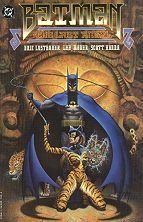
cover by Don MaitzBatman: The Last Angel 1994 (SC GN) 96 pages

Written by Eric Lustbader. Pencils by Lee Moder. Inks by Scott Hanna.
Colours: Lovern Kindzierski. Letters: Todd Klein. Editor: Dennis O'Neil, Jordan B. Gorfinkel.

Rating: * * * * (out of 5)

Number of readings: 2

This is, I believe, the first graphic novel by suspense novelist Eric Lustbader (sometimes billed as Eric Van Lustbader). It's marketed as a Batman graphic novel, but it's equally a Catwoman story (in fact, at times, it's more a Catwoman story than it is Bats'). The plot has Catwoman out to steal a priceless Maya mask, and Batman out to stop her, both unaware that the mask has supernatural properties. It's rumoured that any who come in contact with it will be possessed by the soul of a high priest who, supposedly, destroyed the Maya civilization itself centuries before. All of this is being orchestrated by another Bat-foe, but that's a revelation later in the story, so I won't say any more.

On one hand, despite this being by a "real" novelist, there's nothing out of the ordinary. Lustbader doesn't bring any particular literary flare to the proceedings, or any edgy dialogue, or any penetrating insight into the Human Condition. And for a man who I remember as writing violent, sexually kinky thrillers, this remains fairly wholesome throughout (despite the occasional murder). Lustbader at times writes with a heavy handedness, with characters spelling out their motivations and concerns in obvious monologues, and with the story often portrayed in tight, almost too tight, scenes. Whether he's writing down to the medium, or whether this is his regular style, I can't say (it's been years since I read anything by him).

With that being said, The Last Angel's weaknesses are also its strengths. There's a kind of old fashioned, unpretentiousness to the story. It trundles along briskly and comfortably fills out its 90-some pages with enough action and twists and turns that you don't feel like there's any padding. As well, Lustbader does throw in character stuff, moreso than one might expect from another comicbook writer who might be so concerned with his style, and his "edge", that he forgets to tell a story. Lustbader sets up some character arcs with Batman and Catwoman so that when we reach the end, we feel as though we've gone somewhere emotionally, not just physically.

The story is seen by some as being almost an "Elseworlds" story (that is, apochryphal), since in some respects it plays fast and loose with Batman continuity. Catwoman has a new, striped costume and seems to have a telepathic rapport with a preternaturally intelligent leopard. As well, in her alter ego of Selina Kyle, she moves in the same High Society circles as does Batman's alter ego, Bruce Wayne, though both are ignorant of each other's secret IDs. As well, some have pointed to the fact that another recurring Bat-villain, Rupert Thorne (in a small part), seems to get killed. But looking over the scene again, there's a certain ambiguity as to whether Thorne is supposed to be dead or not (it's all in the visuals). In a sense, The Last Angel can be likened to a Batman movie in the way it doesn't stick religiously to the mythos...but it feels more truly a Batman story than any of the movies ever did. And in other ways, it's very much evocatve of the stories, including such stand bys as Batman being summoned by Commissioner Gordon via Bat-Signal, to Batman's investigative mix of analytical skill and skulking in the shadows.

When a writer from another medium is lured to comics, particularly for a one-shot deal, you can't help but wonder, is this a closet fan, or is he merely doing it for the money? Since Lustbader was one of many who contributed commemorative essays to Batman's 60th anniversary (published in the back pages of Detective Comics #598-600), I'm more inclined to lean toward a closet fan, discrepancies notwithstanding. The fact that he would even throw in Thorne (a fairly obscure foe, after all) implies some knowledge of the comics -- unless his DC editor just provided him with a list of character names he could use.

Lee Moder's art is appealingly bold and vital, with well rounded figures. Though he's a bit weak on the fight scenes -- a superhero artist who isn't so great at action! At the same time, it's conventional comicbook art and colour, nothing extraordinary as you might've expected DC to provide for their novelist writer. Moder's art, like Lustbader's script, also seems to veer in and out of regular continuity, with both his Catwoman and his Thorne not really looking like themselves -- Catwoman has brown hair, and that odd costume, and Thorne is bald and hulking. At the same time, his Batman and Commissioner Gordon are very much themselves.

This is hardly an essential read, suffering from a little too much brevity in scenes and characterization, but at least there is character stuff. Ultimately, it's a fairly fun, entertaining read and, with its large page count and accompanying plot twists, provides a satisfying adventure -- like coming across a (good) Batman moviie.

Cover price: $17.95 CDN./ $12.95 USA.


<Back    Next>

Complete Reviews List

Or back to: