The
Masked Bookwyrm's Graphic Novel (& TPB) Reviews
The
Masked Bookwyrm's Graphic Novel (& TPB) Reviews
Batman - D (Page Two)
for a complete alphabetical list of ALL reviews start hereA - B - C - D - E - F - G - H - I - J - K - L - M - N - O - P - Q - R - S - T - U - V - W - X - Y - Z
Batman: Dark Legends (1996) 176 pages
 Writen by Bryan Talbot, Alan Grant, Dennis O'Neil, Dan Raspler, Mike Mignola. Illustrated by Bryan Talbot, Bret Blevins, Arthur Ransom, Mike Mignola.
Colours/letters: various
Reprinting: Batman: Legends of the Dark Knight #39, 40, 50, 52-54 (1992-1993)
Rating: * * * 1/2 (out of 5)
Number of readings: 1
Reviewed: Feb. 2015
Legends of the Dark Knight (as I've said in more than a few reviews!) was a comic set aside for writers and artists to tell their story, then move on -- no permanent creative teams teasing along multi-story sub-plots. The other idea was usually the stories were set (or implied to be) during Batman's early days.
Instead of collecting a particular story arc, this brings together a grab bag of different tales. I can't decide if the title -- Dark Legends -- is just because it's from Legends of the Dark Knight, or whether it's meant to refer to the type of stories. Certainly there are dark tales, including some with a supernatural theme, but I wouldn't necessarily say the overall tone was atypically dark for Batman.
Writer artist Bryan Talbot gives us the two-part "Masks" (#39-40) in which Batman finds himself in a mental institution, and told his super hero life is just a delusion. Because it's in LOTDK -- and could possibly be apocryphal -- and Bruce finds he doesn't even have Batman's physique, it can keep you guessing whether it will turn out he really is crazy (as opposed to a villain playing with his head). But though it's okay, the truth is we've seen these sorts of stories before, and Talbot doesn't really bring anything extra to the table in terms of story twists, or character stuff. The way it's set up it really is just an either/or mystery (either he's crazy, or someone is messing with him). It could just as easily have been one issue.
For "Images" (#50) long-time Bat-scribe Dennis O'Neil teams with artist Bret Blevins for a 40 page anniversary story of Batman battling the Joker. Unfortunately, it s a pretty generic tale. The Joker kills a bunch of people at certain deadlines while Batman tries to stop him (but mostly doesn't). It's fine, but reads like any of a zillion similar tales. The main difference is it purports to be the first encounter between the two, so there is a certain novelty in Batman not already hip to the Joker's style (the best scene is at the beginning when Batman breaks up a gang of crooks -- then lets the Joker walk free not realizing he's the real criminal).
"Tao" (#52-53) by Alan Grant and Arthur Ransom has actually been collected in more than one TPB (including Batman International) -- and I'm not sure why. It's not that it's terrible, it's just largely unmemorable. While Batman is on the trail of a Chinese ganglord, he ends up butting heads with an assassin -- cue: flashback to when they were both martial arts students in Tibet. Other than Grant having presumably done a bit of reading about Taoism, there's not much here (it's not like the bad guy has any particular depth or emotional complexity). I've liked some of Grant's Bat-tales for their portrayal of a "nicer" Batman (at a time when the dark n' fascist Batman was common) but here his Batman/Bruce has little real personality. Ransom's art is appealing in its realism, though a bit dark and stiff. Again: it could've been told in one issue and lose nothing.
The collection finishes with "Sanctum" (#54), illustrated by Mike Mignola, who collaborated on the story with scripter Dan Raspler. Mignola had illustrated Batman before (such as Gotham by Gaslight) but he's in particular Hellboy-mode here (complete with cutaways to silent statues and tombstones). It's also evocative of Hellboy in that it's a thin story with a Lovecraftian vibe, buoyed by the moody visuals. Tracking a serial killer to a graveyard, Batman ends up falling into a dream (or not) where a ghostly spirit seeks his life force to come back to life. In a way, it's sort of reminiscent of the first story, "Masks", in that a lot of it's just Batman and another character talking.
What to say? Nothing here really jumps out as a classic, yet neither is anything terrible, boasting mostly attractive enough visuals. Basically it's a collection of tales, ranging from the standard ("Images") to the off-beat. Which maybe is good, as some TPB collections are entirely made up of off-beat or quirky tales, making it unsatisfying if you're just looking for a Batman adventure, or conversely are an assemblage of repetitive generic adventures.
So...an okay collection.
Batman: Dark Victory (2014) 368 pages
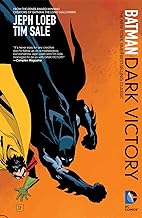 Written by Jeph Loeb. Illustrated by Tim Sale.
Colours: Greg Wright. Letters: Richard Starkings.
Reprinting: Batman: Dark Victory #0-13, plus material from Absolute Batman: Dark Victory (essentially a "director's cut") (1999-2000, 2012)
Additional notes: intro by screenwriter David S. Goyer; covers;
Rating: * * * 1/2 (out of 5)
Number of readings: 1
Reviewed: April 2024
Dark Victory was Jeph Loeb & Tim Sale's sequel to Batman: The Long Halloween. Loeb & Sale were a kind of "it" pairing in comics. After initially collaborating on a quirky Challengers of the Unknown revival they built a body of work at both Marvel and DC mostly with mini-series/limited series telling retroactive tales about key characters. And probably no more acclaimed effort was The Long Halloween, making almost any list you can think of naming the "great" Batman sagas/stories. And, surprisingly, when they revisited it with Dark Victory, they were greeted with mostly equal acclaim -- some saying it was better than its predecessor.
But here's the thing: I was a bit more mixed on the whole Loeb/Sale thing in general. And Long Halloween in particular. In fact it took me a number of reading over a number of years before I started to come around to seeing its appeal. I still don't think it's "great" -- but I see its appeal. And that is that you shut off your brain, your critical thinking, and you coast along on its vibes, like you would a dream.
It's with that new found epiphany I finally tackled Dark Victory.
Although it's a new plot, Dark Victory does follow on the events of the Long Halloween. Things are explained as you go, pre-existing characters re-introduced. You can read it for itself, as you would any comic built on past lore. But if you wanted a tidy, complete-in-itself story, you're better off starting with the Long Halloween and then reading Dark Victory.
At the same time it largely recycles the same plot. Namely it's a year long story arc in which a mysterious killer is going around murdering people to coincide with various holidays. That was the MO in the Long Halloween, but the killer -- dubbed Holiday -- they thought they had apprehended by the end of that saga (though an issue I had with the Long Halloween was the "solution" was a bit of a mess, with two or three people seeming to have committed various of the murders). But whereas Holiday had killed mobsters, this new killer -- dubbed the Hang Man (because he or she leaves as his calling card the child's game hang man) -- is killing police officers.
As I say: it's very much a Long Halloween redux (and indeed, a lot of the Loeb/Sale collaborations -- and Loeb's collaboration with Jim Lee for Hush -- seem to repeat and recycle themselves). The year long story, a murder each holiday, and a generous heaping of Batman's iconic villains popping in to give it a "the ultimate Batman saga" feel. And whereas Long Halloween was used to tell the origin of Harvey Dent becoming Two-Face, here they interweave the origin of Dick Grayson/Robin into the plot. Like the Long Halloween it's heavily indebted to film noir movies and mobster dramas as the plot interweaves Commissioner Gordon, an ambiguous new DA named Janice Porter, and remnants of the Falcone and Maroni crime families, and Batman (of course) with this hunt for this new killer. The prime suspects include Two-Face (who escapes from Arkham Asylum near the beginning) and Alberto Falcone (who gets released from prison). It's full of mood and atmosphere, and beautifully stark imagery thanks to Sale.
And like The Long Halloween it doesn't make a lot of sense or hold together. It's supposedly a mystery but in which there is almost no effort spent actually treating it as such. The focus is more on "who" the killer is, but not much on "why" -- making their focus on suspects like Two-Face and Alberto feel kind of random and groundless. Mysteries are usually full of clues, red herrings, motives to be explored. Almost none of that occurs here. It's as if since Loeb knew the solution, he couldn't really be bothered coming up with false trails. (Or he knew if the heroes did investigate, they'd solve it too soon, so even when mysterious things occur -- such as Alberto Falcone claiming he hears the voice of his supposedly dead father -- no one really bothers to look into it). It's so aimless and pointless, I literally have to flip back through it as I write this to even remember who was revealed to be the killer!
So why am I coming around (a bit) to appreciating it? Why do others love it so much?
Because if you shut off your brain and don't process it any more than moment by moment, it is undeniably steeped in intoxicating atmosphere. Sale's mix of beautifully envisioned environments and caricature-but-still-captivating characters, the stark use of light and shadow -- perhaps reminding me most of Will Eisner's the Spirit -- creates a world that you can easily sink into every chapter, a world that is both warm and charming and dark and sinister. And Loeb's writing is full of brooding captions and effective pacing that both lets the story unfold with a somnambulant languidity while not being boring. If it was a movie, the soundtrack would be all blues and slow jazz.
The best way to describe it is it has the atmosphere of a dream.
Dark Victory is arguably stronger than Long Halloween. The plotting feels a little more complex, more characters are given some breath, some nuance (like Tony Falcone, who claims to want to rehabilitate the family name) so that we can cut between them and feel it's an ensemble of characters caught up in the web of intrigue.
But I still say it's more a veneer covering over a really fragile framework of plot and characters.
Loeb just writes what is needed for the scene and doesn't really care how or why. He needs Alberto Falcone to be released from prison, so he is -- but it's not clear the legal circumstances (he's freed from prison but out-fitted with an ankle monitor); he wants Gordon to assemble a task force to investigate the Hang Man killings -- at one point he refers to them as "undercover" cops but no one goes undercover, and they barely are shown investigating anything. He wants to play with the Batman/Catwoman Bruce/Selina romantic/sexual tension -- without portraying a convincing relationship (or explaining who Selina is in terms of Bruce's social circle). A theme in the story is how the old school mobsters are being pushed out by the "freaks" (ie: supervillains). But we never really see much of that in reality (especially since the supervillains just pop in and out of the story themselves).
In my reassessment of Long Halloween I felt that a lot of Loeb's appeal is that he is very derivative; I don't mean that as a put down (not entirely) because I think it's a deliberate approach. You enjoy Long Halloween and Dark Victory as much for the way they evoke other things as for themselves. It's a patchwork quilt approach to storytelling. Or to continue a linen analogy: it's like it's comprised of the the bumps and folds (the highlights, the cool scenes and moments) rather than the full sheet.
And that gets to my point about vibes, or being a dream. Dark Victory isn't a well-plotted mystery -- but it feels like it is. It isn't a particularly insightful character study -- but it feels like it is.
And, honestly? I'm coming around to seeing the appeal. I viscerally sort of liked Dark Victory, sinking again and again into its world with every chapter -- even as, intellectually, I felt it was full of problems. And I do think it was stronger, sturdier, than the Long Halloween, feeling like a richer, more complex plot for its epic length.
One thing I'll add -- just to be controversial:
A lot of times right wing reactionaries will complain about modern comics (or movie or books or TV) as being too "woke," too full of progressive ideas and values. They complain "why can't comics be like the 'old days' which were apolitical?" This is of course nonsense both because anything can be "political" (even not being political is, in a sense, a political choice -- a defense of the status quo) as well comics have always had their share of liberal or progressive messages and themes. But with that said, when right wing fans look to the sort of comics they like -- I suspect things like Dark Victory (and Long Halloween) are what they mean.
Oh, not because Loeb (or Sale) are forcing in "obvious" right wing screeds, but it's an epic story arc with barely any non-white people in it; the women are mostly house wives, femme fatales, or career women of suspect morals; borrowing from its inspiration of film noir and mob dramas it's steeped in Old School machismo of he-men and tough guys. Interestingly the Long Halloween/Dark Victory are meant to follow on the heels of Batman: Year One, yet downplay the police corruption that was so much at the core of Year One in favour of a more conservative "pro"-cop message.
Loeb (and Sale) may not intend any of that to seem political. But arguably a lot of what detractors call "woke" (in art) is modern creators interrogating and deconstructing the cliches of yesteryear that we never previously questioned (when the arts were dominated by a much more limited demographic). The nature of Loeb's derivative/homage approach is that it simply recreates and repeats the cliches -- and the values -- of yesteryear.
Anyway, I did enjoy Dark Victory. But it's read best like listening to a piece of music -- just let its vibes work on you.
Batman: Death and the City (2007) 192 pages
 Written by Paul Dini, others. Pencils by Don Kramer, others
Colour/letters; various
Reprinting: Detective Comics #827-832
Rating: * * 1/2 (out of 5)
Number of readings: 1
Reviewed Oct 2018
Following Batman: Detective, this is the second of a series of consecutive TPBs collecting a run of Batman comics written by Paul Dini (though with a lot of pinch hitters). Dini being one of the guys who shepherded the critically acclaimed 1990s Batman TV series, Batman: The Animated Series. Part of the idea here seems to be a bit of a step back from the overly violent, overly fascistic Batman that has come to dominate the comics. At times it's only a small step -- I mean. there is still some grisliness and gruesomeness to the tales, and Batman still beats the crap out of people at times. Nonetheless, this was seen as a slightly kinder, gentler, more even-tempered Batman -- a kind of Old School Bats.
Another gimmick was more of an emphasis on tell-it-in-one-issue plots, with little in the way of on-going sub-plots.
Which makes it ironic that arguably the high point of this collection is a two-part tale not written by Dini. In that story a terrorist (of unspecific motives) targets the Wayne Enterprises building while it's hosting an international conference on global security. Bruce (mostly he's Bruce, only becoming Batman toward the climax) and Robin (Tim Drake) try to stop the villain as he races through the building -- his gimmick being he fires a liquid explosive that becomes combustible when it hardens. With it he's causing explosions, with his ultimate goal being to bring the whole building down. You can think of it as a bit like Die Hard, or Towering Inferno, or y'know, any thriller set in an office building. But it's pretty good.
The rest of the one-off stories leave me a bit mixed -- as did the previous volume in this series. Goodness knows I'm on board for what Dini et al are trying to do in terms of bringing back some Old School detective work. But the stories can feel a bit thin -- like maybe Dini's using as his inspiration old stories that were 17, or even 12, pages long...but which he needs to stretch to 22 pages for the modern comics length!
So one of the more explicitly "mystery-detective" stories has Batman investigating the suspicious death of an old chum killed by a shark -- so that makes the chum chum (ba-dump-dump! thank you, I'll be playing here all week). But it suffers from the problem that most of the clues the reader doesn't really have access to, with the villain revealed before we even had any suspects! While a Harly Quinn-focused story (a character first created for Dini's animated TV series) wants to be a character piece, but again feels a bit thin.
There's also maybe a bit too much reliance on recurring villains; especially problematic when I'm not sure how familiar the characters are. One story involves a second string criminal trio called The Terrible Trio who I had never heard of, but where the story kind of hinges on understanding their psychology! While Dini introduces a new iteration of the Ventriloquist/Dummy (the previous Ventriloquist having been killed some issues before) without, I'll admit, entirely making the new version that interesting. I mean, the main point of this character's appearances simply seems to be establishing this new version (and the closest this run has to an on going plot thread) rather than introducing this new Ventriloquist via interesting plots/mysteries. (Although, I suppose one could argue a lot of arch foes are only interesting because they are "arch" foes...more than because there's anything objectively compelling about them!)
The art throughout remains good, relying on straightforward, realist drawing, rather than over-muscled contortions and pinch-nosed heroes with grim jaw-lines.
So, a perfectly okay time killer, but with stories that could maybe have used a few more twists and turns, a little more emotional gravitas, and maybe some sub-plots to fill up the corners.
This is a review of the story as it was originally serialized in the monthly mini-series.
Batman: Death and the Maidens: The Deluxe Edition (2005) 234 pages
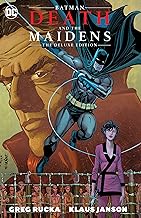 Written by Greg Rucka. Illustrated by Klaus Janson.
Colours: Steve Buccellato, with Lee Loughridge. Letters: Clem Robins.
Reprinting: the nine issue mini-series -- plus an extra prologue
Additional notes: intro by the editor, Matt Idelson; commentary and unused pages/alternate pages by Klaus Janson.
Rating: * * 1/2 (out of 5)
Number of readings: 1
Reviewed: April 2024
One of the great frustrations is when something starts out genuinely promising. And for the first few chapters/scenes/pages (whatever the medium) you're excited thinking you're on to something great...and then it isn't.
Such was my reaction Death and the Maidens, originally published as an epic nine issue mini-series. And this Deluxe Edition includes a prologue scene not in the original series (or maybe it was; I'm not sure). An epic by top tier talent: writer Greg Rucka and idiosyncratic artist Klaus Janson.
The saga embroils Batman with his arch for, Ra's al Ghul, and a brand new figure -- Nyssa. She, like Ra's, is functionally immortal, making use of the same Lazarus Pits that Ra's does to periodically resurrect himself. I hesitate to specify Nyssa's relationship to Ra's because I'm genuinely unclear if it was supposed to be a mystery for the first few issues or whether I just found it initially confusing. But since it's relevant to the review I'll say it: she's his daughter. Although unlike Ra's more familiar progeny, Talia -- who also crops up here -- she's a hitherto un-referenced and unknown character. Still, the important thing is she and Ra's go back a few Centuries and had once been associates, went their separate ways, and in modern times are enemies.
The plot is that Ra's is rapidly aging and near death and is struggling to find a Lazarus Pit to revive himself. He turns to Batman, asking for his help (according to Ra's, Batman has been systematically destroying his pits -- although, somewhat confusingly, Batman doesn't really confirm or deny the accusation). As a trade, Ra's offers Batman a mystical potion that will allow him to speak with his long dead parents. Batman uses the potion, triggering a dreamlike sojourn through Gotham with his mother and, eventually, his father. Meanwhile, we are treated to prodigious flashbacks to Nyssa and her relationship with Ra's -- including an extended, disturbing sequence in a Nazi Concentration camp -- all while Nyssa is planning her own schemes in modern times.
And even trying to summarize it kind of reminds me of how problematic it was.
So before that, I'll mention the art. I described Klaus Janson as idiosyncratic because he has a weird style. Beginning his career as an inker of others, and where he developed a distinctive heavy brush style, Janson eventually became a penciller, too. But he has a strange, rough style, drenched in atmosphere and often a good sense of storytelling/storyboarding, but where the actual figure work can be crude, even bizarre -- with crooked limbs and mismatched proportions and messy line work almost like he draws in ink, rather than pencil, so can't erase mistakes. Yet it's a style that can work, especially on a character like Batman where a brooding atmosphere can be desired (and it's a style not dissimilar from Denys Cowan and others).
In the introduction to this, the editor suggests this stands as some of Janson's best work -- and I can't disagree. It does stand as among the most accomplished work I've seen by him -- especially in terms of backgrounds which are much more detailed and textured than I sometimes associate with him. The art -- though idiosyncratic as I suggest -- is among this story's strengths.
I should also give a shout out to the colourist who shifts to match the moods of various scenes -- rather than feeling like it's all coloured in the same palette. And to letterer Clem Robins. I assume it's computer lettering as is common today, but the style/font he uses gives the lettering an appealingly Old School hand-lettered feel. Appropriate in a story featuring Ra's and where Janson draws Batman decidedly old school in tights rather than the quasi-body armour often given to him today by artists.
Now the story...
The main way of looking at it is that it's actually a saga about Nyssa -- with Batman (and Ra's) merely supporting characters (which is funny because in the introduction by Matt Idelson he harps on the Batman thread, implying the story absolutely started out focusing on Batman and Ra's, with Nyssa almost an addition to the story). But this feels like the thing that occurs in comics where a writer comes up with a new character -- and is more interested in his creation than the established characters. (I've been critical of Talia before, feeling that she's never really been a compelling, three-dimensional person despite her creator, Denny O'Neil, clearly wanting to set her up as a romantic lover-enemy for Batman to supplant Catwoman -- but the way Rucka treats her here suggests he has even more disdain for her than I do).
The plot -- ie: the thing where people are doing things and reacting to things -- is quite minimal for nine issues. After starting out intriguing for the first couple of chapters the story slows down and frankly drags a bit. As I suggest, it mostly just seems to exist to establish and entrench Nyssa as a new villain in Batman's rogues gallery. A lot of the story features flashbacks to her experiences and traumas. Indeed, she's not just a new foe, but specifically seems to be a new Ra's -- as if Rucka liked the idea of Ra's, the immortal villain with a network/army of operatives involved in world altering schemes, but he didn't like Ra's himself, so comes up with a new character to slot into the same function in Bat-lore.
Arguably a problem with the saga is a feeling Rucka got caught up in his themes of family and loyalty/betrayal and the like (Nyssa is Ra's daughter; Batman has a chance to speak with his dead parents, etc.) and story/plot is just a side point to his epic "secret origin" of this new adversary.
There's an interesting idea buried in the Batman sub-plot -- that after all these years Batman realizes he no longer feels the death of his parents viscerally (in contrast to most writers making it the defining core of his character/motivation). But it never really seems to take us anywhere -- certainly not justifying a nine issue epic. The same could be said for the sojourn with his parents despite being Batman's main plot and stretched over a few issues (and with even Batman in the end more than half-convinced it was just a drug-induced hallucination rather than a true conversation with the ghosts of his parents).
I'll also take a moment to address a recurring theme in Batman: characters critical of Batman, of his vigilantism, of feeling he's wasted his potential as Bruce Wayne. The problem is that within the "reality" of the DC Universe, Batman is one of the most famous crimefighters in the world, has saved countless lives, apprehended dangerous criminals the police can't, and has even helped save the world more than once. Does it really make sense for characters to criticize him or suggest he should be doing something else with his life?
Anyway...
As I suggest, the main focus of the story seems to be setting up Nyssa as key adversary, and to try to give her the depth and dimension Ra's kind of lacks. Which is worth diving into.
Ra's al Ghul was originally created by Denny O'Neil and Neal Adams to act as a different kind of foe for Batman. A pulp fiction villain (inspired by Fu Manchu). Indeed he might be one of the first examples of a now-common trope: a villain created as a kind of hubris by the creators (here O'Neil & Adams) -- a foe instantly meant to be bigger and badder than any foe the hero had faced before and moved to the front of the rogues gallery. Essentially what Rucka is now trying with Nyssa.
Instead of merely a crook with a colourful motif, Ra's was the head of an entire organization, a foe who could be stymied but not actually defeated. The first foe to figure out Batman was Bruce Wayne -- not through happenstance, but because he was just that good. But also a villain who admired Batman and which Batman sort of reciprocated -- and of course there was Talia in the mix. But I'll admit, Ra's clearly criminal nature I felt made such mutual admiration problematic -- especially when Ra's and Batman would occasionally lament that they were adversaries. In recent years, Ra's got re-imagined. Instead of being a criminal with designs on world domination, Ra's has become a kind of eco-terrorist, committed to the idea of global genocide.
Which I'm not sure fixed the problem, vis a vis the mutual admiration, or Ra's incessant belief that he could somehow recruit Batman. Honestly? My take would've been to make Ra's more ambiguous -- that only some of his organization is engaged in criminal acts, and his agenda less heinous than genocide. Then we could maybe share the characters' desire for some sort of detente.
This is an issue in this story because Ra's is dying of natural causes and wants Batman to tell him where he can find a Lazarus Pit. In other words, Batman doesn't have to contravene his own moral code about killing; he could just let Ra's die a natural death and the world would be rid of a monster who has murdered thousands and whose stated goal is to murder countless more. The fact that Batman eventually agrees to help him is problematic as heck.
Anyway, Nyssa feels like Rucka wanted to re-create Ra's but with a better character grounding. The problem is -- he doesn't really succeed. Nyssa still feels like a one-dimensional foe going forward. The main shift between her and Ra's is that while Ra's claims his villainy is motivated by good intentions, Nyssa fully owns her evil; she wants to do harm because she thinks the world is horrible and wants revenge. But I'm not sure that leaves room for growth or narrative variety.
But that's where the flashbacks come in, showing us the things she went through. The problem is, I'm not sure they do. Her character arc seems to be that she starts out a good person full of love for humanity (even breaking from Ra's for that reason) and then has that love and optimism beaten out of her by man's incessant inhumanity to man. But weirdly enough, we are told this more than shown this. Which surely should be the point of so many flashbacks -- to portray this character arc. But I never got much sense of Nyssa as some good-hearted Florence Nightingale. We are told that she does charity work -- but we don't really see it, nor does Rucka fully present such a character. Ideally Nyssa should be a completely different person at different stage of her life -- and we should see that change. Yet, to me at least, she didn't really seem to change.
Whch brings us to the pivotal Nazi concentration camp scenes. There's a part of me that wonders if such scenes belong in a comic about super beings and guys in tights, or if it is in danger of trivializing the horror. But equally, if handled properly, maybe this is a good place to tackle such subject matter -- in a mainstream story rather than in a "very special" story explicitly about the Holocaust. Granted that was probably more true when comics' readership was often younger, so such scenes might be quasi-educational. I assume Rucka is presuming a mostly adult readership (including with scenes alluding to rape). And there's no doubt the concentration camp scenes are meant to be disturbing. And certainly germane to Nyssa's motivations (although doesn't that make her another Magneto? A Jewish magalomaniac defined by being a victim of the Holocaust?)
But the concentration camp scenes take on a different shading if you read the end notes by Klaus Janson, talking about how the mini-series evolved and changed as they went -- implying Rucka hadn't plotted it out fully from the start. The implication is the concentration camp scene was only conceived part way through. Which is ironic, if true, since it is so clearly meant to be the bedrock of Nyssa's motivation.
In other words, what was Rucka's plot and vision of the character without it?
And maybe that gets back to my original point. That it feels a bit like it's a series that starts out intriguing in the opening issues -- and then seems to lose its way, unsure what to do with its story and characters. And where Batman himself seems almost a side character.
And though I freely admit I'm a comic book diletante, diving in and out of on-going continuity, the fact is I had never heard of Nyssa before reading this 15 year old story. I'm not sure how significant a character she has gone on to be in the Bat-mythos.
Or go to