The
Masked Bookwyrm's Graphic Novel (& TPB) Reviews
The
Masked Bookwyrm's Graphic Novel (& TPB) Reviews
Batman - D (Page One)
for a complete alphabetical list of ALL reviews start hereA - B - C - D - E - F - G - H - I - J - K - L - M - N - O - P - Q - R - S - T - U - V - W - X - Y - Z
Batman: The Dailies, 1943-1944 1990 (SC TPB) 176 pgs.
 Written
by Bill Finger, Don Cameron, others. Art by Bob Kane, others. Inks by Charles Paris.
Written
by Bill Finger, Don Cameron, others. Art by Bob Kane, others. Inks by Charles Paris.
black & white. Letters: various.
Reprinting: a year's worth of the Batman newspaper strip
Rating: * * * * (out of 5)
Additional notes: intro by Joe Desris; published in oblong format.
Number of readings: 1
Reviewed: Jan, 2012
I have a fondness for old newspaper comic strip adventure series. I say "old" because even though some are still hanging around, the series themselves are few, and appear in only a few papers, whereas once drama/adventure strips were as ubiquitous as Peanuts and other comedy series. As well, the shrinking of the physical size of the newspaper strips has rendered it harder to tell a serialized story in daily instalments -- where once such strips featured usually four panels per day, and big enough to encompass a reasonable amount of dialogue, now such strips are often only three or two panels, with less room for verbiage. And the story telling art has been lost a bit over time -- whereas you can read collections of old newspaper strips and the story can flow almost seemlessly, nowadays the heavy use of recapping means that often one day's strip spends half its space...simply recapping yesterday's strip.
Anyway, another interesting thing about old newspaper strips (which, were the origins of the comic book -- literally, the first comic books just reprinted newspaper comics) is that in some ways they were actually more sophisticated than the comic books published at the time. This was partly a result of the format, forcing the stories to be more plot oriented, requiring twists and turns to keep things moving from day to day, and also being longer than the average comic book story. But also the nature of being published in the family newspaper meant there was an assumption that they were trying to catch the attention of the adults, as well as the kids who were otherwise the main readership of the newsstand comic books.
And just as the newspaper strips gave rise to the comic books...so it was that some comic book characters attempted to make in-roads back into the newspapers. Though usually with limited success, such as the 1940s Batman newspaper strip which only ran about three years.
But what's interesting about this collection of 1940s Batman daily strips (the first of three volumes) is, as I mentioned, newspaper strips were in some ways more ambitious than the comics. So even though these are written and illustrated by the same creators who worked on the DC Comics...in some ways these are better, smarter stories that weather the test of time, owing as much to, say, Dick Tracy as the Batman comics.
I've often commented that even though signature, recurring foes are a staple of comics -- and seen as a big part of their appeal -- stories with such foes often aren't the best, as they tend to be repetitious, without much room for surprising twists in character or motivation. So it's perhaps unsurprising that the weakest storyline here is the one where Batman & Robin take on the Joker -- it's basically just a pretty straight forward, undistinguished adventure of the heroes chasing after the Joker, following various obvious clues he's left behind.
Much better are the other stories, bereft of familiar foes (or costumed villains in general) that owe as much to Dick Tracy and Dragnet as they do super hero adventures. And there is a certain variety in the plots and the milieus. One is a nicely traditional, nicely evocative tale of mysterious goings on at a theatre, that has a gothic, Phantom of the Opera feel to it. Another is a taut tale of an injured Batman holed up in a cabin while mobsters move in. Another has a human drama melodrama aspect to it as Batman and Robin become involved in the schemes of a murderous con artist which has some nice twists and turns. Indeed, the nature of the various stories' length, serialized over many days and weeks, is that many have a human/character aspect to them, the supporting characters and guest stars given more to do and more fleshing out, than as simply plot devices.
Batman, being a "creature of the night" is perhaps well suited to the black & white presentation of these daily strips. And though the art is simple and straightforward as reflects its era, there are still some nice, artful techniques...such as the way Batman's shadow is deliberately exaggerated as it plays across the walls, almost like a character in its own right.
I actually think the daily strip format is perhaps more conducive to telling deeper, more complex stories than the Sunday colour format, the very limitation of panels per instalment meaning the focus is more on telling a story, rather than on the big action scene.
But if you have a nostalgic affection for old, vintage Batman comics...but find that, when read, they can often seem a bit too juvenile and simple for your modern, adult tastes...these newspaper strips might be a nice middle ground. Oh, I'm not saying anyone was Jonesing for a Pulitzer, they're still goofy and juvenile -- but they marry the visuals and flavour of the old comics with a slightly more ambitious approach to the stories.
Cover price: $__ USA.
Batman: Dark Allegiances
see review in Batman Elseworld section
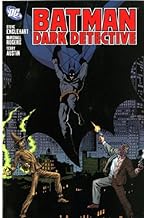
Batman: Dark Detective (2006) 144 pages
Written by Steve Englehart. Pencils by Marshall Rogers. Inks by Terry Austin
Colour: Chris Chuckry. Letters: John Workman. editor: Joey Cavalieri.
Reprinting: the six issue mini-series
Rating: * * * * * (out of 5)
Number of readings: 2
Mildly for mature readers
(I think this has fallen out-of-print but the story is available in one or two other omnibus-style collections, like a Marshall Rogers or Steve Englehart-themed Batmen collection).
Three decades ago, Steve Englehart, Marshall Rogers, and Terry Austin produced a brief run of Batman stories in Detective Comics that was considered a creative benchmark, with fans long after demanding (in vain) the return of the love interest Englehart introduced in those issues, Silver St.Cloud. It's one of the few Bronze Age (late 1960s to mid-1980s) story arcs DC has collected in TPB form -- as Batman: Strange Apparitions. (I actually came across a review which, referring to that Englehart/Rogers run, claimed it was what the 1989 Batman movie was based on -- sure, insofar as they both featured a guy with pointy ears and a cape...but not in anyway that related to plot, theme, characterization, style, or artistic intent. I've seen that before -- it's a trendy marketing ploy when a super hero movie/TV show does well, to hype any and all comic book stories as being THE one that directly inspired the movie, even if it bears little resemblance to it).
Anyway, last year the team reunited (including letterer John Workman) for the mini-series, Batman: The Dark Detective, subsequently collected in a TPB.
For the record...I wasn't a big fan of the original Englehart-Rogers run. But I picked this up, unhappy with some current Batman stories and feeling nostalgic. What I got...was one of the best mainstream comics in recent years!
Englehart sets it up as unpretentious, super hero adventure, with The Joker, Two-Face and the Scarecrow all in town, pursuing separate schemes...but then he returns Silver St. Cloud. She rekindles her romance with Bats, and the comic takes on a refreshing maturity, as we get a grown up, and messy, relationship (Silver is engaged to another man, a gubernatorial candidate the Joker is targetting). Englehart, while still portraying a brooding Batman, redefines him as a three dimensional human being, capable of passion, insecurity, and even wit.
There's humour, too, and Englehart throws in cheeky political jibes -- adding to the sense he's writing up to his readers, not down. Current affairs satire in a super hero comic? Will wonders never cease? There's also a Cary Grant reference and character names derived for old Batman writers and artists -- again, suggesting an older target audience.
Rogers-Austin's line work isn't as tight as in their heyday, but Rogers can do mood-heavy backgrounds like few others, and flares Batman's cape with a aplomb. He often had a good eye for composition but perhaps because of the character-rich scenes, excels himself here. And the fight scenes, though innovative, retain a pleasing reality.
The adventure aspect is straightforward, super heroics -- The Scarecrow doesn't even seem to have any particular plan. Though Englehart has a better sense for making the Joker seem truly crazy than most writers. But by having three villains, we get a cleverly chaotic reality, where Batman can't just deal with one case at a time (as he remarks to Two-Face when stumbling upon the latter during a robbery: "I was actually looking for the Scarecrow!") While a scene where Joker and Two-Face briefly confront each other is an understated bit of coiled tension, suggesting two old soldiers but with significantly different world views -- none of the cutesy "super villain club house" stuff ala Identity Crisis.
But it's with the characterization that the saga leaps above the crowd. Englehart puts a provocative spin on Two-Face's two-headed coin obsession that, if other writers had already posited it, I've never read. However, it's with Batman that Englehart really shines, creating a plausible human being, not just an icon. In fact, the reason the Scarecrow doesn't seem to have much of a goal is because he's really just a catalyst for exploring Batman's psyche.
Of course Silver and Bats don't live "happily ever after" -- though not necessarily for the reasons you might expect.
Admittedly, the climax left me with mixed feelings as Batman, and some police, separately invade the Joker's booby trapped house. It's a genuinely creepy, edge-of-the-seat sequence -- generating more tension than I expected, or thought could be mustered in a comic book form (especially given that Bat-foes with booby trapped lairs are a hackneyed staple of the character). But it demonstrates a level of violence that jars with the series overall.
There are some continuity questions. Batman is an outlaw, but it's not explained why, and Englehart ignores that Silver had previously returned to Gotham (in the "Siege" storyline, from the comic Batman: Legends of the Dark Knight -- drawn by Rogers, yet!). Silver's participation in that earlier story was sufficiently peripheral that he could've told this story while still acknowledging it.
Anyway...
What was maybe intended as just an excercise in nostalgia turns out to be a refreshing mix of fun, four-colour super heroics...and sophisticated, adult drama. What Batman should be...and too rarely is. Definitely recommended.
This is a review of the story as it was originally serialized in the monthly mini-series.

Batman: Dark Knight, Dark City (2015) 192 pages
Written by Peter Milligan. Pencils by Kieron Dwyer, Jim Aparo, with Tom Mandrake. Inks by Dennis Janke, Mike DeCarlo, with Steve Leiahola.
Colours/letters: various.
Reprinting: Batman #452-454, Detective Comics #629-633
Reprinting: the six issue mini-series
Rating: * * * * (out of 5)
Number of readings: 2
Reviewed: June 2015
Dark Knight, Dark City was a three-part story published at a time when a number of Batman story arcs were treated almost as a mini-series within the main series -- even featuring the story title in distinctly designed logos on the covers (some of which have also been published as TPBs). And Dark Knight, Dark City had already been collected in one of the DC Comics Presents 100-Page Spectacular DC put out in the late 2000s. But at three issues, it warranted a little more padding to justify a TPB. So this could equally be labelled "The Peter Milligan" collection, featuring in addition a bunch of other Batman stories written by Milligan from that period.
And it's a good choice to focus on Milligan (as opposed to, say, an all-Riddler collection, or some other connecting theme). Because in his brief run Milligan wrote some notably quirky, intriguing tales.
Yet for all the existing accolades, Dark Knight, Dark City is an enjoyable, fast-paced story -- but not especially stand out. The art is great, from penciller Kieron Dwyer (and inker Janke) who nicely mixes both clean, straight forward realism, super heroic idealism (with Batman looking like a super guy in a cape) with appropriate spooky, Dark Knight Gothic-ness. The faces are expressive, the figures rounded with dimension, and the environments detailed. As for the story, it clips along at a breathless pace for its three issues.
The premise is that The Riddler has blown back into town -- except acting with an uncharacteristic psychotic-ness usually reserved for The Joker, including a disturbing kidnapping of an infant, and leaving a string of murders (or attempted murders) as Batman tries to unravel his various riddles. The reason for this is The Riddler seems to have tapped into some demonic presence lurking beneath Gotham. And the story features cutaways to Satanic rituals committed by the city's founding fathers -- the idea being that Gotham itself may have been built upon a foundation of evil (hence -- "Dark City"). These ideas have been re-used since (both a homicidal Riddler and Gotham-as-an-evil-presence) but I think Milligan was there first (being British, Milligan perhaps has a little fun tweaking expectations, suggesting some of America's founding father's were part of this 18th Century cult).
As I say: it's fast, exciting stuff. The only reason I say it's not "exceptional" is just because, well, that's all it is. It's not exactly a twisty saga, or with a great deal of underlining emotion (though Milligan does handle Batman well). And the idea of taking a previously "mild" villain and turning him into a meaner, nastier, crazier version has been done so often it gets kind of cliche. (By the end, even Batman is unsure if The Riddler was being influenced by the demon -- or just 'cause he had become more psychotic). But as I say: a good page-turner and strikingly illustrated.
The remaining stories bar one are drawn by veteran Bat-artist Jim Aparo (with his frequent inker from the time, Mike DeCarlo). Although I used to feel DeCarlo's hard, rigid inking wasn't ideally suited to Aparo's more flowing, sinewy pencils, I've grown to appreciate the combo more. And the thing about Aparo was, in many ways, his almost effortless storytelling composition. It wasn't that he was particularly stylish, or broke down a scene in an eclectic way, but particularly late in his career ('80s-'90s) he could present a scene in such a way that it just flowed. Often able to convey a scene, even character emotion, without any written caption.
While Milligan delivers some intriguing, off-beat tales. Admittedly, part of the problem with Batman over the years -- and it's true here with Milligan -- is that sometimes writers seem not to know what to do with Bats himself. Comic fans and pros often like to claim Batman is the most emotionally complex super hero -- but he's often the least complex as writers sometimes have trouble presenting him as anything more than the grimly obsessive Dark Knight. The result is a lot of Batman comics almost focus more on the villains-of-the-month with Batman just the cowled figure who catches them.
But that's why Milligan's quirky plots -- like Dark Knight, Dark City often heavily drawing upon the supernatural (or at least the weird) -- are so important. In one story Batman investigates a series of inexplicable deaths with its roots in Irish folklore, in another he tussles with Siamese Twins hitman/men (one black, one white -- biologically impossible of course, but it suits a kind of Dick Tracy weirdness). In a two-part tale he gets caught up in racial strife and a resurrected Golem from Jewish mythology. All of which manage to be perfectly familiar Batman-style thrillers...yet with enough twists, emotional nuances, and quirkiness to also keep you turning pages to see where it ends up.
Perhaps the most disappointing is a tale where Bruce Wayne finds that his memories of being Batman are disputed. Alfred professes not to know anything about it and there seems to be no hidden Batcave. The problem I have with a story like that (and, let's face it, it's been done a few times over the years) is it's really just a build up to whatever solution the writer is going to use (it's a dream, it's a villain's scheme, it's a practical joke, etc.). It's probably better used in some 8 page short rather than a full 22 page story. (Or, at least, come up with more plot to go with it).
This is a good collection, well illustrated throughout, and with stories that, as I keep saying, nicely straddle being familiar Bat-tales yet, at the same time, unique and intelligent versions of them. Though Batman himself is more just a lantern-jawed hero to run across the pages, rather than a protagonist to invest in emotionally. Perhaps that's why, just as I think these are all good stories to read -- they are equally good to re-read, because it's hard to recall what happened in them!
But then -- that's kind of a good thing if you want it for your shelf.
This is a review of the story as it was originally serialized in the monthly mini-series.
Batman: The Dark Knight Detective, vol. 1 (2018) 300pages
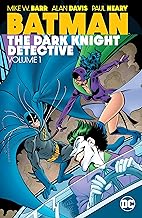 Written by Mike W. Barr, with Joey Cavalieri, Jo Duffy. Pencils by Alan Davis, with Norm Breyfogle, Jim Baikie, Klaus Janson, others. Inks by Paul Neary, others.
Colours/letters: various
Reprinting: Detective Comics (1st series) #568-574, 579-582 (1986-1987)
Additional notes: covers; excerpts from Who's Who Update '87 #1, 2
Rating: * * 1/2 (out of 5)
Number of readings: 1
Reviewed April 2024
Batman: The Dark Knight Detective (vol. 1) is part of a series of collections reprinting much of the initial post-Crisis Bat-era (other series include Batman: The Caped Crusader volumes, and Tales of the Batman collections). This collects an -- almost -- sequential run of issues marking Mike W. Barr's assumption of the role of scribe; Barr, a long-serving writer at both DC and Marvel, had written for Batman in back-up shorts, some memorable Annuals/Specials, and of course as the writer/co-creator of the team book, Batman and The Outsiders. But I believe this was his first time as the regular writer on one of the main Bat-titles.
I say "almost" sequential because this collection skips Detective Comics #475-478, the four-part story known as Batman: Year Two, for the primary reason that it is available in its own collected edition. And as a retro tale inserted into the title, its absence is unnoticed in this collection as it has no effect on, or relevance to, the other issues.
Joining Barr at first is popular artist Alan Davis (who had worked with Barr on Batman and The Outsiders). Though Davis departs after a few issues.
A quirky aspect to this collection -- and a reflection of DC's (and Marvel's) penchant for crossover epics, is the first issue here loosely ties into the crossover series, Legends, and the final issue with the crossover series, Millennium! Also included is the 50th anniversary issue, #572, which comes in at 54 pages. It's meant to pay homage to some of the history of Detective Comics with a tale involving Batman & Robin joining with the Elongated Man, private eye Slam Bradley (a character that was first introduced back in the earliest issues of Detective Comics) and that grandfather of detectives, Sherlock Holmes! Taking a page from other Anniversary-style specials, it's broken into chapters, with contributing guest artists including Carmine Infantino, Terry Beatty, and ER Cruz (drawing a Victorian-era Sherlock Holmes chapter), though with Alan Davis contributing the lion's share.
And the overall result of this collection? Um...mixed.
Firstly this might seem odd to modern readers, used to the ultra-dark, ultra-grim, ultra-gritty Batman of recent years. The tone here is often light and definitely Old School. How much that was just a reflection of comics at the time and how much a deliberate creative experiment by Bat-editor Denny O'Neil and DC I'm not sure. Certainly it can feel a bit like a throwback even by the standards of the 1980s.
(I assume it was at least in part a creative experiment when you contrast it with the more sombre tales Jim Starlin was writing for Batman in Bat's self-titled comic at the time. It was perhaps DC's way of testing the waters -- or appealing to different fandoms. Want super-villains and gee whiz adventure? Try Barr and Detective Comics. Want sombre introspection and less garish menaces? Try Starlin and Batman comics.)
The Bat-comics had introduced Jason Todd as the "new" Robin -- a decidedly younger, more boisterous Robin than he had been for years (Dick Grayson having been a level-headed young adult since the late 1960s). Despite this being a sequential run, there's next to no on going character stuff or soap opera-y sub-plots. Just adventures of the month. And those almost entirely devoted to running through familiar foes, performing familiar crimes, building to familiar denouements, with The Joker, Two-Face, the Penguin, the Scarecrow, and others popping up (with the Joker a decidedly less lethal version than he is now -- and even compared to previous tales). Even when villains crop up who I thought were "new" it's apparent even these too are older villains, just less familiar. Indeed, other than the Anniversary issue, there's scarcely an original villain in this collection -- and even that uses Sherlock Holmes' arch foe, Moriarty!
The opening story is a pinch hitter by the creative team of Joey Cavalieri and Klaus Janson (before Barr/Davis take over). And funnily enough, it's one of my favourites in this collection. It sets the tone for a lighter Bat run, with the Penguin showing up to do a bird-themed robbery. But it's engagingly told and with Janson's art evincing his usual sense of atmosphere (even if the underlining drawing is a bit uneven). Of course there's an overlap with the Legends crossover, so a reader might wonder about the cutaways to a politician leading an anti-superhero rally...that then is not referenced in the subsequent issues.
Speaking of lack of continuity...
The lack of on going character or soap opera threads seems like a deliberate creative decision. Early in the run it seems that Bruce (Batman) Wayne is romantically involved with a reformed Selina (Catwoman) Kyle. But then she is kidnapped by the Joker and subjected to a mind-altering experiment that returns her to her criminal ways. It's a bizarre story, effectively severing their romantic relationship but in a goofy, implausible way. Especially given it leads to Batman losing his temper, half-beating the Joker to death, as if meant as a powerful dramatic moment (despite being, as I say, just silly). But not only does Catwoman not reappear in these issues, Batman never refers to her again. And you realize Barr (or O'Neil) just wanted to wipe the slate clean and eliminate any romantic/character stuff from the series. (Or, possibly, because O'Neil-as-editor wanted to shift away from a Batman-Catwoman pairing to leave the door open for a Batman-Talia pairing, Talia being O'Neil's creation; not that Talia appears in these issues, but she -- and her dad, Ra's -- would crop up quite a lot in comics/graphic novels from that era, I think).
There's nothing particularly wrong with a lighter Batman with a punster Robin at his side; a fun adventure series of outlandish villains hatching goofy schemes and Batman foiling them in climaxes at bizarre theme parks -- after all, that was what the series was built on.
The problem is twofold.
Barr doesn't really come up with anything fresh. A lighter, more innocent Batman comic doesn't preclude interesting plots, quirky twists, or nuanced characters. But too many of the stories feel like they're written on auto-pilot. Or, to be more charitable, that Barr is enthusiastically paying homage to the stories that would've been told in the 1940s, or 1950s, or even 1960s, and doesn't feel they need to be sophisticated-up for his 1980s readership. Even when he does come up with a twist on the cliches -- such as the Scarecrow developing a chemical that, rather than instilling fear (his usual MO) it actually robs the victims of their inhibitions -- it never develops into much more than a generic adventure.
But the other problem is that for a lighter, more goofy Batman series -- Barr has a nasty streak, making it kind of ugly and mean-spirited at times. Such as a scene where Batman threatens an informer with prison rape! Or in another scene uses a crook as a human shield against another crook's bullets! I mean, those scenes would be gross and problematic at the best of times, but seem particularly out-of-place in a run of stories that can feel a bit like Bats Super Stories (if you get the reference to Spidey Super Stories, the 1970s younger-aimed Spider-Man comic).
And with all that said, Barr does occasionally veer into more serious, character intensive issues. But these too can be problematic.
Barr seemed to have a great affection for Leslie Thompkins, a character created by O'Neil in the 1970s, but I don't think was of much significance until Barr seemed to take an interest in her, and especially after he revamped her for the post-Crisis era and used her in a number of stories. Unfortunately I'm not sure to good effect. A doctor who ran a medical clinic in the ghetto and knew Batman's secret ID, her role is mainly to play Devil's Advocate; a pacifist constantly haranguing batman for his War on Crime. The problem is that as Barr writes her, Leslie doesn't actually come across as particularly kind or compassionate herself. Her scenes with Batman (both here and in other tales Barr wrote with her) just tend to be repetitious in tone and theme, and seem unhealthy for Bats (she's essentially a surrogate mother figure who is constantly telling him how disappointed she is in him!) Yet at the same time: she's also kind of right. But since Batman's nature and character is set in stone, it doesn't really advance the story or provide any food for thought, since Batman (and Barr, and the reader) just ignore her admonishments.
As well, the whole young-Robin thing is really not something the writers should try to take seriously. Because it is completely and unarguably unconscionable that Batman would recruit essentially child soldiers in his War on Crime. So if you want a young Robin, fine -- just accept it as a harmless convention of a genre originally written for kids, like Batarangs, or villains with silly motifs. But having people seriously point out how effed up it is, and then carry on with it in the series is just...stupid. Or creepy. Or both.
Especially given Jason actually did get killed off a few issues later (and in that way there are some eerily prescient bits in this run -- with a story where Jason gets badly injured and Batman is depicted carrying Jason's limp body in his arms on a cover. Or another story where Batman reveals his greatest fear is that Jason might die. Almost like the guys at DC were already thinking of killing Jason!)
But to be fair, Barr may have been settling into the gig. The issues toward the end of this collection are a little stronger than those at the beginning: still fairly generic run-ins with familiar foes, without much Bruce (as opposed to Batman) stuff, but maybe offering a few twists and turns, a little more character stuff for supporting figures. Although even here it's nothing that breaks outside the box. The Two-Face story involves an ersatz Two-Face (another old character Barr has resurrected) but basically just recycles Two-Face cliches: he's emotionally troubled, Batman wants to help him as much as arrest him, his wife is brought in to reach the good man inside, etc. These are also the issues after Davis has departed.
Art-wise: as mentioned, Alan Davis draws more than half the pages here. And Alan Davis is a popular artist, rendering lush, heroic figures, scenes full of energy and verve. I generally like Davis and his presence on a story has occasionally tilted me toward purchasing it. But with that said, I can also find weaknesses to Davis' style: his storytelling/composition not always exceptional, his characters lacking much individuality. And bear in mind, this was among some of his earliest work, especially working in American comics (Davis starting in British comics). I've said before that Davis can remind me a lot of someone like Don Newton, a popular Batman artist of just a few years prior to these issues (as well as Neal Adams, another iconic Bat-artist) but lacking Newton's eye for character, for mixing interesting supporting faces amid the lantern jaws and beautiful women, and imbuing the characters with body language. Davis' Batman is top notch -- mixing superheroism with creature-of-the-night gravitas. But it's in the surrounding characters (and storytelling) that it's not as effective: his Robin is kind of bizarrely cartoony (with huge Manga-style eyes!) -- but that may be deliberate, as I suggest an attempt to invest the comic with a lighter tone. And his depiction of Batman's rogues gallery is rarely that charismatic. Perhaps even to my surprise, Davis' work isn't maybe the best art in this collection (though it's still good, of course).
Arguably an artist like Jim Baikie (on a two-part Two-Face tale) isn't as good an artist as Davis, but may be a better storyteller. Likewise Norm Breyfogle, who contributes toward the end and begins settling in to be a popular Bat-artist, is someone I can have mixed feelings toward because of his stylized, angular figures; but he effectively creates a world for Batman to inhabit.
The result? Well, as you can tell from my review, I wasn't overly enthusiastic about this collection. Decent visuals throughout but with pros and cons from the different contributors. But the stories range from mediocre to decent-but-unexceptional. As I say, it's not because I'm opposed to a lighter, less grim n gritty Batman -- far from it (just read some of my other reviews!) But there's a difference between lighter and light-weight, between absence of grim n' grit and just kind of bland. Still, on the plus side: this is a run of decently drawn adventures that run through many of Batman's popular rogues gallery in uncomplicated, mostly tell-it-in-one-issue adventures. And lacking connecting sub-plots, they can be delved into from time to time if you have it on your shelf.
Batman: The Dark Knight Detective, vol. 2 (2018) 280 pages
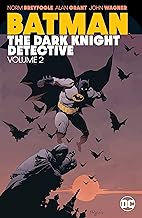 Written by Alan Grant & John Wagner, with Denny O'Neil, others. Illustrated by Norm Breyfogle, with Klaus Janson, others. Inks by various.
Colours/letters: various
Reprinting: Detective Comics #583-591, Detective Comics Annual #1, and excerpts from Who's Who #18, and Who's Who Update '88 #3, 4 (1986-1988) with covers
Rating: * * * 1/2 (out of 5)
Number of readings: 1
Reviewed: April 2024
I've been going through a phase of reading these collections of the early, post-Crisis Batman adventures. DC essentially re-booted its universe in the mid-1980s and recently it has been collecting these "early" tales in more-or-less consecutive collections (the Batman issues in various Caped Crusader volumes and The Detective Comics issues in The Dark Knight Detective volumes). And they're intriguing in terms of seeing how different creatives approach the character and how Batman tales can be pushed in different directions (as opposed to a "definitive" Batman style). I suspect the variety reflected editorial experimentation, as DC (and Bat-editor Denny O'Neil) tried to figure out what worked/what didn't for its then contemporary readers.
In the previous volume of The Dark Knight Detective, chief writer Mike Barr seemed to be going Old School: each issue featuring a recurring costumed foe, usually in light, simple adventures, often evocative of the 1960s Batman TV series, albeit with less overt camp (or with a mix of camp and grittiness). While over in the Batman series (collected in the Caped Crusader volumes) writer Jim Starlin went in the opposite direction, trying for a more gritty -- and even low-key -- realism, with few costumed villains at all, telling stories about mobsters, terrorists, and domestic abusers.
Both Starlin and Barr producing hit and miss efforts.
Then Barr stepped away and was replaced by British imports, the co-writing team of Alan Grant & John Wagner.
And it feels a bit like the fairy tale about Goldilocks and the Three Bears, as they find the middle ground between Starlin and Barr's extremes. Although, in a way, that was achieved just by going back to a traditional type of Batman story that had dominated throughout the Bronze Age -- albeit more gritty, and arguably more sophisticated. Mixing mean streets noir with gothic horror and colourful villains to produce arguably the most consistently strong run of comics in these volumes so far.
Unlike Barr, Wagner & Grant mostly eschew familiar arch foes (arguably allowing their appearances to seem more "special" when/if they do appear) but that's because they decide to introduce their own rogues gallery: notably these issues introduce the Ventriloquist/Scarface combo, the Ratcatcher, and Mr. Kadaver all who, like a lot of traditional Bat-foes, walk the line between super-villain and realist villain. A lot of the stories also mix gritty noir and horror vibes with a deliberate quirkiness and tongue in cheek. A style the duo may have honed in British comics which often blended those styles. So Scarface/the Ventriloquist is both a murderous mob boss in a ghoulish story involving smuggling drugs in corpses -- even as it's equally silly: a mob run by a ventriloquist's dummy, decked out like a 1930s gangster, while the ventriloquist presents as a mild mannered nebbish, appalled by his own puppet's ruthlessness. And Scarface speaks with an exaggerated speech impediment because ventriloquist's have trouble pronouncing certain consonants. It's comedic and creepy all at once. Likewise Mr. Kadaver is both sinister and silly.
And the plots, too, benefit from some quirky plotting and story twists, making them a notch or two above what Starlin and Barr were doing. Or at least more eclectic. Probably the high-light is the three-part story introducing Mr. Kadaver which takes place all in one night and starts out with disparate threads that seem to have no connection but which slowly tighten around each other -- a killer of homeless men, a man mutated into a monster by toxic waste (a standard comic book/Batman cliche), a drug shipment, and Mr. Kadaver, all while a late night DJ's commentary threads through the background.
Norm Breyfogle has settled in as regular artist. Breyfogle often gets cited as one of the "great" Bat-artists, although I was often a bit more mixed on him. I'm not as much a fan of "stylized" art, and his thin, angular figures are often a bit cartoony. But these issues drag me closer to his corner. The early issues here evince a lot of interesting atmosphere (crucial to Batman in general, and especially the kind of stories Wagner & Grant are telling) and dynamic storytelling. Although I did think toward the end the art started to reflect more of what I didn't like about Breyfogle (including thinner ink lines, losing some of the rounded atmosphere). Still, whatever quibbles, the art is compelling and definitely has made me more of a convert to the Breyfogle fan club.
I used to feel Batman was one of the easiest characters to dip in and out of over the years (despite DC's re-boots and new directions) because he changed the least from era to era. But I realize that can also be a problem. Because as is often the case with Batman comics -- it is almost entirely Batman. That is, little of Bruce Wayne, or any secondary, soap opera-y threads. Whole issues, whole story arcs, can roll by without Batman ever out of costume. There's an absence of a "human" factor to the stories, with Batman just a big cape who swoops in and out of the scenes, with little effort to give him much inner life (which also relates to my comment about Breyfogle's art being less realist). With that said, they do give Batman some vulnerability (able to be shocked or put on the ropes) that humanizes him.
But this lack of a human/civilian side to the stories also maybe makes the grisly, ugliness more prevalent. As mentioned, there's definitely a horror vibe to some of these stories, a nastiness (despite the humour) that can be a bit unrelenting when it's story after story. Honestly? A themed robbery by a colourful foe would almost be welcome as a counterpoint.
You can contrast Grant & Wagner with the Annual, written by veteran Bat-scribe Denny O'Neil, and illustrated by the unusual combo of Klaus Janson and Tony DeZuniga. It's a story that's okay but decidedly more average in terms of themes and execution and which trots out familiar foes like the Penguin (although made more evil and psychotic, natch') and -- since it's O'Neil -- his creations: Ra's al Ghul and Talia, and also Lady Shiva. Another extra is a sixteen page insert story in one of the monthly issues that was apparently an effort by DC to provide a showcase for new talent: but it suffers from stilted art and dialogue, albeit a more humanist, compassionate Batman (DC might've been better to pair new writers with veteran artists or veteran writers with new artists; as it is, the strengths of each in this story is undermined by the inexperience of the other and vice versa).
Despite a mostly strong run, toward the end the final two issues are a bit weaker. They are single-issue tales, perhaps suggesting Wagner & Grant work best when they have room to stretch.
The penultimate story here has Batman taking on Middle Eastern terrorists (a recurring theme in Starlin's run, too) and it's every bit as cringey and kind of racist as you might expect (especially when you realize this was before Sept 11th so you can't even excuse it as a traumatic reaction to that horror). Wagner & Grant try to balance it by having the terrorist point out all the atrocities done by the west to the Middle East -- and they maybe state that argument more boldly than some. But it doesn't quite shift the balance in a story in which the only Arab people depicted are murderous terrorists with no rhyme nor reason to their anarchy (beginning with shooting up a bar of US Vietnam veterans). The story has Batman going to London, no doubt a fun choice for the U.K. writers (although Grant is actually Scottish).
The final story follows another familiar pattern (a wronged man is killing a bunch of people who wronged him until Batman catches up with him) and a familiar pattern of being both progressive and problematic simultaneously. Here an Australian Aborigine mystic comes to Gotham, murdering his way through guys who stole a sacred artifact. So on one hand the story is sort of trying to make a point about racism and colonialism -- while the murderous antagonist is still the Aborigine guy!
(I mean if Grant & Wagner were serious about wanting to deal with racism and colonialism in both these stories, maybe instead of doing a story where the murderous villain has a speech about how his people were wronged, they could've done stories where Batman actually tackles those issues directly. But maybe that's for later issues.)
Still, whatever its ups and downs, definitely among the strongest, more consistently interesting of these early volumes I've read (starting with Second Chances, Caped Crusader vol. 1, and The Dark Knight Detective, vol. 1)
Batman, The Dark Knight: Knight Terrors
see review Batman: Knight Terrors
Batman: The Dark Knight Returns
click here for review
The Dark Knight Strikes Again
click here for review
Or go to