The
Masked Bookwyrm's Graphic Novel (& TPB) Reviews
The
Masked Bookwyrm's Graphic Novel (& TPB) Reviews
Thor (Page 5)
for a complete alphabetical list of ALL reviews start here
A - B - C - D - E - F - G - H - I - J - K - L - M - N - O - P - Q - R - S - T - U - V - W - X - Y - Z
Thor: Ragnarok (2011) 128 pages
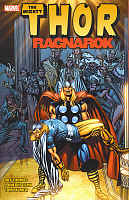 Written by Roy Thomas. Pencils by John Buscema. Inks by Tom Palmer and Chic Stone.
Colours: various. Letters: Joe Rosen.
Reprinting: Thor #272-278 (1978) - with covers
Rating: * * * * 1/2 (out of 5)
Number of readings: 2
Reviewed May, 2011
Thor constantly is torn between being a super hero series...and a fantasy series set in magical realms inspired by ancient myths. And because Norse legends often serve as a recurring source, similar plots tend to crop up again and again, including the inevitable "fight for Asgard/end of the Universe" epics, often referencing Ragnarok -- the ancient Norse myth of Armageddon! Yet though past stories called upon elements of the myths, they were pretty loosely inspired by them. So in 1978 writer Roy Thomas, a fan of mythology, history and one of coimicdoms most faithful adapters, decided it was high time time Thor dealt with the myth of Ragnarok -- literally.
This collection begins with an issue where Thor recounts a tale of his and step brother Loki's younger days. It's a tale also inspired by Norse myths, and is enjoyable...though, as myths often are, it's a bit dream-like. It's unconnected to the greater saga save it leads into an epilogue that (sort of) kick starts the six-part Ragnarok saga, as a newsman, Harris Hobbs, approaches Thor with the idea of filming a TV special in Asgard itself! Thor refuses, but through Loki's scheming, the camera crew ends up in Asgard anyway, to bear witness, and to inadvertently affect, the coming crisis.
Although the contrast between the gods/fantasy with the modern day newsmen might seem an odd match, even too self-reflective, it captures the dual nature of the Thor comics. Thomas has a particularly good feel for the two extremes of, on one hand, the Asgardians with their Shakespearean phrasings, and on the other, the contemporary -- almost hard boiled -- flippancy of the mortal characters, even when in conversation together (other writers tend too often to either make mortals sound like Asgardians, or Asgardians sound like contemporary mortals). The results are conversations which are both colourful, true to the various characters, and inherently -- and deliberately -- slightly humorous in the quirky contrasts
What unfolds is the prophesied events leading to Ragnarok -- with even the characters aware of what the events portend, but unable to alter them. By drawing upon the ancient legends, Thomas is able to follow a dramatic template that, after all, was good enough for the Norse centuries ago, and maybe makes for an atypical plotting style than the average comic. Yet the weakness is Thomas is just following an established legend, and by relying on the crutch of "prophesy" doesn't fully justify actions and motives in the context of the Marvel Comics version of these characters. For example, what partly kicks off the events is that Balder, flaunting his invulnerability, invites his fellow gods to try and kill him (something which even a character suggests is out of character, and must be Loki influencing his mind). Firstly, I'm not sure if Balder's invulnerability was ever a part of the Marvel version of the character before. Secondly, it's not explained -- exactly -- why mistletoe proves deadly to Balder!
Yet, in a sense, that's where the TV camera crew provides a useful plot addition. Because even as Thor and his fellows are playing out an established ancient scenario, having these characters who are not part of the legends flittering about allows for original sub-plotting that does, nonetheless, tie into the greater saga, as a cameraman becomes smitten with Thor's girl, Sif, and so becomes a pawn in Loki's scheming. So even if you knew the myths...there are still a few twists and turns and character threads to keep you guessing.
In addition to drawing meticulously on ancient legends, Thomas was also very much at the forefront of the continuity movement in comics, always happy to draw upon past issues. So there are spots here where characters will refer back to events and characters from Thor comics published years earlier! Fortunately, they're mainly minor references.
The art is provided by old master John Buscema. His composition and storytelling is fine, the scenes playing out clearly and dramatically, but the actual pencil work can seem a bit rough and hasty. Though whether that's a fault of Buscema (maybe growing tired after a hundred some issues of drawing the series, or being overworked with other projects) or a weakness of Palmer's inks, I'm not sure. Palmer is a well regarded embellisher, and can do some nice work, often adding shape and dimension to a penciller's lines. But he also sometimes seems a bit reminiscent of an inker like Klaus Janson, in that he sometimes seems to use a thick brush that maybe isn't always that sensitive to the penciller's line work. The final chapter is inked by Chic Stone, who I often have some ambivalence for. Still, despite my quibbling, the result is certainly good art -- dynamic and well suited to telling the tale.
Thomas is a writer well matched to the Thor milieu, but is so in love with the form, the content of his tale -- the retelling of ancient legends for a comic book audience -- he maybe sacrifices the emotions of the characters. What I liked about some of Stan Lee's era of Thor stories (and, admittedly, few since have matched him) was the emotion, the passion, of Thor and his crew, their love and loyalty for each other. Yet here, Balder lies near death, and the characters are mainly concerned (understandably, of course) for how it signals the coming of Ragnarok -- yet there's little sense of Thor grieving on a personal level for the loss of one of his best friends. Likewise, his scenes with Sif lack passion. The Warriors Three are part of the story, but even though Volstagg makes comments about his legendary valour, it's only a long time reader who would understand the intended humour of those scenes, because as depicted here, Volstagg is given little comedy shtick to indulge in. Still, there are a few chuckles that way.
Ironically, the greatest emotion is milked from the TV newscrew and their reaction to what's going on!
Nonetheless this is an enjoyable arc, and with the 17 page issues cramming more in than most modern 24 page comics, it makes for a dense, meaty read! It's a better-than-average telling of the sort of "fight for Asgard" tales that the Thor series has churned out on a seeming semi-annual basis for decades!
Indeed, after a first reading, I gave this very good 4 out 5 star rating. But after a second reading...I'm boosting that a bit. After all, I'm the one who says my reviews are usually based around the idea of how well do these TPBs read as just something to be enjoyed for themselves, dragged off the shelf for a few nights distaction? And in that sense, Roy Thomas and company have concocted an enjoyable epic that holds you from beginning to end, that manages to be faithful to the character's mythological roots yet marrying it with the comic book eclecticism, mixing elements of the "real" world (ie: the news crew), with the sci-fi (Asgard looking as much like an alien civilization as a land of myth).
This story takes place just shortly before the Celestials/Eternals/Ring of the Nibelung epic that would consume a huge run of Thor issues and is itself collected in the two volume TPB Thor: The Eternals Saga (reviewed this page). Indeed, at one point, oblique references are made to events in Thor Annual #7 -- an issue not included in this collection, but was included in the first of the Eternals Saga TPBs. And this collection ends, after the Ragnarok matter has been settled, with Thor having a tiff with Odin and flying off warning of danger from The Celestials -- who otherwise were unreferenced here. My point being that, though Ragnarok is perfectly readable on its own (those minor references aside) for those curious about those comments, subsequent issues are also available as TPB collections.
Thor, God of Thunder: The Saga of Gorr the God Butcher (2019) 248 pages
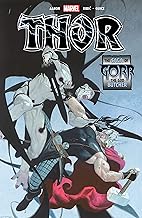 Written by Jason Aaron, Illustrated by Esad Ribic, with Butch Guice & Tom Palmer.
Colours: Ive Svorcina, with Dean White. Letters: VC's Joe Sabino. Editor: Lauren Sankovitch.
Reprinting: Thor: God of Thunder #1-11 (2018)
Additional notes: covers; alt covers; pencils art/sketches
Rating: * * 1/2 (out of 5)
Number of readings: 1
Reviewed Jan 2024
It's also interesting as this was the story adapted into the movie Thor: Love and Thunder (which I saw first). The movie changed a lot, not the least the tone, but this is the primary source material and it's interesting to consider what was changed, what was kept, and the weaknesses that remain in both. Funnily enough, I didn't really like Thor: Love and Thunder. But these original comics I also found unsatisfying.
The premise here is that an all-powerful alien, Gorr, has been going around the universe for centuries killing the gods of various cultures -- often brutally (hence why he is dubbed The God Butcher). Thor becomes aware of this and sets out to investigate.
The story is initially split across three time lines: the modern superhero Thor seeking out to learn about and stop Gorr; a younger, impulsive 10th century Thor who has his first encounter with Gorr; and in the far future an ageing Thor, now All-Father of Asgard, making his last stand against Gorr who had laid waste to the cosmos' gods. Things take a weirder turn when, thanks to time travel, all three Thors end up in the same future, grudgingly teaming up to stop Gorr before he can unleash his ultimate plan...a Godbomb that will kill all gods at once throughout history.
So, yes -- if you've seen Love and Thunder, it's very different and yet built on the same foundation stones. There's no Jane Foster (or Valkyrie) here, no kidnapped children of Asgard. And the tone is much, much darker than that often comedic film -- it's a more violent and brutal tale (and worth maybe a "mature readers" caveat for some of the gore).
It starts out fairly intriguing and compelling as in parallel sequences we see both the present and the past Thor first have their grim inklings as to the greater menace afoot. And of course this falls into the comic book sub-genre of introducing a new foe who's just that much bigger and badder and unstoppable than any the hero has faced before.
The art by Esad Ribic is beautiful and elegant. I've seen his work before and liked it -- albeit with the same caveat. It's lush and almost looks like something that belongs in a gallery. But that can almost be a problem, making it a bit aloof -- beautiful to look at, rich in atmosphere, but maybe sacrificing the humanity of the characters, the immediacy of the scene, and of the comic book "storytelling." The colouring by Ive Svorcina is also a bit too much of similar hues (particularly when we're cutting between different storylines) and washed out. The opening issue, coloured by Dean White, is a bit more vibrant. There were also times where I wondered if writer Jason Aaron was picturing visuals a little more cosmic and Ribic just stuck to vague shapes and designs. Old pro Butch Guice pinch hits an issue -- a flashback filling in Gorr's origin -- and though his art is more traditionally comic book-y than Ribic's it was just as effective for that.
I did enjoy the art, don't misunderstand. And maybe part of that aloofness, a feeling I'm not quite being drawn into the nitty gritty emotion of the story, is a fault of Aaron's as much as the visuals.
The funny thing about this 11 issue epic is that presumably part of the reason they changed a lot for the movie is because, honestly, I can imagine them reading this and thinking...there isn't two hours here. For all this totals over 200 pages, and despite the time travel/time lines idea, the plot isn't really that complex, nor does it really twist or turn much or pad things with sub-plots. Given comics are constantly re-booting and re-imagining their characters, and this is the start of -- yet another -- new Thor series, it gives you very little sense of what the status quo is in Thor's part of the Marvel Universe these days. For a lot of it, Thor (or Thors) are practically the only characters: there's next to no use of the Asgardian characters or any human cast members (Iron Man appears in one brief scene).
And the truth is, as much as it started out kind of intriguing, building a sense of genuine menace...it runs out of steam. Having an unstoppable menace who the heroes fight -- repeatedly -- over the course of the saga can get a bit tedious after a while. Especially when the Thors never seem to have much of a plan, so there's no reason to think this fight will go any better than the last fight. Sometimes less can be more. If the premise is the villain is unstoppable, then maybe space out the encounters, building the sense of danger precisely because the hero isn't fighting him all the time.
It can feel a bit like Aaron comes up with a neat idea...then can't really figure out where to take it beyond the initial idea of: unstoppable bad guy who has vowed to kill all gods. Gorr's motive (when we learn it) is pretty much what you'd expect (admittedly, I'd seen the movie; but it's still pretty straight forward). The source of Gorr's power -- y'know, the rather crucial plot device that allows him to be this unstoppable killing machine -- in both movie and comic feels a bit like an ill-explained plot device (when it could've maybe added a sub-plot or a twist if it had been explored).
For such a long epic, a few times Aaron will kind of throw in new information in the same issue it will be relevant, as opposed to introducing it earlier to be teased along. Maybe he's doing this deliberately, thinking of the readers picking up individual issues in the store. But it just means plot ideas that might be interesting if threaded along and developed can feel a bit abrupt.
And like with the movie, a problem with the story is wondering what the point of it all is. Is it some sort of allegory about religion, belief, agnosticism? Is it a metaphor for politics or an out of touch elite and the suffering of the downtrodden? Or is it just a fantasy superhero adventure? I sort of feel like it's ultimately just the latter and it really doesn't hold up to any deeper interpretation.
Funnily I saw a review by a Christian who assumed the story was Atheistic -- since it's about someone killing useless gods -- but equally the story could be seen as pro-religion since it's the villain who is killing gods and there seems to be a message buried in there that people need gods to believe in.
Now I suggest the plot is a bit thin, likewise the characters. But maybe that's because I'm neglecting the central concept (and was absent from the movie): the team up between the three Thors. That may be what Aaron saw as the bigger gimmick than even Gorr the God Butcher: a chance to explore the character of Thor through, essentially, three different versions of him which regard each other as almost strangers (and thanks to vague hand waving about time-lines, none of them have any memory of these experiences through the perspective of the others). Although what's odd about that is that for a saga that started out -- and remains -- dark and brooding and violent, the tone shifts more into sort of comedy with the bickering Thors, and even other minor characters being sarcastic and wisecrack-y. But it feels a bit like a clash of tones.
There's also just the whole approach to Thor's character, which may be Aaron's or simply reflective of the modern take on him. Thor is one of those characters who can be written rather differently depending on the era of comics and the writers involved. Gone is the old thee and thou and Elizabethan English of the character (except oddly the characters do slip into it occasionally) and the whole sense of Thor as this character somewhat removed from the more common "everyman" Marvel hero. Indeed, at times Aaron seems to write Thor very much like a "normal" character. I'd almost wonder if this is a writer who likes to insert himself into his characters and so rewrites Thor to his tastes (including having Thor narrate some of the story -- one idiosyncracy of older Thor comics, when I think about it, was how little we got too deeply into Thor's thoughts; Thor was a character defined by what he said and did). Though if so, it makes the emphasis on Thor's whoring and drinking somewhat...curious (and this isn't just a tendency of Aaron's but other modern era Thor scribes, too).
Honestly? I'm struggling to write something deep and analytical here, and it probably shows. Truth is, after thinking the story started interesting (if a bit grisly) toward the end I just was finding it a bit tedious. Gorr, for all his unstoppableness, never really develops much dimension or nuance, and despite three Thors, Aaron never quite made Thor that compelling. And despite 11 issues, the actual plot is a bit too straightforward and repetitive (despite the three time-lines) without sub-plots or threads, and with the main plot rarely going anywhere unexpected (once you get past the first few issues which, after all, are setting up the pieces). In fact it's funny how the comic devotes an entire issue to detailing Gorr's origin and motivation...and the movie basically conveyed the same in one scene.
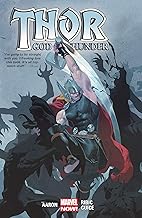 This is another one of those story arcs that has been collected in more than one version and title (God of Thunder, vol. 1, is another, I think) -- including spread across two TPBs, The God Butcher (collecting #1-5) and The Godbomb (#6-11) respectively. Despite that, #1-11 are a full story.
Thor (Epic Collection): Ulik Unchained 2021 (HC) 232 pages
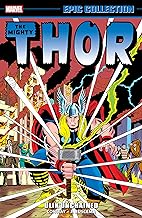 Written by Gerry Conway, with Roy Thomas, Bill Mantlo. Pencils by John Buscema, with Rich Buckler, Sal Buscema, George Tuska. Inks by Joe Sinnott, others.
Colours/letters: various
Reprinting: Thor (1st series) #217-241, Marvel Premiere #26 (1973-1975)
Additional notes: covers; pin-ups, promotional art, mainly prepared for Marvel Treasury #3 (a Thor issue)
Rating: * * * (out of 5)
Number of readings: 1
Reviewed Jan 2024
Ulik Unchained is another in Marvel's mammoth "Epic Collections" and though the intent of these omnibuses -- as distinct from earlier Essential/Complete/Masterworks -- is the volumes themselves weren't necessarily meant to be sequential, in this case Ulik Unchained slots neatly inbetween Into the Dark Nebula and War of the Gods (or, as I read some of the issues, the smaller collection If Asgard Should Perish).
Anyway, the point of the Epic Collections is they are meant to be (relatively) self-contained, and read for themselves, neither beginning nor ending on a cliffhanger -- though plot threads may carry over from earlier issues, or into later ones.
My point about my having read surrounding issues/collections is relevant in that, although I have a nostalgic affection for this era (and John Buscema's visuals) I might also have been over-satiated on it, too. Because it can feel a bit uneven, as if writer Gerry Conway is struggling to find inspiration; likewise Buscema at times.
The Thor series is an odd mix of elements and themes: some stories rooted in superhero/supervillain antics in the big city; other stories are High Fantasy/mythology tales of Thor in nether realms; while others are space faring science fiction. And Conway rotates between the genres.
Arguably among Conway's strongest efforts in this collection are a couple of early story arcs here in which he leans heavily on the science fiction, with Thor in outer space, encountering weird planets and cultures. The mix of the mythological Thor with the sci-fi adds some novelty and those stories tend not to be as predictable in where the plot is headed, or in characters' motives. But Conway does have a bit of trouble sticking the landings in the climaxes.
The problem with many of the other stories is it feels like Conway is struggling to find inspiration, recycling old scenarios (and foes) for a mix of myth/fantasy stories and superhero. But where the villains, their plans and their motives, tend to be one dimensional. He threads in sub-plots -- but without a strong sense of where the sub-plot is headed, or why he introduced it (like an Asgardian maiden, Krista, who gets kidnapped, rescued, hangs around for a few issues, possibly as a romantic interest for Hercules -- who is added as a supporting player -- before she seems to disappear as if Conway forgot about her entirely).
You can get away with bland "adventure of the month" plots if they feel like just window dressing surrounding an engaging on-going soap opera, or you can have minor sub-plots linking well-crafted adventures-of-the-month. But you need one side to do the heavy lifting.
It can feel a bit like Conway is trying to find something that clicks. Or possibly his editors might have been suggesting ideas, encouraging a new focus. After a long run of stories with Thor in Asgard or outer space, the stories shift back to New York. Asgardian supporting characters seem to get sidelined or written out, including ones Conway himself introduced/created, like Hildegarde, till Hercules remains the main recurring supporting character -- until he just gets a job offer and departs the comic for the west coast. Conway adds in a recurring New York police detective, Blumstead, but without finding any use for him other than having him crop up and act like we're supposed to find him interesting.
More significantly, Thor starts using his Dr. Donald Blake alter ego again after a long spell of not (when he returns another doctor remarks they all thought Blake was dead, it'd been so long since anyone had heard from him). Part of the problem with bringing back the Blake alter ego is Conway doesn't really make any use of him, as a character, or his profession.
Even more significantly: Jane Foster is returned to the comic -- Thor/Blake's one-time love interest who had been written out of the comic probably close to a decade earlier! Even more, he writes out Thor's long serving love interest, the Asgardian Sif, by having her sacrifice her life/life-force to cure an ailing Jane. The problem is Jane had initially been written out because, one suspects, she was kind of dull and didn't add much to the plot. And here she remains just as dull, her relationship with Thor unconvincing.
But comics are cyclical and it could well be that Conway -- or his editor -- was keen to recreate the spirit of the early Thor comics (that they had read in their youth). An further hint that this was the case is that part way through these issues John Buscema is dropped and Rich Buckler added as artist. Nothing unusual in that. Comics change creative teams. Except this was when Buckler was drawing in a decidedly Jack Kirby-esque style (much different from his later style) and when he joins the team a caption declares it's a "return to former glory!" Aside from seeming a bit of a snub of Buscema, it reinforces my impression that they wanted to turn back the clock to the 1960s, with Jack Kirby-like art and Don Blake and Jane Foster back in the story.
I'm not sure it worked. John Buscema was back on pencils in just a few issues, the Blake character barely used, and though Jane is prominent, she feels extraneous -- or becomes a Sif substitute (fighting Trolls at Thor's side). A few issues after this collection I think she was mostly written out again and Sif brought back!
Conway bows out and the final story arc is written by Roy Thomas and Bill Mantlo and ends the collection on a fairly strong note. At least it benefits from antagonists whose motives are a little more nuanced, and some eerie, otherworldly visuals from both John and Sal Buscema (the latter drawing an issue here and there). It's not a great story, but it's okay.
Just to close off the collection is a solo Hercules story from Marvel Premiere by Mantlo and artist George Tuska. It's mostly just an action piece, but well told by the two. I suppose that was the weird thing about such "try-out" stories. The story isn't necessarily meant to point the way to what a Hercules solo series could be so much as test whether people would pick up a comic with Hercules as the star. (It didn't lead to a Hercules solo comic but I think it did presage The Champions -- the west coast-based team comic in which Hercules was a member).