The
Masked Bookwyrm's Graphic Novel (& TPB) Reviews
The
Masked Bookwyrm's Graphic Novel (& TPB) Reviews
Thor (Page 3)
for a complete alphabetical list of ALL reviews start here
A - B - C - D - E - F - G - H - I - J - K - L - M - N - O - P - Q - R - S - T - U - V - W - X - Y - Z
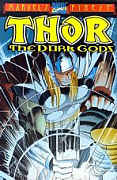 Thor:
The Dark Gods 2000 (SC TPB)
128 pgs.
Thor:
The Dark Gods 2000 (SC TPB)
128 pgs.
Written by Dan Jurgens. Pencils by John Romita, Jr., John
Buscema. Inks by Klaus Janson, Jerry Ordway.
Colours: Gregory Wright. Letters: Richard Starkings. Editor: Tom Brevoort.
Reprinting: Thor (2nd series) #9-12 (1998)
Rating: * * (out of 5)
Number of readings: 2
Published by Marvel Comics
Asgard, home of the Norse gods, has fallen to dark gods
and Thor must save it, with the help of a couple of allies (like his buddy
Hercules) in the climax. The Dark Gods is one of those collected
sagas in which the story, through sub-plots, had been around for a few
prior issues -- at times you can feel like you're coming in at the climax,
rather than getting a full plot. Still, the story trundles along reasonably
briskly, there's plenty of hitting and fighting and people exclaiming in
"thee"s and "thou"s -- all the stuff you'd expect from a Thor story. But
it's all a little...bland.
Jurgens plotting lacks complexity and ideas are only half-heartedly
developed. Mijolnir, Thor's hammer, gets broken in one scene (which
has happened before, though it's described as unprecedented) causing Thor
to revert to his current mortal guise of Jake Olson in mid-battle -- yet
later, he just puts it back together as easily as though it were a snap-together
toy. The climactic resolution just seems like a lame Deus ex machina
ending (though, perhaps appropriate for a story about gods) and things
lack verisimilitude. Asgard doesn't seem like a real society (as it has
in other Thor stories I've read), you can't believe the Dark Gods could've
conquered it or, if they had, that Thor could win it back so easy. Jurgens
can't decide if he's depicting a war, or simply a superhero free for all.
The Dark Gods themselves are insufficiently defined as individuals, despite
potential for motivation. Instead of drawing upon real myths, as have other
Thor writers, Jurgens creates his own evil pantheon, but fails to create
anything more than a minor goon squad.
The story kicks off with John Buscema penciling the first
chapter (with Ordway's inks) and one can be forgiven for feeling a giddy,
nostalgic rush. After all, Buscema used to draw Thor back in the '70s,
and I had thought he retired a few years ago. Seeing this giant of the
biz back in action, his knack for realism, and seeing Thor as he draws
Thor, might explain why the early part of the saga seemed somewhat promising.
I also enjoyed seeing Thor back doing the Shazam-thing,
having a mortal alter ego, something that had been dropped from Thor when
last I read the comics.
Then the more stylized regular art team of John Romita,
Jr. and Klaus Janson reclaim the reins for most of the story. Romita-the-younger's
current Frank Miller-inspired style worked for me better than I expected
-- but it lacks Miller's subtlety and dynamic composition (at least the subtlety and dynamism Miller had in the 1980s). As well, Romita
Jr. never quite creates a believable foundation. Instead of conjuring up
a god-like presence among mortals, as Buscema does, Romita Jr.'s Thor looks
like a comicbook drawing among other comicbook drawings. And during some
of the climactic battles, I had trouble figuring out what was going on
in spots.
This is a review of the story as it was serialized
in Thor comics.
Cover price: $__ CDN./$15.95 USA.
Thor: The Eternals Saga, vols. 1 & 2 2008 (SC TPB) app. 210 pages each
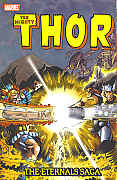 Written by Roy Thomas, with Mark Gruenwald, Ralph Macchio. Pencils by Keith Pollard, with John Buscema, and Walt Simonson, Arvell Jones. Inks by Chic Stone, with Ernie Chan, Gene Day.
Colours: various. Letters: Joe Rosen. Editor:
Volume One: reprinting: Thor (1st series) #283-291, Thor Annual #7 (1979-1980) - with covers
Rating: * * * * (out of 5)
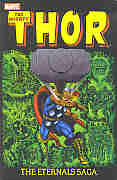
Volume Two: reprinting: Thor (1st series) #292-301 (1980) - with covers
Rating: * * * 1/2 (out of 5)
Number of readings: 2
This is a massive epic comprising about twenty issues -- and even then makes peripheral references to previous Thor adventures (including events subsequently collected in the TPB Ragnarok -- reviewed below -- and even going back a hundred issues or more!). As well, it's intended as a sequel to Jack Kirby's interrupted series, The Eternals. Along the way, we get the origin of Thor's Asgardian realm, and a lengthy adaptation of Richard Wagner's operatic Ring cycle. And it represents much of what's good...and, arguably, what's bad about comics. It is deliriously ambitious in epic concepts...and overly obsessed with comic book minutia and patching over continuity problems -- a hallmark, nay, an obsession of Roy Thomas in particular, whose recurring theme in so many stories he's written at Marvel and DC both is simply tying together past stories and events into a coherent narrative. Comicdoms self-apppointed continuity Mr. Fix-It, if you will.
And by its very length (and with chief instigator Roy Thomas bowing out before the end!) it can feel as though the creators themselves had trouble staying on top of all their ideas.
And it's spread over two TPBs but, other than a "1" and "2" unobtrusively on the spine, there's nothing that obviously alerts a casual purchaser to that fact (no "volume one" or "volume two" as part of the cover title), so they might be surprised (and miffed) to find the first volume ends on a cliffhanger.
Anyway, each volume has its own focus.
Volume One details Thor's encounters with The Eternals, both a millennium before in a flashback tale (from Annual #7) and then in modern times. The Eternals are a race of superhumans created by the star-spanning Celestials, the latter being enigmatic giants as far above Thor's god-like race as Thor is above mortals. The Celestials have been guiding earth evolution for hundreds of thousands of years and are now in the process of their final judgment on the result -- a judgment that, if negative, will mean the end of life on earth.
This is all drawn from The Eternals' own then recently cancelled series. Yet it's explained as you go, so you don't really need to know much about it or be that familiar with the Eternals.
And the ensuing half score of issues are an entertaining romp.
Super hero comics are THE great storytelling stew, mixing genres with delirious abandon in a way novels, movies and TV rarely attempt, so there's an unapologetic blending of urban cities and otherworldly realms, super hero action, magic, and science fiction. Thor attempts to confront the Celestials, then allies himself with the Eternals, getting drawn into a few conflicts with the Eternals' opposite numbers, the evil Deviants, eventually building to a climactic battle between Thor and his Eternal allies...and his own Asgardian people, led by his sire Odin (allied with the Greek gods) who, incomprehensibly to Thor, seem to have sided with the Celestials!
It's pretty entertaining. Like a lot of comic book epics of yesteryear, it's comprised of smaller one or two-issue arcs within the greater epic, although unlike some, it remains focused on the basic story (there are no unconnected filler issues). And there's even a mad wackiness that evokes Jack Kirby himself such as an issue involving Mexican masked wrestlers (a real life entertainment) in which an evil Deviant, who works as such a wrestler, breaks off a battle with Thor...because he has a professional match scheduled! It's nutty -- but that's the world these characters inhabit.
Writer Thomas keeps things bouncing along, capturing Thor's mix of emotive bombast and steely determination in the face of daunting odds. And he threads question to provoke and intrigue as we go, such as why Odin seems opposed to resisting the Celestials. He even plays around with some subtle emotional undercurrents. At this point, Thor is somewhat estranged from his father, Odin, and is even self-exiled from Asgard, and he carries that baggage, perhaps colouring his judgement in scenes with the Eternals and their own Odin-like patriarch, Zuras.
Admittedly, there can always be a problematic aspect to using one series -- Thor -- to wrap up loose ends from another -- The Eternals (something that is not uncommon in comics where series get cancelled in mid-story...but are still meant to be part of the company's continuity). It means that the titular hero has to share space with others...even as those others are ultimately guest stars and can't really be afforded as much space as their fans might like. Given that The Eternals series was developing an epic saga involving The Celestials, fans can be happy Thomas attempts here to provide some closure to it -- but it can seem a bit perfunctory at times, the various individual Eternals not getting as much face time as a fan might want.
As well, even Thomas seems to be struggling to stretch things out, or to justify conflicts. At one point Thor is angry because other characters aren't willing to stand up to the Celestials...then later is trying to stop them from possibly provoking the Celestials by standing up to them! At one point an Eternal seems to be a servant of the Celestials...yet later he sides with the rest of his people against them.
The art is handled by Walt Simonson on the Annual (a few years before he would take over the comic as both writer and artist for an acclaimed run), John Buscema for a few issues, and mainly Keith Pollard. Simonson is almost unrecognizable inked by Ernie Chan, one of those inkers who tends to impose his style on the pencils -- but Chan has an attractive style, so the result is decent. Buscema's issues, coming at the end of a long stint as Thor penciller, seem a bit uninspired, but I suspect that has a lot to do with Chic Stone's inks -- Stone also inking Pollard. It isn't that Stone is a bad inker -- he provides clean, efficient lines -- but it's rather devoid of style or mood, making the art flat and workmanlike. In its thick, bold lines it reminds me a bit of Gene Day's inks (and perhaps significantly, Day inks the double-sized 300th issue). And Pollard was a competent artist of the era, though not as strong as, say, Buscema -- and perhaps more suited to the down-to-earth realism of Spider-Man than the epic grandeur of Thor. Still, throughout the art tells the tale well enough. And with the emphasis on plot and machinations and exposition, it is the writing more than the art that is intended to turn the pages.
Though a flaw with this saga is when you actually contrast it with Kirby's Eternals issues -- the art lacks Kirby's power and drama, and Thomas's plotting likewise lacks Kirby's almost Shakespearian melodrama.
But it's problematic on a number of levels. For one, years later Thomas adapted the cycle again, this time with Gil Kane, which I had already read, meaning from my point of view I'm reading a TPB collection of a story I already had. And given how literally Thomas stuck to the source material in Thor, it's unclear why he even wanted to repeat himself, though since he left Marvel in the middle of it, and was tying it into the comic book Thor, maybe he felt he wanted to do a straight, stand alone adaptation (and he had no way of knowing Marvel would one day republish his Thor issues as a TPB). Both versions have their strengths -- Kane's dynamic art and a more theatrical telling in the later version, while here there's an appeal to Pollard's more down-to-earth pencils, and though Thomas recycles the same scenes and dialogue, there's just an extra line or two to here that humanizes the characters more.
Though a problem with any version is, frankly, the source material -- outrageous as that may sound to opera buffs. But just as the Norse gods as interpreted originally by Lee & Kirby diverged from their origins in an attempt to make them more in tune with modern mores, making Thor and the others more noble, more sympathetic, Wagner's opera is perhaps dated a bit, full of swaggering, hyper macho characters that are, frankly, a tad obnoxious and unendearing, and with even a subtext about gentic purity. Frankly, it's not surprising the Nazis took these operas so much to heart!
It's also problematic because the adaptation hues pretty closely to the myth and fantasy aspect of the character, meaning it lacks that narrative stew appeal I earlier applauded (Pollard's visuals eschewing the sci-fi traipings of Marvel's Asgard). As well, Thor spends a huge run of issues...as a bystander, observing events. And even though, in the convoluted logic of the tale, the protagonists of the cycle look like Thor...it's not quite the same thing.
Furthermore, the Eternals are reduced to a cameo at the beginning and end of the collection, when the plot finally returns to the Celestials story that started it -- especially disappointing for fans of those characters.
Thomas leaves the project shortly before the end, with the writing chores taken over by Mark Gruenwald and Ralph Macchio (Macchio and Gruenwald were credited with plotting assistance earlier so that one can assume their story was, more or less, what Thomas intended). Anyway, when the two take over, there's some quick explanations that kind of clarifies motivation, as if they realized Thomas had let it get a bit too muddled. In fact there's a rather crucial bit relating to astrology and cosmic cycles that isn't really explained until you read an editorial published with one of the comics -- an editorial Marvel thoughtfully reprinted in this collection (albeit, at the end of the volume).
Though if the "why" is explained, a lot of the "how" remains vague...a problem with magic-based stories. Indeed, for such an epic saga meant to explain so many things...you can find yourself still not really sure what was going on or how such-and-such relates.
Still, the plot lifted from Wagner's opera(s) is interesting enough -- particularly if you're unfamiliar with it. It's not like there isn't an entertainment aspect to it...but it just doesn't feel wholly like a Thor story.
Once the saga finally comes back to the Celestials in the double-sized 300th issue...it all seems a bit perfunctory and anti-climactic. Thor remains mainly a bystander, and the solution to Odin's long ago capitulation to the Celestials seems like a Shaggy Dog story. There's reams and reams of exposition harkening back to various Thor comics as if to pretend this was all foreshadowed years earlier. And when the Celestials are finally thwarted...it requires bringing in characters and ideas that basically come out of nowhere. By this point the saga is bursting its seams with too many ideas and theological pantheons -- even working in some Christian martrydom imagery to little sense.
Still, it does all get completely wrapped up, with the collection including #301 which resolves a dangling plot thread from #300.
I enjoyed the first volume, with its emphasis on Thor and Eternals and Celestials, and the mysterious machinations of Odin, and its eclectic plotting and introduction of the dilemma, more than the second volume which is largely a perfectly decent adaptation of Richard Wagner's operas, book-ended not altogether effectively by the Celestials Saga. Yet one can't divorce the first volume from the second. I mean, you can to an extent. Despite ending on a cliffhanger issue, and with the greater conflict still unresolved, there are enough mini-arcs and issue or two (or three) conflicts that do get resolved, that there's still an enjoyability to it. And the volume two/opera material is entertaining and full of twists and cosmic machinations -- and my ambivalence may stem a lot from simply having read Thomas & Kane's later re-telling of it (which a lot of people picking this up won't have).
But as a massive epic, it ends up a bit unwieldy, possing intriguing questions with anti-climactic solutions, stretching the ideas past their tension point, and trying to graft together two epic arcs that don't fully complement each other. And the art, though serviceable, is a bit flat.
 And though volume one builds to a cliffhanger, it is resolved quickly within a few pages of the beginning of the second volume as the story veers off in a wildly different direction (now drawn entirely by Pollard). Though theoretically still part of the Eternals/Celestial arc, Thor -- and writer Thomas -- get distracted by a new idea as Thor tracks down Odin's sentient, disembodied eye which relates to him events from the distant past. And what ensues is both Thomas' attempt to reconcile and explain the discrepancies between Marvel's Asgardian pantheon and its mythological inspiration (though I think later Thor writers more-or-less ignored Thomas' explanation), and also Thomas' clearly passionate desire to adapt Wagner's operas into comics. It's an audacious thing to do. Nor is Thomas simply vaguely inspired by the operas, but faithfully adapts them, and that comprises the bulk of this collection.