The
Masked Bookwyrm's Graphic Novel (& TPB) Reviews
The
Masked Bookwyrm's Graphic Novel (& TPB) Reviews
_Star treK_ (Page 6)
for a complete alphabetical list of ALL reviews start here
A - B - C - D - E - F - G - H - I - J - K - L - M - N - O - P - Q - R - S - T - U - V - W - X - Y - Z
Star Trek - Re-Booted/Movie Universe
Star Trek, Vol. 1 2012 (SC TPB) 102 pages
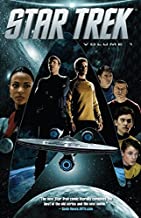 Written by Mike Johnson. Art by Stephen Molnar, with Joe Phillips.
Reprinting: Star Trek: #1-4 (2011)
Rating: * * 1/2 (out of 5)
Reviewed: Oct. 2019
Number of readings: 1
Published by IDW
This is one of those books it's hard to review -- because it's hard to know what the intention is and so whether it succeeds or fails at its goals.
Star Trek used to be hard enough to define with all those series -- but now even when talking about the "Classic" version of Trek (Kirk, Spock, etc.) there are two versions: the originals (played by Shatner, Nimoy, etc.) and the "alternate time-line" (portrayed by Pine, Quinto, etc.) -- and now with Star Trek: Discovery thrown in the mix, too!
The gimmick here is to take the "alternate time-line" characters (and the visual likenesses of the movie actors) and retell specific episodes of the original 1960s TV series.
This first TPB collects only four issues which represent only two episodes. An adaptation of the pilot episode, "Where No Man Has Gone Before," in which a crewman starts to manifest superpowers -- and become dangerously megalomaniacal -- after an accident; a crisis made more trying because the crewman, Gary, happens to be Kirk's best friend. And an adaptation of "The Galileo 7" in which a party involving Spock and Dr. McCoy get marooned on a hostile world, and Spock has to take charge, his logical approach clashing with the others.
Taken as just straight adaptations of the episodes, they can feel a bit workmanlike. At times sticking so close to the TV episodes the dialogue is lifted verbatim from the TV scripts, while still feeling rather cursory, even spread over two issues each. Key moments and elements are omitted that, arguably, gave the originals emotional and/or intellectual heft (reminding me a bit of James Blish's prose adaptations of the episodes, wherein he would shoe-horn hour long episodes into sometimes 15 or 20 pages, but at least the brevity made them enjoyable Reader's Digest versions of the episodes).
In "Where No Man Has Gone Before," the character of the female psychiatrist (played on TV by Sally Kellerman) is written out entirely -- yet her presence was central to the story (and Kellerman's performance, along with fellow guest star Gary Lockwood, were crucial to the episode's effectiveness -- not that a comic can be expected to recapture an actor's nuances). While "The Galileo 7" feels like a watered down version of the original which was all about the rising tension and clashes between the characters, and Spock's struggles with command -- making mistakes as well as the right calls. There's a bit of that conflict, but here it feels mostly disconnected from a greater context (as an example, in the original a few characters get killed, exacerbating the anger and frustration of the others about how they feel Spock is handling -- or mishandling -- the situation; but here only one character is killed). Spock doesn't really make any mistakes (that would test his belief in logic) and the obstacles and dilemmas are easier to overcome. It can feel a bit like writer Johnson felt the original episode was too dark and intense and he wanted to present a nicer version of it.
I had initially assumed these would be "re-imaginings" of the original episodes, the creators taking these classic stories and turning them on their head, or at least giving them spins. A kind of "Elseworlds/What if...?" version of the old plots (or like the Star Wars Infinities projects -- reviewed in my Star Wars section). Instead, they seem to stick fairly close to the source (even, as mentioned, using the same dialogue). Except there are some changes -- notably in the climax of "The Galileo 7" (more anon).
I could see that as a fun endeavour for a writer (and Trek fan): taking the old episodes and finding new ways to tell, essentially, the same story. They could've re-imagined the old stand-alone episodes in the manner of modern TV series (and comics), perhaps teasing things along as sub-plots, or overlapping stories (maybe mash up "Where No Man Has Gone Before" and "The Galileo 7" into a four-part epic where Spock and the shuttle get lost even as Kirk has to deal with his renegade crewman!) Or since the crewman was supposed to be a member of the crew, don't begin the comic series with "Where No Man Had Gone Before" but instead weave him into other stories first, so that when he finally goes bad it might seem more tragic because the reader sees him as a genuine part of the crew!
Likewise, if you are re-interpreting the old stories for the new characters, surely that should be played up more -- notably the Spock-Uhura relationship. But it isn't really. I mean, it is a bit in "The Galileo 7," but in "Where No Man..." Uhura basically just man's the communication's counsel like in the old series and there are no scenes between her and Spock. (One way they have adapted the plots to the "new" version is that in the original series, Shatner/Kirk was supposed to have been fairly grim and studious in his youth, whereas Pine/Kirk was a reckless hothead, slightly inverting the relationship between Kirk and Gary. Another change is suggesting Gary is no longer Gary -- almost as if possessed; but it's not really expanded upon).
The most significant plot-change is in the climax of "The Galileo 7." The movies introduced the idea of a romantic relationship between Spock and Uhura (I'll admit, I don't think it worked because I don't think the creators had any idea what to do with it besides it simply being a "surprise" gimmick) but since it's there, it should be a factor in the comics. Likewise, a thing I did like in the movies was pushing Uhura's role up onto the main tier of characters (as opposed to the original where she was a supporting character) -- but then I like Zoe Saldana. In these comics, Uhura is mostly a peripheral character, but her relationship with Spock does come to the fore in the climax when it's her who breaks protocol and ends up rescuing them. Unfortunately it's more done as a plot device, rather than necessarily feeling like Uhura-as-a-character is getting more focus. And it further bleeds any sense of what the story was "about" -- namely Spock grappling with logic/emotion and his first command.
I couldn't decide if it was just scripter Mike Johnson was unenthused about the project and didn't really have anything he wanted to do with it except cut n' paste from the old scripts. But then I realized maybe the point was to do straight adaptations. It's easy for someone like me to forget how old the original TV series is. Perhaps the publishers figured there might be a lot of movie-Trek fans who've never seen, or intend to see, the old series and so would enjoy these re-tellings as "new" adventures as if Pine, Quinto, Saldana, etc. had agreed to do a weekly series.
So while I might be feel these are just Classic Illustrated versions of the old episodes, new readers can embrace them as original and intriguing stories. Except then we get back to my point that they can feel like lesser versions of the TV episodes, watered-down and simplified. Part of this is also the modern "cinematic" comic book style of relying mostly on dialogue and pictures, eschewing thought balloons or text captions. Emotional nuances can get lost because things actors use to convey nuance (tone of voice, delivery, subtle facial ticks) usually can't be duplicated just with a pencil. Instead of adapting the series to the medium of comics (and recognizing it's a different medium) these are more just transpositions -- like those old Star Trek photonovels (where episodes were presented using stills from the show with dialogue pasted in using comic book dialogue balloons).
Maybe they'd have been better to just shoehorn the episodes into single issues. Because as it is they feel too long for what they are, even as at two issues still feel like they've condensed the plots.
To be honest, these kind of put me in mind of the old Gold Key Star Trek comics, which generally aren't that well regarded. Now I don't mean that too critically (I actually have affection for the Gold Key comics) but it does evoke some of that same stiffness, same superficiality.
The art is also a bit mixed. Oh, it's not remotely bad. And it succeeds in fairly consistently capturing the appearance of the actors (especially crucial in a comic like this where the main gimmick is inserting the new cast into these old TV episodes). But equally -- and again true of a lot of Trek comics -- there can be a certain stiffness to the poses and the movement, the faces better realized than the bodies (this is especially true in "The Galileo 7"). And there's a general lack of atmosphere (that in a comic can be created by the use of shadows, or angles and composition). Obviously I'm influenced by having seen the episodes first as a kid, but despite their limited budget (or maybe because of it) Star Trek managed some moody and atmospheric scenes. I recall "The Galileo 7" as being kind of creepy with some fog-draped scenes and the creatures seen as vague shapes. Ironically here they use the limitless comic book budget to actually show the creatures more clearly -- but I'm not sure to any benefit.
Again I get to my point about whether you are adapting the episodes to the comic book medium (and making use of things like introspective thought balloons and more creative visuals) or simply transposing them.
Which is why I said it's hard to review this because I'm not sure what the intent was. It doesn't offer enough freshness or twists to be novel spins on familiar stories. Nor does it adapt the plots to the medium in such away that it's the old stories but told in a new way. So maybe the main audience is modern fans who have never seen the old episodes, who will find these comics fresh and exciting -- but I'd still argue the TV episodes are better.
Still, given these were the first issues, perhaps Johnson and company themselves were trying to suss out the landscape. Maybe I should try a few issues down the line and see where they took the idea.
Cover price: __ USA.
Back to