The
Masked Bookwyrm's Graphic Novel (& TPB) Reviews
The
Masked Bookwyrm's Graphic Novel (& TPB) Reviews
_Star treK_ (Page 5)
for a complete alphabetical list of ALL reviews start here
A - B - C - D - E - F - G - H - I - J - K - L - M - N - O - P - Q - R - S - T - U - V - W - X - Y - Z
Star Trek - Various (Voyager, Mixed, Etc.)
Star Trek: Deep Space Nine - Hearts and Minds
The mini-series is reviewed here
Star Trek: Other Realities 2001 (SC TPB) 198 pages
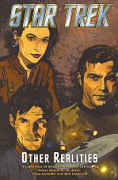 Written by Tony Isabella & Bob Ingersoll; K.W. Jetter; Peter David.
Pencils by Aaron Lopresti; Toby Cypress; Michael Collins. Inks by Randy
Emberlin; Jason Martin & Mark Irwin; David R. Roach.
Written by Tony Isabella & Bob Ingersoll; K.W. Jetter; Peter David.
Pencils by Aaron Lopresti; Toby Cypress; Michael Collins. Inks by Randy
Emberlin; Jason Martin & Mark Irwin; David R. Roach.
Colours:/letters: various. Editor: Jeff Mariotte.
Reprinting: Star Trek: All of Me, Star Trek: Deep Space Nine - N-Vector #1-4, Star Trek: New Fronntier - Double Time
Rating: * * * (out of 5)
Number of readings: 1
Published by Wildstorm/DC Comics
There have been many Star Trek comics over the years, published by many companies. And Star Trek itself has spawned other TV series and novels. Wildstorm focused most of its efforts on Star Trek: The Next Generation projects (like Forgiveness) -- I guess it's a generational thing (presuumably the Wildstorm guys gew up with that series). But it also produced a few Voyager stories, collected in Encounters With the Unknown, as well as the occasional project focusing on one of the other Treks -- most of which are collected here...
"All of Me"
Utilizing the original "Classic" Trek crew, this begins with a brawl on an Orion pirate ship, with Captain Kirk leaping about, and seems just a little too comicbooky. But once it settles down, the story enters nicely familiar Trek terrain as the Enterprise is sent to check in on one of the Federation's greatest scientists who, in true Trek fashion, it turns out has gone a little mad. It's briskly paced, and though the concept -- which I won't comment on to avoid giving too much away -- threatens to seem a little tongue- in-cheek at times, it's off-beat and reasonably entertaining.
There is an interesting quirk to the scientist in that, though arrogant to the point of megalomania, he actually respects Spock. But ultimately, the story is more focused on the adventure, rather than providing any deep character thred, or metaphor. The weakest part is the end, as an evil alien presence is revealed to be involved. The Star Trek TV series didn't tend to go for plain "evil" (even the nastiest critters they encountered still usually had a motive, even if it was only hunger). And aside from that, the ending feels "open". Perhaps writers Tony Isabella and Bob Ingersoll were hoping to do future Trek comics for Wildstorm, and to use this presence as a recurring menace (even having the characters vow "until next time"). But I'm not sure Wildstorm produced any further Classic Trek comics.
The art by Aaron Lopresti is nice, solid work. Not, perhaps, photo-realist, and not too much in the way of moody shadows or anything, but good comic book art and where the characters readily evoke the actors.
The bottom line is it's a decent enough read, though it shows its comic book origins a little too obviously in the opening and closing.
"N-Vector"
This Deep Space Nine mini-series is set after the TV series and, because the series ended (unlike most Trek shows) with a certain finality (half the characters left) it might seem a bit unrepresentaive of the show. At the same time, it's still set on DS9, and with the remaining characters (Major Kira is now in charge, while Nog -- yes, Nog! -- is acting chief of security). The story has strange things going on, involving Quark, and with evidence of sabotage that seems to point to former chief engineer O'Brien, who is dragged back to DS9 under guard. But (and we learn this early, so it's not a spoiler) the culprit is an experimental Romulan super-virus that can influence machines as well as men. In order to combat it, the characters must team up with a Romulan scientist.
N-Vector is the longest and the least successful of the stories collected here. Although, despite Ferengi characters featured on all the original covers, the story does involve most of the characters (though ferengi Quark is definitely prominant in his sub-plot). Ezri Dax is probably the most ill- served. Author K.W. Jetter wrote an early DS9 novel -- Bloodletter -- which was an O.K. read. It was early enough in the series' production that he (she?) didn't have all the characters down pat, but he did a decent job. Yet, here, individual personalities are almost non-existent. Mention is made that Bashir and O'Brien are friends...but little is depicted. There's a low-key approach to the story, in both writing and art, that never really allows it to become exciting, or particularly involving. And the whole "super virus that can infect/possess any being or object" seems a tad undeveloped, logically. There are also implausible aspects, like the Romulan informing Kira that he has information about what's going on...and she ignores him and boots him out of her office!
The art by Toby Cypress seems more suited to an alternative/independent press sort of thing -- in fact it reminded me a bit of Graham Annable (my review of Annable's Stickleback is here). The characters are rendered in crude, cartoony forms, with impassive expressions, and where, frankly, you can only tell who's who by a process of elimination (It's not O'Brien. It's not the Romulan. Why, it must be Dr. Bashir!) rather than because they look like who they're supposed to. Ironically, in the included character sketches at the back, Cypress shows he can capture a likeness when he tries, but I guess in the comic itself, he wanted to be more impressionistic. There is atmosphere to the art, particularly with the dark colours, but it's very problematic.
"Double Time"
Double Time was my first exposure to the "New Frontier" saga. What's that? you may be asking. Well, it's yet another Star Trek spin-off, featuring a whole new crew and starship (The Excalibur -- yeah, same name as the ship in TV's "Cruusade"; which is why it's a good idea to avoid public domain names when naming your stuff in a story). So why have you never seen it? Because it was never a TV series, but exists only in a series of books, all written exclusively by Peter David. This comic is the New Frontier's first (and for a long time, the only) foray into a visual interpretation. Because of that, there was a certain novel appeal just off the top, seeing characters I'd never encountered before, and figuring out their relationships. At the same time, the comic doesn't fully introduce all the characters, so some of the supporting characters remain vague (I wasn't sure if there was one, or two, female Vulcans).
David (a long time comic book writer in addition to being a novelist) is well known for the wit he brings to things, and there's plenty of wisecracks and amusing banter at play, even as the basic story is serious and deals with the tried and true dilemma of power and responsibility.
Captain Calhoun is definitely the most impulsive and headstrong of Star Trek heroes (his rebel leader background making him a bit like if Major Kira, from Deep Space Nine, were given command of a starship). When the crew arrives too late to save an entire civilization from being wiped out by another species, Calhoun, wracked by guilt, decides to time travel back to a point where they can arrive in time. Of course, this raises ethical questions about interference. Writer David seems as though he's siding with Calhoun...until we get to the denouement.
The story is reasonably interesting, and gets marks for trying to tackle an ethical idea (moreso than "Double Time" or "N-Vector"). It's a story that probably couldn't have been done using any other crew (it's hard to picture Kirk, or Picard, or anyone acting so impulsively...well, except maybe Archer). Interestingly, one of the most famous episodes of the original Star Trek series, "The City on the Edge of Forever", was one conceived by Harlan Ellison where Kirk faced a similar time-interference question. It was controversial (within certain fan circles) because in the original draft, Kirk, in a moment of emotional weakness, fails to make the hard decision, but the series' makers re-wrote the script. David really liked the original concept (as evident by his writing an afterward for a re-issue of the original script in book form) and so it's interesting that he, years later, writes a story wherein a starship captain sides with emotion over logic in such matters, just as Ellison wanted Kirk to do.
Anyway, it's an interesting enough tale, nicely illustrated by Collins in a straightforward way (lots of realist poses of people standing around, talking) but with some nice mood created by inks and sombre colours. Of course, because of the emphasis on the "dilemma", the adventure-story aspect can be a bit thin in spots. As well, the problem with grappling with the question of time, interference, and paradoxes, is that it really raises a whole lot of technical problems that David just ignores. Reading it, you suspect there'll be an ironic twist in the end. And there is. Except, perhaps hoping to surprise us, David goes for an unexpected twist...but one that has little to do with their messing with the time stream!
As well, the downside to having lots of witty badinage, I've realized over the years (notably in SF shows like StarGate and Andromeda) is that, although it can make the scenes more fun...it can rob some of the reality and seriousness from the story, undermining the drama a little.
Still, Double Time is certainly a good read. It should be fun for fans of the novels to see a visual interpretation of the characters, and for those unfamiliar with the books, it certainly encourages one to try them.
Bottom line? An O.K. collection, but nothing exceptional.
Cover price: $24.95 CDN. / $14.95 USA.
Star Trek: Voyager - Encounters with the Unknown 2001 (SC TPB) 210 pages
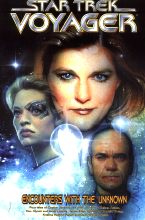 Written by Nathan Archer; Janine Ellen Young & Doselle Young; Dan Abnett &
Andy Lanning; Kristine Kathryn Rusch & Dean Wesley Smith. Pencils by Jeffrey
Moy, David Roach, Robert Teranishi. Inks by W.C. Carani, David Roach, Claude
St. Aubin.
Written by Nathan Archer; Janine Ellen Young & Doselle Young; Dan Abnett &
Andy Lanning; Kristine Kathryn Rusch & Dean Wesley Smith. Pencils by Jeffrey
Moy, David Roach, Robert Teranishi. Inks by W.C. Carani, David Roach, Claude
St. Aubin.
Colours/letters: various. Editor: Jeff Mariotte.
Reprinting: Star Trek: Voyager - False Colors, Star Trek: Voyager - Avalon Rising, Star Trek: Voyager - Elite Force, Star Trek: Voyager - Planet Killer #1-3 (2000-2001) - with covers
Rating: * * * * 1/2 (out of 5)
Number of readings: 3
Published by Wildstorm / DC Comics
Wildstorm's approach, when it became the umpteenth comics company to
acquire the rights to the various Star Trek series, was to forgo
monthly series, and instead offer up various one-shots and mini-series. This
TPB collects, I believe, the whole of Wildstorm's Star Trek: Voyager stories
(the Voyager characters had previously seen comicbook life in a Marvel Comics
series).
An advantage to the format -- most being forty-plus page stories -- is that it
allows for a smoother transition from an hour long TV series into comics than
does a 22 page comic. Most of these stories could comfortably make TV episodes
-- plot-driven episodes, that is. What is nnoticeably lacking is much human
drama (though there is some) or character exploration. Those hoping for, say, some portrayal of the
romantic relationship between Tom Paris and B'elanna Torres will be gravely
disappointed. In fact, many of the characters barely appear -- Neelix has
maybe a couple of lines in the whole collection; Torres doesn't fare much
better; Kes doesn't appear at all (since all stories take place after she was written out of
the show).
Given that these stories were mostly written after the series came
to an end (but set within the time frame of the show), one would think the
writers would've actually had greater latitude to explore the personalities, since they
wouldn't have to worry about a subsequent TV episode contradicting them.
Still, as plot-driven stories, they're mostly decent enough. Though the
title -- "Encounters with the Unknown" -- is an exaggeration as some of
the threats turn out to be familiar.
The best, surprisingly for me, is "Avalon Rising", writen by Janine &
Doselle Young. Surprising because most of the Voyager characters barely appear
in a story in which the Doctor is alone on a medieval-like planet and fans a
fire of chivalry in a disillusioned squire looking for a cause to believe in -- the Doctor's tales of the Voyager crew taking on aspects of knights errant.
It's precisely the kind of, potentially, overly cloying story the series would
do from time to time...but it works surprisingly well. Not the least because
the Doctor, despite being an artificial being, was arguably the most quirky
and human of the characters. The story is also well illustrated by Roach in a
realist, nicely shadowed manner.
"False Colors" (written by Nathan Archer) involves the ship being trapped
in a space ship graveyard and encountering some strangely atypical Borg. It's
fast-paced with some nice twists and turns to the story. And there is some character stuff involving Seven of Nine, and the other characters worried about her trustworthiness in the situation given she is ex-Borg. It's
drawn by Moy in a clean, efficient style, though his is the most comicbooky of
the artists in this collection, and therefore, perhaps the least impressive.
But he's the only one to work on two stories. And by least impressive, I'm thinking in terms of the surprisingly high artistic level throughout...because his work is still very good.
Dan Abnett & Andy Lanning's "Elite Force" is also drawn by Moy and the plot echoes aspects of "False Colors" as well as bearing a passing similarity to an actual
Voyager TV episode, in that the crew must battle both Borg, and another alien
menace, forcing them to tentatively ally with the former. It's also inspired
by a video game, and with its emphasis on the characters running through
corridors, shooting it out with aliens and Borg, it kind of shows. And because
the focus is on a previously unseen SWAT-like team aboard Voyager, the focal
character isn't a series' regular. Though maybe because of that, there's
better exploration of that character. But wouldn't it have made more sense to
have given that part to one of the regulars? Still, Voyager regulars like 7-of-9, Tuvok and Janeway have their moments. in the end, it's a fast-paced,
suspenseful, action-adventure -- even if it does evoke "Aliens" as much as Star Trek. And, as noted, there's actually some decent character development. Although, re-presented in this collection, the second and third pages are improperly reprinted -- they are supposed to form a two-page spread. And given that's when we are being introduced to characters new to the story, it can be confusing (figuring out the names) -- likewise, a couple of other scenes had dialogue balloons pointing at the wring people!
The longest story at some 66 pages, the mini-series "Planet Killer", is
also the weakest. There's no characterization to speak of, and the thin plot
isn't developed enough to compensate. The story revists the idea from the
original Star Trek series of a giant doomsday machine that destroys whole
planets, and the story follows the same progression of the characters coming
on a devastated system, rescuing a survivor, engaging the machine, etc. Seven
pages -- seven! -- are devoted simply to retelling the Classic Trek episode,
yet conspicuously they leave out any reference to the character conflicts that
made the episode so memorable. Presumably they didn't want to remind the
reader of what's missing from this story! Just to add a note of freshness, the
characters must try a different method to destroy the thing -- but it's a
method that kind of comes out of nowhere. I don't know if writers Rusch and
Smith intended to insult the readers with this thin, slapdash story...but they
certainly succeeded. The art by Teranishi is in many ways the most impressive,
capturing the likenesses of the actors best of all the artists here, without sacrificing mood or
atmosphere -- though the talking head nature of the story means it's unclear if he'd be as good at depicting action and movement as the other artists.
But even "Planet Killer" is okay (partly thanks to the moody art) as long as you keep your expectations low (and read as part of this collection, as opposed to for itself alone). Though I still marvel at the writers' chutzpah turning in such a derivative script.
Overall, the art is among the most consistently good I've seen on any Trek
comic, in that all artists capture -- to varying degrees -- the likenesses of the various actors. And
the brooding colours, though mayhap overly oppressive at times, inject a lot
of atmosphere. All artists affect a realist style and all are quite good at
drawing the accompanying corridors, ships, and outer space debris -- though
Teranishi's planet killer is a little hard to get a grip on, visually.
Admittedly, given the lack of deeper emotion, it's not clear how well the
artists would perform were they required to capture the actors while also
expressing complex emotions. (An aside: the one issue I have of Marvel's Voyager comic -- #9, drawn by Terry Pallott -- was also unusually good for a Trek comic at capturing the actors' likenesses, and marrying it with mood and shadow -- though Pallott was definitely better at the talking head scenes than the action/fighting scenes. But maybe there's just something about the Voyager cast that made them easier to evoke in pencil and ink).
A trick that seems hardest to master, even when an artist can duplicate an
actor's likeness, is capturing (in women, for instance) a genuine beauty or sensuality.
In the TV series, it was freely admitted Seven of Nine (played by Jeri Ryan in
a skin tight costume) was added for sex appeal...yet that isn't really evoked
here (as drawn, she even seems less curvaceous than Ryan did). I also had a bit of a
crush on Roxann Dawson (Torres)...but that's neither here nor there. It's Teranishi who most captures the actresses' likenesses.
I wasn't a huge fan of Voyager, so, of course, my review must be viewed in
that light. I sometimes like media comics more the less passionate I am about the
source material. The stories are brisk (even "Planet Killer" breezes along), atmospheric
adventures, even as the lack of too much deep characterization -- and the short-changing of
significant characters, like Torres -- keeps it fairly superficial. And none of the stories manage to seem like anything more
ambitious than modest episodes of the series. But as a book on the shelf, to
be delved into occasionally when looking for a bit of sci-fi escapism (Star Trek or otherwise), nicely
drawn and set against the vastness of deep space, it's quite enjoyable.
Indeed, this may well be one of my favourite Star Trek TPB collections -- of any Star Trek series.
Original cover price: $32.95 CDN./ $19.95 USA.
Star Trek: Waypoint (2017) 144 pages
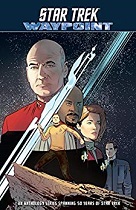 Writers/artists: various
Reprinting: the six issue mini-series (2016)
Number of readings: 1
Reviewed: Feb 2020
Published by IDW
Waypoint is both an odd, atypical Trek comic -- and an obvious, inevitable one. Given that Star Trek encompassed five different TV series by the time this was published (more since!), Waypoint was an anthology mini-series mixing short, ten-page-or-so tales -- about two stories per issue -- set in the different series and at different times. (This collects the original mini-series, but IDW has subsequently released a couple of Star Trek: Waypoint Specials.)
So the opening story is a TNG story -- but seeming set long after the movies, with Geordi now captain of the Enterprise and Data serving as most of the bridge crew (because he's an android, he has duplicated himself). I don't know if this vision of the TNG crew was presented in another context (a comic or a novel) but as such it's both intriguing for fans...even as it's not really an archetypal TNG story. However other TNG tales in this collection are set in the time-line of the TV series.
While the Classic Trek tales run the gamut from stories set during the series, to one done as a joke/homage to the Gold Key era of comic books (complete with lettering evoking the old Gold Key font) to a particularly esoteric premise: a tale set during what is referred to as Phase II. This was a proposed Star Trek series in the 1970s that never happened, but evolved into Star Trek: The Motion Picture and, to some extent, character dynamics were cannibalized for Star Trek: TNG. To hardcore fans it might be a neat glimpse of this "lost" era of Trek -- but more casual fans might wonder why it seems like the original series, with Kirk, McCoy, etc., but a Vulcan named Xon in lieu of Spock, and with Decker and (if only in the background) Ilya among the crew.
(Curiously enough, I don't think any of the tales are set during -- or use costume designs -- from the era of the movies).
The tales also veer about in tone and intent. Some function as, more or less, adventure stories, while others are low-key, human drama type stories; some are serious, some tongue-in-cheek. Some are attempting to evoke the different series, some push at the edges, focusing on original characters only tangentially connected to the main characters (or giving life and background to a minor character that maybe briefly appeared in a single episode).
As such -- it's a mixed bag.
And the creators -- or the editors -- clearly have biases and preferences. While there are a few Classic Trek (Kirk, et al) and TNG (Picard, et al), there are fewer DS9 tales, and I think only a couple of Voyager tales (one of which is told as a child imagining an adventure of the crew, so the art is deliberately child-like and the plot goofy, and the characters not exactly consistent with their TV versions). While there's only one Star Trek: Enterprise story -- and though it ties into the narrative of the series (specifically the Time War arc from the first season) it's mostly a flashback to Captain Archer's childhood. So the only character from that series to actually appear is Archer, and even he's not his TV version self. (It's too bad there weren't more Enterprise stories, given that as a far as I know the ST: Enterprise crew has never really been used in comics).
As I say: a mixed bag. Particularly if you were hoping for mostly stories that felt like "lost" episodes. But equally, the variety is what keeps it lively, and the page length is maybe ideal for this kind of experiment: short enough that you can breeze through the less interesting tales, long enough that they can have plots to develop (rather than just be vignettes). And, of course, a lot of the Trek TV series themselves often did episodes that were more human drama, or quirky, rather than straight sci-fi adventure anyway. Because of its scope -- including tales focusing on more-or-less original characters rather than the various series' stars -- Waypoint can be seen as expanding upon the idea of a Star Trek "Universe." In a way, it anticipated the short film-like Short Treks episodes that have been released in conjunction with the Star Trek: Discovery TV series.
So I'm kind of on the fence about this. It's not quite what I was looking for, but taken for what it is, more stories are agreeable reads than aren't.
Back to