The
Masked Bookwyrm's Graphic Novel (& TPB) Reviews
The
Masked Bookwyrm's Graphic Novel (& TPB) Reviews
The Legion of Super-Heroes (Page 5)
for a complete alphabetical list of ALL reviews start here
A - B - C - D - E - F - G - H - I - J - K - L - M - N - O - P - Q - R - S - T - U - V - W - X - Y - Z
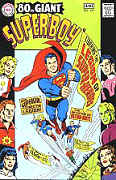
Superboy #147 - Replica Edition 2003 (SC GN) 80 pages
 Written
by Jerry Siegel, and Robert Bernstein, E. Nelson Bridwell. Pencils by Curt
Swan, Pete Constanza, Jim Mooney, George Papp. Inks by various.
Written
by Jerry Siegel, and Robert Bernstein, E. Nelson Bridwell. Pencils by Curt
Swan, Pete Constanza, Jim Mooney, George Papp. Inks by various.
Colours: unbilled. Letters: Milt Snappin.
Reprinting: the complete original version of Superboy #147 (1st series) -- which included an original tale, The Origin of the Legion, plus selected stories from Superboy #98 -- The Boy With the Ultra Powers -- Adventure Comics #293, 290 -- The Legion of Super-Traitors, The Secret of the Seventh Super-Hero -- Action Comics #276 - Supergirl's Three Super-Girl Friends - Superman #197 - The Legion of Super-Villains -- 1961, 1962, 1968 (most of those comics also featured other, back up stories)
Additional notes: afterward detailing some of the Legion's (pre-Crisis) history.
Rating: * * * * (out of 5)
Number of readings: 1
Over the last few years, DC comics has printed occasional one-shots -- somewhere inbetween trade paperbacks and regular comics, format-wise -- reprinting collections of older stories. Often they're labelled as "lost" annuals, harkening back to the days when DC's annuals tended to be collections of reprints. Other times they're literally just reprints of older comics that were such collections -- a reprint of reprints. Falling into the latter category is this replica reprint of Superboy #147, 1968, which featured stories from the early 1960s involving Superboy and the far future Legion of Super-Heroes. Although, I'm not sure if "replica" is entirely the correct word -- the story contents are reproduced directly from the original Superboy 80-page giant, it's true, but the ads are new.
Of course for modern readers, this harkening back to Silver Age lore -- and pre-Crisis on Infinite Earths continuity -- might be a tad perplexing, as the characters and situations don't quite match DC's current reality. This Superboy, after all, is Superman as a teenager, and Supergirl is his biological cousin.
The result is highly enjoyable. Since these stories, I'm assuming, stem from a period before the Legion had their own series, and were perennial guest stars, the focus is more on Superboy (and Supergirl, in one story), often in their regular, small town earth milieus. Although there isn't as much far future space action as one might like -- save one story, written especially for this collection (in 1968, that is), that focuses entirely on the Legion in their future world -- it's compensated for by allowing a modern reader a glimpse into long ago Superboy continuity, with appearances by the supporting cast of his parents, buddy Pete Ross, and perpetually suspicious Lana Lang. Best of all, three of the six stories are drawn by the peerless Curt Swan. The low-key realism of Swan's work, the simple humanity of his faces, the clear story-telling, is all very much a plus. The other artists -- Pete Constanza, George Papp, and Jim Mooney -- do perfectly respectable work, but it's Swan who really makes it sing (particularly when inked by the tight, sympathetic lines of George Klein, as he is on two of the stories). Swan is one of those artists who I probably didn't give much thought to as a kid, but I find I've become a real fan of as an adult. Curiously, though, Swan's young Clark Kent, when out-fitted in his trademark red sweater, puts me in mind of Rupert Bear!
The stories are, of course, a mix of elements. Some modern readers will see them as corny, as childish, as silly -- which they are. Sometimes quite intentionally. But there's also an eye to plotting that, frankly, is sorely missed in modern comics. In one story a juvenile delinquent stumbles upon Smallville -- a delinquent who looks exactly like Clark Kent! Meanwhile, Legionnaire Sun-Boy has arrived in the 20th Century to recruit Superboy's help in a mysterious scheme...and with decidedly nefarious motives. The plot threads (plus a few others) don't tie together as satisfying as one might hope, but it's still an interesting read, played out in fourteen pages. Cynic that I am, I can't help thinking a similar story today would be a twelve issue crossover epic, written by a half-dozen different writers...and it wouldn't actually be any better, or more sophisticated.
Sure, there's a goofiness at work, with cape-wearing super animals (that think!)...but there's also a charm to stories played out against a more gentle, four colour world that barely knows what serial killers or international terrorists are, let alone as something teenage superheroes have to deal with. These stories can get an entire tale out of a mysterious arrival trying to ferret out Superboy's secret identity -- with nary a blood stain or body blow in sight -- and still be interesting (of course, there are plenty of action-fight stories too!) There's a kind of innocence, yet Rockwellian plausibility, to the portrayal of Superboy and his friends. Ironically, Superboy is better portrayed -- better realized as a person -- than is Superman, who appears in the final story. And for all the goofiness, there's an inherent inner logic that makes thinking animals, time travel and the like almost reasonable...at least within this reality. Modern writers have tried to tackle the notion of superhero "reality", either through gritty revisionism, or by gently mocking old conventions, but, in a sense, these early writers had already created their own, self-consistent reality -- a reality where super heroes form clubs, rather than teams, and where a (Super)man's word is never broken once given, even when given to a villain. And there's nary a shred of irony in sight.
For pre-Crisis continuity buffs, the stories collected here feature a number of first appearances, of everyone from Brainiac 5 to Comet, the super horse, who in a bit of brain twisting continuity, appears in a story before he had actually been introduced into Supergirl stories! (an editor's note advises the reader he will soon be appearing later). And Ultra-Boy's abilities, here, seem limited only to his vision. There are other, interesting ideas, like that Superboy's heat vision was, at the time, treated as an extension of his x-ray vision...and he couldn't use it on lead. There are also technical gaffs, like in one story referring to the Legion's future reality as being the 21st Century...rather than the 30th!
Why DC has remained rooted in the 1960s (and earlier) with these reprints is a matter for debate. Is it just because they are so genuinely trying to evoke the annuals and 80-page giants of long ago? Or, more cynically, are they being released as promos for DC's much, much more pricey hardcover Archive Editions which reprint 1960s material (ads for which occupy most of the free space in this comic). Or, as I've often suspected, is there an editorial regime at DC that is hostile to promoting Bronze Age stories? Whatever the reason, some collections from later, like the 1970s, might be nice.
Maybe you have to be really young (taking everything at
face value) or much older (to appreciate the low-key charm) than the average
comic reader, but this collection is quite an enjoyable read, featuring
a better-than-average selection of stories. Though if DC keeps doing straight
facsimile reprints, they might alienate a few comic shop owners -- after
all, having this version on the shelf will probably diminish the collectible
value of the real Superboy #147.
 Reprinting:
Superboy
(1st series) #158, and one story each from Adventure Comics #355,
Action
Comics #392, and ???
Reprinting:
Superboy
(1st series) #158, and one story each from Adventure Comics #355,
Action
Comics #392, and ???
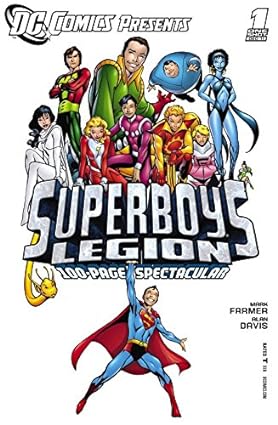 Originally a 2 issue, prestige mini-series pub. 2001; this was also re-issued as a single issue comic in 2011: DC Comics Presents Superboy's Legion: 100 Page Spectacular
Superman and The Legion of Super-Heroes 2008 (HC & SC TPB) 144 pgs.
 Written by Geoff Johns. Pencils by Gary Frank. Inks by Jon Sibal.
Colours: Dave McCaig. Letters: Rob Leigh. Editors: Matt Idelson, Nachie Castro.
Reprinting: Action Comics #858-863 (2007-2008)
Rating: * * * * 1/2 (out of 5)
Number of readings: 1
One could argue the problem with modern comics is not their obsessive, fetishtic continuity, where every story ties into ever other...nor is it that they completely disregard continuity, changing things willy nilly as some new creative team (or editorial regime) comes along. No, the problem is: they kind of need to be one thing or the other.
I mean, in this story arc, why does Perry White chastise Clark Kent for having no friends other than Jimmy? Isn't Perry his friend? Isn't Clark married to Lois Lane?
Which brings us to Superman and the Legion of Super-Heroes -- how or why or when or if this relates to DC Comics' continuity...I don't know. I mean, obviously it does. I guess. But it seems to be ignoring a lot of recent mythology and events as it deliberately harkens all the way back to pre-Crisis continuity. That was back when Superman started out as Superboy and he would frequently team up with teen heroes from the 30th Century for time/space spanning adventures. That was all erased by the Crisis on Infinite Earths and the Legion of Super-Heroes had undergone more than one reboot over the years, and even as this story arc was running in Action Comics...there was a monthly Legion comic featuring a somewhat different take on the team.
But if you've long since given up trying to understand DC's incoherent continuity, this can be a lot of fun. Particularly for older readers...like myself.
The story has Superman being contacted by Brainiac 5, one of the Legion of Super Heroes he used to hang out with as a teen but hasn't seen in years (and the flashbacks are deliberately vague as to whether he was supposed to be active as "Superboy" at that time or not). Seems there's trouble in the 30th Century and they need Superman's help. But when Superman arrives in the future, he finds it's worse than he could imagine. Earth has become a xenophobic police state and though Superman hooks up with a few fugitive Legionnaires, Brainiac 5 himself has vanished, and he was the only one with a plan, or knew why he had summoned Superman. Too make matters worse, a team of super powered beings, calling themselves the Justice League, have misappropriated Superman's own legend to their ends, fuelling the xenophobic philosophy by claiming earth's greatest champion (Supes) was an earthmen.
And the resulting six issue arc works a lot better than it really has any right too.
After a strong opening issue, and a great climactic revelation in that issue, the story falters a bit, as the twists and revelations become a bit fewer, with scenes where we, the reader, are told things, then the information gets repeated later as if writer Geoff Johns forgot. There are a few plot holes and logic lapses. And despite the potentially provocative themes of prejudice and persecution, the story never really seems to act as a profound examination of intollerance. The villains we learn early were all rejected applicants for Legion membership...which seems to be their sole motivation. Johns could be intending it as a comment on the trivial roots of prejudice, but it just seems kind of goofy. Further adding to the problem is the villains know they've lied about Superman's origins -- it might've been more effective if they believed in their own propaganda.
There's a certain irony in Johns tackling this theme, as I'd read some on-line reviewers who've criticized other works by Johns as Xenophobic (and I mentioned some qualms in a Hawkman story). In fact, the way the origin caption for Superman describes him as fighting for truth, justice and "the American way" is a curious contradiction in a story that criticizes such parochial jingoism. Another problem I've had with some of Johns' other work is that he seems to have an unhealthy obsession with violence and sadism. When there's a scene revealing one of the villains has a surgical fetish and doesn't use anesthesia -- well, I almost chuckled out loud, thinking, "Geoff, Geoff, Geoff."
In fact, violence is a problem with a lot of modern comics writers (like Johns, Alan Moore, Grant Morrison, etc.) who clearly feel a nostalgia for the comics of their childhood...but can't resist upping the violence and brutality. Though not as bad as some stories, there are certainly aspects here that seem inappropriate for both Superman and the Legion both, and rather contradictory. At one point a character specifically states the Legion doesn't kill...even as some of the visuals would seem to suggest the opposite (in one scene freezing two guys into popsicles!)
And of course, the notion that Superman's legend is so much at the core of the turmoil is also awkward. In recent years, there has been a real attempt at DC to almost deify Superman in a way that just seems...creepy (and I suppose it dates back to Elliott S! Maggin). In the original Legion stories we knew Superman was famous in the future, and the Legion had been inspired by him...but after that, it was barely even alluded to. Here, the misuse of his legend can reshape an entire civilization, and the Legionnaires frame their actions by saying: "What would Superman do?" as if referencing a holy scripture -- it makes them seem more like a cult than a team.
Still, if the story arc fails to quite live up to the potential of the deeper themes inherent in the premise, then as a swashbuckling adventure, it works quite well. Johns throws in a lot of running about and cliff hangers with an almost corny glee that's enjoyable. Despite the grim and gritty...there's also a lot of fun and witty quips as if Johns is having a ball and wants us to, as well, dragging out all the old "toys", including the misfit Legion of Substitute Heroes. Super hero stories set in Dystopian futures can often be quite effective and this is no exception.
Above all...it is just fun to see the old Legion back at play. Or at least a reasonable facsimile (after all, these are supposed to be slightly older, slightly jaded versions of them). As much as I was really enjoying Jim Shooter's run on the (then-)recent Legion comic (collected as Enemy Rising and Enemy Manifest -- both reviewed elsewhere in the LSH section), there is a nostalgic rush to seeing the older characterizations (Brainiac 5, though a little arrogant, is more affable) and Johns' choice of characters to focus on -- the Legion having too many members to use them all equally -- maybe reflects a decision to further emphasize the pre-Crisis differences, using characters like Wildfire and Dawnstar who I'm not sure have been used much in recent years.
A big appeal here is the art by Gary Frank. Frank has a detailed, clean, realist style that is a nice contrast to a lot of modern comics artists who go for the more stylized, cartoony, or manga influence. It's ideally suited to this teaming of Superman and the Legion, since both are often identified with Curt Swan who also had a clean, realist style. I could well imagine a different art style negatively impacting on the effectiveness of the story. Frank has a nice eye for composition and story telling -- the second-to-last page of the first chapter is a perfect example. Although there is a harshness to his line work that means his women aren't that always that attractive -- despite his emphasis on cleavage (and maybe his men aren't, either, but that's for another to judge). I'd also quibble with his decision to redesign the Legion's costumes. If this is supposed to be a grand and glorious return of the "classic" Legion, the nostalgic angle would be better evoked by sticking truer to the classic visuals.
I began this review commenting on how comics are a weird battle between continuity and those who constantly want to reinvent things. I mentioned that the themes of prejudice and xenophobia aren't as well explored as they could be. But with a lot of comics, you're never sure if the "issues" are meant to be taken literally...or as a metaphor for the comics themselves. The very notion of a story where Superman finds his legend being misused by those who wish to imagine him as an earthmen could be seen as a jibe at the mid-1980s revamp of Superman where there was a deliberate attempt to shift the nature of Superman from being an alien on earth (as the previous generation of stories had seemed to be) to an American who just happened to have alien DNA.
Anyway, despite my qualms here and there, I really enjoyed this arc. Part of the appeal is that it is an epic arc that's relatively self-contained -- a grand adventure. I say relatively, because there are passing references to a brief appearance from some Legionnaires a few issues earlier and, more glaringly, because a couple of times the characters make references suspecting there's another force manipulating things. But for the most part, you can pick it up, read it cover to cover, and put it down again, satisfied. Yes, Frank's art definitely goes a long way to shoring up the weaknesses in the plot, and it probably helps to have a sneaking affection for the "classic" Legion of Super-Heroes -- but ultimately, pretty enjoyable.
This is a review of the story as it was serialized in the comics.
is reviewed here in my Superman section.
BACK (to Legion reviews page four)
Back to complete list of all GNs/TPB reviews
OR
Back to