The
Masked Bookwyrm's Graphic Novel (& TPB) Reviews
The
Masked Bookwyrm's Graphic Novel (& TPB) Reviews
The Legion of Super-Heroes (Page 4)
for a complete alphabetical list of ALL reviews start here
A - B - C - D - E - F - G - H - I - J - K - L - M - N - O - P - Q - R - S - T - U - V - W - X - Y - Z
The Legion of Super-Heroes: 1050 Years in the Future 2008 (TPB) 218 pages
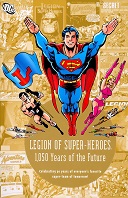 Written & illustrated by various.
Reprinting: stories from Adventure Comics #247, 304, 312, 354-355, Superboy (and the Legion of Super-Heroes) #212, Legion of Super-Heroes (1st series) #300, Legion of Super-Heroes #0, Legends of the DC Universe 80-Page Giant #2, The Legion #3 (1958-2002)
Additional notes: intro/commentaries by Paul Levitz, Jim Shooter; various character profiles, pin-ups, and HQ blue-prints reprinted from various issues and specials.
Rating: * * * * (out of 5)
Number of readings: 1
Reviewed: Oct 2016
This basically falls into the "best of..."/"Greatest Stories Ever Told" category of TPB collection, assembling sample stories from throughout the Legion's history.
I tend to have affection for the Legion, even if I was never a rigorous collector, in part because the property maintains a fairly unique place in comics with its mix of super-heroes and a slightly Utopic sci-fi. Plus throw in the "teen" angle of young heroes (underplayed or overplayed as the stories require) and it has a unique flavour.
All of which may go some way to explain why even vintage, juvenile Legion tales can still be fun for a jaded older reader like me in ways that old Batman stories, for instance, might not be as much.
The collection begins, appropriately, with the very first Legion appearance when they are introduced in a Superboy adventure ("when Superman was a boy!") as a "club" from the far future. This is followed by "The Stolen Super Powers!", which according to some reports is widely regard as the first "great" Legion tale, mixing the to-be-expected corny simplicity of its era (a certain repetition and loose logic) while, nonetheless, generating some mystery-suspense and poignancy. Next up is "The Super-Sacrifice of the Legionnaires!" wherein the Legionnaires try to find a way to revive Lightning Lad (who had died a few issues before). It's best not to question the Legionnaires deciding that the only way to revive Lightning Lad is by sacrificing one of themselves (a "twist" revealed on the story's cover so I'm not giving it away, though it is a bit of a spoiler) but with no one pointing out the illogic of reviving one Legionnaire by sacrificing another!
Then comes the two-part "classic" Legion tale wherein an adult Superman visits with grown up Legionnaires. It's partly remembered for the pairing of what is widely seen as the first great LSH creative team -- writer Jim Shooter and artist Curt Swan -- and for the nifty idea of seeing the teen heroes as adults at a time when DC often did "imaginary stories." Though this isn't treated as imaginary and, indeed, Shooter (and others) went to the effort of incorporating things predicted in this tale into later stories (certain Legionnaires are shown here who wouldn't be introduced into the regular team until later). Admittedly, there isn't too much here that couldn't have been told in a regular LSH story -- the main thing you notice about the adult Legionnaires is the alarming number of receding hairlines! But it's an enjoyable romp involving both a mysterious saboteur from within and a battle with the Legion of Super-Villains!
(Part of the fun of these collections is the continuity evolution, like in the very first tale having Cosmic Boy's power manifest as beams from his eyes!)
The 1970s is represented by a Jim Shooter/Mike Grell tale of the Legion battling would be usurpers with similar powers ("Last Fight for a Legionnaire"). I wouldn't say there's anything special about it (I could name more memorable tales from that era) but it's interesting as a reflection of how sci-fi tales reflect their eras as much as any prediction of the future. So the conservative, clean-cut look of the 1960s LSH has now been replaced by bellbottom trousers, bare mid-rifts, and guys with longish hair and sideburns. A reason it might have been chosen is just to give a glimpse of evolving continuity. The early LSH was never perhaps that concerned with on going story threads, but these early tales do make a few references to each other, so that it creates a certain sense of a continuum. (Perhaps the oddest thing about this tale is the decision to include a single page that was clearly done later -- either for this TPB or a previous reprint as a "director's cut" of the story).
Then we come to the semi-classic epic tale from LSH #300 ("The Future is Forever!") which is broken into various small chapters, drawn by a variety of popular Legion artists, in a tale that incorporates almost any one who was a Legionnaire and gives glimpses of alternate timelines of the team (some happy, some poignant). I can't fault it as a genuinely memorable tale nor as an ideal choice for a collection like this -- but I do sometimes quibble about TPBs reprinting long single-issue tales. It wouldn't be that hard to pick it up on its own from a back issues dealer. Better to focus on shorter tales (so even if you have it in your collection it only represents a portion of this book) or multi-issue tales (which might be harder to collect years later).
Things become a little more problematic once we get into the re-booted tales (following the Crisis on Infinite Earths wherein DC re-started it's entire line).
The first tale is still good, a retelling of the Legion's origin from the #0 issue (which otherwise hasn't been told in any of the stories reprinted here) by Mark Waid & Tom McCraw and Stuart Immonen. They stick mostly with the established origin (in a later re-boot Waid re-imagined it entirely) while stretching it out, making it more sophisticated for modern readers -- there's still some action, but it's more focused on the characters as a light drama.
Unfortunately the next tale, though beautifully illustrated by Immonen inked by George Freeman (two Canadians!) seems to be struggling to justify its concept. The idea is to show how different people (and races) from the future have remembered (or mis-remembered) Superman's origin. The problem is: writer Paul Levitz hasn't really come up with anything that interesting with the idea (other than, say, the inhabitants of a planet where people are generally born as twins assuming two Kryptonian babies were sent to earth).
And then we come to the final story, "Legion World." Clearly the Legion is pulling itself back together after some recent traumatic adventures. The result just feels like a place holder, referencing events that went before and setting things up for subsequent adventure. The dialogue's fine, it's well illustrated -- but it feels kind of pointless in isolation.
As with any "best of" collection, one can point to "great" stories that should have been included. Indeed, I might have made a case for including the mid-1970s treasury-sized Legion adventure -- despite my objection to long-form tales. But I don't think the treasury tale has ever been reprinted and would be hard to trackdown at comics shops. And it's a pretty decent example of an "epic" tale, with Superboy discovering someone has messed with the timeline and the Legion's future isn't what it should be. (Actually, despite my issue with reprinting long stories, a number of my favourite Legion tales are over-sized efforts, including the LSH #300 reprinted here, plus a few of the 1980s annuals. Maybe DC should put out a TPB titled "Legion Giants" reprinting nothing but long tales. Equally, the Legion was a series often given to short back up tales focusing on one or two Legionnaires and a collection of Legion shorts throughout the years might be neat).
But ultimately this is a nice Legion aggregation to have on the shelf.
The Legion of Super-Heroes: Teenage Revolution (2005) 180 pgs.
 Written
by Mark Waid (co-plotter Barry Kitson). Pencils by Barry Kitson, with Leonard
Kirk and Dave Gibbons, Scott Iwahashi. Inks by Art Thibert, Barry Kitson,
Mick Gray, Drew Geraci.
Written
by Mark Waid (co-plotter Barry Kitson). Pencils by Barry Kitson, with Leonard
Kirk and Dave Gibbons, Scott Iwahashi. Inks by Art Thibert, Barry Kitson,
Mick Gray, Drew Geraci.
Colours: Chris Blythe, with Dave McCaig, Paul Mounts. Letters: Phil
Balsman, with Jared K. Fletcher, Pat Brosseau. Editors: Stephen Wacker,
Harvey Richards.
Reprinting: The Legion of Super-Heroes #1-6 (2005- series)
Rating: * * * * (out of 5)
Number of readings: 3
I've added a few extra comments in this review. I always "liked" this collection but after a recent re-reading I think I enjoyed aspects more than I had. So I've kept the old review, but added a few extra modfifying comments throughout.
As I've begun many-a review, I'll just point out that
back in the mid-1980s, DC's editorial regime became convinced their "universe"
had become too confusing. So they restarted the DC Universe into a cleaner,
simpler narrative for the fans to follow. And we've been paying for it
ever since. You see, once one editorial regime says, "Hmmm, I don't like
what was done by a previous regime, I think I'll simply wipe it out of
existence and start from scratch", it means the next editorial regime,
and the next, and the next, can do the same. And the result is it's really
hard to know what is, and isn't, continuity any more.
Which brings us to the latest incarnation of the venerable
Legion of Super-Heroes (well, latest circa 2005; they've been rebotted a time or two since -- which is my point!).
The concept was first introduced in Superboy stories
in the 1960s (back when Superboy was Superman
as a youth), and the LSH was a club of teenage super heroes from the 31st
Century. They became increasingly popular (eventually taking over Superboy's
own comic). But the LSH has undergone quite of a number of overhauls, reboots,
and reimaginings.
Mark Waid and Barry Kitson once more start from scratch, reviving the characters...while seeming ignoring previous series. So the familiar characters are here, but altered; some cosmetically (Star Boy is now black), some in their nature (Triplicate Girl is given a different origin), some in personality (Brainiac 5 was often a little arrogant...here, he's insufferably -- and comedically -- arrogant). The downside to all this revamping and revising is it makes it hard to know how much we're supposed to bring to the table in our understanding of the characters. But, in theory, it should make it easier for a novice reader to jump into the story.
The 31st Century is still a hi-tech reality with a federation of planets, but whereas originally the Legion was a semi-official branch of law enforcement, here, the creators borrow the idea of the 1960s hippy-era by having it be that the Legion is actually a social movement of rebellious teenagers, with an entire commune of teens camped outside their HQ like a future day Woodstock. As such, there is friction between the LSH and the authorities...friction that occasionally spills over into conflict.
Although one might quibble a bit (surely the fun of the LSH was the idea of a pleasant, optimistic, Star Trek-like future), it serves to play up an angle that previous versions hadn't -- a generation gap. As well, the LSH had the largest active membership of any super hero team in the history of comics. So Waid and Kitson extrapolate that to the point where the Legionnaires number in the thousands...symbolically. The actual "team" is limited in number, but any teen can wear the emblem and call himself a legionnaire.
On the strong side, the comic is full of amusing quips and witty lines, as well as some heartfelt characterization. Waid and Kitson are clearly having a lot of fun taking traditional ideas of the Legion and seeing what they can come up with that would be a little different (Colossal Boy is really a giant who can shrink to human height) and playing around with the personalities -- the fractious relationship between Brainiac 5 and team leader Cosmic Boy seems modelled on the Avon-Blake rivalry of the old British sci-fi series, Blake's 7. The new take on the Invisible Kid is perhaps the most interesting -- the youngest of the team, his power seems a reflection of a shy personality, yet with a genius level intelligence even Brainiac 5 respects.
The first few issues mix relatively stand alone tales -- more focused on character than action-adventure -- while also threading hints of a looming galactic threat (that becomes front and centre in the last two issues...but doesn't resolve, as it carries us into the next TPB collection). But if Waid's focus on the characters and the milieu sometimes seems like a man losing interest in the action-adventure of a traditional comic, he nonetheless can step up to the plate there as well. The fifth issue is a pretty effective, darkly tense tale where members of the team have their first direct encounter with the coming evil.
Waid hints at machinations both within, and without, the team, as we realize that, as with any "movement", different members envision different goals and agendas -- though Waid's depiction of the "adults" tends to be one note and simplistic.
If I were to have a criticism of Waid, it might be that he tries too hard -- that he can be almost too transparently clever. Sometime after Waid, comics veteran Jim Shooter began a run on the new series, and though both mix comedy and drama, Shooter let the characters be people...whereas with Waid there can almost be a little too much of a sense of the writer looming over the actions, tugging the strings, admiring his own cleverness. Or characters quipping like something out of sitcom, rather than humour arising from believable badinage. It isn't that the dialogue and quips aren't funny -- they are! It's just they can sometimes undercut the reality (even as other times, they completely arise from the moment and the scene, like a quip Invisible Kid makes when being chewed out by Cosmic Boy).
Kitson is a well regarded artist, with his straightforward, realist faces and figures. His art brings a definite sureness and confidence to the story -- though I would argue he doesn't maybe make the characters look like teens as oppossed to adults. And as much as I like Kitson, there can be a bit of a stiffness to his figures, a sameness to his faces. Leonard Kirk pinch hits an issue...and in some ways it was more dynamically illustrated. Still, Kitson is a fine artist and his contribution definitely enhances the telling.
Waid and Kitson have worked together before, and are seen as a hit combo.
But ironically, it's in their past work that some of the problems here are echoed. The two worked on JLA: Year One, a mini-series meant to re-tell the early days of the Justice League for the post-Crisis reality...and where Waid indulged in a kind of short hand storytelling, skipping over scenes, referring to them having occurred, but not depicting them (unlike a conventional, monthly comic where you kind of expect all relevant scenes to be depicted). Not only does Waid apply some of that style here, with references hinting at scenes -- whole adventures -- unchronicled...but it's even applied to the characterization and overall premise.
As mentioned, I believe this is meant to be starting from scratch. Yet the first issue begins with the Legion already established as if we've jumped into an on going series. At one point a character remarks on how Sun Boy is thinking of leaving the team...yet nowhere in the previous scenes with Sun Boy did we get any hint of that (or how that character would infer it anyway). Or one issue has Ultra Boy hitting on Triplicate Girl...an issue or two later it's implied he and Shadow Lass are an item. It reminds me a bit of series like Robert Kirkman's Invincible and Kurt Busiek's Astro City. Some modern comics writers seem less interested in building their realities, nuance by nuance, than in just leaping into a pre-fabricated reality where they don't have to worry about building a foundation.
It can feel a bit like you're missing a few issues! When Timber Wolf shows up part way through, clearly with a history with the team, it seems natural to old time readers...unless you think about the fact that he hadn't even been referenced previously in this series! For that matter, Lightning Lass and Saturn Girl, the two founding members of the team traditionally (along with Cosmic Boy) get referenced, but don't make a full appearance until #5.
It does feel a bit half developed at times.
In a way, the whole exercise seems almost more like one
of DC's Elseworlds projects -- meant to be a "new" take, but where resonance
occurs only because we are expected to be familiar with the original version. This also means that long time fans might be miffed at the ways Waid and Kitson have altered the characters -- Chameleon Boy (now genderless and known as simply Chameleon) becomes more guileless comic relief (for a character who I seem to recall as being almost as canny as Brainiac 5) and Princess Projectra is here a completely spoiled, well, princess.
WITH THAT SAID...I recently dug these issues out for a re-reading (a few years later) and there's no doubt the issues held my attention with the mix of humour, drama, action and characterization, served up by Kitson's solid pencils. Even the narrative choppiness I kind of dug more, seeing in it almost as though Waid was trying to present it as a mix of an "anthology" -- with each issue relatively self-contained, pushing certain characters to the fore, and with sometimes inspecific time gaps between issues -- with an on-going, unfolding saga whose plot moves to the front as the issues unfold. Most of the individual issues are quite good as self-contained, one-off tales (which isn't always the case with on-going comics where a lot of issues can feel pretty average).
The basic concept of the Legion as a social movement, though intriguing, is also a bit awkward. Though meant to have hippy-era resonance, there's not too much of a hippy vibe in their Hawkish philosophy. The series begins waxing nostalgic about the days when "history was made on the battlefield" and Waid tends to characterize a lot of the team as basically the same A-type, relishing-a-brawl sort of personality. There's a feeling Waid wants to borrow the iconography of the hippy movement...but utilizing it in service of a more neo-conservative agenda.
And for a series about rebelling against conformity, there's a certain conformity to it all, as Waid and Kitson reshape the Legion to suit the cliches of our time...such as by giving Cosmic Boy a dark-hue uniform instead of his traditional pink one (I mean, come on: how more radical can you get than an action hero dressed in pink?) And outfitting a number of characters in "cool" long coats and speaking in decidedly modern colloquialisms ("Dude!")
Overall, I enjoyed this. The art is solid and attractive, the writing witty and trying to be thoughtful. And as the sub-plot of the coming danger builds, it does succeed in generating effective tension and suspense. At the same time, that can be a downside to this collection, reviewed just as a collection in and of itself, as it leaves the greater story unfinished (until the collection Death of a Dream). And Waid's deliberately choppy storytelling (skipping scenes) hurts the flow of the narrative and our ability to become involved with the characters.
Still, re-reading it recently, I'll admit I'm moving it up a notch in my estimation.
This is a review of the story as it was originally serialized in the monthly comics.
\
NEXT (to Legion reviews page five)
BACK (to Legion reviews page three)
Back to complete list of all GNs/TPB reviews
OR
Back to