The
Masked Bookwyrm's Graphic Novel (& TPB) Reviews
The
Masked Bookwyrm's Graphic Novel (& TPB) Reviews
Fourth World Saga ~ Page Four
for a complete alphabetical list of ALL reviews start hereA - B - C - D - E - F - G - H - I - J - K - L - M - N - O - P - Q - R - S - T - U - V - W - X - Y - Z
The Fourth World Saga published by DC Comics
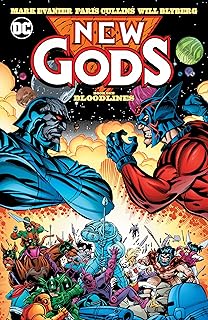 New Gods, Book One: Bloodlines (2021) 360 pages
Written by Mark Evanier, with Jim Starlin (co-plotter Paris Cullins). Pencils by Paris Cullins. Inks by Will Blyberg, with Bob Lewis, others.
Colours: Tom Ziuko, Julianna Ferriter, Gene D'Angelo. Letter: Bob Pinaha.
Reprinting: New Gods (2nd series) #1-14 (1989-1991)
Rating: * * * 1/2(out of 5)
Number of readings: 1
Review posted: June 2024
I'd been going through a phase of reading/re-reading early New Gods comics, from Kirby's various original Fourth World series, to the revivals by Conway/Newton and Englehart et al (for Mister Miracle), bringing us to this late 1980s iteration. This was at a confusing time for DC Comics as it followed the universal re-boot that was Crisis on Infinite Earths.
I believe this was the first major revival of the Fourth World characters since the 1970s -- save for Cosmic Odyssey and a Forever People mini-series (both of which get referenced here -- especially Cosmic Odyssey). Yet the characters and milieu are already in place and draw upon Kirby's original -- pre-Crisis -- series.
Fans had, I think, been a bit disappointed in the earlier Conway series, feeling it wasn't really Kirby-esque. This revival has as the chief writer Mark Evanier, a one-time Kirby assistant/associate. Although the true creative driver for the series is a bit unclear. Artist Paris Cullins is credited as co-plotter (and had drawn the Forever People revival mini-series). And Jim Starlin writes a few of the early issues -- Starlin who had written Cosmic Odyssey and whose classic Captain Marvel run at Marvel Comics was indebted to Kirby's Fourth World material. I read some suggestion Starlin had been intended to be the chief writer, so I'm not sure of the behind the scenes shuffling.
Anyway, on to the review:
It's uneven but not uninteresting and both Kirby-like and un-Kirby.
It starts out problematically. Partly because of following on the heels of Cosmic Odyssey and, indeed, the whole Fourth World stuff. Instead of getting an introductory few issues, it kind of assumes the readers knows the background (though as with any comic, you can pick up what's needed as it goes). But as was common with that whole pre-Crisis/post-Crisis thing, it cherry picks its own adherence to established canon.
So it draws a lot on Kirby's original, throwing in characters like Eva Donner and Harvey Lockman with little explanation, yet it ignores events in Kirby's own subsequent Hunger Dogs graphic novel. It tosses in Jezebelle, a character introduced in the Conway/Newton run -- only to simply kill her off a few panels later. Which feels a bit like a deliberate thumbing its nose at the Conway run; they could've just ignored her as part of the re-boot. But maybe that was part of the whole dark n gritty phase, signalling to the reader no one was safe -- after all, Starlin had killed off Bug in Cosmic Odyssey.
Speaking of Cosmic Odyssey, in that Starlin introduced the idea that the anti-Life formula (a recurring thing in the Fourth World stories) was a sentient being; yet here, despite referencing and following on from Cosmic Odyssey, we're back to it just being a formula that Darkseid is seeking. Except instead of being something he is looking to find and decipher, he already knows whose minds contain aspects of the formula and he just kidnaps individuals whenever he's running low. Or something.
Arguably one of the biggest, and somewhat problematic, shifts is that in earlier iterations (Kirby and Newton), Orion was a good guy with a dark streak, quick to throw himself into conflict. But in Comic Odyssey he was basically a thug, his violence appalling Superman. And here the whole theme is how Orion is basically a monster Highfather and the rest of New Genesis can barely control, even committing genocide.
Instead of Kirby's sense of operatic grandeur, the focus here is more on political machinations, with in-fighting among New Genesis' ruling council (and among the Apokolips crowd). Ironically, adding a ruling council might seem like a desire to democratize the heroes, since previously the planet seemed ruled by a benevolent autocrat, Highfather. Except it actually seems to be re-enforcing an anti-democracy theme since the reader's sympathy lies more with Highfather than the council!
And dare I make a point that Highfather's chief antagonist is drawn as a Black man. It might seem like an attempt to diversify the traditionally white New Genesis. Except he remains pretty much the only person of colour. And he is first introduced in a plot line involving New Genesis' antagonism to the Bugs, where he is basically the face of bigotry (and I've probably written before about the long history of sci-fi doing racism allegories where the bigot is non-white; an idea that was arguably an interesting reversal back when Star Trek did it in "The Galileo 7" but with its repetition in subsequent years has started to seem problematic).
Anyway, this might seem like adding modern grittiness to Kirby's good/evil conflict, where even New Genesis is not wholy "good" (not that he didn't touch on New Genesis not being above reproach -- especially in their relationship with the Bugs) and even a continuation of what Englehart/Gerber were doing with their decade-earlier Mr. Miracle revival. But arguably it robs the series of its mystic grandeur and good/evil themes.
But despite focusing more on political talk, the new series (like Conway's) seems less overtly political than Kirby's. At least Kirby's work really did feel like he was pouring out his heart, grappling with big themes of tyranny and freedom and individualism. But here? Not so much. Or at least, only in so far as its recreating Kirby's ideas as narrative tropes rather than as deeply pondered metaphors.
This is a recurring thing I've noticed in many of the post-Kirby versions: they drag out the old toys, play with the tropes, and even delve more into the characters, but often lack that greater sense that the stories are grappling with big themes. An exception arguably being the Englehart/Gerber run of Mr. Miracle.
As well, initially Cullins art is somewhat unsatisfactory. Competent enough, but lacking either Kirby's dynamism and storytelling knack or Don Newton's aesthetic beauty of well drawn faces and figures.
However as the issues progress things start to improve. Notably once Evanier settles in as the regular writer. It's still not Kirby in terms of themes, but it arguably becomes Kirby-esque in terms of a certain wild n wooliness. And if Evanier and Cullins (and Starlin) seemed less interested in Kirby's socio-political themes, they replace it with an intense character focus. Especially in terms of Orion, the nominal lead character and New Genesis champion who is Darkseid's son.
The stories focus on Orion's struggle with his own innate monstrous nature, his capacity -- even need -- for violence even in the service of good. This launches a six-issue saga wherein he infiltrates Apokolips in order to find his mother in a quest to understand (and he hopes connect with) the non-Darkseid aspect of his nature. Continuing with the "character" focus, there's a lot of nuance and machinations within the Apokolips crew, too -- making them much more human and nuanced (and sad and poignant -- like suggesting Kalibak genuinely longs for Darkseid's fatherly love).
While parallel to this is a thread involving the zombie-fied "old" gods (remember: New Genesis and Apokolips supposedly arose out of the ashes of the final conflict between the old gods) living in catacombs beneath Apokolips.
As I say: it starts to feel more Kirby-esque just in its willingness to dive into weird ideas. Though it's not always coherent or well developed. But -- honestly? -- that's part of the Kirby-like fun, the sense the creators are having trouble herding their own imagination. (Though the incoherence thing can literally apply to occasional images and dialogue, to the point where I wonder if some scenes/pages were being edited at the last minute).
The effectiveness of the Bloodlines arc may relate to how I've suggested before that stories set within the environs of dark and totalitarian Apokolips are often weirdly atmospheric and effective (perhaps because it's an unusual setting for comic book superhero stories).
Cullins art seems to get better and better, too. Or at least more Kirby-like with greater bombast and big splash pages, and maybe the Apokoliptian setting means the lack of aesthetic "prettiness" is fine. Cullins may also be aided by the addition of Willie Blyberg as inker -- Blyberg doing for Cullins what Mike Royer did for Kirby on the original series. Likewise, the final issue collected here is inked by Denis Rodier and Cullins' pencils take on an almost Walt Simonson-esque vibe.
At the same time, the series suffers from repetition. The Bloodlines saga is six issues long and frankly builds to a pretty foreseeable denouement. The political in-fighting on New Genesis just seems to get repeated from issue to issue (it builds to a vote; but I mean the thread itself doesn't really evolve or develop). The character stuff is interesting, with Orion struggling with his dark side; but whereas Kirby used it more as an underpaint, here it is often the main show...issue after issue after issue. And with no resolution since, well, that's how they've defined the character.
This take on Orion (perhaps begun by Starlin in Cosmic Odyssey) is more extreme than Kirby's original, making him not exactly likeable or sympathetic (as I say: despite the character focus, Orion himself doesn't really evolve or change much over these fourteen issues). And though Lightray is more "nice" he's still not really an engaging character. And Kirby at least managed to create a genuine sense of friendship and camaraderie between the characters, despite their differences. A lot of the characters seem damaged (like Eva Donnner, a character Kirby introduced briefly and this series turns into a recurring character with definite psychological issues).
It's a series that's more intriguing intellectually than involving emotionally. If you don't "like" the characters (and they aren't really evolving) it's hard to get too caught up in what happens to them in an on-going series.
Still, I'll admit that after finding the first few issues disappointing, the series does get more intriguing as it goes with Evanier and Cullins mixing Kirby-like big ideas with gritty emotionally disfunction (I sort of found myself thinking of it as Kirby meets Anne Nocenti).
There's enough stuff I didn't like: Cullins art still lacks the aesthetic aspect where I just enjoy looking at the characters; the repetition; the fact that ultimately the characters are too removed from me to invest in them too much. But also stuff I did: Cullins capturing the visual spectacle; the feeling they are trying to grapple with big ideas by the emotional and psychological delving into characters. Enough that I'm not rushing out to buy the second volume...but I might keep an eye out for it if comes on sale.
(Which I did -- see the next review: Advent of Darkness).
New Gods, Book Two: Advent of Darkness (2022) 364 pages
 Written by Mark Evanier (co-plotted with Cullen, Hoberg). Pencilled by Paris Cullins, Rick Hoberg, with Steve Erwin. Inks by Will Blyberg, others.
Colours: Gene D'Angelo. Letters: Bon Pinaha, Gaspar Saladino, Albert DeGuzman, John Costanza.
Reprinting: New Gods #15-28 (1990-1991) - with covers
Rating: * * * 1/2(out of 5)
Number of readings: 1
Review posted: June 2024
This is the second of two volumes collecting the entire New Gods series from the early 1990s (Bloodlines is reviewed above) -- as such this follows the format of an omnibus collecting a run of issues (the story from which this book derives its title only occupies a half dozen or so issues). This was the first New Gods series post-Crisis (DC's massive re-boot of its fictional reality -- although these issues refer back to the original issues as if the same continuity). As well, this was only the third stab at a New Gods series (after Kirby's original and Gerry Conway/Don Newton's late 1970s revival) and actually managed to run the longest!
I had mixed reactions to the previous collection -- but it mostly held my attention in its rough, uneven way.
And this collection feels a little more sure-footed, as if Evanier and company are getting more comfortable. While still feeling uneven and uncertain.
First: the art. I liked Cullins more here than I had in the previous volume (I felt he improved over the course of the first volume and we pick up from there). You can definitely feel he's channelling Jack Kirby's spirit with raw, bombastic imagery and composition (especially as that's not how I remember his style; it could be just be a natural stylistic evolution but, as I say, I think it's a deliberate choice to Kirb-ify it). In this he's aided by Willie Blyberg's inks (reminding me of Mike Royer on Kirby). At the same time, I still don't find his art altogether aesthetically attractive (the faces, the bodies) -- but more than I had. But in this volume the art chores get handed about, with Rick Hoberg settling in as the next regular penciller (and sharing a co-plotting credit as Cullins did -- whether they were co-plotting the storylines or more the issue-by-issue storytelling, perhaps in a Marvel Method way, I'm not sure). Hoberg's style is a bit more pleasing in the simple faces and figures but doesn't evoke that Kirby vibe the way Cullins did (though he tries with double page spreads and the like). Steve Erwin pencils a few issues with an even cleaner style in terms of faces and figures but less dynamism. The depiction of the planet Apokolips in some of these issues is cleaner than Kirby envisioned, the buildings more like something out of the Legion of Super-Heroes.
The result is art that shifts around with each artist having strengths and weaknesses in respect to the others.
I found Bob Pinaha's lettering a bit stiff -- perhaps early, nascent use of computer lettering that has become the norm. But the other lettering was more expressive.
As for the writing: I think Evanier feels more comfortable, like he's settled into the gig. But Kirby's shadow still hangs over it (Evanier was actually Kirby's assistant back in the day) shackling the creative choices, even as in other ways Evanier tries to re-imagine ideas.
Part of the problem with Kirby's shadow is what made Kirby's original so memorable was the way he threw in wild and crazy ideas at the drop of a hat, sweeping concepts and wild digressions. The Source! The angel of death, the Black Racer! The Promethean Giants! But it wasn't clear even Kirby had any idea what he would've done with these ideas had he continued with the series. Evanier is stuck either trying to stretch out a mystery with no answer or to give an answer that makes it mundane.
In the case of The Promethean Giants -- immobile beings frozen at he edge of known space, damned by their search for the answer to the mystery of The Source -- they become central to the title story, Advent of Darkness. It is revealed that one of the giants is actually Yuga Khan, Darkseid's own father. He breaks free of his imprisonment and cuts a swathe of destruction across the stars as he heads back toward Apokolips. It's actually an effective arc, creating a genuine sense of apocalyptic menace as we are told Yuga Khan is a greater evil than Darkseid. But the climax feels a bit anti-climactic.
And it's sort of an example of what I mean about Evanier stuck. By having Yuga Khan be one of the Promethean Giants it robs the enigma from them, but equally the story still has to continually dance around what The Source is, since there's no answer to that mystery.
Still, Evanier seems willing to push beyond just recycling Kirby, adding to the mythos, like Yuga Khan, or a new addition to the Apokolips crew in the form of Necromina and others. But his choices aren't always to good effect. His Darkseid never fully captures the essence of Kirby's characterization.
Like Kirby, he clearly wants to approach the series as a mishmash of ideas and styles, stories ranging from the New Genesis/Apokolips sci-fi/mythology to stories set on earth with Orion and Lightray defacto superheroes, hunting a serial killer, or being drawn into a fight with a man who is jealous of superheroes (in a story that feels relevant today with the rise of Right Wing reactionaries) and more human interest tales including a story about a gay man dying of AIDS which, I guess given the editorial edicts of the time, can't quite come out and say that's what it's about.
But even though in some ways it feels like Evanier is more in control of the material, seeing it as his playground now, not just occupying Kirby's chair, it can still feel like he's not sure where he wants to take it, just recycling ideas like creatively we're just circling a drain (like the anti-Life equation which in the previous volume he turned into just a power source Darkseid taps from the minds of random humans).
He introduces (or re-introduces, since Kirby created them) human characters like Eve Donner and Dave Lincoln without much sense what he wants to do with them. In the previous volume Eve seemed like she had some serious mental health issues -- but she only appears a few times in the 15 issues collected here. While Orion refers to Dave Lincoln as if he's a source of moral stability for him, without Dave having much personality or presence. While a New God politician that had been a thorn in Highfather's side in the previous collection gets killed off in these issues.
The Forever People guest star in a couple of issues, but their presence is a little confusing since (at the writing of this review) their 1980s mini-series has yet to be collected, so any modern readers are just left with Kirby's original run to reference. Likewise, Mr. Miracle makes a cameo appearance -- but in a way that would be confusing if you didn't know who he was from his own series.
There's no doubt Evanier is trying to thread themes and subtexts through the stories, about war and peace, morality and mortality (and even more overtly in the Forever People story involving industrial polution) but without fully pulling it off, of making it feel like this is a genuinely thought provoking saga.
Which brings us to the characters. And I guess I'd say that's the big snag. Evanier is genuinely interested in the characters, in exploring them...but often in an academic way. We study the characters more than empathize with them. This relates to a bigger issue I've been thinking about in how stories are told, and read, in terms of the difference between observing a character and relating to a character. In Kirby's original, Orion had a wild, untamed streak...but you still felt for him, he was still the hero. Evanier is instead fascinated by the idea of Orion as a monster who acts for the good guys, he's an abstract concept more than a human being. And to an extent I felt that way with a lot of the characters (Lightray, Metron -- Darkseid). We observe their individual actions and motives, but Kirby made us feel them.
At least, that was how I reacted to them. (Funnily, in the first volume Evanier seemed to try the opposite -- at least with Kalibak, giving him more relatable emotions. But then he killed off Kalibak).
The result? After reading the first few one-off issues and then the Yuga Khan saga, I was thinking this was a better run than the first volume. But then it settles back down to being comparable in its impefections.
But that still means it's an interesting run. Whatever its flaws and shortcomings, it's an ambitious run of stories, and if it struggles with ideas, doesn't really seem to know where to take some ideas, or drops threads and characters willynilly -- well, in that way it's not that much different from Kirby's original.
 Orion:
The Gates of Apokolips 2001 (SC
TPB) 144 pages
Orion:
The Gates of Apokolips 2001 (SC
TPB) 144 pages
Written and illustrated by Walter Simonson. Additional
back up stories illustrated by Frank Miller, Dave Gibbons, Klaus Janson
and Jon Bogdanove.
Colours: Sherilyn Van Valkenburgh. Letters: John Workman. Editor: Joey
Cavalieri.
Reprinting: Orion #1-5, including back up stories, plus a couple of short stories from Secret Origins of Super-Villains 80-page Giant #1 and Legends of the DC Universe 80-page Giant #2 (2000)
Rating: * * (out of 5)
Number of readings: 2
In the ever evolving collected edition market Walt Simonson's Orion series has been re-collected in larger volumes, reprinting more issues. This is a review of the first TPB edition that only reprinted the opening story arc.
This was yet another revival of Jack Kirby's problematic
Fourth World saga -- problematic because, after all, even Kirby had trouble
making it a success. Since Kirby began the saga, there have been various
revivals under the New Gods title, plus a series called Jack Kirby's Fourth
World. And then this one, named after the lead character, Orion.
In the first few issues of this series, writer/artist Walt Simonson allows us into his behind-the-scenes thinking with some afterwards (I don't know if these were reproduced in the TPB collection). And what's fascinating is how often such commentaries reveal the gap between perception and reality.
Simonson bemoans the gimmick marketing in modern comics, where series are restarted from issue #1 just to make them seem more collectible. He dismisses "jerk pages" (pin up style art aimed at the jerks in audience). And he says that his contribution to the Fourth World mythos will focus on Orion, and he isn't interested in just dusting off old characters but in creating new ones.
Yet Orion #1 follows directly on the heels of a series called Jack Kirby's Fourth World (which was done by John Byrne, not Kirby), even continuing a question introduced in it. In other words, Orion feels like a series re-started from #1 so it will seem more collectible (an irony Simonson acknowledges). The climax of this opening arc is a wordless, 22 page fight scene (so much for no "jerk pages"). And Simonson just seems to throw in various characters from the previous series, often with little context or relevance to this story.
Maybe it's a nitpicky, but it didn't feel like this was being fashioned for new readers, with too many references and concepts not really making sense if you aren't already familiar with the premise. Since I am familiar with the premise, that shouldn't be a problem. But I just didn't feel that The Gates of Apokolips quite stood on its own, as a story should.
The premise has Orion still wrestling with the news that the evil Darkseid may not be his father after all. As well, he goes to investigate strange events in small town America, all culminating in what's meant to be the final showdown between Orion and Darkseid (yes -- again!). Along the way Darkseid discovers the anti-Life formula for which he has long been searching (and which I'm pretty sure he's found a time or two before, but Simonson seems to ignore that). Jimmy Olsen and the Newsboy Legion are tossed in, and there are appearances by Lightray, Lt."Terrible" Turpin, Kalibak, and more.
When reading Kirby's original series, you couldn't help feeling Kirby was trying to grapple with big, philosophical ideas, technology vs. nature, war vs. peace, nature vs. nurture, fascism, idealism, and the plain old Human Condition.
Here...I just didn't really get any sense of bigger themes. Simonson regurgitates all the cliches (the Orion/Darkseid conflict, the anti-Life formula) but it feels like Simonson is just so eager to play with these toys, he hasn't thought about the game he wants to play with them. There are even scenes that seem meant to echo the original series (the first issue has Orion going to Apokolips, encountering Kalibak, and learning Darkseid is away on earth, planning some villainy...like the first issue of The New Gods back in 1971).
According to some, later issues (this series only ran a couple of years) had Orion mastering the anti-Life formula himself and facing the old "power corrupts" dilemma. So maybe Simonson had big themes he wanted to explore. But I'm reviewing this story in this collection, nothing more. And this story seems kind of wanting. As mentioned, he throws in various appearances, and has the Newsboy Legion be quite prominent throughout...but they never actually seem relevant to the action, or as though they exist for any reason other than because Simonson wanted to throw them in (or for comic relief). It's as though we have a story that is meant to seem complex -- constantly cutting between various characters on three different worlds -- without the plot actually supporting them.
Even the opening scene involving an eerie small town, which seems so promising, never quite delivers as it soon becomes just an excuse for a lot of fighting and explosions.
Simonson is no stranger to writing about demi-gods, having had a very successful run on Marvel's Thor. But Kirby's characters tended to be full of wild emotions and bombastic exclamations, nowhere more so than with the New Gods. Sure, it might seem too corny or stylized today -- but I miss that. Simonson's writing is more restrained, the characters and their emotions not as dramatic.
And their motives are vague. Orion has learned that his arch-foe might not be his father, which might actually be a relief to him, even as it might shake up his view of himself. But despite this being the central theme throughout this story, it was never clear what Orion thought about it! (Worse, we don't learn whether it's true or not in these pages).
For that matter, Simonson acts as if Orion not being Darkseid's son would change everything. But no one knew Orion was Darkseid's son, not even Orion, for a long time. So really, this would just switch things back to their status quo.
Perhaps nowhere is the lack of bombast/character stuff better demonstrated than in the climax. Simonson treats us to a 22 page fight scene between the two arch-enemies, almost entirely without words (Orion says, "The time for talk is past" and proceeds to stick to that for the rest of the issue). 20 pages without words (save sound effects)? Nothing but fighting? Besides, surely Orion's nature is that he can't fight without venting his emotions verbally. Likewise, surely Darkseid is a guy who loves the sound of his own voice. But instead of having a fight scene filtered through the personalities, it's an anonymous battle that could've involved anyone! And although I realize Simonson saw this as the climax to a decades long conflict...a mindless, Superman vs. Doomsday-style fight just seems anti-climactic, particularly when there's no strategy involved, just hitting and hitting.
Perhaps the biggest problem, as a climax of the Orion/Darkseid conflict, is: why now? What was it that meant they had this showdown, resulting in this resolution...now?
If Simonson's subsequent issues explored the notion of Orion being corrupted by power, maybe this initial story arc was simple house cleaning -- Simonson's way of getting the characters to the point where his "real" story could begin. I can sympathize if true, but I can only review this TPB as it stands on its own.
I have mixed feelings about Simonson's art. I like some of his stuff, and I don't dispute his talent. But he tends to go for a rough style which can often make it a little hard to figure out what's going on (particularly in fight scenes where he'll throw in lots of lines and weird effects). He often employs unusual panel arrangements and the like, and his figures are energetic, but the humanity can be muted. As well, the Fourth World stuff is constantly cutting between three locales: earth, bucolic New Genesis, and the industrial hell of Apokolips. An artist needs to clearly envision the various environments, so that when we cut from one to the other, the reader feels it. And that I felt Simonson failed to do. Things aren't helped by Sherilyn Van Valkenburgh's employing of drab hues, shading entire scenes in what are little more than variations on a single colour. It makes the visuals a tad dull and fails to distinguish the environments.
And the sound effects, written in stylized fonts that make it hard to read the letters, were just annoying.
I first read this some time after I read Kirby's original. Then I re-read the other TPB's on this page, and then re-read this...and it still didn't work for me. Granted, as the only non-Kirby collection of New Gods stories (other than maybe Cosmic Odyssey), fans of the Fourth World might want it just as part of their collection. But despite Simonson's undoubted passion for the material, it seemed tepid and half-baked.
This review is based on the story as it was originally serialized in Orion comics.
Back to