The
Masked Bookwyrm's Graphic Novel (& TPB) Reviews
The
Masked Bookwyrm's Graphic Novel (& TPB) Reviews
Fourth World Saga ~ Page Three
for a complete alphabetical list of ALL reviews start hereA - B - C - D - E - F - G - H - I - J - K - L - M - N - O - P - Q - R - S - T - U - V - W - X - Y - Z
The Fourth World Saga published by DC Comics
 Jack
Kirby's New Gods 1998 (SC TPB)
304 pgs.
Jack
Kirby's New Gods 1998 (SC TPB)
304 pgs.
Written and Drawn by Jack Kirby. Inked by Vince Colletta,
Mike Royer.
Letters: unbilled. Grey Shades: unbilled. Editor: Jack
Kirby.
Reprinting: New Gods (1st series) #1-11 (1970-1971) (the New Gods lead stories, plus some short "filler" tales, plus covers)
Additional notes: intro by Mark Evanier
Rating: * * * * * (out of 5)
Number of readings: 3
Considered by many as the crowning achievement of Jack "King" Kirby, the comic legend who co-created Captain America, the Fantastic Four, and many others, and who helped usher in the modern age of more sophisticated superhero comics back in the '60s, The New Gods was one of four interwoven series labelled as Kirby's "Fourth World Saga" (called that, apparently, after the four comic book series comprising the saga) chronicling the war between demi-Gods of the benevolent planet New Genesis and its evil counterpart, the planet Apokolips, when Apokolips' evil master, Darkseid, set his sights on earth. First against him is Orion, New Genesis' atypically fierce champion who, unbeknowst to himself (but not the reader) is Darkseid's son.
I had never quite fallen under Kirby's magick, as others have. Though I've liked his art (particularly on the Fantastic Four), he was hardly my favourite artist, and when he started writing his own stuff in the '70s, after years of partnering with scripters like Stan Lee, I felt his writing...underwhelming; his dialogue clunky, his plotting simplistic. Ironically, there had long been debate in comicdom as to just how much of Marvel's 1960s stuff was Kirby and how much Lee, with Kirby proponents claiming Kirby basically wrote and plotted everything, and Lee just stole credit. My feeling was that one merely had to look at Kirby's solo stuff to see that was an argument hard to credit. Still, I picked up this book both because this was considered Kirby's magnum opus, and because, in comic circles, it was long claimed George Lucas had ripped off a lot of the New Gods for Star Wars, and I wanted to see for myself.
This reprints Kirby's entire original run of New Gods issues, but reprinted in black and white to keep down the cost. However, instead of just being black and white, DC painted the panels in shades of grey, giving the pictures a sense of colour, if not the colour itself. Although overdone in spots (a little too dark and glum) it's an interesting technique, something Marvel might want to consider for their Essential books.
Surprisingly, this TPB started to win me over. The early issues are sort of what I expected -- some interesting ideas, some big emotions, but marred by clunky dialogue and thin plotting. But then the thing starts to pick up, with some powerful, heady storytelling. At his best, Kirby wrote like he drew: raw, unpolished, a little uneven, but passionate and gutsy. There's also a refreshing emotionalism at times, in contrast to a lot of modern, "sophisticated" comics where characters are often drawn inexpressively, and react dispassionately.
Where the series is strongest, like with other superhero comics, is in its odd-ball mix of ideas in a way rarely mimicked in any other medium. The main core is the rather simple story of Orion on earth, allied with a few humans, playing out a covert war against Darkseid's minions. Pretty standard episodic fair with Darkseid and his crew plotting some villainy, then Orion stopping them. But where things get more off-beat is in the side-lines -- cutaways to New God Metron, popping around through time and space, pondering the mysteries of the universe; the Black Racer, an angel of death -- literally -- who claims the souls of dead Gods and inhabits the body of a paralysed Vietnem veteran and flys about on -- wait for it -- snow skies (shades of the Silver Surfer, another Kirby co-creation); or an ambitious flashback issue in which Kirby chronicles the beginning, middle and truce of a previous war between New Genesis and Apokolips that manages to be an epic-in-one issue -- and apparently was one of Kirby's all-time favourite stories. At times, The New Gods really does seem like a sprawling epic of mindless fisticuffs and staggering philosophical ambition.
Kirby manages to create a sense of a modern mythology, cemented by the fact that these characters know each other, implying a history that we only have hints of. It also gives the thing a kind of creepiness. Wars are usually anonymous, fighting enemies we intentionally depersonalize. But Orion knows his enemies by name, and they him, and still they still want to kill each other!
Of course, reading Kirby is still an acquired taste, with his curious grammatical structures and generous use of exclamations!!! Still, mayhap it can be likened to reading hiaku -- comics have their own rhythms, their own styles, that might seem strange or even childish to the uninitiated, but weave their own spell if you let them. Epithets like "Dog of Apokolips!" actually start to sound natural.
It's not perfect. As noted, the series' strengths comes in ebbs and tides. Kirby's dialogue is uneven, his plotting too quick to run to big fight scenes. The series was cancelled before Kirby could conclude it (which was supposedly his intention), but one wonders whether Kirby could have maintained it -- even in these issues there are inconsistancies, as if he was changing his mind as he went along. Darkseid (who remains largely in the background) comes to earth searching for the anti-Life formula buried in the subconscious of an earth person...but later issues drop any reference to that, and the assaults on earth seem largely just random, physical attacks (according to an e-mail I received, the anti-Life concept is explored more fully in The Forever People). The principle New Gods are the troubled Orion, given to berserker furies; the joyful Lightray, representing youth; and Metron, the ambivalent intellectual. But Metron disappears from the later stories, and soon Lightray is being referred to as "the planner", as if Kirby was reinventing him as a substitute Metron. And would we ever really have learned the secret of "the Source" and other metaphysical questions if Kirby had continued the series? After all, just because someone promises a beginning, middle and end, it doesn't mean that they'll deliver (one can't get burned watching five seasons of Babylon 5 and not be a little cynical -- a novel for TV my fanny!).
Kirby seems most comfortable with the demigod characters: Orion, Highfather, Lightray and the rest, even Darkseid, are dramatically, even subtly portrayed. There are some genuinely powerful scenes, and intense, florid dialogue. The human characters aren't always as well realized, again hinting at where Kirby's solo work differs from what he did with Stan Lee (and, therefore, revealing Lee's contribution). This is ironic, since Kirby often described himself as a guy interested in the average person.
The themes and moralising of the New Gods, I'll admit, leave me a little confused at times. Kirby seems to be saying something, but I'm not always sure what. Orion, though fighting for New Genesis, has the bloodlust of his Apokolips heritage. He's given to rages that border on making him an anti-hero, rages the other characters remark on...but Kirby falls short of actually criticizing his brutality. And since this is war, even good-natured Lightray has no compunction about plotting the demise of his enemies. At times the series seems like a gung ho war adventure, at other times, a grim critique of warfare. The series is at its strongest when this sense of darkness, of grimness, seeps through, distinguishing it from similar efforts. This is where the grey hues actually add to the mood of the thing.
In other ways, middle-aged Kirby seems to be embracing the hippie/youth movement of the period, with New Genesis a nature paradise, with young characters always around, while Apokolips is a foul industrialized hell. Yet that thesis too is not consistant, with the heroes relying on technology like the ambiguous Mother Box.
What's interesting about the New Gods is that the premise seems somehow atypical for an American to create. It's the story of two superpowers warring, with earth the battlefield and earth police raging at both sides, but helpless to truly interfere. Written during the cold war, this is an allegory you would expect from a European or Canadian, people who spent decades watching the U.S.A. and the U.S.S.R. struggle, knowing if a third world war was ever fought, the U.S. and the Soviets had no intention of fighting it on their territory. The bombs would land in Canada and Europe.
The series is an "unfinished symphony" as Mark Evanier comments in his introduction, and that makes it problematic, since some plot threads never go anywhere. Conversely, if Kirby had known it was going to be cancelled with #11, he couldn't have picked a better story. The final tale, "Darkseid and Sons", may not resolve the war, but it brings closure to a few other plot elements, giving a reasonably satisfactory finish to this collection.
Kirby, long acknowledged as a pioneer in comic art, has a nice eye for just telling a story with panels. There's nothing flashy or cutting edge, per se, but it's precisely because you don't find yourself (too often) thinking about the art that shows the true talent at work -- small panels to massive double-page spreads, close ups to long shots, it all unfolds logically, compellingly. Inking-wise, Vince Colletta inks the first few issues, Mike Royer the remaining lion's share. Colletta brings a restraint to Kirby's pencils that is actually kind of appealing -- cleaning them up, prettifying them. Royer captures more of the purer Kirby -- rawer, uglier, but more passionate, more kinetic. Both men capture something, just different things. Ironically, the change in inkers creates its own subtext -- as the secret war progressess, things become more untamed.
Jack Kirby's New Gods has been published with the companion TPBs Jack Kirby's Mister Miracle, and Jack Kirby's Forever People. There are aspects to the New Gods that seem a bit abrupt, as information is dropped rather casually that, I wonder, might have been supplied in greater detail in one of the other series. New Gods stands alone, but probably gains a bit read in conjunction with the others. (And does to some extent: subsequently I re-read the collections of all three series together, crossing over between them, and it did create an even greater sense of a grand epic.)
Subsequently, DC itself published omnibus collections of all the series -- including Superman's Pal, Jimmy Olsen and the later graphic novel The Hunger Dogs -- in just such a manner, presenting the various issues chronologically, as opposed to series by series.
Actually, there is yet another "end" to the saga, though Kirby purists might cry foul. The New Gods was restarted in the late '70s with Gerry Conway as scripter and Don Newton as artist -- it ran, I believe, in a First Issue Special, The New Gods #12-19, and concluded in a couple of Adventure Comics (plus a Lightray tale in a Secret Origins Special). If DC really wants the Fourth World to be viewed as a literary epic in comic book form, why not reprint those stories in a TPB, as well, allowing the series to be completed. Fans who want can regard the various ends as apocryphal, and those who don't can be treated to a completed epic.
Finally, as mentioned earlier, there are many who feel there's more than a little of the New Gods in Star Wars. There both is and there isn't. In broad strokes, there isn't. Star Wars was a galactic war, New Gods is covert skirmishes. But in the details there're interesting connections: a hero who learns he is the son of the villain; an ill-defined cosmic essence called, not the Force, but the Source; a villain called Darkseid and a villain who worships the Dark Side (though Darth Vader owed as much to Dr. Doom and the martian ice warriors of TV's Dr. Who); even a war that owes its origins in past events. More obvious imitators of these stories can be found in comics themselves, such as Jim Starlin's Captain Marvel stories (collected in The Life of Captain Marvel) which, now that I've read the New Gods, contain a staggering number of parallels; or the Micronauts comics, specifically the early issues. The Micronauts had long seemed to me heavily influenced by Star Wars, but the connection to The New Gods I realize now is even more vivid.
I had picked up this collection just to satisfy my curiosity, and so I could say I'd read it, not really expecting to be impressed. I guess the joke is on me, huh?
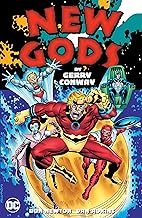
Written by Gerry Conway, with Denny O'Neil. Pencils by Don Newton, with George Perez, Rich Buckler, Mike Vosburg, Dick Dillin, Arvell Jones. Inks by various.
Colours/Letters: various.
Reprinting: New Gods (1st series) #12-19, Justice League of America #183-184, 1st Issue Special #13, Super Team Family #15, and stories from Adventure Comics #459, 460, from DC Special Series #10 (1976-1978)
Rating: * * * 1/2(out of 5)
Number of readings: 2
I originally wrote this BEFORE DC collected these issues in a collected edition, so my review was initially just speculating on a collection -- and is a bit ad hoc. I've left it as I first wrote it, but if some of the references seem odd that's why...
Although comics tend to be continuity heavy -- they also give rise to a lot of semi-apocryphal tales, simply because subsequent editorial regimes decide to just ignore inconvenient tales from earlier. The New Gods is a case in point -- I mean, how many times has villain Darkseid "discovered" the secret to the anti-Life formula...as though for the first time? Or is depicted searching for it...when he had found it in a previous run?
Perhaps no better illustration of this than was the late 1970s revival by Gerry Conway.
The New Gods was, of course, Jack Kirby's magnum opus -- and his unfinished symphony as it (and its companion series) were cancelled before Kirby could bring it to a climax (assuming he ever would've). But then the characters were revived for a new series in 1977 under the pen of Gerry Conway, with the main artist Don Newton -- continuing the numbering from Kirby's run, though now labelled "Return of the New Gods". Actually, they were first revived in an issue of 1st Issue Special, a try-out comic in the days when anthology comics were used to test the market (like Showcase, Marvel Premiere, etc.). I had assumed the 1st Issue Special was the start of this run, particularly as it was plotted by Conway -- but it actually came out a year before the revival of the regular comic, and was otherwise by a different creative team (Denny O'Neil and Mike Vosburg) and, though the subsequent series made a few passing references to it, it's not especially relevant to the plot -- and, honestly, in my opinion, just wasn't very good. So you can skip it or include it as the whim takes you.
Conway's run received a mixed response from fans -- sure, partly due to its own uneven merits, but partly, I suspect, as a knee jerk response because Kirby fans saw it as almost sacrilegious for another writer to dare to follow Kirby. In later years, the adventures of the New Gods have been guided by a string of writers in various series, including Mark Evanier, Jim Starlin, Rachel Pollack, John Byrne, Walt Simonson. But back in the 1970s, Conway was the first post-Kirby writer to assume control of the characters for a regular series -- and it would remain the only non-Kirby run until the late 1980s! (Though Steve Englehart had revived Kirby's Mr. Miracle for a short-lived revival around the same time).
The fact that neither Kirby, nor Conway, were able to make a commercial success of the concept presumably led to DC's editors being gun shy about the whole project. Indeed, it's not clear how successful even the later revivals have been -- none exceeding 30 issues, and undergoing various title changes (from New Gods, to Jack Kirby's Fourth World, to Orion) suggesting DC is still in search of that marketable label.
Though some criticized Conway's run for mishandling the Kirby concepts, Conway faithfully roots his story in Kirby's originals (including elements from the spin-off series Forever People) so that it is indeed a continuation of Kirby's story, in some cases trying to provide "answers" to elements Kirby left frustratingly vague. Conways does make some cosmetic changes (more likely an editorial edict, rather than his decision) such as having hero Orion's costume redesigned to look more "super hero"-esque, and powers Orion used to have through mechanisms are now incorporated into his suit -- a fact only really articulated in the editorial pages (making it perhaps confusing for some readers when, in an ancillary Secret Origins of Super-Heroes comic, Lightray is referred to as the only New God with special powers).
There are oddities, like Conway giving Darkseid a sidekick named Gargon who is basically just a substitute for his previous sidekick, Dessad (whom Kirby killed off in #11 of the original series) -- and then, with no explanation, suddenly Gargon is gone and Dessad is back! And then there's the Eskimo (one of the humans the New Gods are protecting) who is basically depicted as a loin cloth-wearing primitive...even though this is the 1970s! (Comic book writers have often seemed to have trouble depicting Native People as just, well, people).
Of course, like with Kirby before him, Conway's saga was cut short (but at least the final issue -- what was the finale to that story arc -- did see print, serialized in the two Adventure Comics) so some things can't maybe be blamed on him. Threads that were left dangling may have been intended to be explored later -- such as a sub-plot where Darkseid kidnaps the New Genesis youth, Esak, and exchanges him for an Apokoliptian lad.
So with its shortcomings, what's the appeal of the saga?
What Kirby did have going for him was passion, and a sense he really was using the saga to explore philosophical issues. Something Conway -- and most subsequent writers who've tackled the characters -- pull of with considerably less conviction (though the critical depiction of the airforce general has aspects of provocative commentary). Yet one assumes Conway was sincere in his affection for the concepts -- both because his saga draws heavily upon Kirby's originals (as opposed to ignoring them for his own ideas, as others have done), and because Conway stuck with the property, not just writing this series, but their appearances in other comics around that time.
The pacing is good, with enough things going on to keep your attention. If Conway was a poor man's Kirby in some areas, his ear for dialogue was a little better. Interestingly, how connected Conway's New Gods were to the greater DC Universe is a bit vague. It might seem odd to modern readers, who seem to regard cross-continuity as the rule of comics, that there might be some attempt to isolate different series. But DC in the 1970s had a few series that seemed to exist in a nebulous no man's land where it wasn't clear if the characters were part of the DC U or not. Although Kirby himself had set the New Gods in the DC Universe, it wasn't too entangled with it. Perhaps both creators realized "gods" were more unique in a world where they weren't brushing shoulders with super heroes!
Unlike Kirby's original series, Conway doesn't deliver many stand out issues or story lines -- there are no "The Glory Boat", or "The Pact", there's nothing like the Fantasy land arc from The Forever People. The issues tend to blend into each other, the "plots" wrapped around some attack by Darkseid's forces (which usually then turn out to be a distraction from his real scheme). Yet viewed as merely chapters in service of the greater arc, I enjoyed these issues more the second time through. The lack of development for the human characters becomes less glaring if you accept them as plot points, rather than players in a proposed on going soap opera.
And it does build to a definite climax, which is why I have a certain fondness for it, as opposed to it simply being a run of issues that carry along, and then stop. Although the series was cancelled in mid-run, forcing the concluding chapters to appear in two Adventure Comics, earlier text captions had already indicated they were building to a conclusion. And the final story, serialized over those two Adventure comics, totals 25 pages (the earlier New Gods were 17 page issues) just at a time when DC was switching some of its comics to 25 pagers -- again indicating this really was the story intended for the 20th issue of The New Gods, and that Conway had already intended to wrap up the conflict (though not, of course, the series).
A few months after the series' end, Conway and Newton reunited for a Secret Origins of Super-Heroes Special (DC Special Series #10) in which, in an issue also featuring the origin of Dr. Fate and Black Canary, they contributed a 14 page New Gods tale -- telling the hitherto unrevealed origin of Lightray (again, an example of Conway trying to "explain" inconsistencies in Kirby's original, namely why Lightray has powers different from other New Gods). Though in plotting it is unconnected to the greater Conway epic, I include it both because it is by Conway & Newton...and also because it's a good tale. The irony is, it's a tale that in many ways puts to rest any questions about whether Conway could follow in Kirby's footsteps. It's a retro tale (as Kirby himself would sometimes tell), and though focusing on Orion, Lightray and Metron as youths/kids...Conway actually does a better job of capturing their personalities, and evoking a sense of interpersonal dynamics, then he did in the main series. It's an interesting story, playing on some of the themes of war & peace Kirby did, but told with clever, sharp dialogue and interplay, and beautiful visuals. It's as if, after the regular series had been cancelled, Conway finally connected with the muse that had been eluding him.
While I'm at it, I'll mention a couple of other ancillary comics. Super Team Family #15, featured a teaming of the New Gods with the Flash in a story written by Conway and published in the midst of the regular series. Yet it's not really clear where it fits into the overall arc, and is drawn by Arvell Jones, not Newton, making it unessential to the "saga". Though it does feature a prominent use of the cosmic barrier in the Promethean Galaxy, which proves crucial in the climax of the main saga, so could be viewed as a foreshadowing (since, otherwise, I'm not sure Conway references the barrier until the climax of his saga). A couple years later Conway would toss the New Gods into the mix of the annual JLA/JSA team-up told in Justice League of America #183-184. Dick Dillin drew the first issue, but sadly passed away, leaving George Perez to finish it, with his hyper detailed style perhaps better evoking the oppressiveness of Apokolips (where most of the story takes place). But it too feels unessential to the regular series -- Conway not using it to tie up any lose ends from the regular series (no mention is made of Esak). It's quite an enjoyable adventure, just doesn't demand to be regarded as part of the overall narrative. But it is one of the best of the annual JLA/JSA team up stories (the whole series of those stories collected as the Crisis on Multiple Earths collections which I review in the JLA section).
As mentioned at the beginning, there are more than a few New Gods stories that tend to be dismissed as apocryphal (or at least ignored) -- Conway's run inparticular. Characters Conway introduced, like Jezebelle, haven't been used much since. When Kirby returned to the property for his Hunger Dog's graphic novel, he ignored the events in Conway's run. Yet Conway's ideas resurfaced in later stories -- perhaps suggesting it was more influential than most will admit. So Conway has the boy, Esak, kidnapped to Apokolips -- Kirby has Esak on Apokolips in the Hunger Dogs (though hinting at a different reason). The climax of Conway's run involves Darkseid trying to breach the cosmic wall in the Promethean Galaxy -- in the subsequent X-Men/Teen Titans one-shot, the climax has Darkseid attempting to breach the cosmic wall. And so on.
Equally interesting is the fact that comics fans have long pointed out thematic similarities between Kirby's New Gods and George Lucas' Star Wars movies -- notably that both involve a hero who is the son of the villain. Well there's a scene toward the end of Conway's run, where Darkseid attempts to recruit Orion, that could've been the template for the same scene a couple of years later in the Empire Strikes Back!
This isn't a "great" run -- it has its flaws. But it's an engaging page turner. Building on what Kirby wrote (and so maybe not a great jumping on point for new readers), but itself existing in a finite number of issues (as opposed to just being a rambling, on going series), while delivering a "final" showdown between the heroes of New Genesis and evil Darkseid, beautifully rendered by Don Newton's pencils, it makes a pleasing addition to a New Gods library -- a "lost", if possibly apocryphal, saga.
 The arc of the series is that evil Darkseid has deduced that the anti-Life formula (for which he has long sought) resides in the sub-conscious of six humans -- so it falls to hero Orion and various other New Gods to protect them. The various familiar New Gods split up, each to bodyguard a different charge. The human characters seem deliberately edgy and provocative: the US general suffers from paranoia, and another character is a junkie -- yes! a junkie when just a few years earlier, comics weren't allowed to even talk about illegal drugs! But Conway spends very little time developing a soap opera/human interest element, focusing instead on diversionary battles. It's as if Conway came up with the basics for a great, multi-layered saga...then ran into writer's block when it came time to actually develop it. Despite its ensemble air, other New Gods like Metron and Lightray get little page time, while a sequence where Orion and Jezebelle (Conway's chief addition to the New Gods pantheon) are subjected to a "memory machine" supposedly laying bare their inner turmoils proves decidedly anti-climactic. Conway breaks his saga into acts, with "Part One" covering the first four issues (itself broken up into smaller chapters)...yet such labeling seems arbitrary. Even stranger, "Part Two" begins with a chapter three, with no indication what happened to chapters one and two (nor is there any indication we've missed scenes, so I'm guessing it was a typo that no one caught).
 Well, maybe like with Kirby's original, it's as much for the promise as the execution. As much as I am a genuine fan of Kirby's original, he was equally guilty of haphazard plotting, tossing in a story idea or character...then seeming to forget about it, or with characters evincing arbitrary abilities as the scenes require. Honestly, it would be hypocritical to knock Conway for those things, and ignore Kirby's problems, too.
 The saga also benefitted immeasurably from the art of Don Newton, particularly when inked by Dan Adkins. Newton's realist, softly organic style with its elements of Classic Romanticism (evoking Alex Raymond and the like) couldn't be further removed from Kirby's craggy cartooniness -- but maybe that was the appeal. Instead of coming across as a second rate Kirby substitute, Newton made the series his own. And not only was he good at drawing the people, and the city scenes -- which I knew he could do -- he also nicely evoked the kind of otherworldly splendour of New Genesis, and the weirdly dreamlike architecture. Comics are a visual medium, and a good artist can certainly tip the scale on a story. I've picked up comics I might not have otherwise, just because Newton drew it. I figured I should be up-front about that. (Rich Buckler pinch hits an issue, to more than decent effect).
Back to