The
Masked Bookwyrm's Graphic Novel (& TPB) Reviews
The
Masked Bookwyrm's Graphic Novel (& TPB) Reviews
The Eternals (Page 2)
for a complete alphabetical list of ALL reviews start here
A - B - C - D - E - F - G - H - I - J - K - L - M - N - O - P - Q - R - S - T - U - V - W - X - Y - Z
The Eternals: The Dreaming Celestial Saga (2021) 480 pagwes
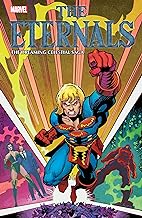 Written by Peter B. Gillis, Walter Simonson, Roger Stern, others. Pencils by Sal Buscema, Ron Wilson, Keith Pollard, Al Milgrom, Paul Ryan, others. Inks by various.
Colours/letters: various
Reprinting: The Eternals (2nd series) #1-12, The Avengers #246-248, Iron Man Anual #6. and stories from What if...? #23-30 (1980-1986)
Additional notes: intro by Peter B. Gillis; sketches, ancillary text and promo material circa the 1980s.
Rating: * * * (out of 5)
Number of readings: 1
Review posted: May 2024
This collection seems to be part of the newer trend of big "omnibus" compendiums. Ostensibly collecting the mid-1980s maxi-series -- The Eternals second go round in a self-titled comic -- it also reprints a bunch of ancillary material. And sure, maybe that's because some of these other comics get referenced in the main story, so it makes sense to include them. But it also just provides a more complete representation of The Eternals saga. Add this volume to the original Eternals saga by Jack Kirby (available in both a two volume, and single volume omnibus), and the follow up stories in Thor comics (collected as Thor: The Eternals Saga -- again in both a two volume, and single volume edition) and I'm guessing pretty much the entirety of the Eternals appearances from the mid-1970s to the mid-1980s can be re-read by modern readers.
This collection begins with a series of short tales originally presented in Marvel's What if...? comic -- a magazine mostly devoted to telling apocryphal and alternate reality tales, but this back up series was meant as canon, and set out to fill in and retcon the ancient history of the Marvel Universe. And, y'know, there is a kind of fun to such tales (reminding me of DC's old Tales of Krypton stories, as well as Marvel's Tales of Asgard stories). They're maybe not high art (told in such brief instalments) but they do effectively evoke the sense of folk tales and legends. And for those newer to The Eternals it helps explain the background, as well as linking The Eternals to other Marvel demi-gods and parahuman races (such as The Inhumans and the inhabitants of Titan). Although I'll confess I wasn't entirely sure it always made sense.
(One thing they change is that in Jack Kirby's original stories the Space Gods -- the Celestials -- had force-evolved Eternals, Deviants, and Humans, from apes. Here it's implied humans evolved naturally, and only the Eternals and the Deviants were created by the Celestials. It's a change that arguably doesn't make sense, since the Celestials were supposed to be judging ALL of earth's sentient races, implying even humans were part of their experiment. Presumably Marvel either did it because attributing human evolution to the Celestials messed up other mythos on the MU -- or because they were afraid of angering religious conservatives).
Then we jump to the modern era with an Iron Man Annual where Iron Man stumbles upon the city of the Eternals after it has been taken over by the Eternals' arch foes, The Deviants. It's a pretty good tale, just for itself. This isn't the traditional Iron Man -- a.k.a. Tony Stark -- but instead is from a period where Jim Rhodes was inhabiting the suit. And though that makes this less of a quintessential Iron Man tale (though Rhodey later got his own suit as War Machine) Rhodey's newness to the job is dramatically effective, emphasizing his vulnerability since he lacks Tony's experience (and, as such, emphasizes his heroism, as he must rise to the challenge). And it's a kind of moody, intimate tale as Iron Man is lost and alone in this strange city, skulking in the shadows, caught up in a conflict he (and the reader) has to gradually learn about. It also sets the stage for the next issues reprinted as it ends with the Eternals grappling with their place in the world.
Which brings us to a three-part Avengers tale which, to a large extent, just seems to exist to re-set the bar for the Marvel Universe and the Eternals. Oh, there is some action, and conflict -- including with a mysterious bad guy who, though defeated, his motive and origin is left to be explored in later Avengers issues (and so not followed up on in this collection). But the story exists mostly to have the majority of the Eternals leave earth for the stars -- the Marvel brass obviously deciding a city full of super humans was problematic (in Kirby's original comics, it was unclear if Kirby intended the series to be set in the Marvel Universe with its existing pantheon of super heroes). Some key Eternals remain -- Ikaris, Sersi, etc. -- but the group is now reduced to the size of, well, a team (but with just enough ambiguity about their remaining numbers that writers can add in new, unseen characters if warranted). Which -- arguably -- diminishes the point of Kirby's idea, that this was an entire society!
Which then brings us to the main event: the 12 issues maxi-series (with the first and last issues double-sized). Remember this was the era of the maxi-series, with The Watchmen, Squadron Supreme, the 2nd Vision & The Scarlet Witch series, etc. published around the same time. And that may be one problem: the editorial decision was to make it a 12 part epic -- but they didn't really have a plot to justify that length. And unlike, say, the Squadron Supreme which told smaller stories within the greater arc (almost like an on going series) this Eternals series is mostly focused on the main plot threads (though there are a few quiky chapters, like a deliberately humourous issue set entirely during a cocktail party).
Part of the problem is, of course, that initial writer Peter B. Gillis inherits problems from Kirby's original. Namely that for all its brilliant imagination and scope, Kiby's original had flaws when it came to character development and with even Kirby unsure where to take his initial concept. The maxi-series begins touching bases with various Eternals -- and adds in the idea that there seems to be some sort of collective memory hypnosis that means humanity no longer remembers the Celestial visitation (from those earlier Eternal and Thor comics).
The focus shifts more to the Deviants, the Eternals' arch foes. In Kirby's hands the Deviants were mainly caricatured villains, their physical monstrosnous a metaphor for their vile characters. Gillis comes at it from the opposite angle, seeing the Deviants as tragic victims of their genetic deformities, whose resentment of humans, Eternals, and Celestials is, in a sense, justified. As such the Deviants are written with more nuance than Kirby generally used (more civil with each other and less sneering "dolt" and "cretin" at each other!) and introduces a mysterious priest caste that has its own agenda. The result is that Warlord Kro -- largely a villain in Kirby's era -- becomes more of a protagonist. As I say: it can almost feel like Gillis is more interested in the Deviants, and the machinations within their culture, than he is in the Eternals.
But like Kirby before him, he fails to fully realize or define the characters much. Ikaris, the nominal main protaogonist of the Eternals, mostly has the personality of a brick. Makkari, another main character from Kirby's era, just seems a sidekick. One of the interesting -- and unexpected -- aspects of Kirby's era was throwing in a romantic tenbsion between Deviant Kro and the Eternal, Thenia (unexpected given Kirby's tendency to cast characters as good/evil). Gillis picks up on that, making it arguably the most important character thread of his saga -- but without developing it much. It's importance is more for its impact on plot than as a character thing. Other potentially interesting Kirby creations -- such as the Deviants who joined the Eternals, the hideous but kindly Karkas, and the handsome but brutal Reject -- can feel like Gillis has no idea what to do with them. Karkas remains mostly a side character, while the Reject just gets repetative.
Like Kirby before him, Gillis tosses in potentially interesting ideas, but then fails to really seem to know what to do with them. Here Sersi befriends a suicidal human, Thomas, but Thomas never becomes an interesting personality. The tepid personality/relationships become obvious when Gillis even kills off central characters and it's pretty obvious he did so because he realized neither he, nor the reader, really cared about them.
The plot hinges on machinations and mysterious agendas within the Deviant society, with Kro uncertain what the priests are up to, and the Eternals, in turn, unsure what the Deviants' goal is -- especially when it leads to a Deviant armada invading an Eternal ruin searching for some mysterious artifact (a ruin last seen in the Kirby run). Again, Gillis' desire to give the Deviants nuances seems as though it might even apply to the priests. For though they seem to be the villains, it's not clear (at first) if their motives are truly evil.
Then something weird happens.
Gillis is gone two-thirds of the way through the maxi-series, and artist Sal Buscema follows an issue later. Gillis is replaced by Walter Simonson, the artist-turned-writer who was no stranger to writing about demi-gods thanks to his popular run on Thor. But when it's a limited series it can leave you puzzled. Simonson was credited nowhere earlier (though he provided a cover or two), nor is Gillis given a story credit on the final issues. So was Gillis fired? Was it possible he was having trouble figuring out how to tie things up? Or was he just swamped with other work and bowed out? And was Simonson finishing an already outlined story, or making up his own conclusion? (Despite this collection being introduced by Gillis, he makes no allusion to the creative change over).
It's weird to have a the main creative team exit a "mini"-series 2/3rds of the way through.
Unfortunately there's no particular up-tick in quality (and maybe a slight drop in dialogue -- or at least a reversion to more unsubtle Kirby-esque "dolts" and "cretins", and the priests are more explicitly revealed as bad guys -- though that may have been Gillis' intention).
The overall problem with this series is that it maybe inherited Kirby's flaws, without benefitting from Kirby's strengths. Kirby's work had bombast and could genuinely evoke a sense of the mythic -- Kirby using his run as an umbrella for a variety of tales, shifting focus in different issues. Gillis (and Simonson) go for a slightly more initimate approach, emphasizing machinations and character. Except without really doing much with the characters or making them interesting or engaging personalities. They either have little personality or, in the case of the Thenia/Kro thing, get repetitious. While the machinations aren't nearly as twisty or as intriguing as you might need to sustain 12 issues (Or closer to the page count of 14 issues!).
In short it feels like the story might have been better served as, say, a six issue mini-series, and it lacks some of the epic grandeur of Kirby's run.
Sal Buscema draws the lion's share of the maxi-series and he's one of those artists I have shifting feelings towads. A real workhorse in Bronze Age of Marvel, Sal was never a favourite of mine as a kid -- but as an adult I can look back and appreciate his solid fundamentals, his storytelling, composition, and appreciate the craftsmanship he brought to a page. His art on the first few issues is also particularly strong from him -- aided and abetted by strong inkers. But as the series progresses it can get less effective, maybe because he was rushing to meet deadlines, or also because on some issues he inks himself (Sal Buscemsa was a good penciller and a good inker -- but I never felt he was a good inker of his own pencils). When he drops out he's mostly replaced by Keith Pollard (then Paul Ryan) who are similarly solid-but-unspectacular stylists. The result is perfectly okay visuals for the maxi-series but without any of it being "special" as you might hope for an epic saga. Likewise, other artists on display throughout this collection, from the Avengers issues, the Iron Man Annual, etc. are solid enough, but no A-listers (in my opinion, of course) and nothing that really stands out or does more than serve the scripts...and the scripts are themselves mostly of average quality.
That's actually both the strength and the weakness with these massive compendiums, especially from the perspective of reviewing them. Because I can't really say there's too much here that's "great" -- probably the Iron Man Annual stands out most as a read-it-for-itself story. But equally, because of the amount of material, it maybe doesn't have to be that "great," because the sheer amount of material means no one story, or storyline, has to justify the purchase on its own.
The result isn't terrible but, I'll admit, little here that demands a purchase if you're on a budget. Even from the point of view of a completist, it's not like The Eternals are of that significance to the overall Marvel Universe. And even in terms of the Eternals, for all that there are major changes to the status quo -- the majority of the Eternals leaving earth, a few characters killed off -- little here really feels that impactful. (Especially as subsequent revivals played fast and loose with the continuity and a lot of this series has been ignored or otherwise rendered irrelevant!)
Eternals: Manifest Destiny
see To Defy the Apocalypse
Eternals: Only Death is Eternal (2021) 156 pages
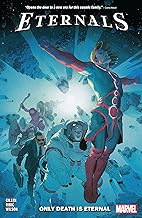 Written by Kieron Gillen. Illustrated by Esad Ribi.
Colours: Matthew Wilson. Letters: VC's Clayton Cowles.
Reprinting: Eternals (2021 series) #1-6 (with covers; alternate covers, character sketches)
Rating: * * 1/2 (out of 5)
Number of readings: 1
Review posted: May 2024
So I recently decided to go on a deep dive into The Eternals, reading various collections in sequential order. Because the Eternals have always been a commercially problematic property, it means they get dusted off for a usually short-lived series, then fall into obscurity, then get revived again. Which I thought would make it fairly easy to peruse the "complete" Eternals saga. But of course Eternals appearances and events can occur in other, non-Eternals comics (an obvious case being the Thor: The Eternals Saga epic).
Or maybe I just missed a series here and there. Because this latest iteration of The Eternals begins making references to some previous story where all the Eternals ended up killing each other. This new series also sets up Thanos as an arch-foe -- and though Marvel history/lore had linked Thanos to the Eternals before (via a family tree), in no other Eternals comic I read had they even met Thanos! So I'm not sure what I've missed -- and what's just been re-imagined/retconned.
Because, um, yeah -- that happens a lot with the Eternals. Since they have never sold that well, it seems like every revival will tweak this, change that, ignore some inconvenient bit of established lore, or add in something completely new...all while pretending it's the same continuity. On one hand, if the series/characters have trouble clicking with readers, it maybe makes sense not to bullishly stick to the same ideas that didn't sell the first time. On the other, if you keep changing things it makes it hard to build up reader loyalty -- not to mention making it deeply confusing or, worse, make it hard to care.
For instance you might ask: how can the Eternals have died in a previous story when they are famous for being, um, eternal? That's because, though in the original Jack Kirby incarnation they were immortal beings, over time (notably in the Gaiman/RomitaJr series) it was changed to being that they do die -- only they get resurrected. By this series the Eternals seem to be practically living robots or something (not only do they get reconstructed after death, but their memories are stored and they can be rebooted using earlier saved copies of their memories, and with pre-programmed priorities). Oh, yeah, and they are officially protectors of the earth. And their cities exist in kind of pockets of sub-space and they have a giant computer that is also, in some way, connected to and/or is the earth itself. And there have only ever been 100 Eternals (and there were 100 Deviants, though most of them have been killed off). So, yeah -- the concept has been altered A LOT since Kirby's version. Unfortunately, as much as the changes are clearly meant to "fix" problems in Kirby's original (or to integrate the characters better with the Marvel Universe) the changes often make things worse, or at least no better.
Plus this series came out in 2021 so I suspect it was meant to adhere more to the MCU movie. So here Sprite -- killed off in an earlier series; like, permanently killed off -- is brought back, and it's revealed they can arbitrarily change gender, meaning the previously male Sprite is now female (matching the movie); the previously white Sersi is not explicitly made not white, but she certainly seems to be drawn more evocative of the actress from the movie (Gemma Chan); and Makkari, previously a white man (then briefly a Middle Eastern man, then back to white) and normally a central character...is nowhere around in this series, presumably because they were a bit uncertain how to seamlessly turn him into a black deaf woman, like in the movie (though a few Variant covers show a black female Makkari, presumably to evoke actress Lauren Ridloff).
Anyhoo... On to reviewing the story itself.
Lets start with the art (I usually start with the story and get to the art toward the end of my reviews). It's frankly gorgeous. Lush and detailed and atmospheric (in both drawing and colouring). It's also hyper realist -- although that technique can often lead to a certain stiffness at times (since I'm guessing the artist is using posed photographs for reference). But maybe not as distractingly stiff/posed as some other artists I've seen. But the result is a comic that is visually striking -- perhaps the most so of any of the Eternals series I've read. Even as it can feel a bit as though the visuals could learn to let their hair down (so to speak) from time to time.
Now the story/writing.
First off, the dialogue can be clever and witty (without sliding too far into being too self-aware silly/wisecrack-y) -- high marks in that department. And as I sort of allude, part of the problem I have with some of these Eternals series is struggling to fit them in with my knowledge/understanding of previous Eternals series: is so-and-so "in" character? does this technical aspect gel with what we were told previously about the Eternals? etc. And maybe I shouldn't. I should just take each series for itself and forget about the past -- except that often the series deliberately reference past things, so you can't just start from scratch.
But the story feels like a big, grand idea -- that they're having trouble figuring out how to tell. The main plot kicks off with leader of the Eternals, Zuras, being murdered! In other comics that would be a big deal. But to the Eternals it's just a matter of waiting for him to be resurrected so he can identify his killer to them...except someone has sabotaged their resurrection chambers! (Again, continuity nitpick: in an earlier series, they had it be the Eternals' resurrection chambers were destroyed and they were no longer immortal. Obviously that was fixed in the interim -- only for that idea to get recycled here).
Recycling of ideas is another problem with the Eternals. This constantly changing aspects of the mythos while recycling the basic plots -- when maybe writers should stick with the established characters/mythos but drop them into new stories.
Anyway... The Eternals try to solve the murder of Zuras and the sabotage of their machines (this is where Thanos comes in, as they discover -- quite early -- that he is the killer...but unusual for him, he is working for some mysterious puppet master). Meanwhile their central computer starts to malfunction...a malfunction that threatens to tear earth apart (since, as I mentioned earlier, the computer is connected to/or is the earth itself). And Ikaris (in another bit of technical handwaving) has a prophetic vision of himself grieving over the death of a human teen in the near future; so he sets himself up as the boy's protector, though he has no idea why the kid is in danger, or why the kid's death should so upset his future self.
And this is what I mean about big ideas but not always clear they know what to do with them. The plot is built around an apocalyptic threat to earth itself...yet other than a few ominous skies we don't really see much of earth imperiled, or things escalating from chapter to chapter. It's a murder mystery...but without much sense of an unfolding puzzle or clues, and with the characters (as written and drawn) seeming rather blasé about it all. And it says something about the handling of the mystery and of the characters/personalities, that when the killer-among-them is finally revealed it's kind of "So what?" rather than "Oh no! Not __?!?" We're not emotionally invested in the characters and the characters don't seem all that invested (emotionally) in solving the crime. And the sub-plot with Ikaris and the teen is kind of dull. Again, because we don't really care (and even Ikaris' motivation is mostly academic and abstract). A recurring problem with the Eternals (dating back to Kirby's original) is a tendency for writers to want to insert human characters into the drama, as if worried the god-like immortals are too unrelateable and also wanting to make some point about the human condition...while failing to make the human characters the least bit interesting.
Although that can be explained because (without giving too much away) the teen turns out to be more a plot device anyway. But maybe that's the problem. That whole sub-plot is too obviously set up to serve a point rather than feeling organically driven by a story and the characters.
Which brings us to another problem with this story: it feels a bit familiar in the way it follows familiar grooves common to writers tacking a property for the first time. Namely, it builds to a kind of de-constructionist "revelation" that is meant to shake our understanding of the characters (and their understanding of themselves). The "everything you thought you knew is wrong!" idea. (Well, not everything...but some things). A story that reveals a hitherto "dark" secret. And, like, sure, that's fine I guess...but it's become its own cliché (and is problematic when it relates to subverting something that was only added in by a post-Kirby writer anyway -- essentially a retcon of a retcon). Plus the idea of beginning with the murder of an established character is another familiar trope (although, in this case, the effect isn't permanent -- though whether that's better or worse, I dunno). Indeed, it reminded me a bit of Jim Starlin's earlier Death of the New Gods mini-series (especially as the Eternals have often been seen as Marvel's counterpart to DC's New Gods).
And the problem is, despite the sumptuous visuals, despite some witty dialogue, and despite some potentially interesting (if familiar) ideas, it's a bit...dull. Or not dull, exactly. But just seems to plod along. As mentioned the mystery doesn't really seem to unfold or zig and zag, and the apocalyptic threat to earth feels mainly abstract and theoretical. It was decent enough to get me turning the pages for the first few issues, but long before the end I was just reading to get it finished.
The main plot does resolve by the end, to be fair. The earth is saved, the killer exposed, a secret revealed that changes how the Eternals view themselves and their place in the world. Even as other aspects are left dangling (Thanos is still loose!)
As I've said: it seems so many revivals of the Eternals involve the new creative team trying to make their mark, to shake things up, to re-set the cutlery to suit themselves, to reveal dark secrets or provide revelations that will affect the characters going forward. All of which often gets ignored or re-imagined by the next creative team anyway. And all of which can feel a little bit like they're doing that because they're not quite sure what to do with the series and the characters themselves.
Maybe the key to a successful Eternals revival is to forget about rewriting the past, or foreshadowing the future -- and just focus on telling a good story in the here and now.
Eternals: To Defy the Apocalypse (2021) 244 pages
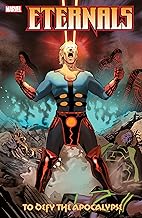 Written by Charles & Daniel Knauf, with Fred Van Lente. Illustrated by Daniel Acuña, Eric Nguyen, with Sara Pichelli, Pascal Alixe.
Colours/letters: various
Reprinting: Eternals (4th series) #1-9, Annual #1
Rating: * * 1/2 (out of 5)
Number of readings: 1
Review posted: May 2024
FYI: These stories have also been collected in two volumes: To Slay a God and Manifest Destiny.
After being relatively dormant as a property for a couple of decades, Marvel dusted off/rebooted the Eternals for the Neil Gaiman/John Romita Jr mini-series which then led directly into this on-going series written by the Knauf father-son team (who have also written for TV and novels). A series that was cancelled in less than a year. As I've noted before: the Eternals seems forever to be a decent concept in search of the proper execution, with the different iterations (Jack Kirby's original, the Gillis/Simonson maxi-series, Gaiman, and now the Knaufs) cherry picking what interests them, changing things while dropping others entirely. For example the Gillis maxi-series almost seemed more interested in the Deviant culture than the Eternals; but here, although the Deviants are occasionally referenced, they never appear...not even Deviants-turned-Eternal allies, Karkas and the Reject!
The Knaufs are more interested in Eternal-internal conflicts, and building on things from the Gaiman series. So only a handful of Eternals are active, with many more still suffering from amnesia and living as normal humans. While Ikaris, Thena, and others are tracking down these wayward Eternals, so to is the sinister Druig who is trying to create his own branch of Eternals in the former Soviet nation he now rules; setting up a conflict between Eternals factions. Meanwhile Makkari is the sole communicator with the Dreaming Celestial standing in a San Francisco park, a fact that worries girlfriend Sersi (since it's physically draining on Makkari) and with the Celestial warning of a coming planet-destroying swarm called The Horde. Much of this is left over threads from the Gaiman run. Added to the mix is Ajak, previously a good guy Eternal, so consumed by jealousy of Makkari usurping his place as speaker-to-Celestials that he starts plotting against the Eternals.
And this may be the least effective Eternals to date. At least in that some of the other series started promising, but then ran out of steam. Here, it never quite builds up a head of steam to begin with. Despite the first six issues being presented as a story arc (and originally collected in their own TPB), the Knaufs -- not unlike writers before them -- don't really seem to have a strong vision for a plot. Instead we cut between the various players, teasing along threads without always feeling like they're being developed so much as they're just reiterated from chapter to chapter, and without too much presented as that interesting or compelling. A main thread is Ikaris and Thena trying to stir the amnesiac memories of Phastos -- but it's not like Phastos is some sort of key or particularly interesting Eternal (although it's odd that Phastos here is white when in the 1986 series he was Black -- and, indeed, Makkari, who had been white, but then made Middle Eastern in the Gaiman series, is back to looking white. I don't necessarily want to draw too much of an inference but, um, it's a bit odd).
Things happen in the first six issues, and it builds to -- not so much a climax as a pause, I guess, justifying it being seen as a story arc (and originally collected as To Slay a God). But it does feel a bit like it's mainly just the Knaufs setting up the board and putting their pieces in place. Which, again, is a problem with so many versions of the Eternals. A feeling the creative teams are more focused on the world building (or re-building), laying the foundation stones, and less on simply telling an interesting story with engaging characters. Like they're focusing on renovating the house because they haven't really figured out how to live in it.
So the Knaufs shake things up by destroying the Eternals' immortality -- which, y'know, seems an odd creative choice given they are literally called the, um, Eternals! The Knaufs can rob the characters of that because in the previous series Gaiman had it be a machine recreated them whenever they were mortally injured (whereas in Kirby's original they were just naturally immortal). Which relates to my point of how each creative team rewrites and re-imagines aspects.
And the Knaufs want to do a deep dive into the mythology of who and what the Celestials are, with Makkari having long conversations with the Dreaming Celestial. But -- I dunno. Wasn't the thing that made the Celestials interesting their whole unfathomable otherness? In a Marvel Universe full of Cosmic Beings, they remained enigmatic. Maybe the Knaufs felt that wasn't sustainable. Maybe they felt after three decades since Kirby's original it was time to answer unanswerable questions -- and to set up a brand new cosmic threat. So we learn the Celestials have an evil counterpart -- the Horde. And it's coming to destroy the earth.
The next story is only three issues long (and with the Annual made up the earlier TPB Manifest Destiny). And here it gets a bit tricky to review because one suspects the Knaufs saw the writing on the wall and were hastily trying to wrap up their series ahead of cancelation. Specifically the Horde plot. Certainly it can all feel a bit rushed and with threads left unresolved (Ajak's villainy remains unrevealed to the others; Sersi -- who sacrificed herself in the previous story arc -- is hanging out in a kind of afterlife/limbo and still is by the end of the story...except in an epilogue where she seems to be corporeal again; etc.)
The plot starts out with Ikaris deciding to have it out with Druig (mistakenly believing him responsible for villainy perpetrated by Ajak in the opening arc) which leads to Druig's Eternals going after Ikaris...who recruits the X-Men to help him. And, yeah -- that's not really explained, since I'm not sure the X-Men had ever met Ikaris or knew anything about the Eternals previously (at least, it's not referenced here if they had, nor in any of the other Eternal collections I've been reading recently!) Maybe with cancelation looming it was thought throwing in the X-Men as guest stars would boost sales, or the Knaufs were just big fans and wanted to write them, or maybe it was, as I suggest, intended to be a longer story arc that was shoe-horned into an issue or two.
But then Eternals (on both sides) have to put aside their differences because the Horde finally arrive (remember they were first mentioned in the Gaiman series). And that part, at least, is wrapped up by the end -- this collection is titled "To Defy the Apocalypse" after all!.
In an odd creative choice, the final is framed by a mysterious character telling of these events...from a Century in the future! I say it's odd because I keep mentioning how different writers re-write the Eternals mythos. So it's odd wrapping up the series by implying how their future will play out, when presumably the next creatives to take a stab at the Eternals will just ignore it anyway.
The Knaufs fail to make any of the Eternals particularly interesting or engaging -- a problem throughout various iterations of the team. The irony is that in Kirby's original he kept shifting focus, or adding in new characters, as if he saw the series almost as an anthology (although coming back to Ikaris, Sersi, etc.). But the problem with some of these later versions is the writers stick with the familiar core characters, without successfully making them that interesting, or with even much sense the writers themselves care that much about them. Or that the relationships (Thena's with her son, or Sersi's with Makkari) are more than abstract ideas to give the characters an appearance of motivation. Indeed, I might even quibble there's something a bit sexist about the writing, with Thena now defined a lot by motherhood, and Sersi defined by her relationship with Makkari (though arguably it was Gaiman who first watered down Sersi into a rather bland, colourless interpretation).
The Annual by writer Fred Van Lente is also reflective of the oddity of comics. It's mostly disconnected from the main story arcs, and largely runs to an extended fight between the Eternals and another group of super beings. The catch? These are the Young Gods first introduced in, and then largely forgotten after, the climax of an earlier Eternals story first published in Thor comics -- the story arc collected as Thor: The Eternals Saga. Which is what I mean about the oddity of comics. Van Lente writes an entire Annual to tie up a half-forgotten plot thread from a quarter Century ago! It isn't that that's wrong, nor can't make for a great tale. Except that it really does feel like the only point of the story is to answer "Whatever Happened to the Young Gods?" (a not-exactly-burning question for most fans I suspect) rather than he had a great plot that could also be used to answer that question.
With that said -- and before I sound too critical -- in some ways Van Lente does a better job of pushing the Eternals' emotions and personalities to the fore. Indeed, I wonder if this collection had placed the Annual earlier (albeit interrupting the Knaufs' arcs) it might have done a better job of giving the Knaufs' issues a firmer emotional foundation in so far as the personalities go.
The opening six issue arc is illustrated in an airy, painted manner that does lend the story a certain aesthetic ambition. While the second arc and the Annual are drawn in a more conventional way. But I do wonder when I complain of a lack of personality to the characters in comics how much the art plays a factor. Because though the visuals are decent enough, telling the scenes, the action, the vistas of cosmic grandeur, I didn't necessarily feel the characters were always well realized in terms of humanizing the protagonists. Acuna's work is probably the strongest in terms of atmosphere, while the other artists can be a bit stiff in how they depict figures and face. Still, it's perfectly good art overall.
Reading through the Eternals saga, going from Kirby, to Thomas et al (in the Thor: The Eternals Saga), Gillis & Simonson, Gaiman, and finally the Knaufs and Van Lente (and subsequently: Gillen), the Eternals remain an interesting property struggling to find someone who can bring it to life. But I would say that although Kirby's original had flaws and certainly could do with some tinkering, often the problem with the later series is the more they diverge from and/or change aspects of Kirby's original, the more the Eternals lose their way.
Eternals: To Slay a God
see To Defy the Apocalypse
Back to