 The
Masked Bookwyrm's Graphic Novel (& TPB) Reviews
The
Masked Bookwyrm's Graphic Novel (& TPB) Reviews
The Eternals (Page 1)
for a complete alphabetical list of ALL reviews start here
A - B - C - D - E - F - G - H - I - J - K - L - M - N - O - P - Q - R - S - T - U - V - W - X - Y - Z
for other Eternals...
Published by Marvel Comics
Just a little intro: I actually really liked the MCU Eternals. But my reading of these books were a bit spread out, time-wise, with some (the Kirby originals, for instance) read long before I ever saw the movie, and others read after the movie. So in some of my reviews I reference the films, and in others...I dont.
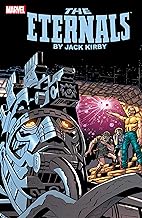
The Eternals, vol. 1
(2008) 200 pgs.
Reprinting: The Eternals (1st series) #1-11 (1976-1977) Rating: * * * * (out of 5)
Number of readings: 2
Review posted: May 2024
Kirby's original series was collected across two volumes -- the format which I'm reviewing -- but also in a single volume omnibus. Just FYI.
Okay, we all probably know the background: Jack Kirby, one of the defining creators in American comics, and especially seminal in the foundations of Marvel, usually working with collaborators such as Stan Lee and Joe Simon, broke from Marvel in 1970. He went to DC Comics where he was given carte blanche not just as an artist, but scripter/editor. But though he created the acclaimed New Gods/Fourth World, sales on his various comics weren't as strong as hoped, and soon he was just as frustrated with DC as Marvel. So he went back to Marvel, securing the same writer/artist/editor deal -- and again produced a bunch of wild comics with mixed success and soon he was leaving again.
During that '70s time at Marvel, he created The Eternals -- which many people saw as his attempt to try and pick up The New Gods/Fourth World stuff under a new name. And reading these initial issues (in the first of a two TPB series) it's easy to see the similarities to the New Gods -- even as it undersells aspects that were unique to The Eternals. Instead of seeing it as Kirby trying to cannibalize The New Gods, it's probably better to just see it as simply stemming from the same creative impulses and preoccupations that had also influenced Kirby's '60s work on Thor and The Fantastic Four and the Inhumans.
Kirby was clearly fascinated by the concept of Gods -- not Judeo-Christian theology, per se, but the literal idea of higher beings and pantheons, and the idea (proposed in parapsychology circles) that space aliens and the like might have inspired ancient man's belief in gods. (I've long thought Kirby's vision of the Norse Gods in Thor deliberately blurred the line between them being genuine gods and being higher beings/aliens). Let's not forget that one of the projects Kirby took on when he returned to Marvel was a monthly comic inspired by the movie, 2001: A Space Odyssey, which was rooted in those ideas.
And in The Eternals he incorporates those concepts into the narrative explicitly.
The set-up is that mankind is not the sole intelligence on earth, but two other secret groups have existed for millennia -- the god-like and (mostly) benevolent Eternals, who inspired many of humanity's ancient myths (a chief Eternal city is literally hidden on Mt. Olympus) and the sinister, undersea-dwelling Deviants, who inspired stories of demons and devils. But all three groups share a common ancestry -- having been force-evolved from primates by enigmatic alien giants known as The Celestials. The Celestial's have returned to earth periodically to check on their experiment. And now in the opening issue they return again; giant, mute, robot-like entities who are beginning what proposes to be a 50 year study, at the end of which they will pass judgement on humanity -- and if the judgement goes against the earth, they will destroy it!
It's a big, audacious concept, and one that deliberately sits only partly in the Marvel Universe proper. SHIELD agents crop up, but no superheroes appear or are referenced -- to good effect, it should be said. Kirby's grandiose ideas would be diminished having to be slotted in around existing Marvel superbeings and cosmic entities. After all, the saga is literally about how the world is altered confronting these staggering ideas and entities (perhaps with shades of Arthur C. Clarke's "Childhood's End"). Of course pragmatic necessity would later require integrating the Eternals/Celestials into the Marvel Universe, but that's for later.
The saga begins with a three-person archaeological expedition uncovering a lost Inca temple that turns out to be a kind of ground control centre for when The Celestials return -- which they do. At the same time, Margo Damian and her father discover their mysterious co-explorer is actually Ikaris -- an Eternal. Margo and her dad essentially act as the readers' surrogates, there mostly to gape and have things explained to them.
No sooner do the Celestials return than the Deviants launch an outright attack on New York -- the Deviants masquerading as space aliens! Their plan being to rile human beings into going to war with the Celestials (whom the Deviants fought to their regret in the distant past). The Eternals, who have lived in secret among humans (when they aren't off in their hidden cities) reveal themselves in order to both defend New Yorkers, and pre-empt a human attack on the Celestials (who they call Space Gods), knowing a war would devastate the earth. (A clever aspect of the strangers-hidden-among-us idea is touched on when Margo recognizes an Eternal as a famous Japanese movie star!)
You can certainly see aspects of the New Gods here in Kirby setting up two ancient society's at odds with each other, yet who have long-standing personal connections (Deviants and Eternals knowing each other by name) and with earth humans caught inbetween.
After a few issues, The Eternals and The Deviants declare a truce, and humans are forced to reckon with the notion of these demigod-like superbeings in their midst -- as well as the looming, enigmatic presence of the Celestials.
In a way, as much as The Eternals is a superhero comic (involving people with powers) it's equally a science fiction story, exploring the clash of these different cultures. Kirby isn't just wrapping adventures around a key hero or two, but setting out to create a sprawling epic with a cast of dozens. A character like Ikaris, who was used as the comics' signature image (back when comics would feature a little icon/image in the top corner of the covers), can disappear for whole issues, while Kirby continues adding new characters and perspectives as we go.
In some respects I would even suggest it might actually be a more sure-footed effort -- initially -- than Kirby's more-acclaimed Fourth World stuff for DC. But regardless of whether one is better than the other, it shares similar strengths...and weaknesses.
As mentioned: it's undoubtedly audacious and grandiose, brimming over with big ideas, both conceptually and thematically. Kirby's art is, not surprisingly, well-suited to his story telling needs: on one hand it's rough and raw, full of craggy, kind of ugly figures, and a childish, "comic book"-y verve -- on the other hand, it breathes with an undeniable energy, a dramatic power, and an awesome sense of spectacle. The Eternals/Celestials were incorporated into the bigger Marvel Universe, so other artists over the years have drawn the Celestials -- but no one conveyed them with the same staggering sense of awesome grandeur as Kirby. There is something chillingly enigmatic and ineffable about how Kirby renders them.
But like The Fourth World stuff (and some of his other solo projects) Kirby's imagination lacks discipline -- and maybe an awareness of the commercial needs of the marketplace (in terms of needing engaging characters and beginning/middle/end plots). Kirby devotees will often pillory his Marvel-era collaborator, Stan Lee, as just riding Kirby's coattails, but at the very least I suspect Lee provided a necessary tempering of Kirby's ideas, a reining hand. Because on his own, it can feel like Kirby's brain is racing from one thought to another, without necessarily shaping them into fully fledge story ideas. The initial story arc that kicks off the saga, involving the battle with the Deviants, just seems to resolve in a weirdly abrupt, anti-climactic way.
Kirby doesn't really want to settle down too much with a "main" character, which maybe makes the saga a bit hard to connect to emotionally. Especially as few of the characters really stand out much on their own (the scene stealer is Sersi, whose heroism is tempered by her vainglorious narcissism, making her a fun personality). But too few of the characters, whether Ikaris and his fellow Eternals, or humans like Margo Damian, truly emerge as compelling personalities (something Kirby pulled off slightly better with his Fourth World/New Gods characters).
While Kirby's dialogue is, well, Kirby's dialogue. Sometimes dramatic and powerful, in a Kirby-esque way, other times kind of clunky, goofy, and childish. (Again making a point about Kirby-Kirby vs. Lee-Kirby: consider how much The Fantastic Four worked because of the engaging humanity and colourful personalities of the heroes).
Although sometimes that's Kirby's appeal, the weird mix of sophisticated ideas with a childish, comic book-y execution, as if Kirby was aware (and comfortable) with the idea that comics were meant to appeal to younger readers. This in contrast to a lot of modern comics folk who set out to write their gritty, edgy comics -- but still end up kind of juvenile. Kirby was unpretentious in his pretentiousness.
But an example of Kirby being undisciplined is the very idea that the Celestials are embarking upon a 50 year study of earth. Kirby's issue-by-issue plotting feels very much like these are just building blocks in some epic saga -- yet it's doubtful even he truly expected the comic to run 50 years! In other words, the very premise seems a tad ill-thought and foredoomed to disappointment (the comic itself was cancelled in less-than two years).
I've often thought the interesting thing about modern TPB collections is that it allows old comics to be read differently -- sometimes for better, sometimes worse. In this case, I would argue that as multiple issues collected as "chapters" between a single cover The Eternals reads better, and is more captivating, than it might have been as a monthly publication.
With all that said: the Kirby strengths (snappy pace, robust, dynamic imagery, a superfluidity of concepts) tend to overwhelm the Kirby weaknesses. And there are surprising -- even unexpected -- hints of subtlety at times. Kirby sets up his pantheon involving the nominally heroic, altruistic Eternals, and the inherently evil, sinister Deviants (much as in The Fourth Word stories he gave us the good inhabitants of New Genesis and the evil inhabitants of Apokalips). Which can seem a bit simplistic if viewed as actual cultures (though obviously one could see them more as metaphors for ideologies). But Kirby surprises a bit with an evil Deviant, Kro, who had a past fling with an Eternal, Thenia, and still carries a torch for her, suggesting more depth and nuance to him than might first appear. In one sequence he brings Thenia to visit a Deviant city and deliberately tries to hide from her the more opprobrious aspects of his society -- indicating even he is conscious they are problematic.
Ultimately, doomed as much by Kirby's creative flaws as it succeeds by his creative virtues, The Eternals is more than just a second hand version of his New Gods/Fourth World. An imaginative sci-fi saga that really does wear the mantle of "epic" it's enthralling and frustrating both, and definitely an engaging read. The rest of the Kirby run was collected in a second TPB. Then after its cancelation, loose threads were wrapped up in Thor comics (issues collected in the two volume Thor: The Eternals Saga). Since then, occasionally Eternal series and mini-series have come along from other talents. Although (as with Kirby's Fourth World stuff at DC) arguably no one quite managed to crack the creative nut.
Perhaps that's what makes some of these Kirby endeavours so powerful and tantilizing -- they are hard to pull off, whether by Kirby, or any of his successors.
Written and drawn by Jack Kirby. Inked by Mike Royer.
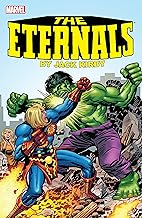
Reprinting: The Eternals (1st series) #12-19, Annual #1 (1977) Rating: * * * 1/2 (out of 5)
Number of readings: 1
Review posted: May 2024
This is the second of two TPBs collecting the original The Eternals series (including the sole Annual) written and drawn by Jack Kirby. This was from the period when Kirby had returned to Marvel (after jumping ship to DC a few years before) where he was essentially given carte blanche to create, write, and draw his own series -- to mixed effect. Kirby was a seminal, defining figure in comics, especially at Marvel, but left to his own devices (without a writer collaborator) his out-put could be problematic. Wildly imaginative, robust, energetic, and ambitious...while also being undisciplined, unfocused, and suffering from uneven characterization and dialogue.
His time at DC produced a number of memorable properties and ideas -- but most of them were cancelled within a short time due to poor sales. And his return to Marvel followed a similar pattern. At Marvel he took on a few established titles (like Captain America) but was more interested in creating his own, new ideas, and ones that operated at the fringes -- if not completely outside -- the Marvel Universe (Devil Dinosaur, 2001, Machine Man). Ironically for a guy who helped create the concept of the Marvel Universe, Kirby's solo work at both DC and Marvel was marked by a resistance to tying his new series in too much with the companies' overall mythologies.
It's perhaps a mark of Kirby's creative imagination that though many of these properties weren't successful at the time, many continue to get dusted off by later-day creators (I mean: there was an Eternals movie in 2021!). But equally, later-day creators haven't necessarily had much better commercial success with them than did Kirby himself.
All of which brings us to the second half of Kirby's Eternals series. And it perhaps illustrates the problems Kirby had -- that he could come up with great ideas, but even he seemed unsure what to do with them or where to take them. The premise of The Eternals (as detailed in the previous TPB) is that earth is home to three sentient races. Humans and two (until recently) unknown off-shoots: Eternals (who inspired many of mankind's myths and gods) and Deviants (who inspired tales of demons and devils). All three off-shoots were created by The Celestials -- giant, mute, god-like aliens who have returned to earth to begin a 50 year study of their experiment; at the end of which, they will decide if earth (and all its peoples) will live or die.
Whew! Heady stuff.
But it's in the execution that Kirby struggles. The first TPB was fairly engrossing, despite flaws, because it was the first, and laying out the ideas for this atypical series, Kirby establishing myriad characters so that even ostensible "lead" characters (like Ikaris) might get sidelined for a few issues in favour of secondary protagonists. Kirby obviously seeing this as a comic about the scenario as much as about any individual personalities (something that was also true of Kirby's New Gods series over at DC -- a property to which The Eternals has been compared). The fact that the Celestials' study will take 50 years and encompasses the globe indicates how much room Kirby was giving himself to play in.
But now that we're into essentially the second year of publication -- Kirby still seems to be reeling about creatively, as if getting distracted by his own fertile imagination. In the first couple of issues The Eternals undergo a ritual called The Uni-Mind -- where they literally unite to form a gestalt consciousness in order to grapple with the dilemma posed by The Celestials. Yet when that's over...little is said about it, as if even Kirby forget why he wrote that plot-line to begin with. Seeming major characters kind of fade into the background (like the Deviant Kro, who was a significant character in the first TPB) as if Kirby has lost interest in them, and new characters will get spotlighted for an issue. It's perhaps fair to suggest Kirby saw the comic as almost an anthology at times, where some issues focus on "guest star" characters (it's worth remembering that one of the comics Kirby worked on at Marvel in the 1970s was 2001: A Space Odyssey, an anthology comic).
And even the existing, main characters Kirby seemed to have trouble defining. Ikaris is sometimes defined as being grim and cold (in shades of Orion from The New Gods) but other times just seems like a generic protagonist. While the human characters who hang around The Eternals, Margo Damian and Professor Samuel Holden, mostly exist just to gape and gasp. For some reason Sersi (arguably the most vivid of The Eternals) seems to be interested in Holden -- but it's entirely unclear why, he has so little personality. It's as if Kirby settled on the idea (the vivacious Eternal interested in the drab professor) without really having any interest in exploring it.
In that vein, it's perhaps interesting that one of the strongest tales here is the Annual. The focus is on supporting characters introduced in the previous TPB (rather than Ikaris, et al) -- namely the Eternal Thenia and two outcast Deviants she's taken under her wing: the handsome-but-brutal, Reject, and the grotesque-but-kind-hearted, Karkas. And the story is very much built around the clash of personalities and ideologies; it's still a rather thin, vaguely defined plot (though evokes some interesting atmosphere as they go undercover at a hotel) but is memorable precisely because of the character focus.
Another memorable issues (#13) slots into the "anthology" niche as none of the "main" characters are involved.
The weakest story -- and unfortunately it consumes two and a half issues -- is one involving a robot Hulk going on the rampage and Ikaris and the others having to stop it. But how much it was an ill-conceived idea (it's basically just a lot of fighting), how much a reflection of my point that even Kirby seemed unsure what to do with his series, and how much it maybe reflected editorial pressure, I don't know. Given the series was cancelled a few issues later, it's possible Kirby was pressured (or encouraged) to plaster a "guest star" on the cover in order to try and boost sales and so the plot was simply an excuse for that.
I had observed that The Eternals seemed to exist outside the proper Marvel Universe. Indeed, the plot -- with giant Celestials, and the revelation of Eternals and Deviants, and the repercussions for the world (and the revelations about human history!), makes an awkward fit with the main superhero universe. So it's interesting that even with this ersatz, robotic Hulk, Kirby leaves it vague as to whether this is the established Marvel Universe or not (characters recognize the Hulk -- but refer to being "fans" of him, and his being a Marvel character; so is this the Marvel Universe world where the Hulk actually exists, or is this more like our world where he's simply a comic book/TV property?).
The result with this second TPB collection is somewhat hit n miss. There's still some good, memorable issues, and when Kirby's on, it can be dramatic and bombastic and Operatic in its sensibilities. But after establishing the ideas in the first TPB, one can also see the property (and Kirby) were maybe running out of steam. The very things that make this (and other Kirby properties) unique and admirable, can also point to the problems with Kirby's talents as a storyteller. Kirby's into the big ideas and the exciting concepts -- but often struggles with the characters and the story-of-the-month plotting. Yet surely it's those latter things that draw readers back, and which insure a series has a long publishing life.
The very things that make the series interesting and unique also hamstring it. Where could it go? How could it develop? Given the Celestials' 50 year study, it's not like Kirby seemed to be promising any quick resolution. And having the Eternals mostly be opposed to doing anything about The Celestials makes them weirdly passive protagonists (not to mention leading to repetitious plots: more than a few plots over these 19 issues involve the Eternals stopping someone else from fighting The Celestials!).
Still -- there are good and entertaining issues here. And though the comic was clearly cancelled prematurely, it doesn't end on a cliff hanger or anything, the final two-part story resolving in these pages (and it's a fairly strong swan song, Kirby at his best when he evokes a kind of quasi-mythological/Operatic feel more than a "superhero-in-the-streets" vibe). So like Kirby's New Gods/Fourth World, maybe part of its appeal is that we can imagine Kirby had great plans for it -- even if he didn't.
I've repeatedly mentioned Kirby seemed to try and keep this separate from the Marvel Universe proper -- but The Eternals were incorporated into the MU, and the outstanding threads from this run (including the judgement of the Celestials plot) was resolved in Thor comics collected in Thor: The Eternals Saga. And of course other creators have taken a whack at an Eternals series (or mini-series) over the years.
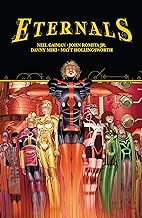
Written by Neil Gaiman. Pencils by John Romita Jr. Inks by Danny Miki & various.
Reprinting: Eternals (2006 series) #1-7
Additional notes: commentary/history of the Eternals & Jack Kirby (by both Mark Evanier and Robert Greenberger); interview with Neil Gaiman (from Marvel Spotlight); Gaiman's original story/plot pitch; character and pencil sketches; covers/variants.
Rating: * * 1/2 (out of 5)
Number of readings: 1
Review posted: May 2024
The Eternals -- created by Jack Kirby in the 1970s -- seems to be an eternally problematic property, one full of great ideas and potential...that is really hard to realize. Kirby's original was intriguing but uneven, cancelled in less than two years, with plot threads wrapped up in a subsequent Thor saga (collected as Thor: The Eternals Saga). In the 1980s the characters were dusted off for an epic 12 issue maxi-series that seemed to have more pages than ideas to fill them. Then Neil Gaiman, celebrated creator of The Sandman for DC before becoming an acclaimed novelist, dipped back into comics with this attempt (joined by popular artist John Romita Jr) at part revival, part reboot, part re-positioning.
Gaiman's mini-series starts out good -- maybe even among the best of the Eternals sagas...but, like those before it, looses steam and focus before its conclusion.
It's sort of an odd duck in that it's not quite a full re-boot (references are made to some past events and Iron Man, who appears along with a couple of other Avengers in a supporting part, remembers when Sersi was an Avenger) even as Gaiman cherry picks from the continuity and re-invents things to please himself.
The series is also, frankly, full of familiar tropes and themes (which isn't always a criticism, but just something to acknowledge). So the story begins with one Mark Curry, a New York City student doctor who is approached by a strange homeless man calling himself Ikaris who explains he, Mark (or Makkari), and others are actually Eternals who have somehow lost their memories and are living normal lives, ignorant of their true selves. Mark assumes he's nuts, but starts to question things when Ikaris heals miraculously fast after surviving an explosion and is then abducted from the hospital by mysterious men. And the story looks in on other erstwhile Eternals, living normal lives. Sersi is a flaky New York party girl who decides to start a party planner business, sinister Druig is a ranking official in a corrupt former Soviet country, Sprite is pre-teen pop star, etc. Various threads and schemes are in motion, from Druig's plot to kidnap western scientists, and creepy Deviants running about (the abductors of Ikaris).
It starts out pretty good. Eschewing the bombast of Kirby's original, or even the 1986 series, this is more a low-key thriller, with elements of horror (as befits Gaiman's oeuvre). Told initially through the perspective of Mark and Sersi, characters who have to learn about what's going on along with the reader. Gaiman (in an accompanying interview) suggested he wanted to write something that could be read equally by those who were familiar with the Eternals...and those coming to the property fresh, and it probably succeeds fairly well. For those unfamiliar with them, they can share Mark et al's surprise and incredulity; for those familiar, they can pick up on clues and foreshadowing (even as Gaiman plays fast and loose with established continuity -- to the point of wholesale re-inventing or changing things, like shifting the Eternals' home to Antarctica, or suggesting they are almost biological machines who get reborn like robots if killed!)
The art by John Romita Jr is quite strong. I always seem to come at JRJR's work expecting not to like it and then usually I do (and he is, for the most part, highly regarded among a lot of comics fans). Maybe it's because when he started in the 1970s his work was a bit unimpressive, or maybe because his style -- often stripped down, lacking realism to faces, etc. -- isn't necessarily my preferred art style. But his sense for storytelling and composition evolved over the years to be quite strong, leading to atmosphere where needed, and dynamism when appropriate. And he's aided by the inking here which maybe adds more contour and humanity to his characters and their environment than in some of his work. But this may stand as among the best work I've seen by him (and, as I say, despite my qualms, I tend to find myself liking his stuff more than I don't in general). Although -- and this may just be nostalgia speaking -- his decision to re-design the costumes results in less interesting/dynamic costumes than Kirby created. And my point about lack of realism/definition to faces may relate to my feeling there's a weakness in how well the characters work. But more on that in a moment.
Perhaps one of the curious things about this series is Gaiman implies he mainly reread Jack Kirby's original series to re-familiarize himself with the property, but had only a passing familiarity with the later series -- even as his series has clear echoes of the 1986 series (both end up revolving around an attempt to revive the Sleeping Celestial with some Avengers getting involved; and both series inject a heavy religious aspect into Deviant society).
Anyway, as mentioned, the series starts out pretty good, in a moody-thriller way. But for my money it starts to run out of steam, getting bogged down in talky scenes that are more abstract than human or compelling, plotting that doesn't always seem to make sense (though maybe I just wasn't reading carefully enough), and eventually a sense the series isn't really sure where it's going, why, or what to do with its threads. (In this collection is included Gaiman's original story pitch, and though the finished comic diverges somewhat, reading it actually makes some of the story clearer! Likewise, an essay by Robert Greenberger synopsizing the history of the Eternals serves as a nice primer for new readers).
Gaiman obviously went into this less to tell a stand alone Eternals saga and more to re-set and re-boot the property for ensuing adventures...even as he had no intention or interest in telling those adventures. Essentially like a TV writer brought in to write a pilot episode but with no intention of actually guiding any resulting weekly series. The result feels a bit half-assed and indulgent, with threads that never really build to anything (such as the Druig scenes). More like a proof-of-concept, with Gaiman pointing the way to future tales (by, among other things, bringing the series back to Kirby's original idea with a Celestial standing in judgement over the earth). If so, he maybe failed to prove the viability of his concept -- this was followed by a monthly comic (written/drawn by others) which was cancelled in less than a year! (And collected here).
One of the key weaknesses with previous Eternal series, I'd argue, is the characters themselves. But Gaiman fails to make them any more interesting. His Ikaris is just a generic hero (Kirby's original conception, with Ikaris as a grim, stoic type, akin to his Orion of the New Gods, was probably the most interesting take on the character...but even Kirby didn't seem entirely consistent with that portrayal). Makkari is sympathetic as Mark, but likewise a bit non-descript. Curiously, Gaiman takes the most vibrant character of Kirby's originals, Sersi, and changes her the most (she never fully recovers her memories or previous personality!). Other of the better (or at least most interesting) characters from Kirby's run, the deviants Kro, Krakas, and the Reject, are nowhere to be found in Gaiman's vision.
Moreso than the big concepts, engaging characters are the things most likely to sustain a series.
As I mentioned, this series trots out a lot of familiar themes and ideas (if you've read as many comics as I have, that is). From the heroes-don't-remember-they're-heroes hook to a story that exists, in part, just to kickstart a moribund property rather than act as a satisfying, self-contained tale on its own. Gaiman's use of Sprite reminds me of other tales where "edgy" writers overthink ideas from comics they read as kids, taking youthful/childish characters/concepts from old comics and using them for gritty re-imaginings. As well you can probably see echoes in this of other works by Gaiman (such as the novel American Gods and even The Sandman).
For me this started out strong, albeit with a decidedly different spin on the property. But my enthusiasm waned, and by the last couple of issues I was mostly reading just to get to the end.
Three takes on the idea (Kirby, Gillis, Gaiman). Three visions that stick with key aspects while re-interpreting others. And all three, to greater and lesser degrees, can leave you feeling the Eternals are a neat idea...if only someone, someday, can figure out how to make it work!
Back to
 Written & drawn by Jack Kirby. Inked by John Verpoorten, Mike Royer.
Colours: Glynis Wein. Letters: various.
 The
Eternals, vol. 2 (2008) 184 pages
The
Eternals, vol. 2 (2008) 184 pages
Colours: Matt Hollingswirth, with Dean White, Paul Mounts. Letters: Todd Klein.

 Eternals (2007) 224 pages