The
Masked Bookwyrm's Graphic Novel (& TPB) Reviews
The
Masked Bookwyrm's Graphic Novel (& TPB) Reviews
Batman ~ C (part 1)
for a complete alphabetical list of ALL reviews start hereA - B - C - D - E - F - G - H - I - J - K - L - M - N - O - P - Q - R - S - T - U - V - W - X - Y - Z
Batman: The Caped Crusader, vol. 1 (2018) 318 pages
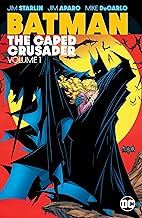 Written by Jim Starlin, with Mike Baron, Jim Owsley. Pencils by Jim Aparo, MD Bright, with Dick Giordano, Dave Cockrum, others. Inks by various.
Colours/letters: various.
Reprinting: Batman #417-425, 430, 431, Batman Annual 12 (1987-1988)
Additional notes: covers; character profiles from Who's Who Update '87 #2, 5
Rating: * * * (out of 5)
Number of readings: 1
Reviews: April 2024
The Caped Crusader volumes are part of a series of collections re-presenting the original, post-Crisis Batman/Detective comics in more or less sequential order (companion series include Batman: The Dark Knight Detective, collecting concurrent Detective Comics). Actually the post-Crisis continuity collections kicked off with Batman: Second Chances which collected issues just prior to the ones in this volume.
I say "more or less" sequential, because sometimes these collections skip issues readily available in other collections. So this run from #417-431 actually skips the four issues from #426-429 that make up the seminal, and initially controversial, Death in the Family story -- in which Robin II (Jason Todd) is murdered. It's actually slightly awkward in this collection, as there are no accompanying editorial notes. So we just have a bunch of issues with Batman & Robin -- and then for the final two issues, Robin is gone and Batman is (slightly) grim, but with little explanation for why.
However this collection does include the Ten Nights of the Beast arc. Possibly it's because Death in the Family continues to get re-issued and re-packaged in new collected editions, but it's possible Ten Nights of the Beast isn't as readily available these days.
One of the interesting things about this era is seeing the shifting creative/editorial decisions. With the initial stories by Max Allan Collins (in the first half of Second Chances, before Starlin comes on board as writer in that book) and Mike W. Barr (in The Dark Knight Detective vol. 1) there was a sense the Bat-franchise was trying to go Old School and let its hair down. In The Dark Knight Detective vol. 1, for instance, it was a continual parade of recurring super-villains hatching ludicrous schemes -- like the old Adam West TV series, only with less (deliberate) camp. But in stark contrast to Barr's run, Jim Starlin offers nary a recurring villain or even a costumed foe in sight (save, to some extent, the KGB assassin, the KGBeast, and an appearance by the recurring League of Assassins). Instead the villains are more down-to-earth: mobsters, serial killers, etc. And the tone is more sombre and low-key, like a crime drama series, more than a superhero series.
I also think it was Starlin who entrenched the idea of Batman narrating the stories in the first person that has been a staple of most Batman comics to this day!
Frank Miller perhaps test drove the idea in Batman: The Dark Knight Returns and Batman: Year One (reviews found here) -- although he shifted the narration from character to character.
But as with the Barr issues in The Dark Knight Detective -- the result is mixed.
As mentioned, this kicks off with Ten Nights of the Beast (which I review more thoroughly in its own collection) in which Starlin tries to work in real world geo-politics, by having a rogue Soviet assassin, nicknamed the KGBeast, seek to sabotage the real life Strategic Defense Initiative, and to assassinate then-president Ronald Reagan. The KGBeast is supposed to be a foe just that much tougher, more dangerous than any Batman's faced before and seems likely to have inspired the later Bane (in terms of visual design and creative intent); given how successful Bane became, Starlin probably regretted ending his saga in such a way to discourage a re-use of the KGBeast! The funny thing is I tend not to have any strong feelings about the story, but every time I re-read it I have to concede it's actually pretty good as an action-thriller. I mean, check your brain at the door; it's kind of goofy and with logic/plausibility problems (and moral/ethical ones). But just for sheer pacing/storytelling, Starlin and Aparo are masters of their craft.
Unfortunately, after these issues, Aparo disappears from the series until the final two issues here (probably because he was working overt-time on the Death in the Family issues -- two of which were double-sized!) It's unfortunate because I picked this up partly nostalgic for some Aparo Batman, Aparo one of the iconic Bat-artists of the 1970s and 1980s. And because he really is that good. Even if this wasn't his heyday (he used to ink himself, but by this point was being inked by others, like Mike DeCarlo) his work here is arguably noticeably more dynamic and striking than the other contributing artists.
Though interestingly Starlin started out an artist himself, and I think you can see his visual influence in the storyboarding throughout these issues, with the different artists often displaying similar scene breakdowns.
The ensuing stories reflect Starlin's efforts to evoke a kind of serious, adult vibe to the comic, with the stories more down-to-earth, filtered through Batman's brooding introspections. And though there is a kind of gritty/violence aspect -- serial killers, mass shooters -- in other ways it's actually less violent than a lot of later Bat-writers, in that Starlin focuses as much on detective work, on the procedural aspect, as on brutal fight scenes. And he writes a more human Batman, a guy who has to struggle to win a fight, one who sometimes can't quite land a punch in a brawl. Which actually makes the action/fight scenes more effective.
I generally associate Starlin with more sci-fi and cosmic comics. Him writing Batman seemed an odd detour in his oeuvre, him writing a down-to-earth, realist Batman even moreso.
The downside is that Starlin rarely delivers stories that stand out. The stories may be unusual for Batman, but kind of mundane otherwise. Maybe it's partly the very low-key, procedural aspect sapping some of the energy from the tales, the sense of thrills. And his attempts to tackle "serious" issues can often feel, well, comic book-y. Well intentioned but simple and shallow.
In one issue, meant as a "faces of the Batman" story where three cops trade stories highlighting different aspects of Bat's character, one involves him rescuing a Black junkie trying to commit suicide. When the junkie lists reasons he wants to commit suicide, one of them is because he's Black. Um, I get the white Starlin is trying to make a comment about society's racism -- but it can also come across as tone deaf and offensive. It's also not like Starlin is dealing with racism in other stories, or even has a lot of non-white characters (indeed, Starlin's penchant for using foreign bad guys can seem a tad racist itself!) Likewise, Starlin's attempt to deal with gender/sexism (in both the story about a serial killer and another about an abusive diplomat's son) can feel a bit like he's trying to write earnest stories...about issues he's only barely thought about.
Actually, that's not entirely true. The way he depicts the serial killer, and his misogynist ranting, is actually chillingly effective and incisive.
Maybe the cop-focused nature of these stories affects my attitude -- not that this is unique to Starlin. But I mean that given what we know about the world and systemic issues of prejudice and misogyny, it's perhaps hard to sincerely tackle such issues if you aren't prepared to ask how do cops (and conservative culture) contribute to it?
But as I say, in the plotting/twists the stories rarely jump above the average line.
This raises an interesting question about the art. As I mentioned, Aparo disappears from the comic, and intervening issues are drawn by the likes of Dick Giordano, Dave Cockrum, etc. -- legends of the biz, but all maybe past their prime. And MD Bright draws a couple of issues. Bright an artist I've liked in other comics, but not at his best here.
Aparo returns for the final two issues in this collection, one written by Starlin, another by Jim Owlsey (a.k.a. Christopher Priest) and they stand as among the best in the collection. Starlin's is a tight, almost real-time story of Batman tackling a spree killer shooting up a public square; Owsley's is an intriguing detective/investigation piece, but with interesting themes and flashbacks to Bat's pre-Bat training. My point is: are these just better scripts (in my opinion) including Starlin's? Or do Aparo's visuals bring them to life better, making them more emotional, more dynamic than the non-Aparo issues?
The other non-Starlin script is the Annual. And here's a recurring frustration I have with comics. Scripter Mike Baron eschews familiar costumed foes and treats us to an Agatha Christie-style thriller with Gothic horror overtones. Bruce Wayne attends an isolated weekend party where a planned Murder Game turns into the real thing. It starts out intriguing and, like with Starlin's stuff, seems to be aiming for a less comic book-y Batman -- only to kind of fall apart because Baron doesn't seem to know how to tell or plot a mystery. The suspects never really come into focus, information is thrown in willy-nilly, relationships aren't properly explained (some of this problems with the visuals). And there's a general everything-but-the-kitchen-sink approach to a story which starts out as a murder mystery but somehow climaxes with a demoniac figure emerging from an explosion! And the art by Ross Andru and, mostly, Pablo Marcos is uninspiring. The Annual also has a back-up Robin story that is almost an After School Special which maybe illustrates the whole problem with Robin in the series: should he be treated like a kid, in lighter adventures, or shoved into the gritty violence (like in one of the Starlin issues where Batman keeps sending Robin off on his own to discover bodies!)
Despite my negativity, this is still a decent enough collection -- at least if you are looking for a more "serious" Batman run. But I do find it curious how much stronger the final two issues struck me and that if the whole collection offered stories like those I'd happily boost this in my estimation.
Batman: The Caped Crusader, vol. 2 (2019) 300 pages
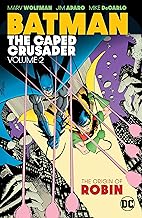 Written by Marv Wolfman, John Byrne, Jim Owsley (ak.a. Christopher Priest), others. Pencils by Jim Aparo, Pat Broderick, Michael Bair, others. Inks by Mike DeCarlo, John Beatty, Gray Morrow, others.
Colours: Adrienne Roy. Letters: various.
Reprinting: Batman #432-439, 443-444, Annual #13 (1989)
Rating: * * * * (out of 5)
Number of readings: 1 (some more)
Reviews: April 2024
Continuing DC's re-presentation of 1980s/post-Crisis Batman comics (in the two parallel TPB series: Caped Crusader and The Dark Knight Detective ~ reviewed elsewhere). This follows on the heels of the previous volume in which Jim Starlin was the main writer, who was clearly trying to give the series a more gritty, realist vibe, with little use of costumed foes and greater elements of social realism. But here the series seems to be settling back into the Goldilocks Zone of Bat-stories -- more outlandish than some of Starlin's tales, without becoming too over-the-top or stuffed with super-villains.
These stories stretch from just after the murder of Jason Todd (Robin II) -- with Batman, at times, being a darker, more driven figure, with even friends and allies noticing his mood change -- to the addition of Tim Drake, a.k.a. Robin III. Part of the problem with these collections is they are meant to present a consecutive run of the series -- but also skip over significant story arcs that are available in their own collections. On one hand, that makes sense: why fill the pages with stories a reader might already have. Equally, it means they fail to be an unbroken stream of continuity. The seminal storyline where Jason is killed was left out of the previous Caped Crusader TPB, and this one skips over the Lonely Place of Dying arc that introduced Tim Drake (soon to be a new Robin). So in this collection we have a run of issues with Batman being dark n broody, feeling the weight of Jason's death...and then suddenly we close with a two-part story in which Tim is part of the cast!
Yet the problem with deciding what to skip or include means there's still stuff the reader might have come across before -- namely this TPB includes the 4-part Batman: Year Three arc...that was also included in Tales of the Batman: Marv Wolfman vol. 1!
And actually from my point of view, the only story I hadn't read previously or didn't already have in my collection, was the John Byrne scripted three part tale, The Many Deaths of the Batman! (But that's my problem, not yours!)
Anyway...
Part of the reason I picked this up was for artist Jim Aparo. Aparo had a long, arguably defining association with the Batman in the 1970s and 1980s (the chief artist in the Batman team up comic, The Brave and the Bold, as well as occasional periods on Batman/Detective, and a longer tenure in this post-Crisis era -- although in the last collection, Aparo was only intermittently represented with a lot of pinch hitters). Aparo's style evolved and changed over the years (while maintaining signature elements). By this point he was no longer inking himself (mostly inked by Mike DeCarlo) but with his eye for storytelling/composition possibly at its peak -- the scenes unfolding cinematically before your eyes.
Jim Owsley (a.k.a. Christopher Priest) starts things off with a detective piece as Batman gets embroiled in a Cold Case -- re-investigating a child kidnapping from seven years before. Then we jump into a more bombastic story from the Annual, also by Owsley, with Bats breaking Two-Face out prison because he needs his help proving a man on death row is innocent. Both are solid tales, both attempting to be "smart" in different ways. Although I felt the moral dilemma in the Annual was problematic. Namely the story seems to present Batman as being driven and recklessly obsessive even as -- honestly? -- he has the moral high ground and it's Commissioner Gordon's indifference to whether a man is about to be executed for a crime he didn't commit that seems morally indefensible. I can't decide if Owsley genuinely thought Batman's actions were morally questionable, or whether he wanted to set up a "dilemma" but didn't want Batman to actually be in the wrong.
The Annual is drawn by Michael Bair and inked by venerable Gray Morrow. The result is a deliberately more realist vibe, with Batman looking like a man in a costume (we can even see his pupils!) while still being effectively moody and atmospheric (if occasionally a bit sloppy).
Then we get a three-part tale, "The Many Deaths of the Batman," supplied by writer John Byrne with Aparo on pencils. This may've been Byrne's only mainstream/solo Batman tale (as opposed to writing Bats as a guest star in Superman, or in an Elseworlds tale) and it's a pretty good, generic Batman thriller. And I mean that as a compliment. In that it is a familiar Bat-plot (a series of bizarre murders -- here, the victims are found in Batman costumes -- while Batman plays catch up, trying to figure out why and who) but even stretched out over three issues it's an engaging page-turner, with Byrne providing a likeable, level-headed Bats (despite being in the midst of the angry, post-Jason phase).
I mentioned I picked this up partly for the Aparo art, and the first issue of the Byrne trilogy is told almost entirely without words, the story told entirely with actions and facial expressions. And arguably Aparo could pull that off better than many artists. It doesn't even feel like a gimmick (though it obviously is!) since his storytelling is so clear.
Then we get to the four-part Batman: Year Three by writer Marv Wolfman (settling in as the new regular writer) and artist Pat Broderick. It's meant to further develop the post-Jason angst, while also delving into the long ago origin of Dick Grayson (Robin I/Nightwing). The earlier Batman Year One and Year Two were retro tales set in Batman's early days; this is set in modern continuity but with liberal flashbacks. It's a pretty strong effort, mixing the various elements -- the mythos building, the character insight and brooding, the detective-thriller-action. And for a long time was kind of unsung (despite, I'd argue, being better than Year Two). But as I mentioned, these days it's also available in Tales of the Batman: Marv Wolfman vol. 1!
We then skip A Lonely Place of Dying which introduced Tim Drake (soon to be Robin III) presumably because it's available in other collections.
So the collection closes out with a Wolfman/Aparo two-parter that is, to be honest, anti-climactic after a generally solid run of issues. You know how I said The Many Deaths of the Batman was generic but pulled it off well? Unfortunately this tale is generic in a generic sense. Not terrible, per se (albeit a bit grisly, with a killer able to make people spontaneously combust) but largely indistinguishable from a zillion other Bat-adventures over the decades.
Still, overall -- a pretty solid collection.
Batman: The Cat and The Bat 2009 (SC TPB) 128 pages
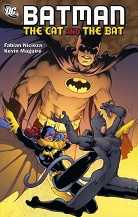 Written by Fabian Nicieza. Illustrated by Kevin Maguire.
Colours: I.L.L. Letters: Sal Cipriano. Editor: Mike Carlin.
Reprinting: Batman: Confidential #17-21 (2008)
Rating: * * * * (out of 5)
Number of readings: 1
Reviews: Mar. 2015
Batman: Confidential was the successor title to Batman: Legends of the Dark Knight in that it was used to tell self-contained arcs (usually flashback stories set earlier in Batman's career than contemporaneous titles) from changing creative teams -- with maybe the difference that it was less self-consciously pretentious than LOTDK.
Case in point is this deliberately breezy, fun romp -- and a story that focuses not so much on Batman, but on Batgirl (Barbara Gordon), likewise early in her career. And it chronicles supposedly the first encounter between Batgirl and Catwoman (who already at this point seems to have shifted a bit from a straight on "villain" to a
more morally ambiguous figure).
Barbara has borrowed (well, stolen) her dad, Commissioner Gordon's, private notebook for personal reasons, intending to return it before he's the wiser -- when it gets lifted from her, in turn, by Catwoman. This leads Batgirl to chase Catwoman across Gotham City, eventually getting them embroiled with Russian mobsters and even a journey through the sinister halls of Arkham Asylum. It's a deliberately light, simple tale (the five issue arc occurs over the course of a single night) with Batgirl's initial pursuit of Catwoman alone taking up a couple of issues (before she learns Catwoman has a possibly altruistic motive driving her larceny). Batman does eventually get involved, but as no more than a secondary figure, with the story remaining about Batgirl and Catwoman.
And it is for the most part a fun romp, full of quips and quirky turns, Batgirl basically a good-natured plucky heroine still relatively inexperienced and guileless, she and the more cynical Catwoman trading -- um, catty -- retorts as they duel. Kevin Maguire has a detailed, realist style, well suited to mixing the super heroic with the whimsy (he used to draw the JLA during its whimsical phase in the late 1980s) and with an eye for drawing pretty women without going too far and just making it a collection of Image Comics-style pin-ups. At one point, Batgirl has to pursue Catwoman into a hedonistic nudists club (even marking the cliffhanger between issues!) for a sequence that smacks of deliberate sexploitation (as Batgirl, determined not to be thwarted, strips down to her mask) but maybe gets a pass by virtue of its intended humour and whimsy -- is the scene salacious or just innocently comedic?
Although that does raise an issue when later in the story the plot involves the characters attempting to secure the release of a woman held by the mobsters -- and it's pretty explicit that she is the monsters' sex slave (Catwoman even thinking how she has been "abused"). It's an odd aspect to toss into a story ostensibly meant to be a light romp, particularly given the story arc's obvious nods to salaciousness. It kind of makes you wonder what exactly Nicieza and Maguire (and their editor) really think about women and sex and the like.
As well, the point of the story is first and foremost meant to be humorous (while still being a fast-paced action-adventure) and the humour stemming a lot from Barbara's naivety and inexperience (even though she's perfectly capable in a fight). And that's fine -- a story about an inexperienced crimefighter in the early days of her career. But it does seem to follow a pattern of a lot of "retro" Batgirl tales, playing up Babs' inexperience or else presented as a kind of "loss of innocence" tale as the naive Barbara must confront serious villainy. But it could be construed as a tad condescending toward the character, losing sight of the more common Batgirl (from the 1960s and 1970s) -- a Batgirl who was a more level-headed figure than the brooding Batman...but nonetheless equally competent and capable.
Still, putting aside quibbles about a trivializing attitude toward sexual violence and the fact that it might be nice to see a more confident Batgirl at work, The Cat and The Bat does succeed as a fun, brisk romp, with some amusing dialogue and enough story twists and turns to keep the pages turning. It doesn't exactly emerge as a graphic "novel," playing out more like a motion picture (the 120 some pages probably amounting to the equivalent of a movie) but is enjoyable on that level.
This is based on the original comics.
|
Mature Readers
Writer: Ann Nocenti. Pencils: Ethan Van Sciver. Rating: * * * 1/2 (out of 5)
A prototype gun that fires heat seeking bullets -- and so can never miss
-- is somewhere on the streets of Gotham and the underworld sets out to
locate it. Catwoman puts together her own gang, figuring if
she finds it first she'll cement her reputation as Queen of Thieves --
particularly when one of her competitors is a legendary thief who's come out of retirement
for the job.
First off, labelling this as Batman/Catwoman is a misleading marketing
ploy. Yes, Batman appears -- but it's basically a Catwoman story with Batman
just cropping up from time to time. Secondly, the (few) reviews I came
upon of this were, in a word: scathing. People seemed to hate it, in no
small part for its didacticism. One aspect of this story is to tackle the
whole gun question itself, and writer Ann Nocenti does go a bit over board
with talking head debates about pros and cons of the "right to bear arms",
and conversations that can seem a little too quick to run to debates rather
than believable dialogue.
Yet -- detractors notwithstanding -- Trail of the Gun is pretty good.
Nocenti is one of those comics writers -- few as they are -- who often
seems as though she's trying to be more ambitious than writing just the
adventure of the month. So yeah, there's the heavy handed gun debate part,
but there's also some character stuff and other themes threaded through.
And it's a surprisingly energetic little thriller. The plot isn't
all that complex, considering this was almost 100 pages (two 48
page issues), but it maintains a snappy tempo throughout. The narrative
technique can be a bit confusing -- starting in the middle, as we get a
"shock" opening of Catwoman waking up amid a pile of bullet riddled bodies
-- then flashback to how it began. You can kind of lose track of what's
when, particularly when you get to the second issue and you have to remember
that part of the story is still a flashback.
The portrayal of Catwoman is particularly effective, though whether
it quite meshes with the way she is usually portrayed I can't say for sure (honestly? She often seems quite different in different stories/eras).
She's a cynical, selfish character, a pettier character -- and, as
such, one that seems slightly less heroic, or "cool" and, therefore, more
vulnerable and intriguing. Yet, under her amorality, there's a glimmer
of a conscience seeking to peek through, creating a character arc. And
it makes her encounters with Batman more dynamic. Instead of emphasizing
the traditional sexual tension, Nocenti plays up her hedonism against Batman's rock
solid morality. In fact, I kind of like how Nocenti portrays Batman, both
here and in Batman/Poison Ivy: Cast Shadows -- as a humane,
compassionate, figure.
Another appeal of the story is just the milieu -- no super villains
(well, save a rock-faced goon who reminds you Batman lives in a slightly
surreal reality), no serial killers or "mobsters", per se. This is a kind
of real world of grifters and fringe dwelling low-lifes who aren't
good, but aren't Joker-style "evil" either -- low lifes who hang out
in the same bars and Catwoman knows by first name. There's even a legit gun
manufacturer who wants to study the gun himself. It gives the story a refreshing
down-to-earthness that can be lacking from Batman's usual battles with over-the-top psycho villains.
I've had mixed feelings about Ethan Van Sciver's art. He's got a meticulous,
detailed, realist style ala Brian Bolland but, as can happen with that
style (including Bolland) it can seem a bit stiff at times. And his penchant
for hyper-detail can make some scenes too cluttered. But, generally, I
liked it -- in fact, I liked it more as the story progressed. Partly because
of what I said -- there's a bit more reality at
work here than in a lot of super hero comics, so it benefits from a realist
artist. The story can be gory at times, with a couple of bloody gun battles
pushing this into "mature readers" territory. I'd like to say that in a story about guns and gun violence, the graphic
brutality is part of the theme. Except, Van Sciver has a history of drawing
brutal violence -- sometimes where it's not called for. So I'm more inclined
to say it's just Van Scriver's excesses rather than a carefully decided
upon intent. (I'm reviewing in this in the context of its time of publication -- so side-stepping Von Scriver's later Far Right turn).
It was also cool seeing John Costanza lettering -- an old hand-letterer
still at work in this age of computer-lettering programs!
So, yes, the story can be heavy handed in its moral debates --
but surprisingly less so as it goes, as the plot, and secondary themes
come to the fore. Besides, Nocenti delivers some nice bits even in that
vein, such as a nicely handled scene of Batman interviewing a young boy.
Yes, one could argue that Nocenti favours the anti-gun crowd and puts forward the argument that guns
are a substitute for those who feel weak and powerless -- not the image
macho gun owners like to project of themselves.
I came upon one message board where a (pro-gun) writer, who hated the
mini-series, also took exception to Batman being portrayed as an anti-gun
liberal, feeling Nocenti had completely betrayed the character. I'd make
the opposite claim, and that given Batman's history and origin, what's
more out of character is when writers have Batman be soft on guns.
I'm not a big gun fan, myself, so maybe I'm biased. But, as I said,
there's more bubbling beneath the surface than just an anti-gun sermon,
and it's this very thematic richness that helps bolster the story. Yes,
Nocenti can miss as often as she hits, delivering a clunky or heavy handed
scene as often as she delivers a sharp, cleverly written scene, but as
a mix of energetic, funky crime-thriller, character study, and socio-political
drama, well drawn, Trail of the Gun kept me turning pages -- and that's
the point.
|
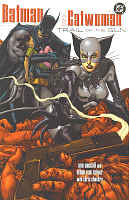 Originally a 2 issue, prestige mini-series pub. 2004; this was also re-issued as a single issue comic in 2011 as part of the : DC Comics Presents: 100 Page Spectacular line.
Or Back to: