Wonder
Woman: The Hiketeia 2002 (HC and
SC GN) 96 pages
Wonder
Woman: The Hiketeia 2002 (HC and
SC GN) 96 pages
Wonder Woman published by DC Comics
Wonder
Woman: The Hiketeia 2002 (HC and
SC GN) 96 pages
Written by Greg Rucks. Pencils by J.G. Jones. Inks by
Wade Von Grawbadger.
Colours: Dave Stewart. Letters: Todd Klein. Editor: Bob Schreck.
Rating: * * * 1/2 (out of 5)
Numberof readings: 1
mildly for mature readers
Wonder Woman has always held a problematic position at
DC
Comics. On one hand, she's the oldest continually published super-heroine
in comics, and one of DC's three most recognizable icons -- but her sales
figures have always been tepid, and the character seems to undergo "new
directions" almost every time there's a a change in creative teams.
The Hiketeia is one of the very few times she's been featured
in a "graphic novel" -- and it works hard to justify itself. At a whopping
90 pages, well illustrated, with a thoughtful, moody premise, it definitely
wants to be a semi-classic in the making.
The story has Wonder Woman (who is an official ambassador
from the island of the Amazons, Themyscira) being approached by a young
woman, Danielle, who petitions her using the ancient Greek ritual of Hiketeia,
begging WW to grant her protection/sanctuary. WW agrees, aware that the
Furies -- creatures of vengeance and justice -- are lurking about. But
when Batman (eventually) shows up, WW learns her charge is wanted for murder
(which the reader already knew). To honour the Hiketeia, WW must defy Batman,
and modern law...yet to hand the girl over, and thus betray the Hiketeia,
will bring the wrath of the furies down on WW.
I'll say early that The Hiketeia is a good story -- a
solid, haunting effort to craft a tale that seems to justify the prestigious
treatment. But though I've read quite a few reviews on the web that thought
it was brilliant, for me it wasn't that good.
It's a bit thin, with few characters or plot twists. Writer
Rucka is happy to let artist Jones' visuals tell a lot of the tale in a
cinematic way, with the verbiage sometimes minimized. It works reasonably
well -- there aren't many instances of gratuitous padding (where an artist
might waste multiple panels showing a character walking down a street).
Jones' panels effectively convey the essential elements of a scene through
the proper close ups, or angles, so the pictures do tell the story. And
the art is quite striking and lavish, aided by the melancholy -- but not
oppressive -- colours. Ironically, Jones is probably weakest drawing Wonder
Woman herself. Oh, he does her well enough, but his Batman and the other
characters -- and the environments -- are even more effective.
It's a 90 page story that, though not slow (it moves along
reasonably well), it is deliberately paced. There are even sequences that
smack a little of padding -- like where Danielle offers to tell WW what
happened, and Rucka milks four pages out of that before WW finally lets
Danielle tell her story. In fact, I'd stick my neck out and say the whole
story could've even been told almost as well in just a regular 22 page
comic.
That's partly because, in a condensed version, it's easier
to forgive short comings since, well, the writer had to squeeze it in.
At 90 pages, weaknesses are more glaring.
Maybe it's because we saw Danielle commiting her crime
and fleeing from Batman, but it's hard to believe WW is surprised to learn
she's a fugitive. I mean -- why else would she come to WW and beg protection
using this ancient and binding ritual of honour? If she was an innocent
victim, wouldn't she have just asked for help? And the way Batman and Wonder
Woman get into a bit of a pissing match over their moral impasse just seems
awkward -- not the way two rational adults who've known each other for
years would deal with the situation. Granted, super heroes getting into
conflicts with each other are almost as old as the genre, but it seems
awkward in this ostensibly high brow opus (not that the conflict is as
extreme as some would've written it -- though made goofy by WW punching
Batman from a second story window and across a street...a blow that would
kill him in reality).
The story builds to a downbeat ending -- Rucka clearly
trying to evoke the very notion of the so-called Greek tragedy. But there
needs to be a certain inevitability...and I just didn't think the characters
had quite been painted into that corner. With that being said, another
problem with the story is that by setting Batman and Wonder Woman on such
mutually exclusive courses, neither one even seems to be pondering a compromise.
I know some people would say that's the point...but as a narrative, it's
weak, since neither character has a plan.
And that's not even getting into the legality of things,
such as if WW's home is really an embassy...does Themyscira even have an
extradition treaty with the U.S.?
As mentioned, there are a very limited number of characters,
and even Batman, though he appears in a few scenes, isn't really explored
as a character -- other than just to act as his one note, I-am-the-Law
avenger persona. I know I'm a broken record, but I find the modern style
of comics, where dialogue is often terse, and thought balloons are entirely
absent, tends to rob comics of their emotional/character aspect. And in
a story like this, where the action is secondary to the drama, the characters
and their motivations and feelings are everything.
But even with Wonder Woman, who narrates, I felt more
could've been milked from the story. Things hinge on her determined to
honour this ancient ritual...even once she learns her supplicant is a fugitive.
But...why? Because her word is her bond...or because the Furies will tear
her to pieces if she fails the trust...or because she sympathizes with
the girl? The fact that all three factors seem to play into it suggests
that even Rucka wasn't entirely sure what her overriding motivation should
be. He liked the concept of WW being bound by an oath that put her at odds
with Batman...but seems a bit wishy-washy on the why.
What might have made the story more rich, emotionally,
is if Rucka had maybe shown us a WW becoming a bit jaded by the cynical,
corrupt, modern world. A WW who sees honouring the hiketeia as an attempt
to reassert the notion of honour and principals in her life...in much the
way one might do a story about a defense lawyer who defends a guilty client,
but believes that he is upholding a greater principal in doing so. Rucka
may intend that a little bit -- certainly at the beginning WW muses about
law and civilization -- but it's not clearly articulated.
I liked Hiketeia, in much the same way that I liked Batman:
Absolution -- because there is a dignity and ambition to it, an attempt
to tell a "meaningful" story. But the very fact that it has such lofty
ambitions, means it has to live up to them, in plot, characterization,
theme...and like Absolution, it doesn't entirely. Hiketeia is a good read,
certainly something that will sit comfortably on your shelf, particularly
given the rarity of great WW TPBs/GNs. It's not a "fun" story, per se.
It's not angling to be THE Wonder Woman adventure epic, but as a more low-key,
sombre piece it's a respectable effort. But the first half is stronger,
setting up the story, than is the second half, which attempts to deal with
the story.
And it is expensive, both in hard and soft cover (I got
it ridiculously marked down).
Soft cover price: $29.95 CDN./ $17.95 USA.
Wonder
Woman: Lifelines
1998 (SC TPB) 160 pgs.
Reprinting: Wonder Woman (2nd series) #106-112
(1996) with covers.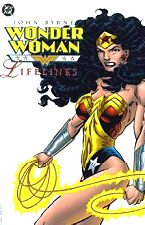 Written
and Illustrated and lettered by John Byrne.
Written
and Illustrated and lettered by John Byrne.
Colours: Patricia Mulvihill. Editor: Paul Kupperberg.
Rating: * * * (out of 5)
Number of readings: 2
As I sit down to write this, I'm
struggling to hold onto any vestiges of impressions I have from Lifelines.
The book can kill a few hours, I won't begrudge it that...it's just that
beyond that, there's little to say of importance. Or even to remember --
even after a second reading!
The first half has Wonder Woman
teaming up with the Phantom Stranger and (sort of) with Etrigan the Demon
to battle the sorceress Morgaine Le Fay (of the King Arthur mythos). The
second storyline (which had begun as a sub-plot during the Morgaine Le
Fay issues) has Wonder Woman battling unspeaking dopplegangers of dead
DC Comics characters such as the Silver Age Flash, and villains Sinestro
and Doomsday. The cause of these pseudo resurrections has to do with a
scientist who has attempted to recreate his dead son as a computer program.
Lifelines is sprightly paced and
moderate, cheesy fun but hardly a demanding read. John Byrne delivers lots
of BIG panels (often just two or three per page), lots of two-page spreads,
and lots of extended, city block destroying fight scenes, all held together
by the barest minimum amount of plotting and characterization he can get
away with. The scenes involving the grief stricken scientist, Dr. Lazarus,
work okay, but that's it as far as any real human emotion is concerned.
And even that aspect of the story wears thin because Byrne kind of does
all he intends to with it early on, then just repeats himself in the later
chapters. The story even ends with some (minor) threads still dangling!
Wonder Woman herself is an ill-defined
personality. Byrne gives her stilted dialogue, presumably to evoke her
mythological origins, but fails to make her a flesh and blood being. She
functions as a physical presence more than a human presence. And
throughout the stories, it's characters other than Wonder Woman
who figure out how to save the day! Likewise, Byrne's version of the Phantom
Stranger is more of a conventional crimebuster than the enigmatic figure
I think of him as being.
Still, it clips along, and the limited
panels prove the old saying about brevity being the soul of wit, in that
the very breeziness of it all, the very simplicity, is why it can be enjoyable
as just super herioc hijinks.
The art is decent enough. Once an
artist known for his smooth lines and intricate details, here Byrne's trying
for a sketchier style that's more evocative of Gil Kane's later style,
or Joe Kubert, without quite pulling it off as well as either of those
guys. Still, it's not bad, telling the tale well enough, though he definitely
needs shadows in his art, to create mood and dimension.
Why this run of issues was collected,
I don't know. Given that there aren't many Wonder Woman collections out
there (at least at the time), one wonders why these issues were
selected for special treatment. Perhaps it's the guest stars galore (something
I kind of associate with Byrne's work) -- Phantom Stranger and Etrigan,
plus bit parts and cameos from Arion, Superman, Vandal Savage, General
Immortus, not to mention the false versions of Flash, Sinestro and Doomsday,
plus Byrne-created Mr. Champion, a new superhero with a hidden agenda (introduced
here but not fully explored in these issues) and a new Wonder Girl who's
one of those precocious (a.k.a. obnoxious) kids that comics writers seem
to love creating.
There are some pages which are comprised
of only a couple of panels surrounded by huge margins that occupy half
the page -- though I think that was done to spread a single page over two
pages, to pace things out better for some of the two page spreads Byrne
indulges in (if that makes sense).
Check your brain at the door and
it's an O.K. time-waster...but nothing more.
Original cover price: $13.95 CDN./$9.95
USA.
Wonder
Woman: Love and Murder
2007 (HC & SC TPB) 160 pgs.
Reprinting: Wonder Woman (3rd series) #6-10 (2007)
Rating: * * 1/2 (out of 5)
Number of readings: 1
Reviewed: Jne 2015
Love and Murder was the second TPB collecting stories from the (then) latest revival of Wonder Woman. After a period of absence, Wonder Woman had returned to super heroing and, under the guise of alter ego Diana Prince, she works for the Department of Meta-Human Affairs (DOMA) -- basically an organization that gets called in on super hero related matters.
And the story here is...is...um...well, we'll come back to that.
Part of the marketing gimmick here is that the scripter is Jodi Picoult -- a respected and popular novelist who hadn't written for comics before. And that maybe reflects some problems. Oh, not with Picoult herself -- but with DC's editorial thinking. After all, the new series kicked off with an arc written by Allan Heinberg, a TV scriptwriter. So, basically, the first year of the new Wonder Woman comic was written by two different "temp" writers, neither of whom had any intention of sticking with the property.
What's more, you might think part of the point of hiring an outsider "name" to work on the comic would be to inject a fresh perspective. Sure, keep the writer on a leash (you don't want then messing too much with continuity) but nonetheless let them tell their version of a story. Instead one suspects the editor was riding herd over Picoult, basically making sure she turned in the sort of scripts that, well, any staff writer could turn in. To make matters worse, Picoult's tenure coincided with Amazons Attack -- that period's big crossover mega-event. Presumably further restricting her story options.
So the premise is that the Department of Meta-Human Affairs (DOMA) has orders to bring in Wonder Woman, still wanted for questions over the murder of a villain she committed months earlier (yes, even though this is a new series/new direction, it still seems to be cleaning up after the last run of the comic). Though even then it's unclear what's going on or why, as they sort of suggest Wondy had already been officially cleared -- and they sort of suggest she's still a wanted fugitive. But that's okay, because the story isn't really supposed to hold up to scrutiny, 'cause a lot of it involves mind-control and people not being who they seem, and a conspiracy afoot. This then ties into foe Circe (who was just featured in Heinberg's arc) stirring up the Amazons (who had left our dimension, but apparently not by much) and resurrecting Wondy's dead mother, Hippolyta (yes -- it's that easy) to attack the earth.
All of which might be interesting, if it seemed to tie together better, or build and develop more. Instead it just seems to lurch about from plot point to plot point, not really milking any particular mood or paranoia from the conspiracy angle. Nor making it clear always why people are doing what they are. Initially Diana assumes her mother is not her mother, or has been brainwashed, but by the end that doesn't seem to be the case. Heck, it's a little frustrating when the good guys wonder who a secondary villain is working for, and who's behind it all, only to have it apparently be Circe...because, um, the reader already knew that! (Now to be honest: maybe I wasn't reading this with as much attention as I should -- but, equally, if my mind was drifting, who's fault is that, eh?)
To make it all worse, the story basically ends on a bit of a cliff hanger -- largely because the Amazons Attack story carried on for a bit, though this was Picoult's last contribution to it.
This isn't to say Picoult doesn't do some nice bits. There are some cute quips. And she does some amusing stuff with Wonder Woman as Diana Prince struggling with "human" things like subway tokens.
And I don't really blame Picoult (though I'm unfamiliar with her novels) simply because this all smacks of her struggling with editorial edicts, and forced to operate within the on-going continuity, rather than being allowed to simply tell a beginning-middle-and-end story featuring Wonder Woman. She does try to invest the thing with a certain thoughtfulness, but frankly that itself becomes annoying. As scene after scene seems to involve characters having "deep" discussions about life and motives, but in a way that feels like a substitute for actual storytelling. More showing, less telling, please. Besides, it feels a lot like the characters are talking around things, but can't really come to any conclusions since, after all, Picoult is working with an on-going property.
I mean, a recurring theme here is Wondy wondering about "who she is" -- but that was the same thread in Heinberg's arc. While both writers are forced to struggle with the murder an earlier writer had Wondy commit when one suspects neither of them were comfortable with it.
Although I've enjoyed some of the other Wondy books from this era, this just causes me to dwell on issues I had with them -- and with a lot of modern super hero comics. Namely a feeling comics have moved further and further away from the real world. Instead of having a super hero surrounded by a plausible, normal life (old Spider-Man comics where, when not fighting crime, he was worried about rent and his relationships), we have Diana's civilian life involving the sci-fi tinged DOMA and partnered with Nemesis, a male sidekick (and possible romantic interest) who has a disguise/shape-changing device that makes him as much a super hero as her. There are super villain-themed bars and so many of the conversations revolve around being super heroes that there's little "real" grounding.
The art is good throughout. The new series started off with Terry Dodson (inked by Rachel Dodson) -- an artist certainly known for his cheesecake/Good Girl Art tendencies, but not so much so that it becomes disrespectful. Essentially the new Wonder Woman is supposed to be sexy enough to attract boys and respectful enough not to repel girls. And though the Dodsons only do two issues here, the other artists work in a more-or-less similar style. Admittedly, it's a hard-lined look that gives everything a slightly artificial, almost plastic look. The scenes and the figures lacking an organic warmth. Still -- it's nice art.
Ultimately, Love and Murder just feels too much like a filler run. Written by a writer who had nowhere she was taking the character, nor any specific plot she wanted to tell (I seem to recall reading Picoult more took on the gig to impress her daughter than because she had a burning passion to write Wonder Woman). The story gets caught up in a crossover saga that means it doesn't even resolve properly in these pages.
Honestly, you can't help but wonder what Picoult might have done if she was actually allowed to just tell her own plot, with a beginning and end. I'm thinking of other such projects like Batman: Blind Justice and Batman: The Last Angel by "outsider" writers that ended up satisfying as stand alone "graphic novels."
For those following continuity: the next TPB is The Circle
Cover price: ___. Wonder
Woman: Who is Wonder Woman?
2007 (HC & SC TPB) 138 pgs.
Reprinting: Wonder Woman (3rd series) #1-4, Annual #1 (2006-2007)
Rating: * * * 1/2 (out of 5)
Number of readings: 3
This collects the first arc from a newly numbered Wonder Woman series -- but it's not a completely new jumping on point, having plenty of references to what's gone before. At the same time, it perhaps better justifies the re-start than some, in that this follows on a (seeming) endless series of DC's "event" mini-series and cross company storylines which resulted in Wonder Woman (and a few other heroes) supposedly disappearing from the public eye for a year.
As such this new series picks up from that point: Wonder Woman, Diana of Themyscira, hasn't been heard from for months -- not since she killed a villain in one of those dubious comic book rationales of, "sure, you wouldn't want to make a habit of it...but hey, some people just need killing."
Trying to fill her boots is Donna Troy, the former Wonder Girl. And the story starts with Donna arriving at a hostage taking wherein some of Wonder Woman's old adversaries are demanding Wonder Woman come out of hiding and face them. Along with Donna, there are agents of the Department of Metahuman Affairs, including Nemesis (who seems to have undergone some personality changes since his days as a Brave and the Bold back-up feature by Cary Burkett and Dan Spiegle -- a series that could warrant a TPB collection, by-the-by). The Department is a government organization that acts as both a watchdog of, and liason with, the super hero community. And along with them is their newest agent -- Diana Prince, secretly the former Wonder Woman having renounced her super hero identity.
I came to this story arc backwards, having read issues from a bit later in the new series first. But Allan Heinberg's opening arc shares some traits with Gail Simone's later issues. And that is a strange, ineffable sense of...fun.
The story that unfolds (or careens) over the next few issues, climaxing in the ridiculously delayed final chapter seeing life as Annual #1 (when it was originally slatted for issue #5!), is fast paced, chock full of affectionate nostalgia as the story includes her various sidekicks like Donna and Cassandra (the new Wonder Girl) -- not to mention appearances from Batman and both the JLA and JSA, and involves a teaming of various of Wonder Woman's key adversaries (some that have barely been seen in years and so might hardly seem like "arch foes" to readers only familiar with the modern, post-Crisis Wonder Woman). Even the fact that Diana Prince dresses in a Mod-ish white jump suit and is an investigator might be a nod to a late 1960s/early 1970s era when Wonder Woman was essentially a private eye series. And though it's definitely heavy on the continuity references with all those familiar faces, and references to the killing that sent Diana into self-imposed retirement, it's generally well explained as you go and doesn't feel too much like a turgid wade through fanboy minutia. That is, you don't have to be an expert on all things Wonder Woman to get what's going on.
The plot is paced more like an old movie serial than a thoughtful drama, but has enough plot twists and talky scenes to have a semblance of substance. Heinberg structures his story rather cleverly, with its provocative title asking "Who's Wonder Woman" and a plot that has the Wonder Woman identity being passed around like a hot potatoe between different characters. So though you know it'll presumably end up being Diana by the end, you can pretend there's some mystery to it. As well, the title even takes on secondary meaning.
Perhaps the most controversial aspect of this "new direction" for Wonder Woman is having her assume the Diana Prince alter ego. When Wonder Woman was re-invented back in 1987, she was simply Princess Diana, ambassador from the Amazons. Fans of the last two decades see the use of an alter ego convention as a betrayal of that version. But Wonder Woman used a Diana Prince alter ego for 45 years before that -- so, to older fans, it can't help but be embraced as a familiar face. Besides, I'd argue giving her an alter ego is a less drastic change than taking one away -- it can be used as much, or as little, as the writer wants. Eliminate an alter ego, and it restricts story options.
And maybe it's because of the plain clothes alter ego that the story feels a bit lighter, a bit more relaxed, like it, and the character, is letting her hair down. It isn't that Heinberg has neglected the essence of the personality -- he doesn't have her talking in slang or cracking wise. But she seems more approachable, more likeable, and this likeability further adds to why the story works. And this is an approach that he applies to other characters, as well. His Batman is positively chummy. And you know what? It's nice to see. Part of this may be because Heinberg is a TV writer more than a comic writer, and so maybe less familiar with (or interested in) the direction the characters have been pushed in in recent years -- hence why his Batman is more evocative of the character from the '70s.
But the "fun" and lightness is a two edged sword. On one hand, instead of dealing with the emotional repercussions of taking a life (as Superman did in a similiar story -- again, 'cause some folks jest need killin') Heinberg acknowledges it but seems to want to move past it, avoiding passing a clear judgement on it, one way or the other, and not intending it as the foundation for the new series. There's an emotional light-weightness to the story overall. Diana's friends are miffed at her disappearance...but it doesn't really last. Donna is kidnapped by the villains, but though Diana wants to rescue her, you don't really get the sense that she's that worried. Even the core concept that Diana doesn't want to reassume the Wonder Woman roll doesn't really gel into any gripping emotional scenes. Plenty of super heroes have hurled their costumes dramatically across the room and sworn "No more!" With Diana, it more seems as though, well, she'd just rather not. Even the notion that the villains don't see themselves as the villains -- ideas rife with moral and emotional grey areas -- is tossed in and tossed off rather abruptly.
There's dubious logic at times, particularly in the climax and the abrupt way the conflict is resolved -- glaring given the long delay before it finally saw print.
As well, re-reading this recently (and maybe reflecting my changing attitudes) the emphasis on so much continuity, and dragging out an endless parade of friends and foes, leaves me mixed. On one hand, it's supposed to be gloriously nostalgic and is admittedly fun -- on the other hand, such fan-boy obsessive-ness can be overwhelming. Like sitting down to a proper dinner and finding, instead, a three-course meal of cake and ice cream. Fun at first -- but you start longing for greater substance after a while. The whole idea of making Wonder Woman's alter ego an agent with the sci-fi tinged Dept. of Metahuman Affairs just further untethers the series from, y'know, reality.
The art by Terry and Rachel Dodson I think, though, is a big appeal of the series. I say "I think" because I've had mixed reactions to the art, with Dodson's style a little cartoony, a little too plasticy (with skin sheening like plastic more than flesh). But at the same time, there's a pleasing realism, too, with Dodson eschewing too much exaggeration or distortion, for bodies that move like human bodies move. And his Wonder Woman is truly beautiful (save for her severe upper lip), walking a fine line of being sexy...without sliding overmuch into exploitive cheesecake. I think it's the open-lined art that adds to the sense of vivaciousness that seems to permeate the comic. And there's some clever details to the backgrounds and nice composition. When Diane finally transforms into Wonder Woman (in that swirling way that is probably the most ill-explained switcheroo in comics), it's a two-page spread that's positively...iconic. You can practically hear the 1970s TV theme playing in your ears.
Gary Frank (inked by Jon Sibal) draw a 13 page short (from Annual #1) that provides a convenient run down on Wonder Woman and her friends and foes -- usseful for the casual reader, though contains some of Frank's ugliest art!
It's the superficiality that keeps the arc from being great...even as maybe it contributes to why it's rather enjoyable. It's a breezy, super hero adventure, yet connected to the Greek mythology of the character, drenched in a respect for Wonder Woman lore and history, with a few nods to deeper philosophizing, and peopled by likeable enough characters.
Fun.
For those following continuity: the next TPB is Love and War
This is a review of the story as it was first serialized in the monthly comics.
Cover price: ___ Back to Wonder Woman reviews Page Two
Back to  Written by Jodi Picoult. Pencils by Drew Johnson, Terry Dodson, Paco Diaz. Inks by Ray Snyder, Rachel Dodson.
Colours: various. Letters: various. Editor: Matt Idelson.
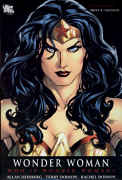 Written by Alan Heinberg. Pencils by Terry Dodson, with Gary Frank. Inks by Rachel Dodson, with Jon Sibal.
Colours: Alex Sinclair, with David McCaig. Letters: Rob Leigh. Editor: Matt Idelson, Nachie Castro.