 Plotting
by George Perez, Greg Potter. Script by Greg Potter, Len Wein. Pencils
by George Perez. Inks by Bruce Patterson, with Bob Wiacek.
Plotting
by George Perez, Greg Potter. Script by Greg Potter, Len Wein. Pencils
by George Perez. Inks by Bruce Patterson, with Bob Wiacek.
Colours: Tatjana Wood. Letters: John Costanza. Editor: Karen Berger.
Wonder Woman published by DC Comics
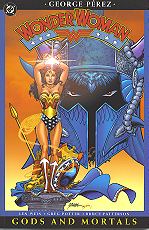
Wonder Woman: Gods and Mortals 2004 (SC TPB) 192 pages
Plotting
by George Perez, Greg Potter. Script by Greg Potter, Len Wein. Pencils
by George Perez. Inks by Bruce Patterson, with Bob Wiacek.
Colours: Tatjana Wood. Letters: John Costanza. Editor: Karen Berger.
Reprinting: Wonder Woman (2nd series) #1-7 (1987)
Rating: * * * (out of 5)
Number of readings: 2
Additional notes: intro by Perez; covers; related character profiles from Who's Who: The Definitive Guide to the DC Universe (which just recap what happens in this TPB and maybe should've been left for a future TPB collection).
As readily identifiable as Superman and Batman, and one
of the few comic book characters to be published, more or less continuously,
since the 1940s, Wonder Woman is considered a lynchpin of DC Comics. At
the same time, she's never been that successful. Some have claimed
that any other character with her sales numbers would've been cancelled
decades ago. But she's such a marketing icon -- gracing pillow slips and
lunch boxes and puzzles -- DC has never wanted to retire the property.
Supposedly part of the problem has been the difficulty
attracting first rate artists and writers to the book, or at least getting
them to tackle it with enthusiasm (after all, writers have included such
greats as Robert Kanigher, Denny O'Neil, Gerry Conway and Roy Thomas).
When DC Comics overhauled its line after the Crisis
on Infinite Earths, Wonder Woman was felt to be in desperate need of
a shot in the arm...a shot that came when super star artist, George Perez,
expressed interest in the title. Perez's run garnered almost universal
praise, visually and narratively, and boosted sales, though it still wasn't
enough to put her on a level with the genuine best selling comics.
I'd really wanted to read some of these early Perez issues
for a long time. Both because of the accolades, and because I do have an
affection for Wonder Woman, even as I agree with the consensus that her
lacklustre periods overwhelm any highlights. I, too, want to see her done
right.
Finally, DC re-released most of Perez's run starting with
this first of a four TPB collection. The good news is this is a decent
volume...the bad news, it still failed to excite me.
The first issue starts out establishing the back story
of the Amazons of Paradise Island, their connection to the Greek Gods,
and the "birth" of Diana...soon to be Wonder Woman. It reminded me a little
of the issue "The Pact" in Kirby's New Gods,
which crammed an epic saga of mythology into a single issue. But unlike
Kirby, scripter (and co-plotter with Perez) Greg Potter fails to make it
more than a Classic's Illustrated treatment. Although the mythological
aspect was always a part of Wonder Woman stories, Perez's run amped it
up considerably. But there's a certain lack of, well, bombast, in dialogue
and art throughout the "gods" scenes of this story arc -- it lacks the
kind of theatricality that used to make the New Gods, and Marvel's Thor,
fun...and full of passion and vigour.
There's also some aspects that start to veer uncomfortably
toward "mature readers" areas, what with the back story of the Amazons
being that they were once, briefly, conquered by Greeks (led by the demi-god
Heracles), enslaved, and raped!
The saga continues, echoing the familiar WW origin, but
with some twists, as WW rescues Colonel Steve Trevor and goes to America
to stop Ares, God of War, from unleashing some deadly master plan. The
comic starts telling its own story, introducing new supporting characters
(as well as familiar ones like Trevor and Etta Candy) and a plot mixing
super hero action, as Wonder Woman battles agents of Ares, with a conspiracy
plot as Steve Trevor is framed for murder. But even here the conspiracy
plot seems kind of perfunctory. It isn't exactly rife with paranoia, where
the reader isn't sure who to trust -- there're few surprise revelations
or double crosses. Even Ares' "plan" isn't some cleverly laid masterwork
of intricacies but just culminates with a few rogue troops loyal to him
hijacking a nuclear missile silo. It's a bit as if Perez had a vague story
idea that never quite gelled in his head.
In fact, one wonders if the problem with all those creative
cooks -- Potter starting things (then leaving, one assumes, less than amicably),
then Perez plotting, but getting Wein to script -- a lot of the nitty gritty
of logic and cohesion falls in the cracks. At one point, Trevor tracks
Wonder Woman down...but it's not explained how. And various stuff involving
a disk of Ares and a map seemed kind of inexplicable. Even the fact that
the Gods feel their time is ending if Ares wins -- but it's not explained
why. Okay, when you're dealing with magic and fantasy, some things just
have to be accepted as a given of the plot. But still... Even little things
like Wonder Woman using her tiara as a cutting blade when there was no
indication earlier it was that sharp, or her employing her magic lasso
in the climax...but it demonstrates a power that I don't believe was foreshadowed!
All this is nitpicking, I'll grant you, but it starts to pile up after
a while.
Still, when the saga (complete in this TPB) gets going,
the story picks up, and Perez (now joined by Len Wein as scripter) cuts
between the various cast members, and their various plot threads, occasionally
creating a sense of complexity. But it is more a sense than an actuality.
And for a seven issue run, even the supporting cast seems a tad undeveloped...or
maybe they are developed, and are just a bit bland (Etta Candy comes across
best).
Perez is a master of cramming lots of panels onto a page,
and letting writers cram words into those panels, meaning you get a lot
for your money...but the end result, strangely, doesn't really feel like
you're getting more story or characterization. It even seems a bit draggy,
occasionally.
There are clever, imaginative ideas, like having Wonder
Woman arrive in America only able to speak ancient Greek, or the eerie
depiction of the river Styx where river and sky merge into a grey background,
and the surreal vision of Mt. Olympus.
I used to love Perez's art and his intricate detail.
He breaks actions down in an almost cinematic way. And clearly landing
Perez-the-artist was seen as a big coup for the comic. But, I'll admit,
there's a certain stiffness to the figures, and there can be a certain
drabness to the scenes, particularly action scenes. And I mentioned before
the way the characters seem ill-defined, and that's partly attributable
to Perez's art which fails to entirely create memorable looks for the personalities.
Sometimes it's hard to tell who's who. I still like Perez's art, but I'm
no longer sure I love it.
One can't shake the feeling that a problem facing Wonder
Woman over the years...is that, like a lot of DC's heroes, she can be a
bit, well, bland. Her powers are a tad generic (Perez even gives her the
power of flight, dropping her nifty invisible plane, and making her even
more like just Superman with breasts). And her unique aspects -- like her
bullet deflecting bracelets and her lasso are rather under-employed. Perez
also drops the secret identity bit.
One would like to think that he did all that because he
had such a strong vision of this "new" take on the character...but the
very fact that he throws in so many supporting players, and robs her of
her ability to speak English (at first) actually marginalizes her even
more. I can point to some (less well regarded) Wonder Woman comics from
my youth (written by Conway and the like) in which I had a better sense
of WW as a person than I do in these issues. By introducing Trevor
as middle aged, Perez also seems to be shutting the door on any romance.
But most male super heroes have love interests -- it helps define the characters,
giving them something outside their super battles to focus on. By dropping
the romance, it's as if DC's saying -- rather misogynistically -- the only
way a woman can be a hero is if she's sexless.
In fact, the very emphasis on Wonder Woman, and the Amazons,
as agents of the Gods -- though no doubt intended to evoke the flavour
of old Greek myths -- could also be seen as sexist, as Wonder Woman and
the Amazons spend very little time initiating actions or plans.
It seems to me that Wonder Woman shouldn't be seen as
just a female Superman, but as the Silver Surfer
-- a quasi-pacifist (as much as a super heero can be a pacifist) fighting
the very idea of violence. After all, with her magic lasso, she
was already equipped with a great pacifist "weapon", and her bullet-deflecting
bracelets were also somewhat defensive. Perez and the gang certainly seem
to be thinking the same by facing her off against the God of War, where
Steve Trevor is a Liberal soldier at odds with his hawkish superiors. Unfortunately,
Perez doesn't follow through. Pretty soon she is scraping with the best
of them, blustering, and even using lethal force against demonic adversaries
while her (mainly military) allies get into shoot-outs with the villains.
I'm left reading a Wonder Woman comic where I don't really
feel like the creators have much of a handle on Wonder Woman.
And above all, that emerges as the problem here for me
-- I just didn't much care, about Wonder WWoman or her supporting cast.
Despite Wein being an old pro, and a writer I often like, he and Perez fail
to really humanize the personalities and relationships.
In his introduction, Perez admits that Potter actually
started the ball rolling, but that Potter basically quit when Perez started
to dominate (not just the title, but Potter seems to have left the biz
entirely). Perez states that some of Potter's proposed ideas didn't sit
well with some of the DC staff -- particularly the women. But Perez doesn't
say what those ideas were going to be. In other words, he basically
implies there was something sexist and/or offensive about Potter's ideas...then
acts all innocent, as if it would be inappropriate for him to say what
those ideas were. In other words, he slurs Potter, even as he pretends
he's not slurring him.
Cover price: $30.95 CDN./ $19.95 USA.
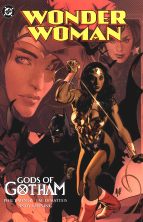
Wonder Woman: Gods of Gotham 2001 (SC TPB) 96 pgs.
 Written
by Phil Jimenez, J.M. DeMatteis. Pencils by Phil Jimenez. Inks by Any Lanning,
Cam Smith.
Written
by Phil Jimenez, J.M. DeMatteis. Pencils by Phil Jimenez. Inks by Any Lanning,
Cam Smith.
Colours: Pam Rambo. Letters: Comicraft. Editor:
Tony Bedard, Eddie Berganza.
Reprinting: Wonder Woman (2nd series) 164-167 (2001) with covers.
Rating: * * (out of 5)
Number of readings: 2
Before I get into the meat of the
book, the format is worth commenting on. It costs roughly half what it
would've cost if it had been published as a more conventional TPB. You
still get quality paper and elaborate colour, it's just the paper isn't
quite as expensive as most TPBs, and the cover is softer, almost more like
a magazine than a TPB. Bringing the prices down is soooo important to the
future of the industry. Cheaper books need to be encouraged. This story
was also subsequently included in the more standard TPB, Wonder Woman: Paradise
Lost (along with the next three consecutive issues)
Now on to the contents...
Three Greek gods have possessed
the bodies of Batman villains the Joker, Poison Ivy, and the Scarecrow,
and plan to open a dimensional portal in the middle of Gotham City that
will allow Ares, God of War, to come to earth. Wonder Woman sets out to
stop them, hooking up with Batman, and each bringing along with them their
"family" of sidekicks. For Wonder Woman there's Artemis, Troia (the former
Wonder Girl), and the current Wonder Girl, plus a brief stop over on Paradise
Island, for Batman there's Huntress, Nightwing (the former Robin), the
current Robin, and Oracle (the former Batgirl). And comic relief villainess
Harly Quinn also shows up.
Essentially this is another one
of those stories where part of the point is to arrange a massive team-up
between various characters.
This marked the beginning og Phil
Jimenez's run on the comic as plotter and artist -- Jimenez, the Man Who
Would Be George Perez, only he's possibly even a bit better than Perez
with his ability to create mood and employ more limbre figures. But the
down side is that Jimenez's art may be a little too busy: lots of little
panels crammed with lots of background and details. It can be overwhelming,
depersonalizing the human factor. Not to mention it's sometimes hard to
tell what's going on, particularly with how darkly Batman's coloured. Of
course Jimenez, with his Perez-influenced style, might bring a nostalgic
flavour to things, as it was Perez who rebooted Wonder Woman in the late
1980s (and, indeed, this story resurrects God villains encountered in Perez's
first
story arc).
As for the plot: the story hits
the ground running, which might almost be a part of the problem. Sure,
it means it starts fast...but there's little build up, little chance for
us to be drawn into the story. Tthe Gods have assembled a cult, headed
by another Batman foe, Maxie Zeus, and most of the story takes place in
a kind of inter-dimensional limbo located inside an old church. Structurally,
it probably works better as a collected story because it doesn't really
feel like something that should've been serialized. There aren't a lot
of twists or turns, nor does it shoot off on unexpected sub-plots. It's
basically an 88 page action sequenc that takes place in and around this
church/dimensional rift. Even a couple of the cliff-hangers that break
up the issues/chapters are kind of pointless, with a character declaring
something we already knew but acting as if it's a shocking revelation that
hooks us for the breathless "To Be Continued" notice at the bottom of the
page that then leads to the next chapter. And the climax is a little too
Deus ex machina.
There is some attempt at character
exploration, with various heroes confronting personal fears (the god who
inhabits the Scarecrow is, not surprisingly, a god of fear) and there is
some intriguing philosophizing about religion and faith here and there.
But a lot of it's heavy handed. The characters state ideas more than demonstrate
them. And the character-human emotion stuff is a little shallow anyway.
The best stuff is the always very "real" interaction between Teen
Titans buddies, Nightwing and Troia. So much so that one half wished
the story could've been just about them. There's also an amusing exchange
between Batman and Nightwing when they first hook up. But the main marketing
point, the teaming up of all the heroes, is part of the problem. With too
many heroes, few get enough space to simply be people.
In fact, this is another Wonder
Woman collection where I emerged out the other side still not really getting
a feel for who and what the writers in question picture Wonder Woman to
be.
I've been feeling old lately. Why?
Because although I'm the first to acknowledge that something like Gods
of Gotham is better drawn and better produced than the few Wonder Woman
comics I read from twenty years ago, as a human personality, I think she
was far more vividly realized in those older stories. In fact, just as
a scientific experiment, see if you can find The Brave and the Bold
#158 in the back issue bins at your local comic shop. It was also a Batman/Wonder
Woman team up. It's not a "must read" story, but see which realizes the
humanity of the characters better. Maybe I'm wrong. Maybe Jimenez and DeMatteis
do a better, more sophisticated job then Gerry Conway (in B&B). But
it'd be an interesting comparison.
Gods of Gotham has nice art and
it isn't dull, but neither is it exciting or particularly original, with
too much sameness throughout. The fact of the matter is -- I've read it
twice, and both times I never really connected with it, emotionally. In
fact, it's -- well, I hate to say it -- but it's a bit of a slog, "full
of sound and fury", but failing to engage as a story.
It's also curious how many of these
Wonder Woman collections I review on this page feature guest stars and
team ups, as if DC's not fully convinced a collection just featuring Wonder
Woman would do well.
Still, you got to love the cover
price!
Cover price: $9.95 CDN./$5.95 USA.
Wonder Woman: The Greatest Stories Ever Told 2007 (SC TPB) 192 pages
Written by Charles Moulton (a.k.a. William Moulton Marston), Robert Kanigher, Denny O'Neil, Elliot S! Maggin, George Perez, Phil Jimenez, Paul Dini. Pencils by Harry G. Peter, Ross Andru, Mike Sekowsky, Curt Swan, Jose Delbo, George Perez, Phil Jimenez, Alex Ross. Inks by various.
Colours/letters: various.
Rating: * * * 1/2 (out of 5)
Number of readings: 1
Additional notes: intro by actress Lynda Carter (from the 1970s Wonder Woman TV show)
Back in the late 1980s, DC released a few "The Greatest ___ Stories Ever Told" of Superman, Batman, The Flash and, I believe, team-up stories. Then they seemed to lose interest in the enterprise. Recently they started releasing such compilations again (now with the character name at the beginning "___: The Greatest Stories Ever Told") and in addition to brand new Superman, Batman, etc. volumes, other characters who never got such collections before are being included. Such as, obviously, Wonder Woman.
I have a certain mixed feeling about such "greatest" or "best of" collections, often feeling the stories included tend to be a mixed bag, only some (if that) living up to the title. Heck, the very fact that DC can release new Superman and Batman collections with only some of the stories carried over from the earlier versions raise the question as to how "great" can the stories be. Of course, it partly boils down to what the selection editors are going for: when choosing from, literally, hundreds of stories, are you picking the most representative...or the most unusual? Etc.
Still, as much as such collections rarely -- to my mind -- justify their titles, I've picked up a few over the years simply because, the flip side, is that it can be fun to get a volume featuring a bunch of different stories, hopefully most of them half-way decent.
Which, at last, brings us to Wonder Woman: The Greatest Stories Ever Told.
This collects ten stories of the fearless Amazon, culled from the last sixty some years. And, once again, I can't necessarily say too many strike me as "great" -- but there is a high entertainment level. Partly, I suspect, because I tend to have mixed feelings about Wonder Woman in general, so the bar wasn't too high. But also because there seems to have been a real attempt to try and capture various creative periods of the character in a way that some other such collections almost seem to shy away from.
The 1940s period is represented by two tales, one, the second half of Wonder Woman's first appearance, depicting her arrival in America during WW II (and it's interesting how the 1970s TV movie starring Lynda Carter actually borrowed scenes from it), the other, "Villainy Incorporated", is a fun 30 page epic that involves her battling a collection of her greatest foes, while aided by recurring supporting characters like Professor Zool and Etta Candy and the Holliday Girls, and the action moving from Amazon Island to America, so it acts as a nice encapsulation of that era.
The semi-classic Robert Kanigher-Ross Andru team is represented by three tales covering the 50s to mid-60s. And it's here some editorializing might've been nice, explaining the choices. Because the first two Kanigher are enjoyable ("Top Secret", "Wanted - Wonder Woman") -- corny, simplistic, sure, but well told and fun and, I'd argue, among the best in this collection. Then the third Kanigher-Andru tale ("Giganta - The Gorilla Girl") seems...odd. Andru's art style seems cartoonier, Kanigher's script seems deliberately campy. And then you realize, maybe it was a reflection of an editorial shift -- the campy Batman TV series was a hit on TV, so presumably Kanigher and Andru were told to tweak their styles in that direction. That story also features the "introduction" of villainess Giganta -- but she also appeared in the 1940s tale reprinted here, "Villaint Incorporated". Again, an editorial could've explained that this was a reflection of DC's decision to shift its Golden Age adventures on to Earth 2, allowing then to "introduce" pre-existing characters to their Earth 1 Wonder Woman as if for the first time (in fact the story ends advising readers to watch for the return of more Golden Age foes).
The late '60s are represented by O'Neil and Sekowky ("Wonder Woman's Rival") and although the story tries for a bit of sophistication -- it's a mystery -- like a lot of comics, it's not that successful as a mystery (it's not like there are a lot of suspects to choose from!). But it involves Wondy going undercover in a hippy hang out and battling bikers. Sure, it's pretty goofy at times -- the erudite Amazon slipping into hippy patois without blinking an eye. But I liked the fact that it's rooted, however imperfectly, in its cultural era. Often these type of collections seem deliberately to avoid such stories, preferring to select more generic adventures. But what's the point of collecting six decades worth of tales if they don't reflect their various decades? The tale's also energetically illustrated by Sekowsky and inker Dick Giordano.
From the seventies comes a tale guest starring Green Lantern ("Wish Upon a Star") culled from a period of tales where Wondy was being considered for re-admission to the Justice League, so each issue involved a different League member observing her as she tackled a crisis. Including such a story perhaps makes sense -- as the arc ran over a number of issues and so qualifies as a significant 1970s "epic" (an epic composed of self-contained chapters). Though I question a run of stories where the comics' star is, in a sense, reduced to more co-starring status, as it's the guest star who acts as narrator and focal personality. According to some reviews of this collection, some fans felt there were better examples of the "Trial of Wonder Woman" period, but I wonder if this was chosen for the inimitable Curt Swan art -- an artist not usually assigned to Wondy. And maybe because, with a new Green Lantern series (reviving Hal Jordan) starting up around this time, DC felt GL was momentarily trendy.
Robert Kanigher returns, pinch hitting an issue (the collection almost serves as a reflection of the way Kanigher's style could shift to suit the times) paired with frequent '70s/'80s Wondy artist, Jose Delbo, in "Be Wonder Woman...and Die!" Reflecting the changing/maturing comics styles which this collection does fairly well, it's a busy tale mixing everything from international terrorism, to spies, to overt references to the Holocaust, but its core involves a pathos-tinged story about an actress playing the part of Wonder Woman in a movie. Conceptually, it's one of the best tales here...but the execution doesn't do it justice, suffering from clunky dialogue, remaining more an okay story with some great ideas.
The final two stories are from the modern era of stories. One ("Who Killed Mindi Mayer?"), from George Perez's well regarded run as writer/artist, is an effectively compelling detective tale involving the murder of a recurring supporting character -- though it's not really that effective as a whodunit?, per se. The final tale ("She's a Wonder!") jumps a few years and is by another writer/artist, Phil Jimenez, whose art style is very Perez-influenced. Eschewing the super heroics, it's a largely expository piece narrated by Superman supporting character, reporter Lois Lane, as she writes a profile of Wondy. It maybe serves as a good overview of current Wonder Woman mythos (maybe too much so, as the constant continuity references can be a bit bewildering to casual fans) but as a story, it's not much -- and reflects the problem I feel about a lot of comics these days. It's trying to impress us by being a character-piece...but it's more telling us about the character, rather than portraying the character.
It's also interesting that both the final stories, like the earlier 1970s tale, are narrated by other characters, so that Wonder Woman herself can almost seem like a secondary character. I've said before that I often have trouble getting a grip on her character, because often times it feels like the writers themselves are having trouble getting a grip on her character, and the frequency with which writers find excuses to shift the focus away from her (or, at least, the fact that the selection editors would regard those stories as among the best) kind of makes me wonder if I'm right.
Both final stories also reflect a, perhaps, troubling trend in modern comics. Comics have long been viewed as primarily "boys" entertainment, but it seems in the last two decades as though, instead of fighting against that, comic creators with overactive libidos are now embracing that notion, as more and more mainstream, super hero comics feature ridiculously scantily clad heroines and cheesecake covers that are liable to put off female readers. There's not much of that here, to be fair, but there's more overtly salacious comments about Wonder Woman and her physique in the final two stories than in all the other stories in this collection combined! (A reflection of just how extreme this trend has gotten is the fact around this time, Playboy magazine featured a cover with a nude model wearing nothing but a painted-on Wonder Woman "costume" -- and apparently DC Comics wasn't particularly incensed at this depiction of their "inspiring" feminist icon!)
As mentioned, my biggest quibble is perhaps a lack of editorial commentary, explaining why these stories and establishing their place in a greater context (kind of like, well, what I'm trying to do with this review!) Maybe because they're hoping a collection like this will appeal to casual fans, or nostalgists, they thought it best not to get too confusing by explaining continuity, like the fact that, technically, this features three different Wonder Womans -- the 1940s stories became the Earth 2 Wonder Woman, the middle stories the Earth 1 Wonder Woman, and the final two, the post-Crisis Wonder Woman. (Actually, my favourite Wonder Woman stories tend to be from a period in the 1970s when they started doing retro tales of the WW II Wondy -- but maybe that would've required too much explanation). Likewise, other fans might have eras they felt were being snubbed, such as John Byrne's tenure as writer/artist.
Still, as I said, this is actually a pretty good collection, in so far as it tries to reflect the changing styles that Wonder Woman -- and comics -- have gone through over the years. How much that was intended, and how much just a reflection of the character (frequently working for the Dept. of Defense in her alter ego, maybe the stories can't help but reflect some of their shifting political climes, as Nazis, Cold War communists, and terrorists crop up in various stories) I can't say, of course. And, in other ways, the collection deliberately skips more extreme changes in the character -- during O'Neil's run, Wondy lost her powers and dropped her costume, becoming more a spy character (a style hinted at in the O'Neil story included here -- and, subsequently, DC released some TPBs devoted to that period entirely!). While during a later run, she was usurped of her role entirely and another character went around as Wonder Woman for a while. But as much as including such tales might have better reflected the character's long evolution, perhaps it was just as well to leave them out in a ten story collection, since most people picking this up will want to read about the spandex-clad Amazon named Diana.
Cover price: $__ CDN./$19.99 USA
Back to Wonder Woman reviews Page One
On to Wonder Woman reviews Page Three
Back to