The
Masked Bookwyrm's Graphic Novel (& TPB) Reviews
The
Masked Bookwyrm's Graphic Novel (& TPB) Reviews
Miscellaneous Super Hero Reviews (Page S-4)
for a complete alphabetical list of ALL reviews start here
A - B - C - D - E - F - G - H - I - J - K - L - M - N - O - P - Q - R - S - T - U - V - W - X - Y - Z
Super Powers by Jack Kirby (2019) 268 pgs.
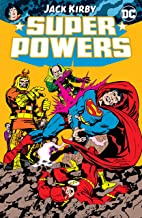 Written by Joey Cavalieri, Paul Kupperberg, Jack Kirby. Drawn by Jack Kirby, Adrian Gonzales. Inks by Pablo Marcos, Greg Theakston, Alan Kupperberg.
Reprinting: Super Powers (1984) #1-5, Super Powers (1985) #1-6
Rating: * * * 1/2 (out of 5)
Number of readings: 1
Reviewed: Feb 2020
Published by DC Comics
Jack Kirby was one of the most seminal influences on super hero comics, and clearly the feeling from publishers like DC is even today his name is a selling point -- hence TPBs like this one. (Whether he actually is still a marketable name for younger readers, I don't know).
Back in the 1980s DC produced three annual mini-series that were meant to tie in with/promote a line of action figures (sidenote: they've reused the Super Powers title more recently for a kid-aimed series, also collected as a TPB...just to confuse things!). These original mini-series were essentially Justice League of America stories in all-but title, and had no particular connection to any toys, except that they were clearly meant to be relatively stand alone reads (as stand alone as they could be drawing upon familiar heroes and villains) and written with a deliberately All Ages vibe: aimed both at the kids who would be buying the Super Powers line of toys, and adults nostalgically enjoying the old school roller coaster ride. Jack Kirby was brought on board for the first two mini-series (presumably part of that nostalgia thing) and it's both his series that are collected in this TPB (the third mini-series remaining un-reprinted).
Part of the fun to this is of course that Kirby had had very little involvement with most of these DC heroes. He co-created and worked on many of Marvel's most iconic heroes, but his DC work was mostly confined to his own creations (with the exception of drawing Superman during Kirby's run on Superman's Pal, Jimmy Olsen). So there's a definite novelty in seeing Kirby bring to life the Justice League in his distinctively Kirby-esque way (drawing Supes, Batman, Wonder Woman, Green Lantern, Flash, J'onn J'onzz, and many others, including Dr. Fate. The span of the series seemed to cross over the whole pre-Crisis/post-Crisis continuity hump, since it has the feel of the Silver Age JLA, but Dr. Fate was restricted to Earth 2 until after the Crisis on Infinite Earths) .
However Kirby's involvement in the series' is a bit erratic. In the first series he's credited as the plotter, but the first few issues are written by Joey Cavalieri and drawn by Adrian Gonzales, the latter affecting an atypical crude, cartoony style that seems meant to evoke Kirby. Kirby only comes on as full writer/artist for the final issue. So Kirby fans might feel more pleased with the second mini-series in which Kirby is the artist from start to finish -- except that may be all he is, since Paul Kupperberg is the writer and there's no reference to Kirby providing plots. There's a definite Kirby shadow cast over both series in that the villain is the Kirby-created arch-villain, Darkseid (although I don't think Darkseid was one of the toys being produced for the Super Powers line!)
The result is that if you like Kirby's visuals, the second series is obviously the more relevant. But if you like Kirby's storytelling -- the first is arguably the better. Although "better" is an ambiguous concept with Kirby. The first mini-series is more madcap, reflecting the kind of unrestrained, and undisciplined, creativity that was both Kirby's greatest strength, and greatest weakness. The plot careens about for its five issues, barely staying with one idea for more than an issue or two as Darkseid and his minions recruit various familiar villains (Lex Luthor, Joker, etc.) in their plan to ensnare the various heroes -- with Kirby maybe even inspiring later writers with a plot thread involving Darkseid unleashing the latent battlelust of Wonder Woman's Amazonian sisters and sending them to war on man's world (a plot used a few times since). It's goofy, nonsensical, but also kind of fun in its unpretentious boisterousness. Another way it seems very Old School is how there's a certain innocence to it, with even The Joker a throwback to being a wacky prankster more than the murderous sociopath he had evolved into by that point.
There's definitely an All-Ages vibe.
And Gonzales' art, crude, rough, and unpretty, suits the Kirby-esque flavour.
In contrast, the second mini-series, though now fully drawn by Kirby, feels a tad less imaginative. I mean, that's a relative term considering the plot involves Darkseid plotting to conquer earth and remake it using giant plant pods that will dig to the centre of the earth, and each issue involving a selection of the heroes thrown through time for an adventure in history (or, in one case, the future). But it's still rather formulaic and repetitive. It follows the archetypal "classic" JLA structure of the team breaking up into smaller groups, but each issue basically follows the same patterns of the characters arriving in the location of one of the pods, battling a few of Darkseid's minions, then getting tossed through time, where they battle more minions and some period-appropriate opponents (medieval knights, Roman gladiators) before returning to the present by issue's end. Heck -- at least twice the characters end up in a gladiatorial arena!
And I'm not sure Kirby's art here is really all that inspired in general. Whether just a reflection of his latter-day style, or because the stories weren't really playing to his strengths.
Likewise, writers Cavalieri and Kupperberg I think are deliberately trying to evoke Kirby's sometimes goofy childishness in the dialogue, without balancing it with the sometimes deeper, operatic gravitas that Kirby would mix into his better solo efforts. It's a lightweight imitation of Kirby.
With that said, there's a likeable charm to both series, especially if you take them as 1980s comics imbued with a bit of a 1960s sensibility. I had read the first mini-series a few years before and recall enjoying it precisely for its charming unpretentiousness. This time around I'm maybe feeling a bit more jaded, but there's still a lightweight charm at work.
Supermen! The First Wave of Comic Book Heroes 1936-1941 2009 (SC TPB) 192 pages
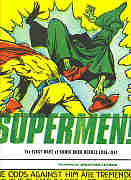 Writers/artists: various. Edited by Greg Sadowski.
Reprinting: various Golden Age stories.
Additional notes: intro by Jonathan Lethen; afterward detaling the creators and publishing history; covers.
Rating: * * * (out of 5)
Number of readings: 1
Published by Fantagraphics Books
Comic book history is littered with the colourfully garbed bodies of heroes who arose in the medium's various boom and bust cycles, maybe even attaining temporary stardom, but nonetheless have fallen into obscurity for all but aficianados and nostalgists. Every now and then, though, publishers come along and shine a little light on these forgotten heroes and their creators. The latest example is Supermen! from Fantagraphics Books which assembles old comic book stories from the first wave, when it seemed like every publisher -- and would be publisher -- was leaping into the new art form of comic books, offering up an array of masked heroes and adventurers to their public.
(Part of the impetus for this collection may have been recent comic book series like Dynamite's Project Superpowers and Marvel's The Twelve, which both resurrected obscure 1940s heroes for modern adventures.)
The obstacle to previous types of these collections has often been the copyright restrictions, making it hard to present an assemblage that includes anything but also rans. Not only do Marvel and DC retain the rights to their old characters, but DC inparticular has, over the years, bought up the rights to various other publishers' heroes. Nonetheless, Supermen! does manage to mix in a few less obscure characters like The Flame, the original Daredevil, the Comet, as well as characters that might be familiar now simply because of the Project Superpowers resurrection (The Face) with others that are pretty obscure, including a few spaceman adventure strips that owe more to Buck Rogers than to Superman. Likewise, the creators included remain well known names (even if this marks their early work), with Simon & Kirby, Jack Cole, Bill Everett, Will Eisner, Gardner Fox, Bill Wolverton, Lou Fine and others all on display.
But this remains a mixed effort.
When I was a kid, a local library contained a book about the Golden Age of comics that was a mixture of non-fiction commentary, and reproduced stories (covering everyone, including Marvel, DC, Fawcett, etc.). Although some stories were reprinted in their entirety, often the writer synopsized old tales, punctuated with a few panels lifted from the story. The result was that a lot could be crammed in (a picture isn't always worth a thousand words) and the synopsizing of the old stories probably made them sound better than they were. As an adult I've never managed to track down that book, or even recall what it was called (books I thought might be it, turned out not to be) and, sure, it might not be half as good as I remembered. But as such, you can understand why a guy like me born in the late 1960s, nonetheless, feels nostalgic affection for 1940s comic book heroes.
But the truth is, a lot of these comics aren't very good, though the art is often quite attractive. Simple by today's standards, there's a clean, classical elegance to the art of people like Lou Fine, Fred Guardineer, Michael Blake and others, a stylistic panache to Bill Wolverton, an energetic verve to Jack Cole and Bill Everett, and Jack Kirby...well, even back then, Kirby had an energy and dynamism, and a more expressive use of panels, that was setting him on the road to being dubbed the "king" of comics (in fact, though you can see echoes of his later style, it's also somewhat different).
It's in the writing the weakness are most pronounced. As a new art form, aimed primarily at kids, and with stories often only six or eight pages, and with creators churning them out for little pay and often between day jobs, the stories aren't just thin without deep characterization...they often aren't even logical, the exposition just there to bridge the action scenes rather than to tell a coherent story. What's funny is that they remind me of the sort of stories I wrote and drew as a kid (and I don't mean that in a good way)!
And I'm not sure I can entirely blame the period, as I've read other comics from this time which boasted slightly more coherent stories, and even witty dialogue.
Some of the better pieces are toward the end of the book (the stories presented chronologically), which maybe reflects the evolution of comics, and the creators now in command of their new medium. The best is Jack Cole's "The Claw Battles Daredevil" which pits the original Daredevil against the giant, monstrous Claw (an attempt by the publisher to create a series around a villain). And maybe because it's the longest piece here (16 pages) actually boasts some build up to the story, with "domestic" scenes of Bart Hill (Daredevil) out of costume, even uttering a few philosophical musings. Sure the action is only vaguely logical, but nonetheless it tells a fast paced adventure, helped by Cole's sense of wit and humour...even peppering it with a few pop cultural references. (And Cole's earlier Comet story is also among one of the more memorable -- the Comet fired lethal eye beams from a visor and may well have served as a visual inspiration for the X-Men's Cyclops).
What's most disappointing about this collection (when contrasted with that long ago volume I got from the library) is the lack of editorializing context. There is some, but most of the text material is devoted to the creators, the publishing history. All well and good and interesting. But it doesn't place the stories or the characters in any context. This is particularly awkward because, despite being billed as containing "twenty full-length stories", a few of the reprinted pieces are merely episodes in a serialized story arc, so it would've been nice to include more of a "what went before/after" introduction.
And even with the behind-the-scenes comments, there isn't much effort given to placing these figures in their creative milieus. For instance with Marvelo, The Monarch of Magicians, the text piece alludes to DC's Zatara...but doesn't point out how they were both obviously inspired by the newspaper strip, Mandrake the Magician. Nor is there any mention of just where the hero Silver Streak fits in to the pantheon of 1940s speedster heroes like The Flash and the Whizzer.
Obviously a collection like this is hobbled by the lingering copyright restrictions, but still, within the context of that, and their specific time frame, it does a credible job of sprinkling some "names" among the curios. But without some better text pieces explaining the characters and their adventures, the stories are left to stand on their own...and other than as a nostalgic glimpse at long ago, few really hold up that well. The book bills itself as covering 1936-1941 -- which might mean they were thinking of releasing later volumes which, given my suggesting the stories are better toward the end of this book, might mean a collection covering, say, 1941-1946 would be even better.
Cover price: $__ CDN./ $24.99 USA
Back to