The
Masked Bookwyrm's Graphic Novel (& TPB) Reviews
The
Masked Bookwyrm's Graphic Novel (& TPB) Reviews
Inhumans Graphic Novel and TPB Reviews ~ Page 2
for a complete alphabetical list of ALL reviews start here
A - B - C - D - E - F - G - H - I - J - K - L - M - N - O - P - Q - R - S - T - U - V - W - X - Y - Z
for other Inhumans appeareances try Fantastic Four, Silver Surfer, and others
Inhumans published by Marvel Comics
Marvel Masterworks: The Inhumans, vol. 1 (2009) 240 pages
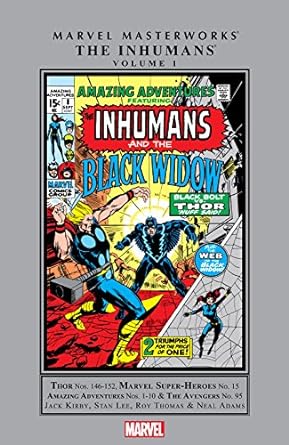 Written by Roy Thomas, Jack Kirby, Stan Lee, Archie Goodwin, Gerry Conway, others. Pencilled by Jack Kirby, Neal Adams, Mike Sekowsky, Gene Colan, others. Inks by various.
Colours/letters: various
Reprinting: the Inhuman stories from Amazing Adventures #1-10, Marvel Super-Heroes #15, Thor #146-152, The Avengers #95, plus (in some editions) Inhuman stories from Not Brand Echh #6, 12 (1967-1972)
Additional notes: intro by Mark Evanier; covers
Rating: * * * (out of 5)
Number of readings: 1
Reviewed posted: Oct 2024
This collects mostly the entirety of the Inhumans early solo stories in various venues (from a back-up series in Thor to sharing pages with the Black Widow in Amazing Adventures). Unfortunately being originally guest star characters (notably in The Fantastic Four) it does mean you aren't really getting the "complete" early Inhumans as the characters and their milieu is already established and they occasionally make references to lore established outside these pages.
I suppose in this day of "Epic Collections" it might be interesting to do a complete Inhumans volume, interweaving their FF appearances with their solo stories -- but I suspect there isn't really the commercial demand for it. Because, to be honest, the Inhumans have always seemed like a potentially cool concept in search of a cool execution.
The premise, of course, is an entire city of people with unique powers and mutations (basically shades of much later X-Men stories) ruled by a royal family who serve as the main heroes or superhero "team". They are led by the idiosyncratic Black Bolt, a character with various powers, but must remain mute because his barest utterances can unleash devastating sonic booms. His wife is Medusa, with prehensile hair, and who was created first of the Inhumans, appearing as a member of the Frightful Four who bedeviled the Fantastic Four (it was later explained she was suffering from amnesia when she fell in with the villains); then there's Gorgon (with his stomping hoof-like feet), Triton (an aquatic fish man), and Karnak (who looks slight but can home in on and detect the weakness/fault line of anything and so with a simple karate chop wreck it -- making him arguably one of the earliest Martial Arts-inspired comic book heroes, not just in using karate, but the idea of the small figure besting someone greater through skill rather than might).
The initial testing of the Inhumans as a solo feature was a back up run in Thor by Lee & Kirby that was meant to fill in the history -- and pre-history -- of the Inhumans, basically a follow-up to their myth-based Tales of Asgard series. But it maybe doesn't do much to prove the characters capable of carrying their own series.
A slight outlier in this collection is the Marvel Super-Heroes issue (essentially a try-out comic like later Marvel Premiere, Marvel Spotlight, etc.) with a new feature and some reprints each issue. In this issue the new story is a feature-length (ie: 20 pages or so) Medusa solo adventure by writer Archie Goodwin and drawn by Gene Colan (inked by Vince Colletta). Remember as I said: Medusa was introduced before the other characters and so was perceived as having a higher commercial profile. It's a pretty decent adventure (involving Medusa getting entangled with her former cohorts in the Frightful Four), the first time I really did start to perceive Medusa and her power as kind of, well, cool, and like she really could carry a series (maybe suggesting later writers failed to capitalize on that). Of course it may just be that Gene Colan's stylish, dramatic art helped.
Then we get the start of the first true solo series for the characters in initially 10-page instalments in Amazing Adventures (the Black Widow getting the other ten pages -- not reprinted here, of course). What makes the first four issues (two two-part stories apparently prepared when they had intended to start the team in a solo mag) are not just drawn by their creator/co-creator, Jack Kirby -- but written by him, too! Presaging his jump to DC Comics and his transition to almost exclusively writing his own stuff.
The Inhumans would seem right up Kirby's street, evocative of ideas he later explored in The New Gods and the Eternals. And there's some of that mythic grandeur (including the second story where they uncover the ruins of a lost city). But in most respects it's kind of bland and doesn't seem to have a strong direction (since Kirby left Marvel around then, it could be he wasn't really putting his all into it).
A significant stylistic change comes with the next creative team -- Roy Thomas and Neal Adams. Thomas seems to have a better sense of how to write a team, and splitting the story/characters into threads, and Neal Adams' sinewy, realist art is far removed from Kirby's craggy stylism. Thomas and Adams collaborated on a run of the X-Men which, at least in time, came to be well regarded, as well as the Avengers' instant classic, the epic Kree-Skrull war. So they would seem just the team to ignite the so-far moribund series.
Thomas launches a few plot threads, almost as if trying to see which tone suits the characters best. So arch foe, Maximus (an example of my point about drawing upon lore from stories not here, because we barely have much sense of who Maximus is prior to his appearance) tries to trigger a war betwen humans and Inhumans, but then we also have a more low-key thread where Black Bolt visits America, gets embroiled in more street-level malfeasance and loses his memory, including that he has super powers (creating suspense for the reader since if he speaks...boom!) There's even a stab at relevancy with some Black militants (issues around racism and poverty tackled in a typically fence-sitting way).
But despite the characters/series looking great under Adams pencils, and Thomas trying to figure out what to do with them, it still feels like a series struggling to find itself -- not helped by Thomas handing things over to Gerry Conway periodically (not a Conway diss, just that the creative hat keeps getting passed around). Then Thomas and Adams are gone and a new visual style is introduced by Mike Sekowsky, former Justice League artist who, by this point, has developed a much more quirky style. Conway is still writing, and the final two issues (now taking up the full pages of Amazing Adventures) have them tackling Magneto (still an utter villain, this being before his later evolution into a more nuanced antagonist). Plot threads are still left dangling, which led to the characters being introduced into an Avengers issue (with Thomas & Adams back on the creative team) to wrap up plot threads -- although since this was in the midst of the aforementioned Kree-Skrull war, the Inhumans may get some closure but the Avengers stuff is left dangling in mid-story.
Also included -- in the e-book version, not sure if it's in the print book -- are some random Inhumans-themed shorts from Not Brand Echh. Not Brand Echh was Marvel's stab at a Mad or Cracked style parody mag, but with a focus on spoofing their own (or other) comic book characters. I'll admit -- for the most part it didn't seem that funny. And with a lot of reliance on pop culture references that will have fading meaning as time goes by. In one story it's a spoof of romance comics with Medusa being wooed by caricatures of rock stars like Ringo Star and Tiny Tim (told you it was getting obscure). Although another story imagining the Inhumans in the style of various newspaper strips of the time (Peanuts, Pogo, Dick Tracy) was kind of clever -- if you recognized the resonance.
Ultimately this is a not uninteresting collection exactly, certainly with some intriguing and varied writers and artists dropping by. Arguably having those changing creative hands hindered the Inhumans ability to really find itself as a property. Or the fact that they kept swapping out creators was a sign no one knew what to do with them. The biggest problem I'd argue (both here and in the subsequent volume which collects their own series) is writers failure to engage with the characters as a team, figuring out personalities, relationship dynamics, and sub-plots for them. None of the characters really emerge as people you invest in (though as I say: the Medusa solo story suggests they have the potential).
Marvel Masterworks: The Inhumans, vol. 2 (2009) 320 pages
 Written by Doug Moench, with Scott Edelman, Marv Wolfman, and Peter Gillis, Jo Duffy. Pencils by George Perez, Gil Kane, Keith Pollard, Al Milgrom, Bob Hall, others. Inks by various.
Colours/letters: various
Reprinting: The Inhumans (1st series) #1-8, 10-12, Captain Marvel (1st Marvel series) #52, 53, The Fantastic Four Annual #12 (1975-1977) - plus, short tales from What if? #29, 30, Thor Annual #12, Marvel Fanfare #14 (1981-1984)
Additional notes: intro by Moench; covers of the main comics; vintage pin-ups
Rating: * * * (out of 5)
Number of readings: 1
Reviewed: Oct. 2024
The Inhumans are a genetically engineered off-shoot of the human race that live in hiding and isolation in the remote city of Attilan, every member with a unique ability and even appearance -- basically the X-Men but an entire community. Generally the tales focus on the royal family: Black Bolt, their powerful leader who must remain mute because his voice releases devastating sonic booms; his wife Medusa, she of the prehensile hair; as well as Gorgon, Karnak, and Triton. Plus with Crystal and her husband, the mutant Quicksilver, in the wings.
This second Marvel Masterworks volume collects the entirety of the Inhumans first solo, self-titled comic (after having previously appeared in back-up series, and as guest stars); as well it collects a few subsequent appearances in other comics from that period, mostly tying up plot threads left when this self-titled series was cancelled. And then it wraps up with a few "orphan" short stories.
I've written before that there can be an appeal to collections that form a "graphic novel" -- even if not intended by the creators at the time. And this is a case in point. Although the 12 issue series (well -- 11 issues, as one was an older reprint and not included here) has various plots that might spread over a couple of issues or so, each adventure leads to the next, linked by a bigger arc. Hence why, after the series was cancelled, it was felt dangling plot threads needed to be tied up -- however imperfectly, and by other creators.
The result is a kind of graphic novel, with a beginning and end.
Sometimes it's fun to discover an old, semi-obscure series, finding a diamond in the rough, or at least something that has aged better than you might expect (maybe a series that failed to sustain sales month-to-month reads better in a collected edition). Some such gems that come to my mind include such 1970s series as Omega the Unknown and Deathlok.
And sometimes short-lived, failed series...well, failed for a reason.
To be fair, the Inhumans are generally a problematic property -- intriguing, brimming with potential, but despite various series, mini-series, and specials over the years, rarely achieving any lasting success.
And when looking at a series like this, it's unclear of the behind the scenes factors. Had Moench pitched the idea to Marvel himself? Or had he enthusiastically signed on when Marvel announced the intention to launch the Inhumans into their own comic? Or was it simply a gig, something to bring in an extra paycheck? In the intro to this collection, Moench waxes enthusiastically about the historical antecedents to the Inhumans (who are the result of alien genetic manipulation in the distant past) -- somewhat, um, credulously citing the "ancient astronaut" theory of some pseudo-scientists. He acknowledges Erich von Daniken is not embraced by mainstream scientists and historians, while citing Zecharia Sitchin as though more credible (spoiler alert: he isn't). I point this out because in his intro Moench seems more interested in pontificating on these dubious theories, or paying homage to Stan Lee & Jack Kirby (the creators of the Inhumans) than in reflecting on his own tenure on the series (other than giving gracious nods to his artist collaborators).
The thing is, these run of issues seem as though Moench hits the ground running, wanting to craft an epic. As mentioned, the various plots are interlinked, ominous foreshadowing thrown in almost from the get go. Yet without it clear that he actually has a larger plot in mind or whether, instead, he was hoping something would come to him in a few issues. The result can both seem like an unfolding epic...and like an unfocused saga careening about.
The overall arc is that the alien Kree (recurring Marvel aliens and the ancestors of the Inhumans) have taken a renewed interest in the Inhumans -- specifically wanting to conscript them into an intergalactic conflict called the War of the Three Galaxies. After a few earth-based adventures, Black Bolt and the main Inhumans set off into space, hoping to find a new home (where the Kree won't find them). But after a Star Trek-like adventure on an alien world (with an, admittedly, intriguing culture aboard mobile city states) that takes a few issues -- they whip back to earth, discovering the Kree are engaged in covert mind-control deviltry (that has nothing to do with the Inhumans). It does feel a bit like Moench hasn't a clear idea of where he's headed.
The problem with setting up a multi-issue story arc is that it can be as much a creative crutch as creative inspiration. Like Wile. E. Coyote running into air, hoping if he doesn't look down he'll make it across.
Likewise, Moench fails to really do much with the main Inhumans themselves, when the obvious approach to a series with a team is to start focusing on the personalities, the interaction, even giving them sub-plots. (I was recently re-reading the early Claremont X-Men and realized that, despite its teething pains, what distinguished the team from so many other comics -- like the Inhumans -- was his clear recognition that the characters were the key).
But Moench's focus remains mostly on Black Bolt, with the others afterthoughts. Late in the series he tries to introduce the idea that Karnak is morose and insecure about his powers -- but never really develops it. It's like Moench realized he should so something with the characters, but isn't really invested in it. He adds a Kree character to the dynamics, but despite some initial depth, the character quickly just becomes another face for the artists to squeeze into the group-shot panels.
Without characters we can become attached to, without better crafted individual adventures, and without a stronger sense the overall arc really is building to something, it's perhaps unsurprising the series failed to catch on and was cancelled. It isn't that it's terrible stuff. There are some okay adventures (the sequence on the alien world). But nothing really stands out too much.
Even the art proves uneven, considering artists on the main series are George Perez, Gil Kane, and Keith Pollard -- the former two, especially, giants of the biz. Kane's work is pretty good, enlivening the story, but Perez's is less impressive. I don't know if that's simply because this was him early in his career, or he wasn't as excited about it (though in his intro Moench suggests Perez was), or whether it's that neither man was well-served by the rotating selection of inkers assigned. It's not that the art is bad -- and, as I say, Kane's work is pretty good -- but neither does it do much to enliven the scripts.
The Inhumans series was cancelled prematurely -- not on a cliffhanger, exactly, but certainly both the main plot of the Kree's War of the Three Galaxies, and a sub-plot with trouble brewing back in Attilan, are left in limbo.
The former is tied up in the two-issues of Captain Marvel (the first Marvel Comics character of that name). Mar-Vell being, of course, Marvel's resident Kree-born hero, so it made a reasonable place to tie things up. It's perfunctory, of course, and Scott Edelman's story probably isn't anything like Moench intended (assuming Moench intended anything). Especially when it turns out the cryptically named "War of the Three Galaxies" is just another variation on the Kree fighting the Skrulls. But it's also kind of an enjoyable wrap up -- precisely because the focus shifts to Captain Marvel and ties into on-going Captain Marvel threads, giving a taste of another series from that era. These kind of ad hoc epics where a plot gets resolved in another character's series being kind of a fore-runner of the later cross-title epics companies engage in all the time today, with some of the fun being sampling a buffet of titles linked by one plot.
Maybe by focusing on Mar-Vell (and sidekick Rick Jones) the story feels more focused than when Moench was juggling a half-dozen Inhumans. And since I was talking about art, the art on the first issue is by the combo of Al Milgrom & Terry Austin -- a pairing that whenever I come across it seems like it was a woefully underappreciated teaming, with Austin bringing out the best in Milgrom's pencils. I mean, in a collection featuring Perez, Kane, etc. -- I'd argue the Milgrom/Austin issue is one of the best looking of the collection. And this is contrasted with the next issue where Austin only inks a few pages, and the non-Austin pages (some possibly inked by Milgrom himself, or Bob Wiacek) look sloppier.
These Captain Marvel issues wrap up the Three Galaxies plot (though ignores a dangling thread involving a Kree-bred monster hunting the Inhumans, and equally shrugs off a conspiracy plot Moench had started to introduce in his issues). But there was still the thread of trouble brewing in Attilan.
That gets picked up in Fantastic Four Annual #12, by Marv Wolfman, drawn by Bob Hall and with Keith Pollard returning to the Inhumans. It's a bit of a mishmash. Again, the focus is more on the title characters (the FF) than the Inhumans (save Crystal -- who was actually under-used in the Moench run). And it brings in a super-powerful villain, the Sphinx, who Wolfman clearly had hopes for, since he had been introduced in Wolfman's Nova series and Wolfman brought him back for a few later issues of the FF (as part of the Search for Galactus saga). But I'm not sure the villain caught on much with other writers. So it feels like Wolfman is using the issue to tie up a few things (as well as throwing in a Hollywood satire sequence with the FF visiting a set of a movie about them that's meant as a spoof of Dino DeLaurentiis' King Kong that had been in the theatres around that time). There's lots of action but without much being inspired, in writing or art.
Still, it allows you to feel that threads have been resolved (even if not the way Moench probably intended -- after all, it's doubtful Moench intended the Sphinx to be the villain).
The short back up tales are a mixed batch, but benefit from variety. They maybe reveal that the Inhumans work best as a broad canvas to paint upon, with enough characters and backstory that the property almost works as an anthology, focusing on different characters and types of tales under the Inhuman's/Attilan umbrella.
BACK TO...Inhumans Page 1
Back to