The
Masked Bookwyrm's Graphic Novel (& TPB) Reviews
The
Masked Bookwyrm's Graphic Novel (& TPB) Reviews
Green Lantern / Green Arrow ~ Page Three
for a complete alphabetical list of ALL reviews start hereA - B - C - D - E - F - G - H - I - J - K - L - M - N - O - P - Q - R - S - T - U - V - W - X - Y - Z
The Green Lantern/Green Arrow Collection 2000 (HC) 368 pgs.
These issues were previously collected in two TPBs titled:
Green Lantern/Green Arrow: Hard-Traveling Heroes and
Green Lantern/Green Arrow: More Hard-Traveling Heroes as well as reissued as simply "volume 1" and "volume 2"
As well as a 7 issue deluxe format mini-series in the early 1980s which might be cheaper to track down in back issue bins or on eBay than the HC collection.
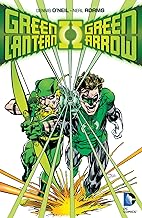 Written by Denny O'Neil (with Elliot S! Maggin). Drawn by Neal Adams. Inked by Dick Giordano, and Neal Adams, Frank Giacoia, Berni Wrightson, Dan Adkins.
Colours/Letters: various. Editor: Julius Schwartz.
Reprinting: Green Lantern (2nd series) #76-87, 89, Flash #217-220 (The Green Lantern back-up stories) (1970-1971)
Rating: * * * * * (out of 5)
Number of readings: a few times over the years
Originally published in the early 1970s, this collaboration between Denny O'Neil and Neal Adams is considered a comic book milestone. O'Neil teamed Green (Hal Jordan) Lantern -- very much the squeaky clean, Silver Age good guy who sees right and wrong as clear cut -- with Green (Oliver Queen) Arrow -- who had evolved by this point into a hot tempered idealist, more familiar with life's inequalities. It was the establishment ring-slinger paired with the urban Robin Hood. Then he did something kind of unusual -- he sent them off into the heart of real world America.
"Relevant" comics weren't unusual at that time. Over at Marvel Comics, Spider-Man and the Fantastic Four had long ago tackled racism, campus unrest and drug abuse, and Marvel had given the world ethnic good guys like the Black Panther, Joe Robertson and Wyatt Wingfoot. But at staid DC Comics, the winds of change blew a little more softly. As well, even Marvel hadn't gone the route of actually doing a run of stories where each adventure would revolve around social problems and moral dilemmas, either as allegories or by literally confronting the issue in a real world context.
Essentially Wojeck with super-powers (or Quincy for the later generation).
The initial story arc has the two Greenies, paired with one of the Guardians of the Universe, setting out to "find" America in a beat-up old pick up truck, confronting urban slums, Native rights and cults. Although the stars of the piece are the two super-heroes, the real impact is on the Guardian who, forced to come down from his lofty intellectual perch, undergoes a spiritual metamorphosis that leads to a bittersweet resolution. Along the way they team up with Green Arrow's on-again/off-again love, the Black Canary. Later stories drop the Jack Kerouac frame work, but continue to jump feet first into social issues. Some issues are what you might expect, disguising the issues in not-so-subtle SF parables and superhero trappings, most, though, are more literal. Though the stories are still, fundamentally, action-adventures, familiar costumed villains like Black Hand and Sinestro only crop up in a couple of stories, and space adventures only feature in three or four. And though the Guardians appear prominently in some stories, the rest of the Green Lantern Corps do not.
So what's the result, viewed all these years later?
Mixed, of course, but surprisingly strong. The stories are unashamedly heavy handed, and the result can be cloying and awkward, as characters break into political soliloquies, and issues are simplified so as to be crammed into twenty-odd pages. But the passion seems real, and the down and dirty willingness to grapple with big issues (most of which are, sadly, still relevant today) is, at times, well...damn intoxicating in its very audacity. At other times, the passion -- the anger -- is a bit disconcerting, suggesting maybe O'Neil was working through some personal issues, with the characters a bit too quick to relish fisticuffs (not that he's the first comic book writer who seems to be working out some pent up anger through his characters).
Sometimes O'Neil and Adams come across as middle-class white guys trying to explore issues they barely understand, writing Native Indian characters in awkward ways (calling white guys "palefaces" -- sure, the character means it to be ironic, but still...) or introducing substitute GL John Stewart as the stereotypical angry black man (at the same time, Stewart is actually a more interesting, dynamic character than he would evolve into years later when he would get his own stories). The infamous "drug" story here came on the heels of Marvel's Spider-Man drug story (reprinted in Spider-Man vs. The Green Goblin, reviewed in my Spider-Man section), but though O'Neil and Adams were supposed to represent the young, hip crowd, their tale seems a little more square, a little too preachy, when compared with middle-aged Stan Lee's Spider-Man story line. Theirs is also the more simplistic and easily resolved.
Other times, it may not be O'Neil and Adams who come across as naive and simple, but my own lack of understanding that may be exposed. In the story "Journey to Desolation" (GL #77), the heroes tackle a one-company town run by the despotic company owner whose goons are Nazi war criminals. When I first read it, I thought throwing in ex-Nazis was a bit overdone -- but years later, I read a news report about North American companies that really had employed ex-Nazis to break-up unions and the like. So maybe O'Neil knew more about these things than I did.
Particularly memorable stories include "No Evil Shall Escape My Sight" (#76), which kicked things off, the eerie "Peril in Plastic" (#84), "And Through Him Save a World" (#89) and others. Also noteworthy in this collection is the 1st appearance of John Stewart in #87 (as mentioned above), the drug story in which a high profile character is revealed to have a habit (#85-86), and a Green Arrow solo story that marked Elliott S! Maggin's first professional sale (possibly from #87 as well).
Surprisingly, what holds these issue-driven tales together is the characters. Green Lantern and Green Arrow seem remarkably real, and the complex dynamics of their relationship brings grounding to the piousness. Ideologically, the reader is expected to be more in sympathy with the Arrow, the passionate, two-fisted hippy (if you'll excuse the paradox) but as a person, the Lantern is more likely to evoke sympathy. Arrow's bull-headed, quick-to-anger temperament, his mercurial nature and his childishness, makes him fun and dynamic to follow, but Lantern is the guy you'd want to hang out with, if only because he's more level-headed. It's a character paradox that, perhaps more than the social issues themselves, gives the stories a richness and level of maturity.
Though O'Neil has gone on to more powerful positions, for a long time being editor of the entire Batman line at DC (a character he has claimed more affinity for than GL), in many respects, this stands as among the best writing of his career, for all of its heavy handedness.
Neal Adams' art is, of course, Neal Adams' art, and with his organic lines, realist faces, sinewy bodies, experimental panel arrangement, and mood, it superbly complements O'Neil's scripts. He had a particularly nice visual feel for both GL and GA.
The complete run of O'Neil/Adams stories is reprinted in the hardcover "Collection", and in the two volume Hard Traveling Heroes TPBs (minus #88, which was a reprint)...I think. One description I came across seemed to imply that #83 was also omitted, but I find that unlikely, particularly as it's a story that explains why GL's girl friend Carol Ferris is in a wheel chair for a couple of the other stories. Which brings up a side point. O'Neil has, on occasion, received some flack over his treatment of women characters. As a writer and/or editor he has been involved in the (temporary) depowerment of Wonder Woman, the death of Batwoman, and the crippling of Barbara (Batgirl II) Gordon. Here, Carol Ferris is crippled...and a character puts it on the level of suggesting it's kind of cosmic retribution for being too proud (GL's "punishment" for the same "crime" is that he has to realize the world is a more complicated place than he had hitherto acknowledged -- not exactly an equal penance, is it?)
The fall out from this run was, well, very little. Poor sales led to Green Lantern going on hiatus (which is why the final story line ended up a back-up feature in The Flash) and this kind of hard-hitting relevancy never really caught on with any other titles -- even when Green Lantern was resumed a few years later. O'Neil has occasionally cranked out an "issue" story over the years, but even his passion seems to have left him. Green Arrow continued as the hot-headed, chilly-eating, anti-establishment character for the next decade and some, but increasingly in an unconvincing way (in the hands of, perhaps, more conservative writers who didn't "get" the character's Leftist P.O.V.) before eventually being remodeled as a less impulsive, more right-wing character in the late '80s. And both Hal and Ollie were killed off in the 1990s (though both have been brought back in recent years).
Perhaps this run of stories reflects, not just an exciting period in comics, but in western culture, when people believed, not necessarily that they could change the world, but at least that they could give it a try.
Earlier in this review I mention anger. An interesting thought is raised examining the evolution of cover art -- though whether it reflects a change in comics, the world, or Neal Adams psyche, that's the question. Presented for your consideration is three exhibits, roughly a decade apart. The first is a black & white reproduction of the original cover from Green Lantern #76, in which the ideological conflict is presented in largely symbolic images. The next is from the 1983 reprint series, in which the conflict becomes more aggressively physical. The third is from the 1992 trade paperback. All are drawn by Neal Adams. 1970 cover - 1983 cover - 1992 cover. Make of it what you will.


This is a review of the stories as they were reprinted in the 1983 deluxe edition mini-series.
Green Lantern / Green Arrow: Space Traveling Heroes (2020) 334 pgs.
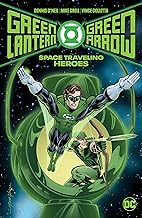 Written by Dennis O'Neil, with Frank McGinty, Elliot S! Maggin. Pencils by Mike Grell, Alex Saviuk. Inks by Vince Colletta, Mike Grell, Terry Austin, others.
Colours/letters: various.
Reprinting: Green Lantern (1st Silver Age series) #90-106 (1976-1978) - with covers
Rating: * * * * 1/2 (out of 5)
Number of readings: 1
Review posted: June 2024
First: a brief comment on modern comics. Amazon was doing an (e-book) sale where many Green Lantern collections were drastically marked down. Looking to sample some current GL, I looked at sundry collections...culled confusingly from various concurrent series, or re-starts and re-boots, while seeming to be continuing threads from a previous collection or laying down threads for the next one. In short: no idea which one would make a good "jumping on" point -- let alone a good read-it-for-itself book. Plus, I'll admit, I just wasn't really excited by some of the descriptions of where current creators seemed to have taken the character and his stories. Frankly, I just got a weird vibe off of some of the blurbs, like the morals and philosophy of these writers was a bit skewed (but that might be way off base of me).
Finally I threw up my hands and bought Space Traveling Heroes -- a collection of forty-plus year old comics which at least seemed to promise you could enjoy it for itself without needing to buy six other TPBs for it to make sense.
Not that I hadn't been eyeing it for a while. After all, I'm a child of the Bronze Age. And this was a belated follow up to the original O'Neil/Adams Green Lantern/Green Arrow run that was a trail blazer in the first part of the 1970s. Neal Adams' stylish and dazzling art helped re-define comic book visuals while Denny O'Neil's scripts used the super heroics to tackle hot button topics in socially relevant stories (what reactionaries would nowadays disparagingly label as "woke"). And beyond the politics, arguably an unsung aspect of those issues was the character dynamics between straight-laced GL and hot headed GA, with Black Canary along as well -- a surprisingly strong, feminist character for the times.
The O'Neil/Adams issues have been collected in various editions over the years, but most commonly under the title: Hard Traveling Heroes (and More Hard Traveling Heroes when the issues were broken into two volumes) alluding to a road trip theme that linked some issues. Calling this collection Space Traveling Heroes is meant to cement a link with the earlier collection(s).
That O'Neil/Adams run ended on issue #89 and so this revival starts with #90 even though about six years had passed between issues (these days they seem to restart a series from #1 when the final issue from the previous run is still on the stands!) O'Neil is still at the writing desk, but replacing Adams is Mike Grell -- one of a number of artists of that era clearly influenced by and, in their various ways, emulating Adams. (Alex Saviuk also draws some issues -- but I'll get to the art more in a moment).
But times had changed. Whether O'Neil's choice or editorial edict, the in-your-face politics of the O'Neil/Adams run is not (quite) as paramount. Indeed, O'Neil seems to poke a little fun at it by literally having the heroes in the first issue self-consciously discuss the "lesson" they learned. With that said, O'Neil hasn't totally forsaken social commentary in these issues -- especially as that's rather germane to Green Arrow's personality (especially in the Bronze Age).
The reason I had been eyeing this but not buying it for a while (aside from the price) is I had a few of the issues from this era and was kind of mixed on them. They were definitely a product of their time: a bit corny, the plotting a bit reckless. Of course this also relates to an issue that's come up a lot these days, of older comic readers (like me) complaining about comics and maybe forgetting they, just maybe, were being written for a younger readership anyway. But I had also enjoyed them -- at least enough that I had been eyeing this collection for months, waffling back and forth about getting it. Heck, the first Green Lantern comic I ever owned was from this run and the warm nostalgia still hits me like a freight train when I think of that issue.
The verdict?
I actually quite enjoyed this collection.
Part of that is adjusting my expectations: what I said about recognizing the target readership. So yes, these issues are frequently corny, the dialogue can be a bit ham-fisted or cringey, the art uneven. But if you accept that -- nay, if you embrace it -- it's entertaining. I've often thought that comic book dialogue could be viewed like, say, Shakespeare; just as people don't talk in iambic parameter, people don't necessarily talk like they do in a 1970s comic -- but the characters do and this is their world. We're just visiting.
The big appeal to the stories is just the raw, unapologetic, pulpy storytelling. Fast-paced with twists and turns and narrow escapes and usually a mystery or puzzle to be sussed out before the end. You rarely have an opportunity to get bored. O'Neil makes good use of the inherent contrast between his two heroes (the down-to-earth bowman and the emerald gladiator from the stars) to veer from earth-based action to space action and back; sometimes splitting the story into two threads that then converge. Honestly? I'm not sure O'Neil has been better at just pulpy storytelling. He's written smarter comics, more ambitious comics -- but more imaginative? O'Neil had suggested in interviews that he preferred "reality" and down to earth heroes, but maybe it's precisely because he didn't take it as seriously that he was willing to just let loose in these stories.
I've written about O'Neil in other reviews and of my mixed feelings toward some of his work. Often finding his stuff a paradox of wanting to decry violence while also writing scenes of heroes gleefully pummelling bad guys. And there's some problematic stuff that teeters toward racism, or xenophobia, with the sometimes cartoony depiction of other countries. Or maybe it's condescension. Not that I'm trying to disparage O'Neil as too much of an outlier for the era. Maybe it's partly just a reflection of his love for pulp fiction of a generation or two before (such as in his creation of the Fu Manchu-inspired Batman villain, Ra's Al Ghul). As well, it's not like he doesn't level criticism at America. This may not be the issues-driven stories of his run with Adams, but social commentary crops up (such as a story where Green Arrow is coerced into being an assassin by a renegade reactionary element in the American government).
And by having the two heroes the series enjoyed an unusual dynamic. Indeed, with Black Canary along -- basically making it three heroes -- and then introducing Air Wave II (a teenage hero who happened to be GL's nephew) the series borders on being a team book.
It's mostly a collection of tight one or two-issue adventures. And it's not like there's a lot of soap opera or sub-plots, but there are some linking threads that overlap the stories.
There's a curious little thread involving GL adopting an odd alien creature as a sidekick/pet, dubbed Itty. It's odd because GL just starts sporting him on his shoulder with no explanation where he came from (there's no footnote to suggest he first appeared in, say, a Justice League of America adventure or anything). He remains an addition to the cast -- and then, toward the end of this collection, morphs into a central plot element. Things like that help turn a collection of issues into a kind of ad hoc graphic novel. And nothing much is left dangling or unresolved by the final issue here.
Throughout the reader is treated to a few familiar or recurring foes (Sinestro crops up a couple of times) but also a lot of original dangers and adversaries. Then-substitute GL, John Stewart, guest stars for a couple of issues, and Katma Tui appears in a multi-issue arc (though written without much personality) and the Guardians of Oa and other GLs pop up here and there, as does Carol Ferris and Tom Kalmaku. As mentioned, the stories veer from earth-based adventures to star spanning romps, alien worlds, celestial phenomena, and even other-dimensional. There are one or two-issue plots, neatly self-contained, and others where plot threads bleed over, linking different issues. And in the centre is a moody little "epic" of four issues where they are threatened by a mysterious adversary known as the Mocker. It's probably the longest GL (and GL/GA) epic to that point.
Hal Jordan is traditionally a test pilot, but throughout the Silver Age/Bronze Age he actually had a few jobs. Early in the issues collected here he starts a new career as a truck driver. His reasoning being it allows him to be more available to answer the call of danger but I also wonder if the career change was motivated by the popularity of trucking (and CB radios) that blossomed in the 1970s pop culture.
The 100th issue is a double-sized comic that split into two full length (17 pages at that time) solo adventure for GL and GA (well, GA with Black Canary). The GA story is written by Elliot S! Maggin and it's funny because a few years before, Maggin had written a story where GA (in his alter ego of Oliver Queen) decides to run for Mayor -- but then later decides not to. Here, Maggin once more throws in that idea. It's as if he really liked it -- but others at DC didn't and in the subsequent O'Neil issues the other characters mock the idea. (Funnily, I think Maggin himself did later try to run for office, suggesting he genuinely had an interest in the idea of public service).
The lion's share of the art is by Mike Grell, back when he was primarily an artist (before his later evolution into a writer-artist and often just writer). Grell's sort of an odd artist because I really dug him as a kid. As an adult I'm aware of a lot of weaknesses: stiff limbs, bodies moving oddly, etc. But, the weird thing is -- I still kind of dig him. His strengths out weighing his weaknesses -- or maybe it's because those weaknesses are so idiosyncratic. As mentioned he was certainly coming out of the Neal Adams school and you can see that in the big close ups of faces and in the way he likes to play around with perspective (hands stabbing at the "camera") and the lithe bodies. Doubtless that was a reason he was chosen for the assignment.
That and he was well suited to the dual nature of the series. As a frequent artist on the Legion of Super-Heroes around then, Grell was adept at depicting the space and sci-fi stuff (there's some striking celestial vistas in these pages) but he also had an affinity for the down to earth bowman. Grell later, of course, writing a well-regarded solo series for the character (though he radically re-imagined his personality). But Grell, like many artists, can be influenced by the inker. He inks himself on some stories, to good effect. And Terry Austin inks a couple, bringing his crisp, clear line work to bolster Grell's sometimes ifier lines. Unfortunately he's mostly inked by Vince Colletta, which was not a great pairing (despite the two often being paired on Grell's Warlord series, too).
Coming in later in this collection, Alex Saviuk takes over as main artist (though Grell pops back in). Saviuk is an artist I wasn't that fond of as a kid. And his visuals aren't as arresting as Grell's. But looking at it now, I can appreciate the effort he puts in. The detailed backgrounds, sometimes with little background figures fleshing out a scene. And he certainly has a solid grasp of the fundamentals. I may still not be a "fan" per se, but I appreciate his style more now.
So is it stupid? Corny? With clunky dialogue and clumsy plotting? Honestly? Yeah. But equally, it's a lot of fun. The story's are fast-paced and, given O'Neil's claims to preferring more grounded stories, they're surprisingly imaginative and varied. And the dynamics between the personalities made the trio of GL, GA, and BC an interesting collaboration. And boasting colourful and imaginative visuals in the space/other worldly scenes.
Sometimes reading old comics requires recognizing that, yeah, they're a bit juvenile, and also, that maybe they have a language and style of their own. And if you can enter that world with a willing suspension of disbelief...you just might enjoy your visit.
I did.
On to Green Lantern Reviews Page Four
Back to Green Lantern Reviews Page Two
or
Back to