
Batman: Going Sane
see review on previous page.
Gotham by Gaslight
see review in Batman Elseworlds section
Batman: Gotham County Line 2006 (SC TPB) 150 pages
 Written by Steve Niles. Illustrated by Scott Hampton.
Colours: Jose Villarrubia. Letters: Pat Brosseau.
Reprints: the three issue prestige format mini-series (2005)
Rating: * * 1/2 (out of 5)
Number of readings: 1
Suggested for mature readers.
Reviewed: July 2015
A string of bizarre and grisly murders lures Batman from his inner city stomping grounds to Gotham's suburbs -- but what at first seems like a serial killer turns weirder and more horrific.
Gotham County Line can seem like a weird mix that, at first, is hard to define. Initially it seems like it's meant to be a grittier, quirkily realistic Batman tale by having Batman venture out from his familiar turf into the suburbs where he's a fish-out-of-water and there are no buildings to swing from, all to investigate a series of home invasions-turned-homicides. It's not till the end of the first of three 46 page issues that it tales a sharp turn into the supernatural and horror -- and then it keeps going into outright dreamlike surrealism of a kind.
Of course the horror thing shouldn't be a surprise since it's written by Steve Niles -- primarily a writer of horror-themed stories and comics.
It's illustrated by Scott Hampton who has an Artsy style that tends to lend the book a kind of high brow, atypical veneer. Hampton's no stranger to Batman, having illustrated other stories, including Batman: Night Cries. He actually seems to be using (or has evolved) a heavier, firmer inking style than in some of the other things I associate with him, to mostly good effect. It makes the visuals a little sharper, a little clearer -- even as it's still dark and murky a lot of the time. And given it's a horror story with an oppressive atmosphere and zombie creatures, dark and murky is appropriate. Though equally it means sometimes faces and figures can feel undefined. Despite his strengths, I can't say Hampton is inherently a better artist than a more convention penciller, in terms simply of faces, expressions, body movement, etc.
Unfortunately, the result is mixed.
The suburb thing feels underutilized. Niles acknowledges that it's not Batman's usual beat (even having Batman initially rebuff calls for his help by saying he doesn't do the 'burbs) but then Niles doesn't really make it that relevant to the story. Batman gets around the transportation problem by simply jiggering up a convenient rocket pack which allows him to fly, and otherwise seems perfectly in his element. And by making the story a horror story, full of dark and brooding imagery, it loses what you would expect to be the point: the dark and spooky Batman operating in the picket fence cheeriness of the suburbs. Despite close to 150 pages, there's little attempt to develop a supporting cast (a recurring beef of mine with comics). A female cop who seems like maybe she's going to be a Commissioner Gordon substitute quickly turns out not to be.
And then we get to the horror stuff. Or, more to the point, the line between horror -- and fantasy.
When, a third of the way through, the story veers into horror with zombiefied corpses I thought it might be an interesting horror tale. Batman in a Walking Dead episode, facing a kind of apocalypse-in-miniature as the zombies threaten to overwhelm the neighbourhood. But it's a bit hard to get a grip on things at first, as even weirder things seem to be happening -- even when Batman isn't present (like something that occurs with Alfred while Batman is on the phone to him) so it can't just be a dream.
As it turns out, horror and magic hasn't encroached upon the Gotham suburbs, rather Batman has been drawn into a purgatory-like nether realm. (And though he's not credited as such, I wonder if Hampton was involved in co-plotting, because it reminds me a bit of a story in Other Realms he did for Batman: Legends of the Dark Knight wherein Batman wandered through a dream-realm).
It means there isn't that much logic to rest the action upon. Worse, the "story" then veers increasingly into simply being an extended, abstract parable or something, as Batman must wrestle (yet again!) with his inner guilts and fears. I like that stuff on top of a story, but not in lieu of a proper story. Or, to quote a line from Buffy the Vampire Slayer "The subtext is rapidly becoming the text."
Niles also throwns in spook hero, Deadman, and in a smaller part, The Phantom Stranger, which I always find ironic. Y'know, when creators craft a story that is supposed to seem different, more sophisticated, or more adult (in terms of the grisliness) than some Batman comics -- then root it even more in the comic book realm by tossing in super hero guest stars. Niles' writing of Deadman doesn't entirely click with my perception of the character, him talking more spirit than street-wise (though maybe that's how he's written today) and likewise Batman's relationship to him seems a bit distant (calling him "Brand" -- his surname -- rather than "Boston" -- his first name).
And ultimately, I found Gotham County Line a bit disappointing. It starts out reasonably intriguing and moody, if short on character/emotion (even Batman, as he often is, more super than man). But just when it should be kicking into high gear, with the transition into the supernatural, is when it started to lose me. It felt a bit like it was spinning its wheels, stretching scenes, repeating things, with no real "plot" to unfold. And it's all wrapped around rather abstract ideas that seemed like they were supposed to give us insight into Batman, without really saying anything surprising.
Not terrible -- but at close to 150 pages, struggles to sustain itself.
Cover price: $__ USA.
Batman: Gothic 1991 (SC TPB) 128 pages
 Written
by Grant Morrison. Art by Klaus Janson.
Written
by Grant Morrison. Art by Klaus Janson.
Colours: Steve Buccellato. Letters: John Constanza. Editor: Andrew
Helfer, Kevin Dooley.
Reprints: Batman: Legends of the Dark Knight #6-10 (1990)
Rating: * * (out of 5)
Number of readings: 2
Suggested (mildly) for Mature Readers.
The sinister, supernatural Mr. Whispers is going around killing Gotham City mobsters, enacting revenge for their having "murdered" him twenty years before. Meanwhile, Batman begins to suspect that Mr. Whisper is really his old boarding school head master, as well as a child murderer, leading him to a European monastery and tales of a centuries old deal with the Devil.
There are some intriguing aspects to Gothic, and moments that threaten to get creepy and moody. But the opening issue establishes some of the overall problems. Though intriguing, in order to establish that someone is killing Gotham mobsters, writer Grant Morrison depicts Mr. Whisper going around, killing mobsters...again, and again, and yet again -- at least once in a particularly gratuitously grisly way. And since that's about all there is to that issue (other than Batman having a dream, recalling his childhood), there's a real sense of thinness...and repetition.
Morrison seems to have trouble developing his story. Batman is told that Mr. Whisper had been murdered 20 years before, and also recalls that his headmaster (whom he suspects to be the same man) quit the school under a cloud of scandal. So wouldn't you think that would be his first area of inquiry, looking into the events of twenty years before? Apparently not. In fact, it's never explained what the scandal was that caused the headmaster to leave the school (since it's unclear anyone other than Batman -- and that only now -- connected him to tthe child murders). Morrison stretches out his story by introducing questions, ignoring them for an issue or two, and then having some character explain it all in a rush that leaves little room for the story -- or the suspense -- to unfold. In one sequence Batman is told about a haunted monastery, where the ghost of a flaming nun has been seen. Batman goes to said monastery, and sees...the ghost of said nun. Uh, wouldn't it have made more sense to have Batman be warned simply of strange lights seen in the monastery, so that when he investigates, he -- and the reader -- can be surprised by the nature of said lights?
The mystery aspects are also oddly handled, with Batman gleaning clues from dreams or happenstance, rather than from more conventional deductive sources. At one point he infers a clue because he accidentally plays the wrong tape (which even Alfred remarks seems like a stretch)! Maybe because of the supernatural aspects to the story, Morrison figures such plot devices are justified (perhaps we are to assume God is helping Batman along or something) but it just makes the story seem loosely plotted.
Even the moderately intriguing idea of underworld figures banding together to hunt Mr. Whispers two decades before (which Morrison lifted from the famous German melodrama, "M") doesn't really seem developed, nor are the characters.
Which brings up Morrison's treatment of Batman. Morrison tells the story only through the pictures and dialogue -- not even a voiceover narration as other Batman: Legends of the Dark Knight stories have employed. This may explain why Batman seems like such an elusive character throughout. I kept reading chapters thinking Batman only had a bit part, but then I realized he appeared on many of the pages -- Morrison just fails to make much impression with him.
As well, I've long felt there was a problem with the modern take on Alfred. In the mid-80s, writer Frank Miller (and editor Denny O'Neil) introduced the idea of Alfred as a sarcastic, wisecracking character, which, admittedly, injected some humour into the stories. But the danger is that Batman's sole human interaction -- with Alfred -- can be sapped of all warmth or humanity, rendering an already isolated character (Batman) even moreso. Some writers have bridge the two versions. Not so Morrison. The scenes between Batman and Alfred are cold, again, explaining why Batman -- as a human character -- doesn't really emerge in this story. Worse, Alfred's asides aren't even all that funny!
Lack of character, and humanity, lingers throughout. Morrison spends a lot of time with the mobsters, without ever fleshing them out. Batman, meanwhile, suspects a childhood school chum, who he had always assumed had transferred away from the school, was in fact murdered by Mr. Whisper. Yet that never plays into his motivation -- in fact, it's barely even addressed.
There are plot holes and unexplained aspects (Batman is tied up in one of those goofy death traps villains like so much...but it's entirely unclear how he escapes it; particularly annoying since the death trap is the cliff-hanger between two chapters and is stretched out over a number of pages). And, overall, like a lot of the five chapter, "epic" stories published in LOTDK, this really doesn't seem to have enough to fill out its length (perhaps explaining why, after beginning the series with a bunch of five-chapter stories, the idea was dropped for the next hundred or so issues of LOTDK!)
There are also a few oblique scenes that assume you know your Bat-lore intimately, like tying an aspect of the story into the night Batman's parents were murdered...without ever actually coming right out and saying that!
The art by Klaus Janson also left me with mixed feelings. Janson, formerly an inker with a highly identifiable crude, heavy brush style, could enhance an artist's pencils with dark, raw mood and smouldering atmosphere, even as he could hurt the work by blunting over the finer details of a picture. As an artist, his work retains a certain kineticism and dark mood, and some nicely composed panels (perhaps a storytelling knack he picked up from his years of inking Frank Miller) but the underlying pencil work seems rushed and shows only the vaguest grasp of anatomy, or even how human bodies bend. The result is art that is intriguing at first, suiting the dark, sinister mood, but starts to wear after a while in its crudeness and lack of nuance.
An intriguing, decidedly dark, potentially creepy tale, full of hints of big -- even relevant -- themes...but the whole thing seems undeveloped, its potential largely unfulfilled. Not terrible, perhaps, but nothing noteworthy, either.
This is a review of the story as it was serialized in Batman: LOTDK comics.
Cover price: $18.95 CDN./ $__ USA.
The Greatest Batman Stories Ever Told 1988 (SC TPB) 352 pages
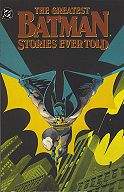 Writers:
Gardner Fox, Bill Finger, (and various uncredited Golden Age writers),
Denny O'Neil, Frank Robbins, Archie Goodwin, Steve Englehart, Len Wein,
Alan Brennert, Bob Rozakis.
Writers:
Gardner Fox, Bill Finger, (and various uncredited Golden Age writers),
Denny O'Neil, Frank Robbins, Archie Goodwin, Steve Englehart, Len Wein,
Alan Brennert, Bob Rozakis.
Art Bob Kane, Dick Sprang, Jerry Robinson, Jack Burnley, Jim Mooney, Sheldon Moldoff, Carmine Infantino, Neal Adams, Dick Giordano, Frank Robbins, Jim Aparo, Alex Toth, Marshall Rogers, Walt Simonson, Michael Golden, Joe Staton.
Many early comics featured a number of shorter stories in one issue, so that most of those stories don't represent the whole comic; even up into the '70s and '80s some of these comics featured back up stories or, indeed, the story included here was the short back-up story!...1940s: "Batman vs. the Vampire" (Detective Comics #31-32), "Dr. Hugo Strange and the Mutant Monsters" (Batman #1), "Knights of Knavery" (Batman #25), "1001 Umbrellas of the Penguin" (newspaper strip), "The Origin of the Batman" (Batman #47) - 1950s: "The Birth of Batplane II" (Batman #61), "Operation: Escape" (Star-Spangled Comics #124), "The Jungle Cat-Queen" (Detective Comics #211), "The First Batman" (Detective Comics #235), "Origin of the Superman-Batman Team" (World's Finest #94) - 1960s: "Robin Die at Dawn" (Batman #156), "The Blockbuster Invason of Gotham" (Detective Comics #345) - 1970s: "Ghost of the Killer Skies" (Detective Comics #404), "Half an Evil" (Batman #234), "Man-Bat Over Vegas" (Detective Comics #429), "The Batman Nobody Knows" (Batman #250), "Deathmask" (Detective Comics #437), "Death Haunts the Skies' (Detective Comics #442), "There is no Hope in Crime Alley" (Detective Comics #457), "Death Strikes at Midnight and Three" (a text story from DC Special Series #15), "The Deadshot Ricochet" (Detective Comics #474), "Bat-Mite's New York Adventure" (Detective Comics 482), "A Caper a Day Keeps the Batman at Bay" (Batman #312) - 1980s: "To Kill a Legend" (Detective Comics #500), "The Autobiography of Bruce Wayne" (The Brave and the Bold #197)
Rating: * * * 1/2 (out of 5)
Number of readings: 1
Additional notes: commentaries by Dick Giordano; Mike Gold; Robert Greenberger; creator bios.
I always seem to have mixed feelings about "Greatest" collections and "Best of..." assemblages.
On one hand, what's not to like? A wide variety of stories collected between a single cover -- some undoubtedly quite rare and hard to find. And stories that have already been vetted by editors, so that you can be pretty sure they're all of at least decent quality. It's a grab bag of tales, and really, that's all you can ask. And assuming the price hasn't changed much...that's a pretty good deal (350 pages for the price that normally wouldn't get you half those pages).
On the other hand, if the promise is that these really are the "greatest" you can kind of expect a certain level of quality, mixing significant, "classic" tales with just well told stories. And that's where my mixed feelings can come in. Because I've rarely read a "greatest" collection that entirely lived up to its name. This one included.
On a technical level, The Greatest Batman Stories Ever Told tries to cover most of the key bases. It reprints stories from over a four decade span, and features appearances by a number of familiar foes such as Catwoman, Penguin, The Scarecrow, Two-Face, the Joker (the latter only in one tale since he got his own TPB collection). And there are lesser recurring nemeses such as Hugo Strange and the first appearance of Blockbuster. There's some interesting variety as well, including a Sunday newspaper strip story line, and a text story. Although published in the late 1980s, after DC's "new" post-Crisis reality had taken effect, all the stories here are pre-Crisis tales, and reflect that mythos -- including a couple of 1950s tales fleshing out Batman's origin: "The Origin of the Batman" (detailing his hunt for the man who murdered his parents, Joe Chill) and "The First Batman" (in which he learns Chill was hired by Lew Moxom); both of which are no longer considered canon (though combine to create a complex origin for the caped crusader).
I'm also appreciative of how much of the book is devoted to Bronze Age (ie: 1970s and later) material.
Other noteworthy -- or just plain better-than-average tales -- include a couple of Denny O'Neil/Neal Adams collaborations: the moody "Half an Evil" (with Bats battling Two-Face -- a story I'd read before so I may view with undue nostalgic affection) and "Ghost of the Killer Skies" which is a bit clumsy as a mystery as Batman investigates sabotage on a film set, but the climax in World War I fighter planes over barren fields is eerily effective (meant as an homage to Robert Kanigher-Joe Kubert's Enemy Ace). "Robin Dies at Dawn", owing a bit to a certain "Twilight Zone" episode, is a surprisingly effective tale from the early 1960s, beginning with a spookily illustrated sequence on an alien world, before reverting to more familiar Gotham City terrain, but boasting (for the time period) some good character stuff. And the Frank Robbins written and drawn "Man-Bat Over Vegas" is fast and energetic, with an interesting plot twist.
A 1950s battle with the Catwoman is entertaining enough, while a newspaper strip story line involving the Penguin is thoroughly enjoyable, even if modern, anal retentive fans would no doubt rage at the light-hearted premise (Batman and Robin agree not to arrest the Penguin until after his ailing aunt, who is unaware of his criminal career, has visited him, leading them to pass themselves off as the Penguin's friends to explain why they're hanging around).
Head and shoulders the best of the collection are the final two stories, both, ironically, by Alan Brennert (a writer with only a handful of comicbook stories to his credit). "To Kill a Legend" tells an intriguing, dramatic tale of Batman being offered a chance to save his parent's lives...on a parallel world; but Robin wonders whether doing so is the right thing, as it will rob that other world of its Batman. It was first published in the over-sized 500th issue of Detective Comics which also included a lot of nice back up stories, including Hawkman, Elongated Man, etc -- just FYI. The final story, "The Autobiography of Bruce Wayne" is, literally, the perfect tale to close out the collection, telling a tale of the Earth 2 Batman (I told you these were all pre-Crisis stories) whose feelings for reformed villainess Catwoman come to a head when they team up to battle the Scarecrow, whose fear gas exposes their secret terrors. Brennert crafts an intelligent, emotional tale, delving into the characters, examining the (possible) root causes of their motivations, to make for the ideal summation of the man who is the Batman. And the art team of Joe Staton and George Freeman is lively and infectious.
Ironically, another Brennert-written tale, not included here, I included in my list of one of the all-time great comics stories.
Early tales of battles with Hugo Strange, or a vampire tale featuring Darla and the Monk (who re-appeared in what I consider a classic saga from the 1980s) are interesting for their relevance to later stories, but aren't very good in and of themselves.
For all the good or great stories, there are a lot that just make you go: uh, why this one? Obviously, one can argue: is the point to assemble "great" stories...or merely representative stories? After all, maybe the editor's didn't want to send a false message about what Batman stories are like by picking too many high-minded, artistic tales. But one might expect a collection like this to detail how the character, and the medium, has evolved over the years. Instead, there are 1970s tales like "A Caper a Day Keeps the Batman at Bay" that, frankly, could've been written in the 1940s (though, sour puss that I am, after a second reading, I realize there is a certain harmless charm to it). And even such semi-classic tales like O'Neil's "There is No Hope in Crime Alley" turned out to be a major disappointment: simplistic, and emphasizing fisticuffs over human drama. The flavour of different eras is strangely ignored (other than showing a more ruthless Batman in the earliest stories). The 1950s and 1960s were supposed to be a time of "goofy" Bat-tales involving a lot of time travel and alien worlds, but little of that is represented here -- which means a later joke filler involving Bat-Mite has no context, since no Bat-Mite stories are included from his hey-dey in the early 1960s. During the '60s TV series, Batman comics apparently became campy, while during the late '60s/early '70s there was a move toward a more urban realism -- neither style is represeted here, in favour of basically forty years of battling super villains.
Someone on the editorial team must've been a big aviation buff, though, because a disproportionate number of stories seem to climax in aerial dog fights!
Artists are also represented inconsistently. Legendary Neal Adams gets two stories (fair enough) while Jim Aparo only gets one, and artists like Irv Novick and Don Newton, both long serving Bat-artists, aren't represented at all! While Alex Toth's only Batman story is included...but it's a pretty minor story. While on the writing side, none of Bob Haney's Brave and the Bold stories were, apparently, deemed worthy enough.
Obviously selecting stories is a tricky matter, particularly when the editors admit certain tales were left out simply because they had already been reprinted a few times over the years. It's hard to argue with that (even then, some of these stories I'd already read in other reprint venues). Still, it's curious to read the closing afterword, mentioning stories that were considered but didn't make the cut, such as "Night of the Reaper", a thought-provoking tale of Batman hunting Nazi war criminals. Leaving it out, in favour of some of the stories included, just seems inane (though I think it was included in a subsequent TPB, Batman in the Seventies).
Ultimately it's a decent collection, with most of the stories being enjoyable enough, but only a few really warrant being considered "great" (most notably the final two Brennert-scripted efforts) while not enough care is given to trying to represent the various stylistic eras. Which, maybe, could explain the nature of comics. After all, the fact that the editors seem to be selecting a lot of, frankly, run-of-the-mill, occasionally mediocre action tales as the "greatest" stories ever could explain the nature of a lot of monthly comics.
Original cover price: $20.95 CDN./ $15.95 USA.
The Greatest Joker Stories Ever Told 1988 (SC TPB), 288 pgs.

Reprinting: Batman #1, 4, 63, 73, 74, 110, 159, 163, 251, 321, Detective Comics #168, 475-476, World's Finest #61, 88, Brave & the Bold #111, Joker #3, 1948 Newspaper strip, 1966 Batman Kellogg's Special. (Note: many early comics featured more than one story per issue, so many of the early issues listed are reprints of individual stories, not the entire comic)
Featuring: "Batman vs. the Joker" (untitled); "The Case of the Joker's Crime Circus"; "The Joker and the Sparrow" (newspaper strip); "The Man Behind the Red Hood"; "The Joker's Crime Costumes"; "The Joker's Utility Belt"; "The Crimes of the Batman"; "The Crazy Crime Clown"; "Superman's and Batman's Greatest Foes"; "Crime-of-the-Month Club"; "The Great Clayface-Joker Feud"; "The Joker Jury"; "The Joker's Happy Victims" (cereal giveaway); "The Joker's Five-Way Revenge"; "Death Has the Last Laugh"; "The Last Ha Ha"; "The Laughing Fish"/"The Sign of the Joker"; "Dreadful Birthday, Dear Joker-!".
By: variously Finger, Kane, Robinson, Burnley, Roussos,
Moldoff, Sprang, Paris, Kaye, Mooney, others; and Bridwell/Infantio/Anderson;
O'Neil/Adams/Giordano; Haney/Aparo; O'Neil/Chan/Garcia-Lopez; Englehart/Rogers/Austin;
Wein/Simonson/Giordano
Colours: various. Letters: various. Editors: various.
Rating: * * * (out of 5)
Number of readings: some stories once, others, more.
O.K., firstly, I think the title of this Batman collection -- The Greatest Joker Stories Ever Told --- is a bit of an oxymoron. The Joker is a fine villain, but he's pretty one-dimensional and stories featuring him tend, likewise, to be lacking any real emotional or intellectual depth. And since Batman, moreso than some characters, had a pretty consistent look from the 1940s to the mid-60s, a big chunk of the book is pretty repetitive. So, with my biases up front, The Greatest Joker Stories Ever Told remains an O.K. if unspectacular collection.
The earliest stories reflect an intriguing, dark ambience. There are some decent stories throughout, though only six comics (representing five stories) are printed from the post-'60s (when story and art styles were more adult-friendly).
Memorable stories include the 1st appearance of the Joker; "The Great Clayface-Joker Feud"; the classic Denny O'Neil/Neal Adams "The Joker's Five-Way Revenge", easily the best comic in the collection and one of the moodiest comic book stories I've ever read; and others. There are off-beat stories and curios that, if not always great, nonetheless show a real commitment on the part of the editors and give the collection some zing. These include the Joker's origin; a complete newspaper strip story line; a rare 6 page breakfast cereal give-away; and an issue of the Joker's own, short-lived comic (featuring the superhero the Creeper, though written poorly out-of-character, I thought).
Added 2003: Yet for all that these are supposed to be "the greatest" Joker stories ever, I recently picked up World's Best Comics, an ultra cheap one-shot comic (.99 cents, US) DC published in October 2003 reprinting some Golden Age stories (as a way of encouraging readers to buy their extremely expensive Archive editions collections). In addition to Superman, Wonder Woman and Plastic Man, included was a Batman-Joker story from the early 1940s -- "The Riddle of the Missing Card" -- that actually struck me as better, and more ambitious, than a lot of the stories included here!
The Greatest Joker Stories Ever Told also exposes a certain myth about the Joker. Since the '70s, the character has been portrayed as a homicidal psychopath, stories featuring him invariably resulting in death. All of which is justified, writers and editors say as though a mantra, because they are returning the character to his pre-'60s, pre-campy Caesar Romero TV version incarnation. But looking at these stories, the Joker was only a killer in the very, very earliest tales. In fact, in one story, "The Crazy Crime Clown", the Joker has to feign insanity to be admitted to an asylum. That doesn't make the current interpretation of the character wrong, but it means Denny O'Neil and company have to take responsibility for the level of violence in their stories, instead of passing it off onto some imagined "tradition".
Cover price: $18.95 CDN./$14.95 USA
<Back Next>
Complete List of Reviews
Or go to