 Batman:
Faces 1995 (SC TPB)
80 pages
Batman:
Faces 1995 (SC TPB)
80 pages
Written and illustrated by Matt Wagner.
Colours: Steve Oliff. Letters: Willie Schubert.
Reprinting: Batman: Legends of the Dark Knight #28-30 (1992)
Rating: * * * (out of 5)
Number of readings: 1
Suggested (mildly) for mature readers
Review posted: Nov. 2014
In Faces, Batman's old foe Two-Face returns, this time with a scheme involving both the murder of some plastic surgeons and a plan to acquire an island that has recently been put up for sale -- an island Bruce (Batman) Wayne is, himself interested in purchasing. As well -- Two-Face has acquired a veritable army of misshapen freaks.
This story was culled from the pages of Batman: Legends of the Dark Knight, a comic in which creators were set to craft isolated tales (as opposed to one story leading into the next or with on-going sub-plots). Often the stories were set slightly earlier in Batman's career than the concurrent Batman comics -- and also with a slight "mature readers" flavour. Funnily, this is perhaps more blatantly the latter than some other LOTDK tales, with its decidedly grotesque aspect involving the army of freaks, one or two particularly grisly bits of violence, and a more explicit sexual angle with a supporting character getting involved in a sexual affair -- with even some nudity (well, one panel, in a long shot). This also uses an idea employed in some other LOTDK stories that, being removed from monthly continuity, it can play around with the time span. The story opens with Two-Face escaping from prison -- then we jump to two years later where the story proper begins.
It's also an unusually short arc to get collected -- usually single story collections involve four or five issue arcs, or contain multiple stories of two or three issue length.
It's short for a collection -- but arguably a bit long for the plot.
Faces is, on one hand, a reasonably okay Batman-vs-Two-Face adventure involving all the usual ideas (Batman trying to puzzle out the pattern, trying -- unsuccessfully -- to stop a series of murders/crimes, a use of dual motifs, and some outlandishness -- in this case involving an airship!). On the other hand, it is a fairly familiar Batman-vs-Two-Face (or whoever) story. It could've been told in two issues, or even one (one could even imagine it squeezed into 12 pages back in the Golden Age).
It's written and illustrated by Matt Wagner, a popular and often critically regarded creator -- but someone whose writing has often left me underwhelmed in the past.
The visuals, though, are certainly striking and are a major appeal of the story. There's a mix of detail and Spartan simplicity that puts me in mind of, say, David Mazzuccelli (on Batman: Year One), a use of shadow and light that can evoke Frank Miller's Sin City work, as well as a Trevor Von Eeden vibe and others. It's moody and atmospheric and yet tells the story with efficiency and energy. At the same time, it's perhaps a style that can lean more toward design and style, and less toward the human and emotive. It's striking to look at and tells the scenes well, but doesn't maybe put the emphasis on the human personalities.
While Wagner's writing is uneven. I've found some of his other scripting (on things like The Sandman Mystery Theatre) to be thinly plotted and to suffer from logic and plausibility holes. And here is no exception. It's a simple story and yet even then I'm not really sure makes a whole lot of sense. Or, if one wants to quibble, one could say it lacks plausibility -- even if the characters' themselves justify their actions. There's a problem when a major part of the crime spree is then dismissed as merely a "distraction" from the real crime (in other words, it was just a plot contrivance). While the plan involves the villain roping in a realtor to help with a crime -- but, honestly, I'm not sure why he was needed (given the crime also involves blackmailing the guy selling the island)!
At first the veneer of complexity is appealing. The nebbishy realtor being approached by a mysterious femme fatale. A mysterious masked figure trying to acquire the island property. How all this relates to Two-Face can make you interested -- except it relates pretty much how you thought it would. In other words, the story is a lot more obvious and straightforward than it promised to be at first.
The premise reminded me a bit of an old Fantastic Four story (Annual #14) in which long-time foe The Mole Man is given a slightly humanizing spin to his villainy, by having it be he plans to set up a haven for freaks and misfits (like himself). But the FF Annual probably handled it better -- more emphasis on the human/character stuff, and it was, y'know, shorter (at 34 pages)!
And there's a kind of contradiction, as Wagner seems to both want to evince some sympathy/compassion for the "freaks" -- even as the story is meant to have a creepy, unsettling vibe because of them (and they're barely more than background players)! Funnily, I wondered if there's a reflection of another plausibility flaw, as at one point it's suggested many of these misfits work as sideshow entertainers in Europe -- so is that because carnival freaks continue to be popular in Europe, or was it that an editor pointed out there aren't a lot of freakshows anymore and so Wagner decided to "claim" they were popular in Europe just to patch over a hole in his story, figuring his reader's wouldn't know any better.
Ultimately Faces is a stylish, atmospheric visual feast, and there is a certain pleasant fun (grisly and ghoulishness aside) in such a "traditional" Batman story. But it's a pretty straight forward tale, that doesn't invite looking at the logic too closely, and in which the story/adventure takes precedence over any genuine emotion/character stuff.
This review is based on the original comics.
Cover price: $__.
 Batman (Detective Comics):
Faces of Death 2012 (SC TPB)
160 pages
Batman (Detective Comics):
Faces of Death 2012 (SC TPB)
160 pages
Written and drawn by Tony S. Daniel, with Szymon Kudranski. Inks various.
Colours: Tomeu Morey. Letters: Jared K. Fletcher.
Reprinting: Detective Comics #1-7 (2011-2012) - with covers; rough sketches
Rating: * * 1/2 (out of 5)
Number of readings: 1
Suggested for mature readers
Review posted: June 2016
Many years ago I stopped reading comics. Obviously, I got back into it, but in those inbetween years I would occasionally dip my toe in, usually by picking up a Batman comic. The reason for this was partly because I liked Batman, but also because Batman seemed to undergo the fewest changes. While other comics would wander further and further afield from their original genesis, introducing new supporting casts, having the hero get a new job, or outright changing the hero altogether (or changing him so much he might as well be a new person) so that it was hard to even orient yourself, Batman was a bit like slipping on an old shoe. Batman. Bruce Wayne. Alfred. Commissioner Gordon. The Batcave. You pretty much knew where you stood (especially if you avoided any of those sprawling crossover epics).
Strangely, though, what was once Batman's strength I'm beginning to find the property's greatest weakness now. Recently I picked up some "hot" new critically acclaimed Batman title (well, their TPBs) -- and I find it's just the same old same old. Or rather, it's more violent and grisly than the previous go-round, but not substantially fresh or innovative in terms of plot or themes or character stuff.
Although, paradoxically, I do sometimes find it hard to just dip my toe in, as I'm not always sure of the surrounding mythology.
Which brings us to this TPB, collecting the inaugural seven issues from a recently re-started and re-booted Detective Comics -- the venerable old comic from which DC Comics derived its name and had, until now, escaped the trend in comics of restarting old comics from a new "first" issue. And this comes along shortly after DC's latest complete re-boot of its fictional universe. Yet I'm not sure how much history is still supposed to be carried along. Clearly the Batman franchise is supposed to be in full swing, all the pieces and people firmly ensconced. In these issues Bruce Wayne has a romantic interest, a glamorous reporter named Charlotte Rivers, but I'm not sure how long their relationship has been going. From my point of view she seemed rather confusingly and perfunctorily inserted as if we're supposed to know who she is (particularly in a story involving her wayward sister, or a belated reference to her being the daughter of another character referenced in these issue, both of which seemed almost like we were supposed to know all this stuff).
What's also confusing is this collection isn't a single story arc, but simply seven consecutive issues presenting two stories. This is significant because it kind of affects how you read the opening story -- I assumed it was going to be some big epic, building to some big pay-off. So that when it ends after only four issues -- leaving threads dangling! -- it seems like a rather minor adventure.
The opening arc begins rather grisly (put a pin in that word as we'll be using it a lot) with The Joker being attacked by a grotesque figure wearing a mask of human skin! Turns out not all is as it seems as The Joker apparently was not entirely adverse to the situation, and later has his face -- literally his whole face -- surgically removed before escaping. Yup, despite getting the cover, that ends The Joker's part in the story (told ya threads were left dangling). Turns out the real villain is a new grisly (told ya that word would recur) killer called The Dollmaker who basically likes to cut people up, sell organs, make clothing out of skin -- y'know, waste not, want not. And he's got a gang of equally deranged aides who wear disguises evocative of various kids toys (a monkey with symbols, etc.) also seeming made from human skin.
Yeah, so I'm guessing Daniel had read a Thomas Harris novel and thought -- Hey, that's what Batman needs; some sort of Hannibal Lector type villain.
It's all very grisly and dark and nasty and might well be interesting in a dark, horror-themed, "mature readers" Batman comic -- save as my earlier lament suggests, it's not like there's much else about the comic that seems more nuaced or mature or sophisticated than the average Bat-comic. It ups the horrific imagery, but that's about it.
Peel beneath the, um, appropriated skin...and a lot of the other ideas feel appropriated, too. Central to the story is that The Dollmaker kidnaps Commissioner Gordon and so Batman has to find him before something irreparably bad happens to him (evoking the Killing Joke and others). The Dollmaker, for all his added grotesqueness, is just another of Batman's murderer-with-a-motif -- and turns out his motive is that Gordon, in the line of duty, murdered his criminal dad (shades of The Wrath). While Bruce Wayne's relationship with Charlotte Rivers reminds one of his other reporter girlfriend, Vicki Vale. While threaded through the story is the idea that Gotham is once more in the middle of a municipal election (seriously, it's like a Twilight Zone episode or the movie Groundhog Day -- Gotham always seems to be in the midst of an election) -- an election where Batman and Gordon are, once again, made whipping boys and platform issues by unsavoury politicians.
I want to make plain there's nothing wrong with recycling ideas. It's actually inevitable with any on-going series. But the trick is to find something fresh or unusual to do with them. Instead, these ideas often just feel like page breaks to separate the action scenes (in these issues, I didn't really get much sense for Charlotte as a person, or her relationship with Bruce).
And there are the, frankly, far right politics that seem to have become the Batman comics' default political leanings over the years. Presenting a world where the only political issue is crime and where heroes are tough on crime, villains soft. Politicians, lawyers, liberals, etc. are sleazy and duplicitous. Strong Man leaders are heroes (there are "bad" cops, but they are usually the cops who don't defer to Gordon or Batman as the defacto Alpha Males). And, of course, remember kids, torture is cool! Batman does it, he does it a lot (at one point musing how "Everyone has a breaking point") and they no longer even makes any pretence (as older writers did) that that's not what he's doing.
Truth to be told, you know there's a problem when a crazy killer who surgically carves up his victims isn't even the most disturbing thing in the comics!
I've had some people write me complaining when my reviews veer off into political tangents. But, firstly, I'm just reflecting on what's on the page. If Daniel and the editorial staff at DC Comics can put their weight behind a comic, presenting a point of view...then surely I can comment on it. Indeed, it would be disrespectful of their work not to comment on it (given all the effort they've put into it). Secondly, as I've said before, my goal is to delve into the material with my sometimes verbose reviews. If I simply say a comic is good or bad, you have no way of judging my opinion. If I tell you why I felt that way, you can accept or disregard my opinion accordingly.
Anyway, even putting aside the cliches and the violence and the (arguably) ideological ideas, the four-part Dollmaker story never quite becomes more than a minor (if grisly) little excercise -- too long for what it is, but not long enough to turn into something complex and epic. It is just the introduction of a new, twisted, member to Batman's rogues gallery. Throughout Batman rarely does anything especially clever or cunning (he'll blunder into traps -- though he announces he suspects it's a trap as if to pretend that makes him clever).
Then we get into the next three issue saga. In some ways it could be a little more interesting. Certainly there are more twists and turns and double crosses. The plot involves someone killing low-level criminals, and building to a plan to rob The Penguin's newly opened casino. But in its case it was almost too confusing -- or Daniel was having trouble articulating things. Or maybe I'm dumb. Or maybe you were supposed to bring pre-knowledge to the story (one of the villain's is Charlotte's sister, an international thief -- but I'm not sure if we were already supposed to know that she had a sister).
So it left me somewhat unsatisfied, as well.
There's also a short back-up tale included, but it seems more about putting pieces in play for an unspecified later story.
Daniel I believe started out an artist, then became a writer-artist. It's certainly nice work for the most part, though it too relates a bit to my point about familiarity. His style seems to a bit of a house style currently going on, at least in that it reminded me of David Finchs art on the roughly concurrent Batman: The Dark Knight comics, and both with a kind of Jim Lee style of tall muscularly men, tall long-legged women, everyone with similar jawline and pinched noses so that it can be hard to tell characters apart. A nice feel for the big, dramatic super hero stuff, even as in the "real "people scenes characters can seem to stand about stiffly.
Strangely, despite my qualms about the violence in the opening story and that I felt the second story tried to offer a more twisty ploy, I think in the end the first story is actually stronger, at least because it was easier to follow. I'm sure the second story will be easier to follow a second time through -- the only question is whether it interested me enough to want to re-read it.
But this is the third or fourth recent Batman TPB I've read that has left me underwhelmed, often for the same reason. Batman himself lacks emotional dimension, the plots are pretty generic, and the surrounding sub-plots and soap opea-y stuff is under-utilized and recycled.
Maybe I need to step back from the franchise until someone writes about a Gotham politcal campaign where the central issue is infrastructure or zoning, and has Bruce Wayne date a plucky chauffeur or something, and Batman starts solving cases with his mind, not just his fists. Y'know, something I haven't seen too often before.
Cover price: $__.
Batman: Fortunate Son 1999 (HC & SC GN) 96 pages
 Written
by Gerard Jones. Illustrated by Gene Ha.
Written
by Gerard Jones. Illustrated by Gene Ha.
Colours: Gloria Vasquez. Letters: Willie Schubert. Editors: Jordan
B. Gorfinkel and (posthumously) Archie Goodwin.
Rating: * * * (out of 5)
Number of readings: 2
My original, slightly different reaction to this graphic novel can be read here.
Posting reviews can be an intriguing experiment for a reviewer: you read something, then attempt to formulate an opinion and to set it into words that convey your reaction. And that should be that. But not always. Nine times out of ten my initial reaction to a comic (or book/movie/whatever) will remain largely unchanged after a second or third reading. Sometimes I'll have a mild change of heart -- something I hated, after a second reading, I simply disliked; or something that blew me away the first time, the second time I'll notice some flaws. Usually it's not enough to warrant revisiting my old review -- or, if I do, it simply warrants changing a sentence or two.
Occasionally I'll have a very different reaction that, in good conscience, seems to require re-evaluating my original review. The two most extreme examples -- so far -- are JLA: Year One and, now, Batman: Fortunate Son. In both cases, my original review was highly critical and unforgiving; but after a second reading, well, my stance has softened. Interestingly, another Gerard Jones-scripted effort -- Green Lantern: The Road Back -- also improved with a second reading. But in that case, I liked it the first time...and really liked it the second.
Ah-hah, say critics of internet reviewers, doesn't that prove the net is cluttered with too many self-appointed reviewers who don't know what they're talking about? Not really, says I. Because in most such cases, it's not so much that I disagree with the points raised in my earlier review, so much as with a second reason I can sometimes find myself looking past the vices of a work, and noticing its virtues.
In Fortunate Son we have a refreshingly atypical Batman adventure -- Batman & Robin that is (the original, Dick Grayson, Robin). No costumed villains, or mobsters lifted from bad Godfather pastiches, or serial killers. Here rock star Izaak Crow finds himself spiralling out of control thanks to drugs and hallucinations, sent off on an odyssey by the ghost of the "God" of rock n' roll (a thinly veiled Elvis Presley figure). But this triggers a mass movement cum rampage among Crow's fans -- fans disillusioned, disenfranchised from society. Batman and Robin set out to stop Crow -- but Robin, a rock music fan, is convinced Crow isn't responsible for his actions, that he's being manipulated by outside forces, while Batman, who evinces a pathological hatred for rock, is convinced Crow -- and all rock stars -- are dangerous, out of control anarchists.
Taken at face value -- heck, taken as an epic, 90 page graphic novel, Fortunate Son is a little thin. And with so few suspects, when Robin turns out to be right, that Crow is the victim of others' machinations, it's not hard to guess who the villains are. And as a character/human drama story -- I'm sorry, but Batman just doesn't seem too much like Batman. Unfortunately, ever since comicdom embraced the notion that Batman is one of the most psychologically complex superheroes, he's actually been reduced to more and more cardboard dimensions, I guess to make it easier to psychoanalyse him. At one point Batman's personality is defined by another character as "Control, control, control, control, control..." He's a control freak. Period. This, along with a personal trauma from his youth, are meant to explain his pathological antipathy for rock. But it just doesn't wash in this day and age that a thirtysomething guy like Batman would have such a reaction -- sure, he might not like rock, that's personal preference, but to have him so lose his perspective over music is just implausible. As well, writer Jones fails to really convince you that Batman and Robin are essentially family -- again, not unlike a lot of recent Batman writers who've so constricted the dimensions of the character, they can't make him both a driven avenger and a father- figure.
A complex character is one who has, well, complexity. Not a character who can be defined by only one characteristic.
Though some of Robin's more light-hearted asides are cute.
But read a second time, I realize that the story isn't meant to be taken nearly as literally as I first read it. It's slightly dreamlike, as Jones attempts to fashion a fable exploring the iconic mythology of rock music. When a character, talking about a region where the "god of rock" is still popular, refers to it as being "still his country", you realize Jones is making the sub-text the text, literalizing his theme that rock is like religion for the secular west. The God of Rock and Roll is, literally, God to his followers. However, Jones' attempts to make a grand, insightful examination of Western Civilization seems to rely a wee bit too much on trite cliches. He wants to embrace the notion of the power of the music, how so many musicians have died or been destroyed by fame because their muses eat them up from inside. But isn't it more likely that it has a lot do with being rich and famous and being surrounded by too many yesmen who won't say no when you start snorting the coke? One wonders if, say, plumbers were afforded the same celebrity as rock musicians, whether that profession too would suffer an inordinate amount of burn outs.
As well, Jones' heavy reliance on thinly-veiled celebrity cameoes (the "God" of rock isn't the only rock star who appears to Crow) and tossing in endless snippets quoting rock lyrics, can be befuddling for someone not as immersed into the history of rock the way Jones is. Ironically, many have complained that modern comics are too inaccesible for casual readers, as they throw in endless references and allusions that only hardcore comic geeks will get. Fortunate Son doesn't require you to be that familiar with comics...but it does help to know your rock n' roll (though, to be fair, I got most of the references).
Anyway...
Recognizing the non-literal undercurrents of the story justifies a scene I found implausible the first time -- as Batman visits Arkham Asylum and gets into a music discussion with some of his arch foes. It's not meant to be read on a realist level.
The point is, accepting that Batman isn't entirely in character, or at least, isn't a well-rounded one, and that the story is more a fable than a kitchen sink drama, I enjoyed it more with a second reading. Not the least of which being, as noted at the start of this review, because it doesn't have any super villains, mobsters, or serial killers! It seems a bit of a welcome throw back to late-1960s Batman comics when the comic was trying to get away from the camp stigma of the TV series by trying for a greater social realism, but before it slid back into being a superhero title with Batman battling the Joker and other melodramatic foes. Don't get me wrong. I like super villains, and mobsters, too, but I also like variety.
The art by Gene Ha, though I little stiff, is also pretty effective. Of a realist school of art, Ha's style works particularly well for this kind of story, often emphasizing, not ignoring, the humanity of the heroes -- Batman actually has pupils!
As mentioned, I'm not quite turning my back on my initial review -- much of what I wrote remains valid (and is still available for reading here). But read a second time, I see the glass as more half full, rather than half empty. The art is pretty good, and though the story is more ambitious than it is successful in being as profound as it wants to be, it is ambitious, and appealingly off-beat. It's still not a great read, but I moderately enjoyed it a second time though.
Soft cover price: $23.50 CDN./ $14.95 USA.
 Batman:
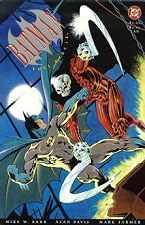
Full Circle 1991 (SC GN)
64 pages
Batman:
Full Circle 1991 (SC GN)
64 pages
Written by Mike W. Barr. Pencils by Alan Davis. Inks by
Mark Farmer.
Colours: Tom Ziuko. Letters: Todd Klein. Editor: Denny O'Neil.
Rating: * * (out of 5)
Number of readings: 2
This was a sequel to the events in Batman: Year Two (and was even included in the 2002 re-issue of the Batman: Year Two TPB), reuniting Barr with the artist who drew the first chapter of that previous story. I'm not sure if either story is to be considered "official" Batman history anymore, but the premise here has Gotham City once more plagued by the murderous Reaper who died at the end of Year Two. This time the Reaper is Joseph Chill, whose dad, Joe Chill, killed Batman's parents. Joseph wants revenge on the Batman for what happened to his dad (again in Year Two) and, with his sister Marcia, has concocted this scheme of impersonating the original Reaper.
I had been kind of cool to Batman: Year Two, feeling it had lots of potential, but didn't really fulfill most of it. I went into Full Circle a little more optimistically. With its shorter length I figured Barr could keep a tighter rein on his ideas, and it was drawn entirely by Alan Davis, a good artist who, unfortunately, only illustrated the first chapter of Year Two.
The story relies heavily on evoking the previous story, as once more The Reaper appears, brutally killing crooks and cops alike, and once more Batman forms a tentative alliance with the underworld (though this time not alienating the police in the doing). And Barr reassembles some familiar characters, such as Barr's re-fashioned Leslie Thompson, a character he clearly has adopted as his own, and the nun Rachel Caspian, daughter of the first Reaper and Bruce Wayne's ex-fiance. And there are themes of family loyalty, revenge and forgiveness.
Once again Barr's playing with good ideas, but once again doesn't really handle them properly. There's a surprising superficiality, despite ideas that should make for rich emotions. Characters, even Batman, never really come into focus (there's barely even an allusion to the fact that Batman and Rachel were once engaged!) while Leslie, who Barr no doubt intends as a lovable crumudgeon, remains obnoxious, a slum angel who seems more contemptuous than compassionate.
A fresh element to the tale is that it's set in the middle years of Batman's career, with Dick (Robin) Grayson. But the relationship between the two is awkwardly portrayed, with Batman as a stern taskmaster and Robin as an irresponsible flake (isn't that precisely the characterization that led fans to dislike the 2nd Robin, Jason Todd?). Anyone hoping for the Silver Age/Bronze Age camaraderie will be disappointed. They actually have few scenes together and Robin seems there mainly to serve the themes of father-son loyalty rather than because Barr has any genuine affection for the character or the Batman & Robin relationship.
The story is evocative of an older, much better Mike Barr-written tale, "The Player on the Other Side" (Batman Special #1, 1984, itself reprinted in one or two TPB collections), which also had Batman going up against a costumed foe who was his kind of emotional twin (shaped, like Batman, by the death of his father).
Barr seems to want to show some compassion for the new Reaper (demonstrating Chill's tenderness toward his own son) but Chill's revenge plan, involving the murder of innocents, is so cold blooded, so psychotic, it's impossible to see the man as anything but a monster. It's ironic that I sometimes criticize Barr for his hardline attitude, rarely showing much compassion or sympathy for the villains...and then when he does, it's for a character that really doesn't deserve it! (Perhaps Barr became so caught up in the abstract plot beats of his story that he kind of lost sight of the basic idea that this is a guy going around cold bloodedly murdering people just for the sake of cold bloodedly murdering them!)
The story itself is kind of draggy, never really surprising or tossing any twists our way. Since we know the true identity of the new Reaper (robbing the story of any mystery or intrigue and the potential spookiness of Batman thinking it might be a ghost) and since, as noted, the emotional/character stuff is kind of weak, we wait a long time for the Chill siblings' plan to truly manifest itself (the whole scheme of dressing as The Reaper has little true relevance). The climax, with Batman involved in one of those delightfully silly "death traps" villains like to employ, and with an attack on Batman psychologically, picks up somewhat, but it's kind of late in the game. For that matter, the whole motivation is kind of hard to swallow -- Chill goes to all this trouble in the name of a father he barely knew to take revenge on a guy (Batman)...who wasn't even the guy who actually killed his father! Like with Batman: Year Two, Barr seems to put his themes ahead of character and plot -- he wants to tell a story about family ties and vendettas, and doesn't really care if the underlining story makes sense.
Davis' art is O.K., but like the story, there's a certain...I don't know. I just wasn't drawn into the story. Perhaps the colours by Tom Ziuko are also at fault, relying on too many similiar hues, rather than emphasizing key figures or elements.
Original cover price: $6.95 CDN./ $5.95 USA.
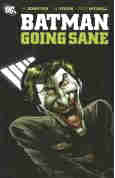
Batman: Going Sane 2008 (SC TPB) 144 pages
 Written
by J.M. DeMatteis, with Eddie Campbell & Darren White. Pencils by Joe Staton, with Bart Sears. Inks by Steve Mitchell
Written
by J.M. DeMatteis, with Eddie Campbell & Darren White. Pencils by Joe Staton, with Bart Sears. Inks by Steve Mitchell
Colours/letters: various
Reprints: Batman: Legends of the Dark Knight #65-68, 200 (1994-1995, 2006)
Rating: * * * * 1/2 (out of 5)
Number of readings: 3
Make of it what you will, but even in this age of "sophisticated" comics,
and "intellectual" critics waxing purple about the profundity of (some)
comics, smart stories can still get neglected, even ignored. Sure, maybe
it's because said stories aren't as great as a fan might think...or maybe
they're a wee bit too smart, too ambitious for their own good.
Case in point is J.M. DeMatteis' "Going Sane" story line. Batman:
Legends of the Dark Knight was a comic in which creators were given the
creative freedom to tell self-contained arcs, without having
to follow it up with another, and another, (as the regular
writer of a title is expected to do). In other words, each and every storyline
should be something special. Although LOTDK has produced a number of TPB collections, "Going Sane" probably stands
as one of the few that actually fulfills the mag's intent.
The story has Batman and the Joker getting into one of their usual life-and-death
struggles, only to have the Joker seeming to kill Batman. Faced with the
loss of his nemesis -- his "audience" -- the insane Joker can only retreat...into
sanity. He adopts a new life, thanks to plastic surgery, and with his mind
blocking out his memories of his criminal career. He even falls in love.
Meanwhile Batman is recuperating, annonymously, in a small town, ministered
by a kindly lady doctor. Both Joker and Batman have retreated from their
former existences, faced with the possibility of starting again. But such
normalacy proves temporary, and the two ultimately head for a climactic
clash.
Alan Moore's Batman: The Killing Joke
is generally regarded as the definitive Batman-Joker story, but I'll admit
I never "got" it. It struck me as shallow and simple. Meanwhile,
J.M. DeMatteis had earlier acquired accolades with his Spider-Man saga
Kraven's
Last Hunt (which, indeed, could be seen to have influenced the Killing
Joke -- though was better). There are definite echoes of Kraven's Last Hunt in "Going Sane"
(without the two stories being the same) so that one could argue Kraven's
Last Hunt was a dry run for this, arguably superior tale.
Ever thought the Joker could elicit sympathy, or could be cast as a
tragic figure? Ever thought a Joker story could put a bit of a lump in
your throat...without radically altering the character, or diverging from
established mythos? If not, "Going Sane" will make you a believer.
The story is structurally complex, playing around with character
analysis, symbolism, and thematic parallels, as both Batman and the Joker
experience similiar life decisions. Some symbolism is, admittedly, heavy
handed, but rarely pointless or overly indulgent: the former Joker and
his love coming upon a river and she remarking they've reached the end
of the road, unaware she speaks of their relationship, or the recurring
use of water as a theme and metaphor. Even the very title, "Going Sane",
is given a clever twist in the final panel of the saga. DeMatteis makes
us believe in the Joker's new identity of Joseph Kerr; a decent man plagued
by nightmares, not fully aware of the demon inside. We believe and we care,
care enough to want him to triumph, even as we know he won't. Nor is Batman
neglected -- this is a Batman story, after all. DeMatteis' handling of
the Batman is also surprisingly deft for a man who has written him rarely. He delves into his psyche, and humanizes him, in a way
that largely puts to shame Denny O'Neil, Alan Moore, Doug Moench, Frank
Miller and others who, over the years, have tried to lay bare the soul
of the Dark Knight.
DeMatteis sets out to tell a sophisticated, grown up tale, a tale rife
with symbolism and thematic threads -- which alone is unusual for comics
writers, though Moore, Miller, Busiek and others have occasionally tried,
usually with less finesse. But it's also very much a human tale,
where the characters are more than just ciphers, and their experiences
more than just intellectual abstractions. And though exciting, with plenty
of action and excitement, DeMatteis isn't afraid to slow down, to tell
a tale that is as much a drama as it is an adventure. And even the pop
references, with the Joker showing a love for old time comedians, show
a writer that isn't entirely pandering to the usual, teen audience (will
most kids even know to whom he's referring?)
Artist Joe Staton, with Steve Mitchell on inks, might seem like an odd
choice for Batman, with Staton's cartoony style. But this is a
different kind of cartooniness than I've commented is common today, with
artists who seem to have learned drawing from saturday morning cartoons,
and Japanese anime. Staton's is a rawer, kinetic style. Sometimes crude,
but frequently dynamic and expressive, and he draws a dark and spooky Batman
better than I expected. And that very cartooniness maybe makes him ideal
for tackling the Joker (not the most realistic bone structure in comics).
So why is "Going Sane" largely forgotten even as aging comic fans are
constantly looking for those great stories that will vindicate their hobby?
Why does Alan Moore, or Kurt Busiek's Astro City get held up as
shining lights of sophistication...and this gets relegated to the cheap
bins? (Only being collected more than a decade after it was first published -- and then presumably just because DC was looking for Joker stories to have on the shelf to coincide with the movie, "The Dark Knight"). Well, to be catty, maybe it's just too smart. Maybe it's not as self-reflective
as critics like their comics these days -- DeMatteis comes from an older
style, which tackled super beings as though they were people first, unlike
many modern comics which seem to analyze super heroes as superheroes. Maybe
DeMatteis' willingness to create suspense and tension through the characters,
rather than just piling on the action scenes (though there are those) had
critics reaching for their TV remote controls.
All I can say about "Going Sane" is this: I've got a friend who has
been acting as an experimental test subject for me. Not a comic fan, per
se, he has been dutifuly reading comics of all stripes and sizes that I
give him, looking for that "great" story that will impress him, a non-comics
regular (including the works of Moore, Miller, Gaiman, Busiek, Waid, etc.).
"Going Sane" is practically the first one which he has, at last, grudgingly,
thought was pretty darn good.
Make of it what you will.
This TPB is rounded out with another -- unrelated -- Batman/Joker tale from LOTDK. Originally presented in the double-sized 200th issue, it perhaps has been included simply because it's also from LOTDK, also featured the Joker...and hadn't previously been reprinted. It's written by Campbell and White and illustrated by Bart Sears. Presumably the writers were watching Grey's Anatomy or an ER re-run when they were supposed to be writing a Batman comic -- and ended up with this. Set one night at a bustling Gotham City hospital, dealing with victims of explosions set by the Joker, it's told from the POV of a female resident (as well as one of the Joker's henchman, just to relate some action scenes). There's lots of running about and medical jargon, then Batman shows up part way through with an unconscious and near-death Joker -- who he needs saved and revived in order to learn where the final bomb is planted. It's energetic and clips along, with dynamic art from Sears. Arguably it's nice that it avoids the straw dog villain approach you might expect (such as having contrived scenes of Batman butting heads with obstreperous doctors). At the same time, for a double-sized issue, there isn't really a lot else going on (like how would people, injured by the Joker, feel upon learning the Joker is receiving preferential treatment) with even the location of the final bomb predictable. Still, an agreeable page turner, and a slightly off-beat approach to the material -- but even at 44 pages, no more than a back up "filler" when contrasted with the main Going Sane story.
This is a review of the story as it was serialized
in Batman: LOTDK comics.
Cover price: $14.99 USA.
<Back Next>
Complete List of Reviews
Or go to