Westerns & Related Milieus... (Page 2)
for a complete alphabetical list of ALL reviews start here
A
- B - C - D
- E - F - G
- H - I - J
- K - L - M
- N - O - P
- Q - R - S
- T - U - V
- W - X - Y - Z
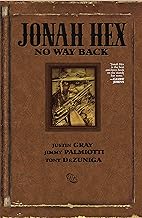 Jonah
Hex: No Way Back
(2010) 132 pages
Jonah
Hex: No Way Back
(2010) 132 pages
Written by Justin
Gray & Jimmy Palmiotti. Illustrated by Tony DeZuniga. Inked by Tony
DeZuniga, John Stanisci.
Colours: Rob
Schwager. Letters: Rob Leigh.
Rating: * * * * (put of 5)
Published by DC Comics
Suggested for mature readers
Reviewed: Dec. 2023
Cowboy bounty hunter Jonah Hex stands as the most successful Western character in post-1960s American comics. An at times shockingly dark and gritty series (even in its Comics Code era), it was created to capitalize on loosening Comics Codes guidelines in the early 1970s by transfering some of the violence and nihilism of the cinematic Spaghetti Westerns to comics. Jonah is a hideously scarred anti-hero who has some nobility beneath his thick, callused hide -- but it's buried pretty deep at times.
No Way Back is that rare beast -- an epic "graphic novel" featuring a mainstream American character. That is, it's not a collection of some previously serialized story. I'll admit I have a certain affection for such projects -- perhaps dating back to the days of my childhood and picking up Annuals, Specials, Treasury-sized, and Anniversary issues. I just enjoy the idea of a "big" comic. And in the era of graphic novels, that applies especially to these rarities that shoot past the standard 48 page, or even 64 page, size. Even as they often don't live up to my anticipation.
But I think part of the attraction (in contrast to simply collected editions) is the possibility of a self-contained epic, a movie-in-panel form, a...a...graphic novel.
And No Way Back pulls it off quite well. Oh, to be honest it's not great exactly. But in some ways it's as good as you could expect for a 125 page Jonah Hex epic. It captures the flavour and tone of the Jonah Hex comics (maybe too much so, published as a gritty, mature readers comic it takes what was already one of the darkest, grittiest series in mainstream comics and ratchets it up a bit), gives us a story with some additional emotional weight and gravitas, and with a plot that, though, moseys along unhurriedly, nonetheless has enough story to tell to fill out its over-sized length.
You can sit this on your shelf and feel that you have a quintessential Jonah Hex saga.
With that said, Jonah Hex has often been a series that sauntered along on atmosphere and attitude more than strong plotting or deep characterization. (Prior to reading this I re-read a lot of my old Jonah Hex comics -- most from the 1970s-1980s, plus a few from the contemporaneous-to-this Gray & Palmiotti revival).
Part of the marketing for this is the presence of artist Tony DeZuniga -- the guy who drew the early Jonah Hex adventures (when he premiered in Weird Western Tales) and inked others over the years. In fact DeZuniga is arguably better known as an inker than a penciller in comics. And it could be argued that's because his pencilling could be of variable quality -- sometimes great and atmospheric, and sometimes suffering from awkward bodies and poses. And the art here is...well, it's somewhat problematic. I don't know if it's that DeZuniga is just getting old and his eyes and hands aren't what they used to be, or whether it's deliberate stylistic evolution (lots of artists' styles change -- and gets looser -- as they get older) but the art is uglier, the figures more crudely drawn, than in his salad days (though faces can still be good and distinctively DeZuniga's).
However -- when depicting Jonah Hex's singularly gritty and nihilistic West, "uglier" and "crudely" aren't necessarily a detriment! Because there's still a lot of atmosphere conjured by DeZuniga and his co-inker and the colourist (the book having an almost painted tone at times). And DeZuniga is one of Hex's signature artists and so there's a lot of history in having him illustrate Hex's first (and so far only) epic graphic novel.
The story, by Gray & Palmiotti, who were writing Hex's revived monthly comic at the time, dredges up some of the horrors and heartbreak of Jonah's past. Readers of the character's past adventures knew he was raised by an abusive, alcoholic father. But this focuses more on his sense of abandonment when his mother ran away from her abusive husband -- leaving Jonah behind. When Jonah learns his mother is alive, but wanted by the authorities, he tracks her down, only to find her a broken alcoholic, dying of tuberculosis -- and that the trumped up charge was simply a lure to draw Jonah out by an old foe, the Mexican bandit El Papagayo (a nemesis from the old comics -- interestingly, unlike a lot of DC's line, I'm not sure this book is really a rebooted Jonah, so much as it's just a revival of the old series). After a fraught reunion, Jonah learns he has a half- brother before his mother dies. Macabrely hauling her body across the countryside, he finds the brother is an up-right preacher in a pious settlement. The meeting of the two brothers goes as well as you might expect for two such very different men -- but then El Papagayo and his men show up...
This is a dark story -- as you might expect for Jonah Hex. But maybe too dark -- like the very grittiness of the Jonah Hex comics maybe means it's not ideal for jumping to a "mature readers" format...because it just lets too much room for the creators to get even more gratuitous! Jonah Hex's wild west is very much where good guys are often less "good" and more just defined in contrast to the really bad guys.
And though there's enough story to keep the pages turning, and different "Acts" to the structure, like with the comics, it's not like it's brilliantly plotted or offers any particular twists or clever surprises, or subtly nuanced characterization. The whole plot of the unknown brother can almost seem a bit like a shaggy dog story in that it never quite goes anywhere. The moment where the brother reveals that he used to hear his mother sob the name "Jonah" at night, but he had no idea why (since he knew nothing about his mother having a previous family), is a powerful moment but feels like it could've been delved into more. While the showdown with El Papagayo feels a bit humdrum.
But as I say: that's about par for Jonah Hex, where often the most memorable tales were minor episodes told in single issues.
What this story does have in abundance is atmosphere, and it does generally evoke and encapsulate one of the more singular (anti)-heroes in American comics. And there is some genuinely raw (if often ugly) emotion in the scenes of the taciturn Jonah confronting his family history and in the heart breaking childhood flashbacks.
Ultimately, for all my off handed criticism, this does satisfy as a Jonah Hex epic one-shot -- the movie the Hollywood movie wasn't. And maybe it does so more than a lot of superhero "epic" graphic novels I've read. But maybe that's because Jonah Hex has a simpler formula that's easier to encapsulate in one book.
What's funny
is that DC didn't do any more Jonah Hex OGN (original graphic novel) --
because it does feel like an occasional epic graphic novel would be an
ideal format for the character.
***
Jonah Hex: Welcome to Paradise 2010 (SC TPB) 160 pages
 Written
by John Albano, Michael Fleisher. Illustrated by Tony DeZuniga, others.
Written
by John Albano, Michael Fleisher. Illustrated by Tony DeZuniga, others.
Colours/letters: various. Editor:
Joe Orlando.
Reprinting: the Jonah Hex stories from All-Star Western #10, Weird Western Tales #14, 17, 22, 26, 29, 30, Jonah Hex #2, 4 (1972-1977)
Rating: * * * * (out of 5)
Number of readings: 1
Review posted Nov. 2010
Published by DC Comics
By the 1970s, super heroes had almost completely pushed out all other genres from serious/drama comics, making the few long running non-super hero adventure comics noteworthy, like Conan, The Warlord...and western gunslinger Jonah Hex.
Hex clearly sprung out of the Spaghetti
Westerns of the cinema, which were perceived to have shaken up the nominally
clean cut morality of the traditional western movie with gritty, violent
tales featuring morally ambiguous anti-heroes. So with this inspiration,
married with a loosening of Comics Codes guidelines, came Jonah Hex...a
gruff bounty hunter who tended to bring 'em back dead more often than alive,
and was himself a hideously scarred misfit. And his exploits took place
against a cynical, violent
backdrop where "good" guys often
weren't much nicer than the bad ones. After a healthy run as a straight
forward western (in All-Star Western, Weird Western Tales, and his own
self-titled comic), the character's path took some curious and -- arguably
-- ill-conceived turns. He was transported into the far future for the
spin-off comic, Hex, then appeared in some later mini-series which relocated
him back to the 1800s, but with an added supernatural element. Then after
a long dormancy, he was revived more recently for a successful series,
returning the character to his western roots. He even was featured in an ill-fated motion picture (which
seemed to take its inspiration from the supernatural flavoured 1990s stories).
In addition to the obligatory TPB collections of the modern comics, DC has released collections of vintage 1970s comics as both an omnibus Showcase volume and this...a selection of seminal issues.
Created by John Albano, the character was introduced in the title story, and it's a pretty simple, straightforward tale -- but effective for that. Hex is hired by a town to rid them of an outlaw gang...but finds himself unwelcome otherwise. As I say, it's pretty obvious...but does pack a bit of an emotional punch in the end.
In general, the tales are fairly simple, albeit well-paced. A big appeal is simply the atmosphere, from the idiosyncratic phonetically-spelled dialogue intended to evoke southern twangs, to the dark, gritty but realist art that lend the tales a palpable sense of place, the men craggy faced and unkempt (though the women are generally pretty). The visuals maintain a stylistic consistency, even as with a variety of artists at work (including well known names like Tony DeZuniga and Jose Luis Garcia-Lopez), it also boasts enough variety to keep it from getting monotonous. And the underlining violent nihilism to the stories is its own appeal -- if only as a guilty pleasure. Indeed, though the character has enjoyed a successful revival, one could argue he was more interesting in the 1970s. Today, with too many comics (even super hero comics) embracing a similar a-moral nihilism, Hex is less of novelty.
Although the stories here are mostly stand alone, there is some continuity. In the second story reprinted here, Hex has a pet dog that dies -- but in this collection you wouldn't realize the dog had actually appeared in previous tales. More obviously, there's a slow building sub-plot introduced by scripter Michael Fleisher, so that this is both a collection of individual stories...yet also feels like a graphic novel. A few stories give us vague glimpses of a man with a cane, Turnbull, pursuing some cryptic vendetta against Hex, eventually building to a climactic confrontation and a flashback to Hex's Civil War adventures, and how he was -- mistakenly -- believed to have betrayed his Confederate regiment to the Union army.
Granted, given his notoriety as a bounty hunter, where people usually know him by sight...it's awkward to suddenly thrown in the idea that he's equally notorious as a traitor, to the point where an entire bar shuns him. Don't you think it would've come up earlier? As well, the fact that Hex wanders about in his Confederate army jacket seems unduly provocative when he knows people believe him a traitor to the cause.
Why the final two stories are included (over any others) is unclear. They establish that Turnbull did not die in the previous stories, but as such kind of rob the collection of the sense of closure it might have had if we had stopped with the story where Hex thinks Turnbull is dead. Maybe the final two stories here were included because they introduced some adversaries that, I'm guessing, recurred (most of Hex's foes end up dead by the end of an issue) and so this collection was seen as establishing the basics of the Hex mythos. By this point, Fleisher has also introduced a sub-plot where Hex has been framed for murder -- not that the collection feels like it ends "to be continued" or anything.
That's because, for the most part, the stories are meant to stand alone, with only minor sub-plots linking one issue to another.
As mentioned, the plotting overall is fairly straight forward and simple. Even the sub-plot with Turnbull isn't really a "plot" per se, where each chapter adds to the narrative. And the flashback story doesn't add much to Hex's origin (other stories, not included here, detailed how he was scarred and why he became a bounty hunter -- questions more likely to be posed by a reader). Though it does establish the idea that Hex, though a southerner sporting a Confederate army coat, was nonetheless uncomfortable with slavery.
Though that brings us to an awkward issue, "Showdown at Hard Times" (WWT #22), in which Hex squares off against a black outlaw and his gang of Indian and Mexican henchmen. The characters are irredeemably sleazy but, granted, most of Hex's foes are cartoony villains -- though making all the gang non-white is odd. But where it becomes bizarre is when the black outlaw starts talking about his love of watermelons! At first one assumes the character is satirizing the stereotype...except, sure enough, Hex tracks him down and he's eating a watermelon, even throwing it at Hex as a weapon! You can find yourself flipping to the copyright dates, wondering if this story was from the 1940s, rather than the 1970s. Admittedly, I have no idea of the origin of the black-man-loves-watermelons cliche (doesn't everybody love watermelons?!?) but as with any cliche or stereotype...it's inherently offensive to employ it. So what was Fleisher and company intending by it? I mean, the Hex stories were supposed to revel in a kind of raw historical realism other western comics didn't...so depicting attitudes of the era is understandable. But this isn't depicting the characters with attitudes true to the era (such as Hex still being friendly with a man after the man ruthlessly puts down a slave revolt, or Turnbull's black manservant speaking in slave-style patois)...this is the comic itself perpetuating the attitudes.
So were the creators just racists? (And did no one at DC question it?) Or was it intended as part of the series' "politically incorrect" tone? Fleisher stirred up controversy with his Spectre stories (collected as Wrath of the Spectre), and even a couple of novels he wrote seemed to deliberately court controversy, apparently. So maybe Fleisher just fancied himself a rebel, a provocateur, tweaking the nose of propriety. But provocative is forcing us, the reader, to confront truths we're not comfortable confronting -- simply using a racist cliche to show you can is just childish (I mean, as a white writer, working in a predominantly white profession, read by predominantly white readers, at a time when segregation and race-based murders were part of the recent past...who exactly would he be "rebelling" against?).
I'd like to think the reprint editors were aware of the uncomfortableness of that issue...but included it because it's part of the larger Turnbull arc. But the fact that no on-line review I've read of this collection comments on the scenes is, itself, curious and disturbing -- I guess we haven't come a long way, baby, after all.
But that aside, otherwise these old comics hold up well. As mentioned, they aren't particularly complex or sophisticated, Fleisher not one for a lot of deep thinking or subtle character development. In one story -- "Face-Off with the Gallagher Boys" (WWT #26)-- the train robbing outlaws are embraced as folk heroes by the locals, while Hex is mistakenly arrested and mistreated in prison. Then you realize, ah hah, that's the clever theme, the turnabout as the villains are treated as heroes and vice versa. So you wait to see where Fleisher is going with it...but after juxtaposing the scenes for a few pages, he simply has Hex escape and have his usual showdown with the villains, any themes not really developed beyond the concept. Arguably some of Albano's stories, like the title piece, and "The Hanging Woman" (WWT #17) have -- marginally -- more emotional depth.
But the pacing throughout is good,
the atmosphere and milieu palpable, the visuals moody, and Hex himself
a memorable personality. If only as a guilty pleasure, you can kind of
revel in the dark world where even the hero is an anti-hero. And the mix
of stand alone stories with a sub-plot allows the collection to act as
both a sampler of tales (generally as good as any of the other Jonah Hex
comics, old or new, I have in my collection)...and also as a story arc.
***
Lady Rawhide: It Can't Happen Here 1999 (SC TPB) 120 pgs.
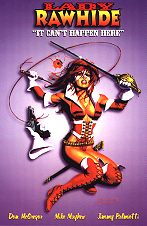 Written
by Don McGregor. Pencils by Mike Mayhew. Inks by Jimmy Palmiotti.
Written
by Don McGregor. Pencils by Mike Mayhew. Inks by Jimmy Palmiotti.
Black & White. Letters: Michael Delepine, Kenny Lopez. Editor:
Renee Witterstaetter, others.
Reprinting the first Lady Rawhide mini-series (#1-5) from 1995-1996 (which was originally published by Topps in colour)
Rating: * * * (out of 5)
Number of readings: 1
Published by Image Comics
First introduced in the pages of Topps Comics' 1990s Zorro
comics (and long before TV's "Queen of Swords"), Lady Rawhide is a masked,
sword wielding heroine existing in the same period: early 19th Century
Spanish-held California. This, her first solo story, has her visting San
Francisco, then a tiny port town rather than the modern metropolis. She
rescues a Russian sailor from a mob who thinks he's a murderer of young
women, then she investigates the killings, suspecting the killer might
be connected to the wealthy family with whom she is staying.
It Can't Happen Here is oddly structured, spanning a day
and two nights -- a kind of modest timeframe (particularly as, when originally
published as a bi-monthly mini-series, it was stretched over 9 months!).
The plot is mayhap a bit slight, but still entertaining. Don McGregor brings
his usual penchant for talky characters and introspective captions, spiced
with odd humour, giving the thing a well-rounded feel, even if the cliched
serial killer plot seems beneath his talents. To his credit, there are
only a couple of murders over the course of the story, and McGregor is
one of the few writers who actually takes the time to contemplate the repercussions
of such violence (without seeming to be exploiting or trivializing grief).
The art by Mike Mayhew and inker Jimmy Palmiotti is attractive
and pleasantly restrained, though there are a few spots where panels are
confusingly arranged.
The thing starts well on a foggy night, with Lady Rawhide
and her rescued sailor running from the mob for two issues -- action and
atmosphere. Granted, read as single issues, there's not a lot of progression,
but in a collected volume they make good chapters. As the story progresses,
things occasionally bog down in over long scenes and wordy conversations
that contribute to the period milieu and the characterization more than
to the plot. And there's a flaw with a story that's supposed to be a mystery
but doesn't introduce us to suspects until halfway through!
Perhaps the most talked about aspect of Lady Rawhide is
the sexploitation angle, with some critics dismissing the character out
of hand as tawdry tripe. Ironically, that's what McGregor and the gang
was going for, hyping Lady Rawhide as a sexual "bad girl".
Both McGregor and his critics may be exaggerating, at
least somewhat.
Sure, Lady Rawhide is dressed scandalously, but not really
moreso than your average comicbook heroine (she wears less than Wonder
Woman, but more than Vampirella). She's certainly no "bad girl", a designation
applied to the comics sub-genre featuring underclad, buxom babes given
to snarling and brutal violence. Lady Rawhide is a level-headed, likeable
character, lacking a vicious streak...and her physical dimensions are rather
modest when compared to other heroines.
The main "sex" aspect is in the writing, occasional use
of words like "cleavage", or in the way characters comment on her appearance,
asking how come her "breasts don't come popping out" of her skimpy costume
-- dialogue that can be inappropriate in some scenes, motivation-wise,
and seem more like the stuff of sophomoric school boys ("wink, wink, nudge,
nudge, say no more," as Monty Python would put it). But all McGregor's
doing is drawing attention to the conventions of superheroines in general,
rather than anything extreme about his own creation. In the entire book,
there's only one scene that seems like it maybe strays a little outside
of what you'd expect to see in, say, a Wonder Woman comic. And, admittedly,
Lady Rawhide is depicted in a few blatant "cheesecake" poses, bending over
for no discernable reason.
Don't misunderstand: there's certainly a sexy element
to the book, but nothing extreme.
Hardly a ground-breaking plot, and a bit slow in spots,
but it benefits from the atmosphere, the unusual (for a superhero comic)
historical setting, McGregor's usual thoughtful, literary prose (when he's
not indulging in snickering innuendo) and nice art. The mini-series was
originally published in colour by Topps, and it's a shame Image was cheap
and reprinted it in black & white, particularly given the price tag.
This led to a follow up comic by McGregor and artist Esteban
Maroto that has, I believe, suffered from an erratic publishing history
(and jumping from Topps to Image).
In deference to the salacious hype, I could give the book
a "mature readers" caution, but more for the way the characters talk
about sex than for any depiction of same. Ironically, there's a bit of
gore in a scene involving some dead animals that makes me more cautious.
Ultimately a modest but appealing read. Nice ambience,
moderately sexy and intelligent (when it's not being sophomoric), but a
tad slow. Attractively illustrated...in more ways than one (wink, wink,
nudge, nudge)
This is a review of the story as it was originally
serialized in Lady Rawhide comics.
ON TO Westerns Page Three
BACK TO < Westerns Page
One