spies, private eyes, and detectives... (Page 2)
for a complete alphabetical list of ALL reviews start here
A
- B - C - D
- E - F - G
- H - I - J
- K - L - M
- N - O - P
- Q - R - S
- T - U - V
- W - X - Y - Z
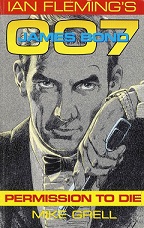
James Bond: Permission to Die 1992 (SC TPB) 144 pages
 Written
and illustrated by Mike Grell.
Written
and illustrated by Mike Grell.
Rating: * * * (out of 5)
Reprinting: the 1989-1991 three
issues, prestige format, co-published by Eclipse (USA) / Acme
Press (UK))
Though there had been a James Bond newspaper strip as far back as the 1960s, the character didn't really start to intrude upon comics until the 1990s, when more than one publisher tried some Bond mini-series. The first one was Mike Grell's Permission to Die. The publishing history of this mini-series is, in itself, curious. It's three, 48 page issues...but one where there appears to have been a two year gap between the second and third issue! (At least going by the publication dates inside the covers). What's equally odd that is one might almost think it was only intended as a two-parter which then Grell decided to add to a little later.
The premise has secret agent 007, James Bond, assigned to get a woman out from behind the iron curtain (this being during the cold war) -- her uncle, a wealthy recluse, has offered Britain some rocket technology in return for this favour. And the first two issues pursue this story, ending with Bond getting the woman out. Which seems like a reasonable finish and, indeed, in the 1996 edition of the Comic Guide, they mistakenly list the series as being two issues long.
The third issue then has Bond delivering the woman to her uncle and becoming embroiled in a, more or less, separate story, as her uncle turns out to have a hidden agenda and, in true Bond fashion, lives in a hidden HQ. There's a deliberate Phantom of the Opera vibe, with the wealthy recluse hiding a disfigurement behind a mask, given to playing the organ...and even named Erik (the Phantom's name) -- Grell also homaged Gaston LaRoux's classic for the Batman story, Masques (reviewed in my Batman: Elseworlds section).
The fact that Mike Grell goes to great lengths to describe the uncle in the first issue (complete with mysterious disfigurement and enormous personal resources) even though he doesn't appear until the third, certainly suggests Grell had intended the whole series all along.
Anyway, Permission to Die is a moderately enjoyable adventure -- with the slightly separate nature of the plots being fun, in that you essentially get two stories in one. There has always been a disagreement among Bond fans as to whether he was better served by the slightly grittier, more sedate novels of Ian Fleming, or the over-the-top action movies. And Grell seems to try for both. The first part of the story is more down-to-earth, with Bond running around the European countryside with Gypsy allies, his most flamboyant adversary simply a high priced assassin; then the second part gets a little more heightened, as we meet the enigmatic uncle, his (of course) sexy-but-deadly Girl Friday, and learn of his earth shaking plan. Though Grell throws in a certain ambiguity with the villain, so that he's not quite a complete black hat -- something not very common in either the books or the movies.
It's as if Grell couldn't decide which version of a Bond story he liked better, so he incorporated them both. At least -- to some extent. One could argue the thing about Fleming's novels wasn't simply that they weren't as over-the-top and tongue-in-cheek as the movies. There was also some genuine attempt at introspection, Bond a more contemplative -- and, at times, vulnerable -- hero than in the movies. And Grell doesn't really aim for that.
And of course the idea of the "super villain" with the secret base originated in the novels, so maybe the whole thing would be seen as a throwback to the novels. A weakness with the mini-series is that it's not exactly fast paced, brimming with breathless action. Grell, in fact, seems to lack a certain sense of fun, so that some of the series can seem a bit, well, dry. Like I noticed with Grell's run on Green Arrow from that time, he can kind of fall in love with his own prose, writing static, verbose sequences of characters just sitting around talking. Though the Gypsy parable about the wolf is memorable, and there are occasional exchanges that seem to reflect an author trying to sprinkle a little real world minutia into his tale (like a cute exchange about which North American fresh water lake is the largest, in which nuance is conveyed with facial expressions).
But despite the flamboyant trappings of the third issue, even there Bond spends more time discussing things than investigating them. In fact, the plot is jumped forward by the fact that he meets someone who has already done the preliminary work on her own and can tell Bond about it! The third issue seems a little like Grell maybe should've stretched it out over two issues, to really develop it, particularly as it seems a bit rushed and with questionable logic. Though logic is questionable throughout -- I mean, would the communist authorities really devote so much manpower and resources to keeping one person from defecting?
Artwise, Grell's Bond evokes a young Sean Connery (without quite encroaching upon any copyright issues), adding to a sense of resonance, and the first issue, in particular, is well drawn, with well handled faces. Grell can be an artist of varying skill, delivering effective, almost breathtaking work on one story...then scratchy, rougher art on another. The art slips as things progress, becoming a bit rushed and even crude by the final issue -- particularly problematic in the action scenes. In fact, one almost wonders if the lapse between issue two and three might've reflected some problems Grell was having, either meeting deadlines, or with his health, or something (each issue credits an increasing number of "art assistants"). The colouring, too, gets a little off centre in the later issues.
There's also a grittiness to the series that, ironic for a comic vs. the movies, can be more than the films, with some violence, and scenes of Bond and romantic interests rather underclad (albeit, mainly in shadow).
Permission to Die isn't a great
Bond saga -- it's a bit thinly plotted, a bit dry, a bit reliant on talking
heads. But it is enjoyable, reasonably evoking Bond and his milieu, and
told with enough maturity to not seem like a dumbed down comic book version.
Not a classic...but not a disappointment either.
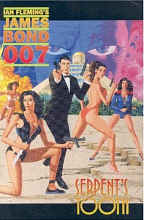
James Bond 007: Serpent's Tooth 1993 (SC TPB) 150 pages
 Written
by Doug Moench. Illustrated by Paul Gulacy.
Written
by Doug Moench. Illustrated by Paul Gulacy.
Colours: Steve Oliff. Letters: Pat Brosseau. Editors: Jerry Prosser,
Dick Hanson.
Reprinting the three part mini-series
Rating: * * * (out of 5)
Number of readings: 2
Published by Dark Horse Comics / Acme Comics
Ian Fleming's super spy has had limited adventures in comics (despite a long running comic strip) -- but there was a slew of prestige format projects in the 1990s. The first was the mini-series, Permission to Die, in which writer/artist Mike Grell seemed to be trying to pull back from the more highflying excesses of the motion pictures. In contrast, Doug Moench and Paul Gulacy's Serpent's Tooth whole heartedly embraces the over-the-top action of the movies -- right down to an opening prologue leading into a title splash page meant to evoke the credit sequence of the movies.
And the result both succeeds and falters for that reason.
The story begins showing key, but seeming unrelated events -- in the South American jungle an Indian girl is kidnapped by a seeming flying saucer; in England, prominent scientists are kidnapped; and then there's the ubiquitous attack on a nuclear submarine which seems like it's begun half a dozen Bond films!
Soon Bond is called in to investigate a mysterious industrialist named Indigo who operates out of Peru -- the two men having their first encounter on opposite sides of a casino's gaming table. And soon Bond, after teaming up with local operatives -- including the obligatory sexy female agent -- uncover's Indigo's world shattering plan.
And, as I say, all this is the strength and weakness of Serpent's Tooth.
If you're a fan of the Bond films, it will all seem nicely familiar and evocative -- but the flip side is it's a little too familiar. Bond's encounter with Indigo in the casino -- a staple of the films -- is entirely geeneric, without really managing to create the undercurrent of veiled tension that some of the (better) such scenes in the movies do. As well, what Moench -- and I suspect many Bond fans -- overlook is that despite the action scenes being predominant, Bond films are, at their core, mysteries. Where neither Bond, nor the audience, really knows what's going on, or where it's all going to lead, at first. Often Bond movies begin with Bond investigating a seeming minor incident -- say, stolen diamonds -- that only graduually lead him to discover an apocalyptic plot. But here, there's a feeling that Moench plays all his cards too soon. Partly that may be less a problem with Moench's unfolding of the story than, as I say, the very cliched-ness of that story. But I do think Moench does have the characters explain what's going on too early, so that the story becomes mainly just a lot of running about and action, rather than a puzzle we're waiting to see how the pieces come together.
And the problem with the inherent superficiality of the Bond films, and their emphasis on long action scenes, is that a sufficiently charismatic actor, like Sean Connery, or Roger Moore, can add a level of emotion, or at least character, to otherwise shallow fight scenes. But in a comic, the writer has to work a little harder to make us care.
One way in which Serpent's Tooth perhaps diverges from the movies is that it's even more outrageous and sci-fi oriented -- Indigo has genetically modified himself so that he's actually part lizard, complete with scales! I don't want to give too much a way, but one suspects Moench was being inspired by a certain hit movie at the time, and asked himself, what if James Bond were inserted into that scenario?
Hardcore purists might balk, but others might see in it Moench and Gulacy deciding that if they're going to compete with a score of motion pictures, the ace they have is that comics basically have an unlimited budget. And Serpent's Tooth certainly contains scenes and ideas that, even today, would probably put it outside the capability of a Bond movie's budget -- indeed, some of the scenes are so grand, they test Gulacy's ability to depict in pencil and ink! In a way, the opposing camps of Bond can be kind of epitomized in the reaction to the Bond film Moonraker -- a movie a lot of critics hated for its outlandishness, even as it was one of the most successful at the box office (and is one of my personal favourite Bond films).
At the same time, the one way the story seems "smaller" than a movie, is the lack of globe hopping common to many (though not all) Bond films. Not that the Peruvian setting here isn't glamourous and exotic, but often Bond films unfold over a few countries and locations.
Moench and Gulacy have been on again/off again collaborators for decades, and this project seems like a logical effort for them. After all, their mid-'70s work on Marvel Comics Master of Kung Fu was clearly inspired by the spy antics of James Bond. And Gulacy has a nice, cinematic eye for story telling, and a semi-realist style of drawing (though he's become more caricaturish in recent years). Though someone needs to tell him that drawing the philtrum on women isn't necessarily attractive! In fact, his realism can be an unintentional problem, when Bond's good guy South American contact looks uncomfortably like Saddam Hussein! The colours too are richly vibrant, bold and attractive -- another necessary part of Bond films which are often as much travelogues, set in beautiful and exotic locales, as action-thrillers!
Bottom line: if you're looking for something that has the look and feel of a James Bond movie -- Serpent's Tooth succeeds quite well. But despite some of the over-the-top plot elements, it remains blandly generic, with none of the characters, or even many of the action scenes, muscling their way to the upper echelons of Bond iconic characters and scenes.
But for what it is, it's a modestly enjoyable romp.
This is a review of the story as it was originally serialized in the mini-series.
Cover price: __
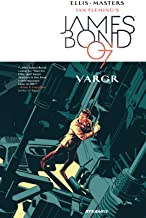
James Bond: Vargr 2017 (SC TPB) 160 pages
 Written
by Warren Ellis. Illustrated by Jason Masters.
Written
by Warren Ellis. Illustrated by Jason Masters.
Colours/letters: various
Reprinting James Bond (1st Dynamite series) #1-6 (2015)
Rating: * * 1/2 (out of 5)
Number of readings: 1
Reviewed: Oct 2018
Suggested for mature readers
Published by Dynamite
James Bond, the seminal super spy of novels and films, historically has only had sporadic forays into comics -- but recently Dynamite seems to have gonne all in with a bunch of Bond projects. And this TPB collects the first story arc from Dynamite's first Bond series (they've done a couple, plus mini-series).
Like a lot of pop cultural properties, there can be debate among fans as to what constitutes the "true" Bond -- from novelist Ian Fleming's original conception of the character, to the movies which catapulted the character to being a global cultural touchstone (movies themselves that reinterpret the character for different actors), as well as non-Fleming novels, video games, etc. And then there's the version of a character that exists in the fans' minds -- irrespective of its roots in the actual property. There are some fans who will dismiss, say, the movies, and talk about the "true" Bond of the novels...when I have a sneaking suspicion they've never actually read an Ian Fleming novel. But they nonetheless have this idea of what they must be like.
All of which is a preamble bringing us to Vargr -- a six chapter Bond adventure penned by Warren Ellis. And I can't decide if Ellis and co are trying to write to the "true" Bond vision -- or they just don't care one way or the other.
Certainly in one sense it can feel more like a slightly subdued Bond adventure -- in that instead of Bond traipsing about exotic locales he's mostly in drably generic European cities, and his assignment involves trying to break a drug smuggling ring. While the action scenes are mostly just fights and shoot outs on side streets or in office buildings. Q, Bond's ordinance provider, just provides him with guns (that presumably you can find listed in any Guns n' Ammo magazine) rather than the spy gadgets familiar to the movies. However equally there are outlandish ideas, including that the illegal drug is secretly laced with an infectious plague, and some of the bad guys are augmented with bionics, imbuing them with super strength (giving the story more of a "comic book" vibe at times).
And the whole thing can feel a bit...bland. Now this is the issue with kicking off a new Bond comic: you maybe want to start out safe, just hitting the appropriate marks before stretching your creative muscles. But it really is just a loose plot stringing together heavily detailed, page-consuming fights (read in monthly instalments, each chapter can feel like a couple of talking head scenes buffering a long fight). There are no big twists, and supporting characters are pretty utilitarian and disposable (in one issue Bond meets the members of MI-6's Berlin station as if we're being introduced to significant supporting characters...except then they get summarily killed off a few scenes later). Even the villain's motive is unclear: Bond point blank asks him about it and the response -- at least to me -- seemed unilluminatingg.
Ellis uses the idea of the lethal drug as basically just a MacGuffin -- a plot device just to give the villain some master scheme to be thwarted. I couldn't help thinking how they could've actually used the comic book as a chance to tell a story slightly more adventurous than the movies can (which have to follow certain formulaic ruts given the box office expectations). The comics could be a chance to push a bit outside the familiar tropes or to import from other genres (such as how the comic James Bond: Serpent's Tooth took Bond and added a bit of Jurassic Park!). To whit: I thought what if they had done this as a kind of Disaster Movie? Y'know, James Bond meets Outbreak, or James Bond in one of those quintessential Old School British apocalyptic tales (like Dr. Who in the Pertwee era). Have the outbreak of a disease actually BE the plot, with Bond racing against the clock to find the cause and the cure, running through London's eerily evacuated streets.
Anyhoo...
With that said: I kind of brushed over the idea of the long fight scenes. But, obviously, that's part of the point. A lot of the readers will come to it from the movies, so it makes sense to cram the thing full of cinematic-style brawls. Masters has a fairly realist style, and this allows the action scenes to be broken down into carefully blocked out fight scenes that can almost feel like storyboards from a movie. Whether it be Bond and his foes playing deadly hide n' seek in a warehouse, or trading blows in a panel-by-panel breakdown.
However there's another matter.
Namely: its tendency toward graphic, sadistic violence. While James Bond films remain (mostly) of a PG variety, Ellis and the artist go whole hog on scenes of the back of characters' heads exploding when shot by a bullet, or close ups of fingers being chopped off by a shovel. And there's a lot of it because, as mentioned, there's a lot of fighting. And it's often presented in meticulous detail -- from an entire sequence of panels depicting sentries being shot by Bond (with a sniper rifle) to panels "cleverly" showing an x-ray style picture so we get every detail of a bullet tearing through bone. It can be a bit disconcerting, especially when you start to realize such scenes aren't simply a by-product of what Ellis and Masters are doing -- they're the point. And fans are supposed to be pouring over the scenes going "coooool!" and thinking how much neater this is than those wimp-ass movies. Especially as Bond himself is often at the centre of it, ruthlessly gunning down/executing people in cold blood 'cause, y'know, like, that's what cool heroes do. (And yes, I know Bond would sometimes do that in the books/movies -- but Ellis takes it to a whole other level of nihilism).
Now this brings me back to my original point about the "true" Bond -- because I suspect a lot of fans of this approach will insist Ellis is just going back to Ian Fleming's Bond who was leaner and meaner than the movie versions. Which, y'know, isn't entirely true. The books were often quite a bit slower-paced (Fleming was writing mystery-suspense novels as much as he was action-adventure). And if we're going back to Fleming -- Fleming's Bond was actually far more introspective than the movie version, and more vulnerable, physically and emotionally (he actually fell in love in some of the books).
Ellis' Bond comes across as a caricature of the Bond-archetype -- he has little personality, and remains blithely unflappable for much of the story (this is a problem with the medium, of course; in movies you can have a charismatic actor bring the character to life, in a novel you can have paragraphs of internal description -- but in a comic, it's too easy for Bond to just end up a plot device).
And that relates to the one thing Ellis has conspicuously omitted from the Bond cliché -- a love interest! Which not only runs counter to most of the movies and books, but also affects Bond as a character: with no one to play off of, and no one for him to care about, his main function is just to go around glibly killing people. Which, y'know, given my qualms about the comics' violence becomes telling: the comic ups the violence and brutality while getting rid of the mushy stuff (which seems like the comic is aimed more at 14 year old boys than anything). Viewed that way, it makes the fact that one of the villain's henchmen is an attractive woman -- so there's a scene where they fight and Bond kills her -- more curious.
I suppose if I'm going to go down this road of snarkily questioning Ellis and company's motives and ethics, I might mention a certain undercurrent of right wing politics (Bond whinges about not being allowed to carry a gun on British soil -- though it has little impact on the plot; and another scene has an MI-6 officer say "bugger" them when asked if they should get permission from a friendly foreign country before violating their sovereignty in pursuit of the villain). I also can't decide if the comics' use of non-white characters is progressive -- or simply tokenism since they tend not to have big parts (Moneypenny is black -- as she is in the current movies -- but I don't think this is meant to be the same Bond/continuity as the films).
So where does that leave us? In a way I'm showing my age because when I talk about different Bond incarnations I talk about books and movies -- and completely ignore that whole other medium of the modern-era...video games. I suppose maybe that's what they are going for when I talk about a few talking head scenes sandwiched around meticulously detailed action scenes: a video game come to (comic book) life. Vargr lacks the mood and introspection of the novels, the fun and flamboyance of the movies, while jettisoning any romantic or softer side in favour of brutal violence -- all in service of a plot that can feel a bit like a generic template for a Bond adventure.
This is a review of the story as it was originally serialized in the comics.
Cover price: __
ON TO > Spies & PIs Page Three
BACK TO < Spies & PIs Page One