Justice League Elite, vol. 1 2005 (SC TPB) 205
pages
Justice League Elite, vol. 1 2005 (SC TPB) 205
pages
by The Masked Bookwyrm
JLA - The Justice League of America
PAGE FOUR
Justice League Elite, vol. 1 2005 (SC TPB) 205
pages
Writer Joe Kelly. Art Doug Mahnke. Inks Tom Nguyen.
Colours: David Baron. Letters: Pat Brosseau, Phil Balsman, Ken Lopez. Editor: Mike Carlin
Reprinting: Action Comics #775, JLA #100, Justice League Elite #1-4 and the lead story from JLA Secret Files #4 (2001, 2004)
Rating: * * 1/2 (out of 5)
Number of readings: 2
Slight Mature Readers caution
Justice League Elite was (yet another) JLA spin-off, this time presented as a 12 issue maxi-series. It was collected in two TPB volumes, the first one reprinting the first four issues...plus some precursor stories.
The idea basically starts in Action Comics #775, a good, double-sized stand alone issue in which Superman must deal with a new global super team, The Elite, headed by one Manchester Black. The Elite sees itself as the good guys...but believe the end justifies the means, and feel the Old School values Superman expounds are out-moded in the tougher, grittier world. The Elite are willing and eager to kill in the name of justice...even if the dead are innocent by-standers. It's one of those comics that works best not really asking how it fits into DC's otherwise tangled and incestuous continuity -- I mean, how could such a super powerful group spring out of nowhere, and why does it fall to Supes alone to deal with it? But taken on its own, as a parable, and as a showdown between Supes' old fashioned virtue against representatives of the "dark n' gritty" movement that keeps cropping up in comics, it works pretty well. In fact, I'd come across some comments suggesting it was one of the best Superman stories...ever. Well, maybe yes, maybe no. But it's certainly a solid read.
Unfortunately, it's the high point of this collection.
The theme picks up a few years later with JLA #100, in which a slightly remodelled Elite crops up -- now run by Vera Lynn Black, Manchester's sister (Manchester having apparently previously returned and died in a story published inbetween). Global catastrophes plague the earth and the new Elite shows up, this time announcing their intentions to conquer the world in the name of saving it. This time it's Supes and the Justice League against them. But despite some sort of interesting ideas, and a nice twist in the climax, it's less successful, being a rather thin plot, with more fighting than story...let alone characterization.
It ends with an idea put forward that the JLA needs a more proactive branch. Which then leads us to the Justice League Elite series. Though four issues of a twelve issue series, it does form a story, chronicling the team's first mission and an issue dealing with the aftermath (while still leaving a mystery dangling)
Justice League Elite isn't atrocious...but I just didn't find it that interesting. The premise is basically that there are those who feel there needs to be a covert branch of the JLA -- a group more willing to skirt moral grey areas, to go undercover, that sort of thing (something which I think was already tackled a few years ago in the JLA spin-off Extreme Justice). To do so, a group is formed comprised of a few regular heroes -- namely Green Arrow and the Flash -- some ex-villains, and a few newer faces. And their first mission is to infiltrate a super terrorist group that's planning on attacking a corrupt South-East Asian country.
I had some problems with the basic premise of this series...namely, I'm not sure even it knew what it wanted to be.
It seems to set itself up with the common whine (uh, I mean, considered argument) in comics, that superhero comics aren't gritty enough, and that the world has changed since the innocent early days of the super hero genre and comics need to reflect that. I don't really agree, and I think comics that take that attitude are, more often than not, unimaginative and dull, but that's neither here nor there. 'Cause it's not clear if that really is its point.
On one hand, presenting an interventionist super team prepared to bend the rules seems like it's inspired by, and endorsing, then-U.S. president Bush's gunboat diplomacy...on the other hand, dialogue is tossed in taking a few gentle swipes at George W., and the team answers to the U.N. (not the U.S.) and their overseer, in a nice touch, is Muslim diplomat (albeit one who smokes and cusses a lot).
Maybe that's the point -- the ambiguity. After all, with the characters constantly arguing about the pros and cons of what they're doing, and the Action Comics #775 issue being so clearly a criticism of the dark n' gritty philosophy, maybe Kelly wants to keep us guessing as to what his ultimate point will be (particularly as, being a mini-series, one assumes it's all building to some climactic resolution).
But the problem is, it seems a bit like it wants to pretend it's an edgy, "sophisticated" series -- "Not your daddy's Justice League!" as one issue's cover proclaims -- but still just seems pretty juvenile and cartoony. Oh, the violence is grittier, there's an unrelenting stream of raunchy dialogue and sexual innuendoes (that I guess is supposed to make the comic seem grown up)...but it doesn't actually seem realistic, or like Kelly really has a firmer grasp on geo-political crises than any other comics writer. For such a bad-boy, black ops team, they still operate under the rule that they mustn't kill anyone, just like other super heroes (but which bears no relationship to real world military and para-military organizations), and their initial adversaries are...super villains whose sole goal is just a lot of pointless anarchic violence. In other words, precisely the sort of apolitical foes the JLA itself normally takes on.
So maybe I'm being too anal about this and the real point is just to create a new super team, with lots of infighting and colourful personalities, and the rest is just window dressing.
But the bottom line is...I just didn't really care about the characters much, and the plotting seemed rather thin and undeveloped (actually, it's more a three issue story arc, followed by a connected one issue story dealing with the fall out). The undercover aspect, which could've been intriguing, is only lightly touched on, then jettisoned for the big action scenes. Which is too bad, because those scenes could've been milked for a lot more tension and suspense -- particularly if we really cared about the characters, and really felt their dilemma of being so deep undercover. And it's funny that I say the characters didn't really work for me...because Kelly spends a lot of time on character. As mentioned, the actual plot itself is paper thin, with whole issues just more about characters sitting around talking and arguing and wringing their hands rather than actually doing things.
One can't even entirely just enjoy the story as a caper story, or like the old Mission: Impossible TV series. The heroes have so many super powers -- and super science -- at their disposal, it's not like how they trick and double cross the villains is cleverly thought out.
I also found a lot of the dialogue just kind of confusing. Partly it's because Kelly is writing some clever phrasing that takes a moment to figure out. Unfortunately, it was a mark of my lack of interest that I didn't always find myself that interested in expending that extra bit of mental energy. Partly it's because, like with a lot of modern comics, Kelly kind of assumes you already know these characters and their histories, so lines have no meaning in these pages, but make sense if you've read some previous story. Partly it's because he has them using hip colloquialisms that either I'm unfamiliar with...or he just made up. He also is really fond of writing in swearing as "@$!*#" which I tend to find distracting and silly. If you can't have the characters swear...then don't have them swear, don't waste time with Mad Magazine style euphemistic symbols. .
The art leaves me mixed, too. On one hand, there's no doubt Doug Mahnke is a talented, skilled artist, but the art never really drew me in, so that I found myself just observing, not being involved. Maybe it doesn't help that it's another one of these situations where the colourist tends to colour everything in a panel in dark colours and similar hues, so the characters often don't stand out from the background.
Obviously, as this was intended as a 12 part maxi-series, reading the first part can't necessarily be expected to satisfy entirely. But even after a second reading, so little here really interested me, whether it be in the characters, the storytelling, the political sub-text, or any teased along mysteries, that I don't find myself interested in reading the remainder.
So, yeah, Action Comics #775 is a good read...but you can probably pick that up by itself in the local back issue bin.
This is a review of the stories as they were published in the original comics.
Cover price: $__ CDN./ $19.99 USA.
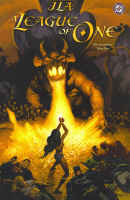 JLA: A League of One 2000 (HC & SC TPB) 112
pages
JLA: A League of One 2000 (HC & SC TPB) 112
pages
Written and illustrated and painted by Christopher Moeller.
Letters: Bill Oakley.
Rating: * * * (out of 5)
Number of readings: 1
Reviewed: March 27, 2010
I have a certain knee jerk interest in these big graphic novels -- ones featuring all original material, but longer than the more common 48 page, or even 64 page, graphic novel. Sure, it's just a formatting thing, but they feel like they should be something extra special. Yet they often turn out to be less than the expectation -- not bad, necessarily, just nothing out-of-the-ordinary.
Still, JLA: A League of One starts out promising. Fully painted by writer/artist Christopher Moeller, who has a style that is realistic enough that the faces and figures look correct (though a far cry from the hyper realism of, say, Alex Ross) yet stylized enough to invoke a mood and atmosphere a strictly realist style would lack. The story, involving fantasy/fairy tale elements such as a dragon and gnomes, even beginning with a prologue involving knights in the 14th Century, is a little off-beat for a JLA/super hero story. And Moeller's art suits it well, with his use of earth tones -- the art can seem like it should be gracing the cover of a re-issue of The Lord of the Rings or something.
The premise is that Wonder Woman learns of a prophecy foretelling the rise of an ancient dragon, and that in defeating it, the Justice League will die. In order to save her friends, she decides she must sideline the rest of the League (by attacking them) so that she alone will confront the dragon -- a League of one -- and so will be the only one to fulfill the prophecy by dying. It's a decent enough concept and, as I said, it starts out well. Particularly with the added mythological aspects, as Moeller introduces some gnomes and dryads (the latter friends of Wonder Woman) who are quirky characters, and provide some humour and charm. But, admittedly, as things progress, Moeller's dialogue (and characterization) overall is fairly workmanlike, occasionally stiff. Nothing bad -- but not really something that makes the JLAers come to life as anything more than figures on a page. Well, save Wonder Woman herself who Moeller handles well in her more traditional characterization (not too aggressive, not too wisecrack-y), and who holds our interest as the central protagonist.
Even the emotional dilemmas at the core of the thing seem a bit like Moeller knew the story was rife with themes...but wasn't sure what they were, or how to develop them. Indeed, we basically gloss over the scene where she actually decides she must betray her friends in order to save them. Still later, Wondy has an attack of cold feet about her plan that, after all, involves her sacrificing her own life. But that could've been explored more. I mean, is the dilemma that she lies to and betrays her friends...or that she sets out on a course she believes will lead to her own certain death?
Doing a story like this, there was probably some question as to whether it should be sold as a JLA graphic novel -- or as a Wonder Woman graphic novel, guest starring the JLA (in its early 2000 line up including Kyle, Wally and Aquaman with his long hair). But though Wonder Woman is definitely the star, certainly making this a desirable acquisition for Wondy fans, others of the JLA get enough page time to make the JLA label not inappropriate.
But ultimately, like some other extra long stories...it just doesn't fully justify the length. Moeller could've squeezed the whole thing into a couple of regular comics without losing much. The problem with Wondy turning on her friends is that it can get a but repetitive, particularly with the Batman and Superman scenes that are a bit stretched out. I was going to say maybe if it had been about Batman or some other lesser powered character it might've worked better, as we watch to see how they will cunningly defeat beings more powerful than themselves (I mean, Wondy is already among the most powerful Leaguers). But even then, the problem is that heroes fighting other heroes isn't really a new idea, so that part of the story -- whatever the motivation -- can seem a bit been-there-done-that. And when we get into the dragon stuff, again, it's all pretty straightforward, without much in the way of plot twists or embellishments, or unusual motivation (the dragon is just bent on wanton destruction). It's a graphic novel that has the "graphics"...but is a bit short of being a "novel" in ambition.
Even the prophecy stuff is a bit vague -- as often happens in such stories. As we're supposed to accept the contradictory notion that the prophecy is unavoidable...even as she can change aspects of it, too (as a character remarks, the death of "heroes" is foretold, so by facing the dragon solo, Wondy is already negating the prophecy -- yet it's still accepted whoever faces the dragon will die). And the final solution for how Wondy survives is pretty, well, lazy
As such, A League of One is an okay time killer, benefitting from the painted visuals and the slightly off-beat mixing of the JLA with gnomes and dragons. Moeller's handling of Wonder Woman herself is quite good. But at a hundred pages, it fails to fully justify that length.
Soft cover price: $__ CDN./ $14.95 USA.
Written by Paul Dini. Painted art by Alex Ross. (story Dini & Ross). JLA: Liberty and Justice 2003 (SC GN) 96 pages
Letters: Toss Klein.
Editor: Charles Kochman, Joey Cavalieri.
Number of readings: 2
Rating: * * 1/2 (out of five)
Additional notes: published in over-sized, treasury format.
Published by DC Comics
Superstar comics artist Alex Ross -- whose fully painted, almost photo-realistic artwork depicting familiar superheroes first started gaining raves
with such mini-series as Marvels and Kingdom Come, has teamed with writer Paul
Dini (involved in the critically acclaimed, adult-friendly cartoon, "Batman:
The Animated Series") for a series of annual, treasury-sized graphic novels for
DC showcasing their key characters (including Superman: Peace on Earth, Shazam!: Power of Hope, etc.) in stories meant to seem more profound than just a
fight-the-baddie story. Their collaboration culminates with the final, and
longest, in the series, the 96 page JLA: Liberty and Justice.
This focuses on the Justice League of America (more popularly known to
Saturday morning cartoon fans as The Super Friends) and features the key
Silver Age membership of Wonder Woman, Batman, Green (Hal Jordan) Lantern, the
Flash (Barry Allen), Superman, Aquaman and J'onn J'onzz, with the Atom
cropping up and other heroes making appearances. Apparently, this line-up is a
bit out of continuity: technically these characters weren't all League members
at the same time, at least in DC's current version of its characters' history
(DC having a tendency to re-invent its "reality" every few years).
The other Dini/Ross books often were presented more like picture books,
eschewing word balloons in favour of introspective captions, perhaps better to
showcase Ross' art. Here, though there is a heavy reliance on narration by
J'onn J'onzz, the Martian Manhunter, the scenes are also told in conventional
comic book format of dialogue and word balloons.
The story has the JLA called in because of a viral outbreak that seems to
have wiped out an area of Central Africa. While the team struggles to deal
with this unconventional threat, fear and paranoia of the unknown disease --
and distrust of the superheroes' handling of the situation -- unleashes chaos
and rioting around the globe.
On one hand, Liberty and Justice is an interesting idea. By eschewing the
usual super-villain formula, Dini and Ross create an unusual story, with the
characters struggling to combat a threat that needs more than just a good
right hook to vanquish. It's "Outbreak"...with super-heroes as the heroes.
Where the book threatens to break down is in its very desire to be
important instead of just telling a taut, atypical suspenser. This is
very much a part of the Iconism that has been sweeping comics for the last
decade or so. Perhaps as a reaction to the dark n' gritty phase comics went
through in the late 1980s and early 1990s, a lot of modern comics emphasize
the grandeur of the heroes...sometimes at the expense of the characters'
humanity. For the most part, the heroes don't panic, don't argue, don't get
flustered or lose their tempers (except Aquaman in one scene...and even he
seems fairly controlled) -- things that real people might do in a pressure
situation. I'm not saying the Leaguers should snipe and bitch at each other,
but a sense that these are real people struggling with a very real threat is
kind of muted. J'onn J'onzz narrates...but it's hard to remember that, because
the "voice" Dini employs is so depersonal, it's easy to mistake it for a third
person narration (a flaw also in the other Dini/Ross book I read). There are
some amusing exchanges (like one having fun with the scientific implausibility
of super heroic feats, and some cute quips about Batman) but overall, the
evocation of bland, clean cut Silver Age heroes is a little too faithful.
The book starts out a bit dry, emphasizing Ross' visuals and J'onn's
narration, then improves in the middle as the story becomes a story,
emphasizing the characters seeking to understand, and find a cure for, the
mysterious virus. But then it starts to peter out again in the final third.
That's because the emphasis shifts from the disease to the "important"
topic Dini and Ross want to explore. Throughout the world, people begin
panicking -- with too little understanding of the virus, they fear the world
is coming to an end, and their paranoia leads them to turn on the super heroes
who are trying to save them.
It sounds like a rich topic. But firstly, there's absolutlely nothing new
here. Using superheroes as a metaphor for those victimized by unthinking
prejudice has become so done to death, it's starting to seem like rote rather
than artistic inspiration. And here, it just isn't that convincing (a better
story is Justice League of America: The Nail). Perhaps Dini and Ross would argue they wanted to deal
with mass hysteria...and the "why" is just an excuse. But the notion of global
panic, of the great unwashed masses running hysterically through the streets
seems a bit of a stretch...and even offensive. In the last few years we've
seen the terrorist attack on New York, SARS outbreaks in major cities, and a
massive blackout that crippled much of Ontario and the eastern United
States...and people kept their heads quite nicely, thank you. Where we do see
the population losing control -- such as in the race riots America suffered a
few years ago -- it tends to swell up from long bubbling frustrations and
perceived grieviances. Or, in other cases, because politicians are
deliberately manipulating public perception through misinformation. Or in post-Katrina New Orleans...but in that case, society and its infrastructure really had broken down.
In other words, it doesn't happen for nothing.
Analysed too closely, there is a distressingly fascistic streak to Liberty
and Justice. The heroes of the piece are the clean-cut super heroes and,
behind them, the military pentagon of the United States. The villains? The
paranoid public, foreigners, and the liberal media that is feeding their
fears. In other words, people, and the media, can't be trusted to do the right
thing. Feulling the public's confusion is that the JLA doesn't bother
explaining why they are doing what they are doing when they quarantine the
viral hot zone. But...why don't they tell anyone? I mean, other than to
provide a plot catalyst? Nor is it clear why the League is acting alone anyway
-- why Batman, a criminologist, is calledd in to analyze a micro-biological
agent is unclear when there are scientists who specialize in the field.
The message seems to be that the public should not question the League or
their actions...ever. The League will do what needs to be done and disseminate
whatever information they feel the public needs to know.
At its most extreme, the book could be seen as a parable endorsing the
recent U.S. led war on Iraq. The JLA (ie: America) unilaterally intercedes in
an African nation; world opinion turns against them; but, in the end, the JLA
is vindicated and the global community sheepishly realize they were wrong.
Except for the part about the world realizing they were wrong, you can see the
potential symbolism (if they had throw in a last act revelation that Superman
had actually exaggerated and falsified reports about the existence of the
virus the parallel would be complete).
Is the above really Dini and Ross' intent? Another reviewer also noted the
potential metaphor, but deemed it unintentional. And Ross certainly irked the
political right a few years ago with his left leaning Uncle Sam comic, so he
might not seem the likeliest candidate to endorse a Republican-led war. But after just re-reading the story...I'll admit, the symbolism seems pretty explicit. But
even if that metaphor is completely unintentional, the underlining philosophy remains:
don't question authority figures.
Ross' painted art is, of course, quite impressive, but it seems somehow
less impressive than when I first came upon it in Kingdom Come. Maybe there is
an aspect of novelty to its appeal that becomes muted after you get used to his work. And presented
in oversized pages, and in big panels on those pages, the photo-realism is
muted a bit. The paintings looking more like paintings. As well, the cute
extras Ross used to put in his panels (joke celebrity cameoes in crowd scenes)
that made the pictures fun to scrutinize, seems absent. It's still darn nice
work, don't misunderstand (and his Wonder Woman remains one of the prettiest
versions of the character), but maybe without stronger characterization in the
writing, it loses its impact. What's the point of painting the characters to
look like real people...if they aren't written with as much care?
One would
also have liked more than a few panels given to characters like Hawkman and
the Elongated Man. Superman, Batman, etc. have already received the Ross
treatment before; second string heroes not so much. And because Ross' work
uses photo references, he's not as strong depicting wholly imaginary
situations, such as brief scenes in Aquaman's Atlantis, or the Atom flying
through the Flash's bloodstream.
For old time League fans (or Super Friends fans), particularly those who've
never seen Ross' work, the book is probably worth getting, if only for the novelty of
seeing these comic book heroes come to painted life on over-sized pages. The
very simplicity of the story -- with its de-emphasis on violence (even the
disease leaves no fatalities) and villain fighting -- makes for an appealing
read, particularly as something to show to younger readers. My quibbles about
any fascist sub-text, given that they are sub-text -- and interpretive,
to boot -- don't entirely sour the book. But the story is thin, really starting to drag toward the end, presumably as it's partly intended as just a showcase for Ross' art. For those hoping that 96 pages of
Alex Ross' painted art, married with a story intended to seem deep and
profound, might have produced a classic tome...Liberty and Justice is more a minor novelty, rather than a must have read.
Cover price: $9.95 USA / $15.25 CDN.
or
Back to complete list of other reviews
or
Back to