 Written by Chris Claremont, Roger McKenzie, others. Illustrated by Michael Golden, Paul Smith, Dave Cockrum, Marshall Rogers, Trevor Von Eeden, George Freeman, others.
Colours/letters: various. Editor: Al Milgrom (Editor-i-Al)
Miscellaneous (Superheroes) - "M" Page 1
Back to the main listings (including character sections)
Manhunter
for a review, go here
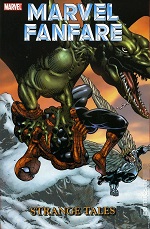
Marvel Fanfare: Strange Tales 2008 (SC TPB) 240 pages
Written by Chris Claremont, Roger McKenzie, others. Illustrated by Michael Golden, Paul Smith, Dave Cockrum, Marshall Rogers, Trevor Von Eeden, George Freeman, others.
Colours/letters: various. Editor: Al Milgrom (Editor-i-Al)
Reprinting: Marvel Fanfare (1st series) #1-7 (1982)
Rating: * * * (out of 5)
Number of readings: 1
Published by Marvel Comics
Reviewed: June 2015
Marvel Fanfare was an '80s anthology comic that was part of the move (or push) to comic specialty shops, when comic shop-only comics initially offered the incentive to readers of heavier paper, richer colour, etc. compared to regular corner store comics. So Marvel Fanfare offered A-list characters, rendered by both respected talents and up-and-comers, in 32 page issues with no ads. Now, years later, the first seven issues have been collected in a TPB. Included are stories that range from 22 pages to 10 pages, with most stand alone, but it kicked off with a four-parter involving (variously) Spider-Man, The X-Men, and Ka-Zar.
Chris Claremont writes that four-parter, plus a Dr. Strange story, with Roger McKenzie, Steven Grant, Bill Mantlo, and others contributing tales. While artists include the likes of Michael Golden, Marshall Rogers, Paul Smith, George Freeman, and Trevor Von Eeden. These were a mix of established pros and newcomers, with this apparently being among Smith's earliest work, and even Von Eeden (though he'd been around since the 1970s) maybe hadn't quite evolved the more dynamic composition-style he would develop.
In addition to the above-mentioned four parter, there's another Spider-Man tale (with the Scarlet Witch -- but in a pretty minor role), no less than two Dr. Strange tales, and a Hulk tale. In the shorter back-up tales there are two Daredevil stories, a Captain America, an Iron Man, an FF (well, mostly a Mr. Fantastic tale), and a story with Hawkeye and El Aguila going at each other. Plus, just to be really eclectic, a Deathlok piece.
As is inevitable, it's mostly hit and miss. Short back up stories than can feel like, well, short back up fillers, and even the lengthier tales aren't necessarily too often anything that sticks with you. Of course the interesting question is how much were these "special" stories, and how much were these stories that had been sitting in a drawer for awhile (under Editor-in-Chef Jim Shooter's tenure, he had commissioned filler stories to have on hand in case a comic's creative team was in danger of missing their deadline -- so it's not unlikely that after a few years Marvel had a backlog of commissioned but unused stories).
Perhaps one shouldn't read too much into it, but with the four parter it's interesting that the first two chapters involve Spidey teamed with the ex-X-Man Angel in the first issue, then the focus shifts more to Ka-Zar (with Spidey peripheral) for the second chapter -- in a way kind of evocative of how Marvel Team-Up would do two-parters where Spidey's co-star would switch in mid-plot. And these two chapters are both about 17 pages long -- about the length of a comic when Claremont was writing Marvel Team-Up a few years before. Then with the next two chapters, the story shifts to being an X-Men adventure (with Ka-Zar still around) and the pages jump up to 22 pages, as they were at that time. I'm not literally saying the first two chapters had been sitting around for a few years (particularly as Michael Golden's art is clearly new) but still, it's weird.
And overall, there's nothing really noteworthy about the story -- other than crafting a tale that variously involves Spidey, the X-Men, and Ka-Zar with art by Golden, Dave Cockrum (on chapter 3) and Paul Smith (on chapter 4) -- Cockrum the original, and then current, "New" X-Men artist, and Smith would get the gig in a few years. Part of the problem just relates to the whole comic book tendency to recycle old foes, old scenarios. So Spidey and Angel are recruited to go down to the prehistoric Savage Land (where lives Ka-Zar) in search of Karl Lykos, an X-Men tragic foe who fled there years ago, and they encounter quasi-mutants the X-Men had fought...a previous time they went looking for Lykos. Then the second half of the story involves the X-Men on the same mission, dealing with remnants of things left over from the last time Claremont wrote then in the Savage Land with Ka-Zar.
Admittedly, before the days of TPBs, the old stories were unlikely to have been read by most readers. But it just feels like Claremont's recycling the old scenarios, the old foes, without coming up with any real impetus for this story (other than, presumably, trying to kick off the new comic with hot properties like Spider-Man and the X-Men).
As for the rest? A mixed bag, with nothing really bad, and with solid art throughout, but not too much standing out. The Hulk tale (from #7) is an okay story with Hulk battling The Blob and Unus. While the other Spidey tale (#6, with The Scarlet Witch) is an agreeable romp, well drawn -- if a bit atypical for Spidey involving him in a magical dimension. And it's another example of recycling ideas, as once more he's battling the sorcerer Xanadu whom he fought in Amazing Spider-Man Annual #2 and Marvel Team-Up #21, both of those times paired with Dr. Strange. (Heck, take those issues, plus this Marvel Fanfare story, add the Spider-Man graphic novel The Way to Dusty Death (which I review in my Spider-Man section), and Marvel could release a whole Spider-Man/Dr. Strange vs. Xanadu TPB!)
Funnily a couple of the more memorable tales are back-ups. #5's Captain America story presents the idea that Cap is more than his superficial trappings in a story wherein a neo-Nazi disguises himself as Cap and Cap ends up in a Nazi uniform. Sure, it creates slightly off-putting optics, but one understands writer Roger McKenzie's point (though arguably it's a point made before using Cap). Though, I'll admit, Luke McDonnell's art is among the collection's least "special." Perhaps even more memorable is a surprisingly low-key and grimly downbeat Daredevil story (#7) drawn by the too-little-seen George Freeman and written by Marvel stalwart Bill Mantlo, a writer with a checkered creative record, but arguably delivering an atypical piece.
This collection is interesting to consider just from the question of story ideas and recurring creators and whether there were deliberately recurring themes. For example with issue #7, Freeman draws the 10 page Daredevil back up...and inks the 22 page lead Hulk story (over pencils by Joe Barney), making for a Freeman-themed issue. While Michael Golden recurs a few times, and Von Eeden draws two different back-up tales. For that matter, some of the creatives had previous associations with the characters. McKenzie writes both the Cap story and one of the Daredevil stories -- and McKenzie used to write for both characters. Marshall Rogers draws one of the Dr. Strange stories and Rogers once had a much publicized (but then disappointingly brief) stint drawing Doc's own comic. While both the Doctor Strange stories employ themes where Strange essentially triumphs through endurance and strength of will rather than simply power (like with the Cap story, such undercurrents are not uncommon in Dr. Strange stories).
Anyway, as a chance to pick up a collection of nicely illustrated tales featuring many of Marvel's key characters (circa that era at least) plus a few more obscure ones, this is certainly an okay grab bag. But as I say, only a few of the stories really rise above average, either by being unusual tales, or by being usual tales told unusually well.
Marvel Holiday Special 1996 (SC TPB) 148 pgs.
 Written and illustrated by various.
Reprinting: the original stories from Marvel Holiday Special 2004 and Marvel Holiday Special 2005 and Marvel Team-Up #1 and Uncanny X-Men #143 - with covers.
Rating: * * * (out of 5)
Number of readings: 1
Additional notes: digest-sized.
Published by Marvel Comics
Marvel Comics has produced various Christmas specials over the years, in a variety of formats and content -- from Treasury Editions, to one-shot comics, to graphic novels, some featuring reprints of holiday themed stories, some boasting original tales, some a combo of the two. And, of course, as such...it can be a bit tricky to specify which version/edition/comic you're referring to.
In this case, I'm reviewing Marvel Holiday Special -- a more-or-less digest sized TPB released in 2006. It reprints the original tales first published in the two previous TPBs: Marvel Holiday Special 2004 and Marvel Holiday Special 2005 (and even utilizes the same cover as MHS 2005). Those earlier TPBs also featured some vintage reprints, only two of which are carried over into this digest: X-Men #143 and Marvel Team-Up #1.
And the result...decent, if unexceptional.
The trick with superhero holiday stories is always to strike the balance and settle on the right tone? Should it be sincerely schmaltzy and sentimental? Should it just be goofy and humorous? Or should it just be a traditional super hero adventure, but set at Christmas?
The original stories here go for a combo of the sentimental and the silly. No Christmas collection would be complete, it seems, without an homage to A Christmas Carol, so here we have "Jonah's Christmas Carol", (26 pgs.) by Tom DeFalco and Takeshi Miyazawa, with Spider-Man supporting character J. Jonah Jameson cast in the Scrooge role (appropriately enough) who falls asleep and has a dream where various super heroes take on roles of the Spirits of Christmas taking Jonah through his life, interspersed with brief cutaways to a super hero battle. Perhaps of all the stories, it tries to be both sentimental and humorous. The other long story, "Yes, Virginia, There is a Santron", (25 pgs) by Jeff Parker and Reilly Brown, has an Avengers Christmas party being disrupted by a rogue robot dressed as Santa Claus. Though there's action, and it's perhaps the most traditionally well drawn in a super hero way, the tone here is definitely tongue-in-cheek, making for a story that, though mildly diverting, isn't sufficiently an adventure story, or heart-tugging.
The shorter pieces include some more sentimental tales, such as one involving a couple of the X-Men deciding to forgo their holiday to spend time with a student at Xavier's School who has no family, and Franklin Richards polling the adult members of the Fantastic Four about what Christmas means to them. There's an amusing, but nonetheless sentimental, illustrated poem involving the FF. And perhaps the funniest of the pieces, an amusing tale of the FF investigating when the Mole Man's minions start kidnapping street corner Santa Clauses.
All in all, there are no real duds in the lot, even as there are none that really manage to be mini-classics, with the Avengers tale proving -- strangely -- the least memorable.
Ironically, the best pieces are the older reprints. Perhaps that's because, being just part of the regular monthly series, they eschew the feeling of being too self-conscious in their ambitions.
"Have Yourself a Sandman Little Christmas", by Roy Thomas and Ross Andru, has Spider-Man and the Human Torch, reluctantly teaming up -- and bickering all the way -- to track down the Sandman. It manages to be an adventure -- without being an inappropriately gritty one -- with just enough sentimentality to score as a heart warmer, and to be funny (with the feuding heroes) without going too far into camp. What makes the sniping of the two heroes work here, and sometimes hasn't in more recent comics, is because it's played straight (even as it's funny) -- they really are getting on each other's nerves.
The X-Men tale, "Demon", by the classic Claremont/Byrne/Austin team is an example of an "inappropriately" gritty tale for a Christmas-themed story, as it's basically an "Alien" rip-off as Kitty Pryde is left alone in the mansion and ends up battling a demon. There's little Christmas spirit, but on that level it's a genuinely effective nail-biter. And it evokes the Christmas milieu, even if not the sentimental spirit.
So, as I say, this collection remains largely agreeable, if not too much in the way of "must reads", with the vintage reprints proving a more satisfying than the more modern tales.
Cover price: $__ CDN. $7.99 USA
 Marvel: 1602
2004 (HC & SC TPB) 216 pgs.
Marvel: 1602
2004 (HC & SC TPB) 216 pgs.
Written by Neil Gaiman. Illustrated by Andy Kubert.
Colours/Letters: ...
Reprinting: Marvel 1602 #1-7
Rating: * * * (out of 5)
Number of readings: 1
Reviewed: 2004
Published by Marvel Comics
Neil Gaiman is one of the more critically acclaimed writers in mainstream comics...even though he has rarely written a mainstream comic. Much of his fame derives from having created and written the horror/fantasy comic, The Sandman, for DC Comics "mature readers" imprint, Vertigo. And with the closing of the Sandman saga, Gaiman hadn't done much work in comics for a few years. So it came as a surprise to some when his return to the medium that made his name was with an eight issue mini-series for Marvel Comics and writing -- gasp! -- mainstream superheroes.
Okay, so "mainstream" overstates the case, but not by too much.
Marvel 1602 can best be likened to DC Comics "elseworlds" concept, wherein familiar trademarked characters are re-imagined in different situations. Gaiman loads up much of the Marvel universe and relocates it to England in 1602. Strange portents are afoot, causing Queen Elizabeth to consult the head of her secret service, Sir Nicholas Fury, and her physician, the sorcerer Stephen Strange. What ensues is a saga that stretches from the English court to the Spanish Inquisition to a colony in America, involving various parallels to familiar Marvel super heroes, including Carlos Javier and his mutant students (here labelled "witchbreed", but still victims of persecution, in danger of being burned at the stake), a blind Irish secret agent named Matthew Murdock, and more.
At first it's unclear whether this radical departure from established history (both ours and Marvel's) is just a creative indulgence, or whether we are meant to be asking, "how is this possible?" But as the saga progresses, Gaiman suggests a connection to the mainstream Marvel reality.
My impression is that the initial reaction to Marvel 1602 was somewhat mixed, with some detractors having expected a little more from Gaiman, and asking: "what's the point?" Given that DC has produced many "elseworlds" stories, and before that Marvel had its "What if...?" comic, surely there needs be no "point" in reimagining familiar icons -- it's simply meant to be fun.
Sure -- there were more ambitious approaches that could have been taken, perhaps by writing it in genuine Elizabethan English (all "thee"s and "thou"s and inverted clauses). Gaiman has the characters speak formally, but could have indulged in wordplay and florid monologues that would evoke Shakespeare (like in the Timothy Findley play "Elizabeth Rex"). OK, sure, it's a comic, but I'm just saying what could've been done with it.
What Gaiman does do is moderately entertaining, as he unfolds a broad canvased tale that involves various Silver Age Marvel heroes embroiled in political alliances, Templar Knight treasures, religious persecution, a certain tyrant from Latveria and, ultimately, the source of the phenomenon that has given rise to these super powered Marvels...and which seems to be precipitating the end of the world. An interesting trick is that these are modelled, generally, after the Silver Age version of these characters -- so the X-Men here are the original X-Men, and Daredevil is his early, swashbuckling, devil-may-care persona.
It's talky and sedate and begins well, with nice mood supplied by the elegant, if occasionally cartoony, art by Andy Kubert given a brooding, painted lushness by Richard Isanove. It is fun seeing how the various characters are threaded into the story, sometimes unexpectedly. And there is a visceral fun in "recognizing" the characters in their new guises.
Initially I could imagine it being more effective for someone unfamiliar with the Marvel Universe, and who could just take things as they came. But, as the story progresses, there were aspects that wouldn't really resonate unless you knew the basics of established Marvel lore. Still, as a story, there are enough threads and disparate characters to keep it going for a while. And Gaiman effectively weaves in oblique references to a Fantastic Four-like foursome, lending them an iconic status normally reserved for someone like Superman, so that you can find yourself anticipating when they finally make an appearance mid-story. Even as, when they finally do, it's a tad anti-climactic.
But it does lose steam, the approach maybe a little too subdued. The characters aren't unlikeable, but you don't entirely find yourself caring overmuch about what happens to them (perhaps a problem with trying to squeeze so many in). In fact, for such a lengthy saga, the character/soap opera aspect isn't especially well developed.
The saga was originally planned to be longer and Gaiman was forced to shorten it, perhaps explaining some of these problems, or why references are made to dinosaurs...but none appear.
Shifting the action to the Renaissance doesn't do much more than put a bit of spit and polish on well used goblets. Once again the X-Men are being persecuted, once more the world hates and fears those who are different. There's nothing wrong with these themes, but there's nothing new about them when it comes to comic book super heroes. The whole tone of the series seems lifted from your average X-comics.
Gaiman tosses in real historical aspects: Elizabeth, King James of Scotland, the Inquisition. But Gaiman never quite convinced me I was reading the work of a historical hobbyist, salting the work with little factual nuggets, the way, say, Roy Thomas could with some of his period comics. Gaiman seems familiar with his period, but it never became more than just a backdrop for a comic.
The saga might have been edgier if, instead of using the usual comic book themes of mutants and superheroes as their usual metaphor for prejudice, he had used the real life period itself as the metaphor for modern conflicts. At a time when Europe was rife with Protestant-Catholic schisms and bloodshed (which Gaiman acknowledges in the story), maybe that should've been the story, with the familiar Marvel characters re-imagined as Catholic and Protestant loyalists, caught up in the insanity of religious feuds.
Gaiman suggests that he concocted this, in part, as an antidote to the despair of post-September 11th, 2001 America, and though it's grim, dealing with witch burnings and other macabre business, it also affects a kind of gentle safeness, where the fight scenes are subdued and only periodic. But despite the grand themes of bigotry, religion, and sacrifice, set in a rich and colourful era, and despite working with characters who, in their original forms, helped usher in a more character-based super hero genre, it remains an enjoyable enough Marvel "elseworlds" story...but not one that necessarily has you waiting breathlessly for Marvel 1603.
Cover price: __ USA.
Marvel Visionaries: Stan Lee 2005 (HC TPB) 336 pgs.
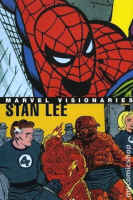 Written by Stan Lee. Pencils by Jack Kirby, John Buscema, Gil Kane, Neal Adams, others. Inks by various.
Captain America Comics #3 (a 2 pg text story) and #16, Suspense #29 (a short tale), Amazing Adult Fantasy #11 (a short tale), Amazing Fantasy #15 (Spidey's origin and first appearance), Fantastic Four #11 (an 11 page story), Amazing Spider-Man Annual #1 (a short piece), Daredevil #7, 47, Fantastic Four Annual #3 (the lead story), Silver Surfer #5, The Amazing Spider-Man #96-98, Thor #179-181, Marvel Premiere #3, Spectacular Spider-Man Super-Special 1995 (a short tale) (1940-1995)
Rating: * * * * 1/2 (out of 5)
Number of readings: various
Review posted Nov. 2010
Published by Marvel Comics
While most collected editions focus on characters, The Marvel Visionaries emphasize the creative talent -- often the artist, but a few spotlight a writer: such as this. Stan Lee is an obvious choice for such a collection, partly from sheer longevity. Although his peak, and most prolific, period was in the 1960s and early 1970s, he was writing as far back as the 1940s, and continues to churn out the occasional script to this day, allowing for some stylistic variety. As well, Lee is, of course, "The Man" -- the guy who as editor and head writer oversaw the so-called Marvel Age renaissance of comics in the 1960s, as the traditional tales of super heroes began to strive for a little more scope and sophistication, arguably making the comics people read today even possible.
The stories here range from an early 1940s Captain America adventure, some short horror/fantasy tales from the 1950s (when super heroes were waning) and a 1995 Spider-Man short -- but the main body of stories are from the 1960s and early 1970s.
And it's a pretty impressive assemblage. Because Lee wrote for so many series, this acts as just a nice grab bag of Marvel Comics, particularly as a window on that 1960s-1970s era. As well, Lee is paired with a lot of top notch artists. One can quibble and suggest certain "classic" tales should've been included (though given the superfluidity of reprint collections, some stories may've been left out simply because they were reprinted elsewhere). In that sense, the origin of Spider-Man (from Amazing Fantasy #15) is perhaps an example of an overexposed tale, and one maybe not especially sophisticated...but highlights the beginning of the "Marvel Age", as it certainly goes for an ambition most of its contemporary comics didn't.
Another Spidey entry is an amusing three page gag piece originally from the first Amazing Spider-Man Annual showing "behind-the-scenes" of the Lee-Ditko creative partnership.
The two early Fantastic Four stories reflect both different tones...and arguably how (in different ways) the series could be ground-breaking. The 11 page "A Visit with the Fantastic Four" is basically just a talky/character interaction piece (though with some "action" as it recaps their origin) and yet works and is entertaining. At a time when most super heroes in comics barely had any personality, the FF showed they could carry 11 pages without a villain or a right hook to be found. It's also fun as essentially a primer on the group told in story format (and features the first appearance of mailman Willy Lumpkin). While "Bedlam at the Baxter Building!", an oft reprinted 23 pg tale from FF Annual #3 (the rest of that annual comprised of reprints), features the marriage of Reed Richards and Sue Storm -- then an unusual premise to feature as your story hook. Indeed, although wedding issues have become common, it may well've been the first! Not that it's maudlin, as the wedding is crashed by a legion of super villains, and the FF and other Marvel super heroes (including guest stars the X-Men, the Avengers, and Daredevil) must fight them off. It's a fun romp, never taking itself too seriously, while keeping the pace fast and furious. And by featuring almost all of a company's heroes in one tale, that too may've been a first. It's energetically illustrated by Jack Kirby -- even if Vince Colletta's inks are rather unsympathetic to the pencil work. The Kirby-Colletta controversy gets debated to this day, but sometimes the pairing worked well enough...I just don't think this is an example of such.
Of the two Daredevil stories, the first, drawn by Wally Wood, pits DD against the Sub-Mariner in a fondly remembered story. I'll confess, it has never struck me as that great -- albeit, I read it first as an adult. But it quickly becomes just a big fight story, though that's sort of the point, the portrayal of DD's indominitable character as he tackles a guy infinitely more powerful than he. Still, it's okay (and lets the Sub-Mariner make an appearance in this collection). The second DD tale, from a few years later, is "Brother, Take My Hand" and has aspects of street level melodrama in its tale of a blinded Vietnam veteran at odds with mobsters, and Daredevil coming to his aid. Again, it's not exceptional, given that it is often cited as such...but that doesn't mean it isn't a perfectly okay little tale, either -- and dynamically illustrated by the great Gene Colan inked by Dan Adkins. I think part of its status derives from the fact that the vet is black -- a fact completely irrelevant to anything in the story, which is maybe why it is viewed as so progressive for its time.
A more pointed use of a black protagonist is "And Who Shall Mourn for Him?", from The Silver Surfer. The Surfer is befriended by a black physicist, Al Harper -- the only acknowledgement of his colour being that when the outcast Surfer asks why Harper has befriended him, Harper just cryptically says he "knows how it feels to be pushed around". Because of its length, the story has a few different elements, but climaxes with the Surfer battling the alien Stranger while Harper tries to deactivate a world-shattering bomb. But the locals, on edge because of the Surfer-Stranger battle, become suspicious of Harper. Given its time period, and not so long ago news footage of racist mobs attacking civil rights activists, the imagery of the black Harper being chased by an unreasoning white mob can't have been mistaken, and is powerful and unsettling. It's a memorable sample of an atypical comic book series, dramatically visualized by John Buscema (inked by brother Sal) -- the senior Buscema's dynamic, but classical style really defining the Surfer as no one had before or since, as if cribbing poses from Michelangelo or someone.
"While the World Spins Mad!", from Marvel Premiere, marked Dr. Strange's return to his own series after a hiatus, with Lee scripting from a plot credited to artist Barry Smith (later Barry Windsor-Smith). Windsor-Smith was an evolving talent, this story maybe in his creative middle period -- there's still some technical roughness, a certain unsureness about bone structure and depth and perspective, but nonetheless boasting some striking composition, and storytelling (evoking the likes of Jim Steranko and Paul Gulacy). It's an entertaining, suitably dreamlike tale -- though does have the flaw that, though the immediate menace is defeated, it's really just a hint of a danger to come. Still, it's a solid taste of Strange-style weirdness, perhaps selected for inclusion over the more obvious Lee-Ditko collaborations simply because it maybe hasn't been reprinted as often.
The three part Thor arc boasts an interesting visual range, the opening issue drawn by Jack Kirby at the end of the Lee-Kirby partnership. But whatever behind-the-scenes friction, Kirby's storytelling is top notch, if still paired with the problematic Vince Colletta. Then Neal Adams draws the next two issues -- Adams around the peak of his fame, and marking perhaps the only collaboration between Lee and Adams, and Adams' only Thor work. It's a thoroughly entertaining saga, utilizing a theme Lee trotted out on a few different series at the time, with the hero and his arch foe (here, Loki) switching bodies, and also involving his allies Sif, Balder and the Warriors Three. It's a fun, bustling saga -- it reminds you just how thin and lazily plotted a lot of modern comics are, which would take twice as many issues to tell half as much story. Lee had a great feel for the Elizabethan English of the god-like characters, and the operatic passions (as even men declare their love for each other), while contrasting it with the genuine humour of Volstagg, and the super hero adventuring.
Another three-parter stands as a benchmark in the evolution of the medium -- the notorious "drug trilogy" from Amazing Spider-Man which led to a wholesale overhaul (and loosening) of Comics Code guidelines. Yet what makes it memorable -- is that it's a good story, even ignoring the "important" subject matter. It involves Spidey battling his recurring foe, the Green Goblin, while his best buddy Harry Osborn begins a pill addiction. Lee could've easily just gone a preachy route, but by making the drug addict a regular, familiar character (as opposed to someone written just for the story) it grounds it in a human realism -- and even then, the drug angle is almost more a sub-plot. So even though you can see it as a "very special Spidey" story...it is memorable more just because it's a good Spidey story, mixing high flying super hero action with soap opera-y angst and human drama, just as the Lee era Spidey always was. And it's dynamically illustrated by Gil Kane -- some of the battles over the city are excellently staged, in terms of figures and the cityscape below so you almost do get a sense of vertigo!
There were other tales included here that I haven't had a chance to read, but just based on the stories that I have, this stands as a great collection to have on your shelf, with all the stories at least decent reads, and some truly memorable page turners, boasting great art. And with the sheer variety of series represented, it acts not just as a nice sample of Stan Lee -- but of Marvel Comics, too. This is a review of the story as it was published in the comics.
Cover price: $__ CDN./ $29.99 USA
Or
Back to