Batman - Wi - Z
Batman: The Wrath 2009 (SC TPB) 150 pages
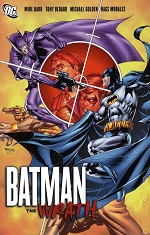
Written by Mike Barr, Tony Bedard. Pencils by Michael Golden, Rags Morales. Inks by Mark Farmer, Mike DeCarlo, Michael Golden, others.
Colourrs/letters: various.
Reprinting: Batman Special #1, Batman: Confidential #13-18 (1984, 2008)
Rating: * * * * 1/2 (out of 5)
Number of readings: 1 (some more)
Review posted: Nov. 2014
The Wrath is a cross-generational collection as it reprints a semi-classic Batman story from 1984 -- and its sequel published over 30 years later! And perhaps what's most amazing is that the continuity remains, more or less, intact. DC Comics has initiated various "universe changing" storylines in the intervening years, yet the Return of the Wrath arc from Batman: Confidential follows quite effortlessly from the original.
The original is a 38 pager first published as the one-shot Batman Special #1 at a time when DC was just starting to re-introduce Annuals into its schedule. Perhaps writer Mike Barr had turned in two really good scripts that the editors couldn't choose between, because there was a Batman Annual (#8) that year also by Barr. Barr was a writer I was mixed upon -- one of those guys who, credit where it's due, did sometimes seem to try for ambition (working themes or subtext into his stories) even as I didn't always feel it lived up to its ambitions. And, just personally, I wasn't always on the same page as Barr, morally, finding his Batman comics too cavalier about Batman being ruthless or using lethal force or his Star Trek comics (another favourite property of his) too militaristic.
With that said, with these 1984 specials he was firing on most cylinders! (The Annual was also top notch).
Titled "The Player on the Other Side", Barr (with artist Michael Golden) gives Batman a foe who is, literally, his opposite number -- a masked and caped assassin who hunts cops because his parents were shot by a cop when he was a boy. The parallels are, of course, heavy handed, but that's the raison d'etre of the story: to pair Batman off against his mirror image. And things come to a head because the beat cop who killed The Wrath's parents was one James Gordon -- now Commissioner Gordon to you and me. So while Gordon finds himself the target of an assassin, Batman tries to track down the killer.
It's an effective, exciting tale. Not exactly subtle in its themes, but a good page-turner. Over the years Bat-writers have tried to introduce a villain who's just that much bigger and badder than anyone Batman's faced before (Bane, The KGBeast) but this story pulls it off precisely because it's not trying to up the ante. The Wrath has no super powers or anything. If anything, he's Batman's match because Barr's Batman is a little more human and down to earth. Two men of equal skill going against each other. There are some memorable suspense scenes -- again, effective for their low-keyness. Like Batman discovering The Wrath has discovered his secret identity and so tries frantically calling home to warn Alfred before it's too late! Barr even tries to humanize the villain -- a bit. At least by giving him a girlfriend and The Wrath vowing to her this will be his last hit before retiring
Michael Golden's art is part of the story's appeal. Golden an effective artist who mixed realism with an organic, flowing style -- but an artist whose interior work, at least on mainstream super hero comics, seemed to be fairly limited (I remember him more as a cover artist). He effectively renders the realism of the day time scenes of the normal characters going about their actions, with the swirling capes and nocturnal prowling of Batman and The Wrath. The one quibble is that Golden's pencils benefitted most from his own inks, but he only inked some of the pages, with much of it inked by Mike DeCarlo, whose harder, more rigid line work wasn't the best pairing. And the climactic scene doesn't quite evoke night time -- whether a fault with the artists, or the colourist, I'm not sure. But whatever (minor) flaws, it's visually attractive.
The story feels self-contained, not like Barr was hoping to add yet another generic foe to Batman's rogues gallery. Indeed, as much as the "player on the other side" idea is a great hook, had The Wrath recurred, he presumably would've become another second-rate foe --the guy you trot out when Catman or Deadshot aren't available.
Perhaps explaining why it took so long for a sequel (but the fact that there is a sequel suggests that the original story made an impression).
I'll first comment on the art by Rags Morales. It's an ideal choice since I'd long thought there was a hint of Michael Golden in Morales' style. Not so you would confuse the two, but enough that it makes a nice, seamless flow from the one story to the next. Morales, too, nicely mixes realism with stylish and dynamic (though, ironically, here too the inking is stronger in the first few chapters -- by Mark Farmer -- than the final, though it's still fine inking). Although credit has to go to Bedard's script, I think Morales' visuals help ground the tale, so that the characters -- Batman, Gordon, etc. -- feel like people with real emotions, not just iconic cartoons. Likewise the fight scenes -- and there's a lot of action -- feel more exciting, like Morales (and Bedard) are trying to milk suspense and drama from the jumps and the punches and not just provide a parade of splash pages.
Which is a surprising plus about the story arc. I'm often the first to criticize comic book stories that run towards long fights and mindless running about. Yet even though that is a lot of this story, it doesn't just feel like mindless action, but genuinely evokes the hi-octane rush and the suspense of an action movie.
The story takes place a few years after the original (not just a vague: "you remember that villain from a few months back?") and part of the mystery is whether this is the same Wrath, or some copycat. I wonder if Bedard meant this as a further homage to Barr. It reminds me a bit of how Barr penned a sequel to his Batman: Year Two (reviewed lower on this page) called Full Circle which deliberately embraced, rather than ignored, the passage of time in its tale of a possibly returned foe. Likewise while in "The Player of the Other Side" Batman was flying solo (Dick Grayson away at university) here Dick (Nightwing) is at his side. The story cleverly takes the "Batman's opposite number" idea and runs with it, adding a logical next step to the equation (which you can probably guess ahead of time). And by doing so, makes the story feel like a legitimate "sequel" -- and not just a derivative rehash.
Although, I suppose the one weakness with the story is the basic concept is pretty much the same. Bedard crafts an exciting action-thriller, and dresses it up with new character dynamics (the addition of Nightwing, the question over whether this is the same Wrath) -- but it is just another story of Batman duelling The Wrath who's targeting James Gordon (and Batman, of course).
To be honest, I didn't read the stories back-to-back and it might benefit from reading the first story, then maybe putting the book on your shelf for a few weeks before tackling the sequel.
Another thing that surprised me -- given modern tends -- is that Bedard doesn't especially up the violence or grittiness. Both the old and newer tales are action-thrillers, and people get killed, but there isn't quite the ol' "He's back -- and more twisted and depraved than ever!" that seems to be the lazy fall back of modern writers.
Ultimately, The Wrath reprints a top notch, well-remembered tale from the Bronze Age (I think it was included in a few "Best of..." collections over the years) and pairs it with a sequel that, in its way, does it justice.
A solid collection.
(This is a review of the version originally serialized
in the monthly comics)
Cover price: $__ USA

Batman: Year One 1988 (SC TPB), 89 pgs.
Written by Frank Miller. Art by David Mazzuccelli.
Colours: Richmond Lewis. Letters: Todd Klein. Editor:
Denny O'Neil.
Reprinting: Batman #404-407 (1987)
Rating: * * * * * (out of 5)
Number of readings: 3
In the mid-1980s, hot, critically acclaimed writer-artist, Frank Miller, who had won accolades for his work at Marvel Comics on Daredevil, came over to DC Comics to write The Dark Knight Returns, a mini-series set in the near future chronicling a dark, gritty, "what if...?" future for the Batman. Coming out around the same time as The Watchmen, it was one of the most significant comics works of the decade. Around this time, DC Comics had also decided to overhaul and re-boot its entire line (claiming continuity had just become too complicated and muddled to follow). Various characters were re-introduced with revised origins, and Miller was tapped to do Batman, with Year One forming a kind of bookend with The Dark Knight Returns -- the Alpha and the Omega of the character (not that The Dark Knight Returns was necessarily meant to be canonical).
Not only was Batman: Year One a seminal work, influencing many a creative team to come (sometimes with unfortunate results) -- but it still stands as a brilliant, powerful, richly textured piece of work.
For those only familiar with Miller of the last decade or so, whether it be his over-the-top pulp noir homage, the Sin City stories, or his recent return to the world of Batman with his sequel to The Dark Knight Returns, The Dark Knight Strikes Again!, and the retro series, All-Star Batman & Robin, it might be hard to reconcile "brilliant" and "richly textured" with Miller. But in the 1980s, Miller really was an extraordinary talent, capable of nuanced characterization and provocative themes, with a great sense of pacing and a knack for the "cool" scene. Miller's a writer whose work actually seems to get less mature as he gets older, his recent stuff seeming more the product of a 14 year old's mind set -- a talented 14 year old,
in the case of Sin City, but a 14 year old nonetheless.
In Batman: Year One, Miller basically skips over the "origin" origin (a one page flashback to his parents murder) and focuses instead on the origin of the Batman persona. It begins with Bruce Wayne returning to Gotham City after years abroad, determined to begin his war on crime, initially not yet settled on the best method. Miller's take on Batman is a slightly unstable, obsessive man -- though still heroic and compassionate -- and the story is as much about police lieutenant James Gordon as it is Bruce Wayne. Both characters arrive in Gotham simultaneously, and the saga remains filtered through them, each narrating and, at times, is almost more about Gordon than it is Batman. Gordon is an honest cop in the corrupt Gotham, where every one up to the Commissioner is on the take. How Gordon tries to maintain his honour, and fight the forces of corruption, is as much a part of the drama as Batman finding his own way. And the evolution of how the two men realize they need each other to survive...and to triumph...is the core character arc. Along the way, Miller also throws in the origin of Catwoman -- not an equal character to Gordon and Batman, but omnipresent nonetheless. And by intertwining the origins of the three characters, it makes the relationships we know lie in the future more resonant.
And by setting the story against a backdrop of a corrupt Gotham, Miller creates a more intriguing, more plausible impetus for a vigilante, as Batman is fighting not just street crime and mobsters, but the system itself -- at one point likened to Robin Hood.
As I said, this is Miller very near the top of his game, a Miller capable of some great, clever turns of phrase -- sometimes pointed, sometimes very witty -- yet also real, nuanced dialogue that can make even minor walk on characters seem like three dimensional people. The story is very talky, very character oriented, yet never lags or drags. Miller's talent for characters in the 1980s was that he let the characters be people -- Gordon has perhaps never been portrayed, before or since, as a more compelling, sympathetic figure; a hero in his own right, yet also a flawed man with feet of clay. He's also an apologetic Liberal -- something I doubt Miller would write today. And the action scenes are striking and dramatic, Miller knowing how to stage a dramatic rescue or what have you. A sequence where Batman is cornered in a bombed out building by a rogue SWAT team is one of the most exciting in Batman's history, with a truly memorable escape -- so memorable, it was ripped off in the movie "Batman Begins"...and wasn't nearly as effectively staged in the film!
Perhaps the most intriguing stylistic thing about Year One is that it lives up to its name: it chronicles an entire year, and perhaps utilizes the comic book format in a way that no movie or novel could quite mimic. Miller tells a coherent narrative, yet skipping weeks between scenes (the scenes are labelled with dates) but without making it seem choppy or confusing as it would in a movie or novel. As such, though only about 90 pages, you come away feeling as though you've read a grand epic.
Miller also chooses to eschew much of the fantasy feel, utilizing, not super villains, but crooks and corrupt cops, giving the thing an edgy realism, without loosing the fantasy heroism. There are some big, dramatic "action sequences", yet the climax is a more intimate affair, the danger more personal -- and as exciting as any movie spectacle climax! In fact the story cleverly manages to play both sides at once. Batman is a man -- a guy in a suit, capable of being drop kicked and surprised, who "stages" dramatic appearances with his own spot lights -- yet also a super human figure, capable of dramatic rescues and awesome feats.
I've gone on and on about the story and plot and Miller's writing, but I shouldn't ignore the art by David Mazzucchelli. Mazzucchelli worked with Miller on his later Daredevil stories (notably the critically acclaimed Born Again story arc), where his style evolved rapidly into a dynamic stark realism, where everything is meant to look real, no heroic exaggerations for Mazzucchelli, but often rendered in a shadowy minimalism. The work suits the tone of the script brilliantly, capturing the dual tones of gritty reality and dramatic super heroism.
There is a slight "mature readers" undercurrent in themes, such as having Catwoman be a prostitute before she dons the cat-suit.
The only downside to Batman: Year One is that it's almost too good. Really! When I first read it two decades ago, I quickly found myself losing interest in comics, finding other stories just paled beside it, none offering the same mix of intellectual stimulation, emotional pull, and old fashioned adventure. It was many years before I slipped back into reading comics -- not necessarily because I found things to rival it, but more because I readjusted my expectations. At the same time, I realize that as compelling, as brilliant as this is, Miller's take on the Batman might not have been sustainable -- he's a little too off kilter (hence why Gordon emerges as a co-lead). It's a compelling characterization for this story...but might have got old in a monthly series. Though it does gel with Miller's Dark Knight Returns -- though this is a kinder, gentler take on that persona, more unimpeachably a hero.
As a work-unto-itself, Batman: Year One stands as one of the best Bat-sagas, building to suitably final finale. But, of course, as a "year one" story, it doesn't tie everything up tidily (Catwoman remains a peripheral character, never fully intregrated into the main plot), as it is supposed to be setting things up for the future. Not that it is directly continued into anything (although there have been subsequent attempts to do follow up stories, such as The Long Halloween or Prey, none really make you feel that, oh, this was the sequel Miller envisioned). As such, it remains a "stand alone" read, albeit within the context of the Batman mythos.
It's a classic of the medium that remains classic.
Though originally published without Comics Code approval,
and containing some "mature" material, Batman: Year One ultimately
contains nothing that couldn't be portrayed in a prime time TV show.
(This is a review of the version originally serialized in Batman comics)
Original soft cover price: $14.95 CDN./$9.95 USA
 Batman:
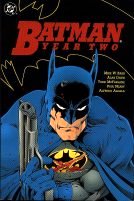
Year Two 1990 (SC TPB), 100 pgs.
Batman:
Year Two 1990 (SC TPB), 100 pgs.
Written by Mike W. Barr. Art by Alan Davis / Paul Neary;
Todd McFarlane / Alfredo Alcala; Todd McFarlane.
Colours: Steve Oliff, Gloria Vasquez. Letters: various.
Editor: Denny O'Neil.
Reprinting: Detective Comics #475-478 (1987)
Rating: * * (out of 5)
Number of readings: 3
Additional notes: This has been re-released in 2002 with extra pages to include its sequel, Batman: Full Circle (which is reviewed here).
Year Two chronicles Batman's attempt to bring down
a sickle-wielding vigilante, The Reaper, who kills criminals...and any
police who get in his way. Concluding that the only way to stop the heavily
armoured Reaper is by upping his own non-lethal arsenal, Batman starts
carrying a gun. And since The Reaper targets the underworld, Batman allies
himself with the mob to set a trap. This puts him at odds with newly appointed
Police Commissioner Gordon...and partners him with hitman Joe Chill, who,
twenty years before, murdered Batman's parents. Batman plots to kill Chill
(who's ignorant of their past history) once the Reaper business is over.
When the climax comes, involving Chill, The Reaper, and the whole question
of violence, it concludes with Bruce burying his gun, and (presumably)
vowing never to carry one again.
Batman: Year Two is, on the surface, an admirably ambitious effort, rich in themes, trying to tell a tale that is complete unto itself...even throwing in a romantic sub-plot (when most comics are concerned solely with the hero vs. the villain). The love interest, Rachel Caspian, is torn between Bruce...and becoming a nun, and is also the daughter of The Reaper (though neither she nor Bruce know that) -- definitely a character overflowing with narrative potential. But Year Two reminds me of a flaw I've noticed in a few other "ambitious" comics sagas I've read (or re-read) recently -- including a few by Barr. And that is it has all these ideas, this desire to be smart and sophisticated...and almost no idea how to realize its ideas. So the creators just press on, forcing round pegs into square holes, pushing plot points for the sake of the themes that make no sense on their own. Throughout the story characters behave inconsistently, motives are muddled if not outright incoherent, and plans and actions frequently make little sense. Admittedly, some of that can be forgiven -- after all, in a comic book world of guys who dress like bats, "realistic" and "unrealistic" are debateable concepts, and even the best super hero comics often suffer from lapses in logic -- but the problem is when the lapses seem to out number the logical bits.
The whole core idea of Batman wielding a gun seems more like a story gimmick than a logical action. I mean, why would Batman think a simple pistol would be at all effective...against a villain who can wade unharmed through police and mobsters armed with assault rifles? For that matter, in the end, Batman hardly uses it at all in his scuffles with The Reaper! Instead, he mainly uses it in fights with other crooks -- and then only to shoot weapons out of their hands, Lone Ranger style. In other words, this doesn't really seem like a callow Batman who hasn't figured out the line between justified and unjustified force. Rather it's his plan to murder Chill that seems unconvincing. As for The Reaper...it's never really explained why he pursues his vendetta with such ruthlessness, why he quit 20 years before, or why he's resuming his activities now. At one point Batman suggests there's a leak in the police department which is supplying The Reaper with his info...yet that's never followed up on, as we never see The Reaper acting as anything more than a lone operator. The Reaper himself remains a plot point -- a thematic beat -- more than a character. And if, in my opinion, neither Batman or The Reaper are that convincingly portrayed, then likewise, we can't really get any convincing debate going about violence, vigilantism, and what lines can't be crossed.
As I say, the whole story is full of scenes and actions that seem to exist because Barr wanted to include them, not because the story and characters justify them. So Gordon and Batman end up on the outs -- for reasons that don't seem particularly clear (certainly not justifying Gordon's venom). Why Batman feels an alliance with the underworld would be the best way to capture The Reaper is not really clear...particularly as the operations they do stage seem poorly planned and end up as fiascos (as the characters even acknowledge).
In
his introduction to the original TPB, Mike Barr claims he wanted to deal with why
Batman doesn't carry a gun. But does a hero have to justify his non-lethal
approach to crime fighting? Barr doesn't see a need to explain The Reaper's
brutality; why then the need to justify Batman's mercy? For that matter, relating to my point about themes-versus-execution...Barr doesn't really deal with it, at least to my satisfaction. It's not really clear why Batman starts carrying it...nor is it clear what epiphany he's achieved by the end. I mean, it's not like Batman has any ambivalence toward The Reaper, or needs a few issues to decide he's a bad guy -- he pegs him as a villain right from the beginning.
And let me just stick in my two-bits of pop-psychology
for a moment. For years comic folks have claimed that Batman is the most
psychologically complex of superheroes, the one whose actions are most
driven by his traumatic origin. So how come no one (I'm aware of) has ever postulated
the obvious: Batman doesn't carry a gun because Batman hates guns
-- hates them with an almost pathologicall aversion. Consider: if he was
so traumatized by his parents' murder that he'd spend the rest of his life
dressing up as a bat and fighting crime, doesn't it seem likely he'd have
been just a wee bit scarred by staring down the barrel of a pistol as it
robbed him of the only stability he had in his life? Wouldn't that explain
why Batman, the supposed champion of law and order, didn't simply become
a police officer (he'd be expected to carry a gun)? O.K., I know no one
at DC comics would ever have the courage to write that into the character
-- the National Rifle Association would sstage comic burnings from Long
Island to Hawaii -- but it's a more plausible take on the character than
having him cavalierly wield the very gun that killed his parents.
But, as they say, I digress.
Anyway, perhaps Mike Barr isn't the one to tackle the
issue of violence. He often seems a bit ambivalent about the whole violence-thing
in many of his stories. In fact, at one point Gordon leads a police raid
on a mob stronghold where the police assassinate look-outs and shoot people
in the back -- how are the police any different than The Reaper?
Artwise, this is (relatively) early work from both Davis and McFarlane. The Alan Davis/Paul Neary combo of the first
issue is pretty good, showing solid technique and a good sense of composition. But McFarlane,
the Canadian wunderkind who's practically a God among his fans, struck
me as a real weakness. His technical craftsmanship is uneven, and his sense
of composition the same -- I found some scenes actually incoherent! Alfredo
Alcala's inks (on two of the three Todd McFarlane issues) help a little,
but not quite enough. Todd McFarlane also seems to revel in violence more
than Alan Davis, and his issues are conspicuously more gory. Though I'll give him credit: he has a nice way with flaring Batman's cape!
Batman: Year Two was part of a rewriting of history
that went on at DC comics in the mid-'80s and contains some rewriting of
earlier Batman lore (some of it detailed in The Untold
Legend of the Batman). Prior to this, when Batman caught up with Joe
Chill, Chill was a low level mob boss, and Batman intended to hand him over
to the authorities. But Chill was angrily gunned down by his own men when
they learned he was responsible for creating the Batman. Likewise, Leslie
Thompkins, a social worker who had comforted young Bruce the night of his
parents' murder, and who was never sure why the mysterious Batman took
such an interest in her, is here reinvented as a younger, harder-edged
figure, all tight-lips and power suits, and is privy to Bruce's secret
identity.
Though Mike Barr doubtless had the best of intentions,
something is lost.
The irony that Chill, a largely untouchable criminal who
probably hadn't pulled a trigger in years, is brought down by an almost forgotten murder
he committed decades before, is replaced by Chill-as-killer-for-hire. The change also impacts on Batman's motives: funnily, you could've almost justified Batman planning to murder Chill in the original precisely because Batman had little evidence against him. But with the modern Chill as a still active mob hitman, it probably wouldn't have been hard for Batman to find some crime to pin on him, even if not the murder of his parents. Likewise,
Barr's curter writing of the confrontation scene is actually less emotionally
charged than the one penned by Bill Finger back in '48. And this new Leslie Thompkins
lacks the simple humanity of the original -- she's a nagging harridan rather than an angel of mercy. Mike Barr subsequently expanded
on this new Thompkins in his "Faith" story line that appeared in Batman:
Legends of the Dark Knight (#21-23)...again, with detrimental effect.
Shortly after this story line was first published, yet another
mythos-shaking took place, and I don't think Batman: Year Two
is really considered canonical anymore.
I don't think this was intended as a "mature reader" piece,
but some of the violence in the Todd McFarlane-drawn issues is a bit off-putting.
Ultimately, I have mixed reactions to this. Definitely
flawed, but the bare bones of the thing are certainly intriguing (I've
read it a few times over the years). Barr and Davis later reunited for a sequel,
Batman: Full Circle. Cover price: $12.95 CDN./$9.95 USA
Or back to: