
 A
BRIEF PUBLISHING HISTORY OF CAPTAIN
CANUCK
A
BRIEF PUBLISHING HISTORY OF CAPTAIN
CANUCK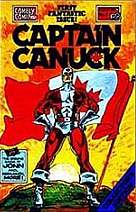 Published
out of Winnipeg by Comely Comix, with Comely practically
everything
from the cook to the bottle washer, Captain Canuck tried
to distinguish itself from its U.S. competition. Markedly more
expensive
at 35 cents (U.S. comics were 25 cents) Comely offered glossy,
expensive
paper, multi-tone, painted colour, and more pages (with two features)
plus
some odds and ends. Comely was literally years ahead of his time:
U.S. comics only started employing quality paper in the 80s and the
multi-tone
colouring in the last decade.
Published
out of Winnipeg by Comely Comix, with Comely practically
everything
from the cook to the bottle washer, Captain Canuck tried
to distinguish itself from its U.S. competition. Markedly more
expensive
at 35 cents (U.S. comics were 25 cents) Comely offered glossy,
expensive
paper, multi-tone, painted colour, and more pages (with two features)
plus
some odds and ends. Comely was literally years ahead of his time:
U.S. comics only started employing quality paper in the 80s and the
multi-tone
colouring in the last decade.
The staff tripled quickly with the addition of newcomers George Freeman and Jean-Claude St. Aubin, and Comely tried to evoke a humourous, bullpen air in his regular columns, keeping things friendly and personal, reminiscent of Marvel and Stan Lee's soap box. Fans were invited to just drop by, and apparently some did...and were well received.
But costs were high and the production schedule was erratic. There are no cover dates on the 2nd and 3rd issues, but based on comments in the letter columns, the schedule might have been quarterly...or even bi-yearly. Reference is also made to a Times Magazine article that was, apparently, less than flattering.
The early issues were admittedly uneven, but showed a marked improvement in story and art, but Comely Comix folded and that was the end...
until...
 ...1979
when Captain Canuck resumed, this time published by CKR
productions in Calgary. The original trio reunited (with the
addition of business manager Ken Ryan), and Captain Canuck was
back
in action. Still more expensive than its U.S. competition (though
less so: 50 cents vs. 40 cents), the paper was now conventional comic
book
paper, but the vivid colours remained, as did the extra pages and back
up features. The production schedule was more regular (bi-monthly)
and the series gradually became better all around, particularly when
George
Freeman took over as permanent artist (not just because he was the
better,
more dynamic artist, but because Comely's scripts improved).
...1979
when Captain Canuck resumed, this time published by CKR
productions in Calgary. The original trio reunited (with the
addition of business manager Ken Ryan), and Captain Canuck was
back
in action. Still more expensive than its U.S. competition (though
less so: 50 cents vs. 40 cents), the paper was now conventional comic
book
paper, but the vivid colours remained, as did the extra pages and back
up features. The production schedule was more regular (bi-monthly)
and the series gradually became better all around, particularly when
George
Freeman took over as permanent artist (not just because he was the
better,
more dynamic artist, but because Comely's scripts improved).
Subtle changes in content began to take place. Religious references made in the early issues, reflecting Comely's Mormonism, were dropped entirely, and the Captain became more secular. As well, the character went freelance. Story elements also became more flamboyant, relying less on real world spies.
How much of that was Comely's decision and how much might have been imposed upon him, I don't know. Comely left the company shortly before the end. In the pages of the comic, it was said he had left to pursue other projects (and certainly within a year he had launched his political comic Star Rider and the Peace Machine, in which he expounded on his belief in a global conspiracy between Western super-industrialists and the U.S.S.R.). However, in Star Rider a reference is made to his "dismissal" from CKR.
Freeman (who had co-plotted many of the issues) took over the scripting without any noticeable drop in quality.
With #14, an attempt was made to switch C.C. from his future setting to modern times -- a change I regard as ill-advised. C.C. wasn't the most flamboyant of characters, in powers or personality; part of his appeal (and uniqueness) was the science fiction element that distinguished him from Batman or Captain America, and his status as an operative as opposed to a loner. And by this point, the comic had built up a healthy supporting cast and a rogues gallery of villains -- all necessary foundations for an on-going comic. To start from scratch seemed risky.
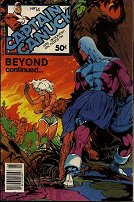 Considered
in the context of subsequent events, it was presumably a last,
desperate
attempt to boost sales by moving the character more in line with U.S.
superheroes. It was too little, too late. Captain Canuck
was cancelled
for a second time. The claim was that the sales were good, but the
costs of producing an independent comic were just too high (U.S.
advertisers
weren't much interested in hawking their wares in a Canadian comic, and
Canadian companies just weren't used to the idea of advertising in that
venue). And this was before the boom in direct sales and comic
book specialty stores.
Considered
in the context of subsequent events, it was presumably a last,
desperate
attempt to boost sales by moving the character more in line with U.S.
superheroes. It was too little, too late. Captain Canuck
was cancelled
for a second time. The claim was that the sales were good, but the
costs of producing an independent comic were just too high (U.S.
advertisers
weren't much interested in hawking their wares in a Canadian comic, and
Canadian companies just weren't used to the idea of advertising in that
venue). And this was before the boom in direct sales and comic
book specialty stores.
Since then...
You can't keep a good Captain Canuck down -- not
entirely. In 1993 (ironically, the year in
which the first story
was set), Richard Comely
relaunched Captain Canuck,
once again on his own. This was a completely new Captain; it was
set in modern times and continued the political philosophizing of
Comely's Star Rider and the Peace Machine, with Captain
Canuck
battling a global conspiracy. Despite attempts to make use of the
internet, and an on-line format (as well as a printed version), this
new
series folded quickly. Still later, in the mid-2000s, there was a third
CC -- subsequently identified as the West Coast Captain Canuck -- with
Comely as editor, but with others as the creative forces. Around this
time Comely also tried to re-launch his 1993 version in a mini-series, Captain Canuck Legacy.
There was also effort to tie all three versions together into a
consistent "universe". For more on these guys check out my page on Other Captains