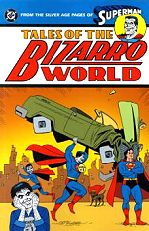
 Written
by Jerry Siegel. Art by John Forte, with Wayne Boring.
Written
by Jerry Siegel. Art by John Forte, with Wayne Boring.
Colours/letters: uncredited.
Superman: Tales of the Bizarro World 2000 (SC TPB) 192 page
Written
by Jerry Siegel. Art by John Forte, with Wayne Boring.
Colours/letters: uncredited.
Reprinting the complete run of "Tales of the Bizarro World" stories that ran as a back up feature in Adventure Comics #285-299 (1961-1962)
Additional notes: introduction by sitcom writer (Seinfeld) David Mandel, plus a mock interview with Bizarro by Mandel; a brief essay on the beginnings of the Bizarro concept; selected cover reproductions.
For more Bizarros, see The Greatest Superman Stories Ever Told, The Man of Steel, Escape from Bizarro World, and Bizarro's World
Rating: * * * * (out of 5)
Number of readings: 1
Prior to this I only had a passing familiarity with Bizarro -- a dim-witted, Frankenstein's monster typpe who was an imperfect duplicate of Superman, with all of Supes' powers, created by a Duplicator-Ray. I didn't even know there had been a run of stories set on a square world inhabited by nothing but multiple Bizarro duplicates of Superman and Lois Lane (and, as the stories progress, other Metropolis personalities). And that the stories were supposed to be funny. Funny? Yeah, right, I mean, who am they think they kidding?
Oops. I started to sound like a Bizarro there for a minute.
But it's easy to do, 'cause there's something appealing about these surrealistic stories (with the real versions of Superman, Superboy and Jimmy Olsen cropping up once or twice). On the Bizarro world everything is the opposite of earth. Workers get rewarded with lowered salaries, kids are expected to flunk school, etc. And throughout these topsy turvy stories is Bizarro Superman No. 1 -- the original of the Superman look-alikes -- and his family (Bizarro Lois No. 1, Bizarro Junior No. 1). Bizarro No. 1 gets into various misadventures, attempting to be a detective, or a lawyer, or coming up with various backward schemes using his super-powers to aide his friends and family in their personal crisises, usually saving the day completely by accident.
Much has been written about how funny the Bizarro stories were, and they are. Maybe not always laugh out loud, but amusing. And sometimes for the subtle humour more than the obvious. Like artist John Forte, delivering appealing art, recognizing that if cars had square wheels, the cars would shimmy like crazy, or writer Jerry Siegel throwing in lines that are kind of...witty.
But there's an appeal beyond the gags. There're elements of true science fiction. This is an alien world with alien customs where even mundane activities become inventive (even if the wrong-is-right concept is impossible to maintain consistently). There's also interesting world building -- literally. The series begins populated solely by Superman and Lois Lane clones. New clones are manufactured to suit the needs of a given story (such as a Bizarro-Jimmy Olsen)...then, instead of being forgotten, they're added to the cast for future stories! As well, the plots are briskly paced and often elaborate, going beyond a lot of "serious" comics from the same period. They set up interesting premises, situations to be resolved, then go off on tangents, throw in silly sidelines, but always remembering what the particular plot is about.
The Bizarro stories can even be read in a revisionist manner Siegel and editor Mort Weisinger probably never intended in the conservative, God-and-country early '60s: as social satires. The Bizarros value coal, not diamonds, and our works of art are considered trash by them. All this was intended to be funny, mocking the Bizarros. But it can also be seen as a gentle poke at us, too, by showing up the arbitrariness of civilization. Diamonds are just rocks -- they have no objective value, yet in our so-called normal world we prize them, horde them, even sometimes kill for them. Hanging with the Bizarros for a while, like science fiction in general, can make you re-examine truths you don't normally question.
As well, there's something kind of endearing about the Bizarros. By being about a man with a family and kids, showing him looking for work, or portraying a housewife going stir crazy, these are actually one of the more adult, realistic strips in superhero comics. And though Bizarros can be dumb, mercurial, on occasion mean-spirited, overall, a character like Bizarro No. 1 loves his wife, is loyal to his friends, and wants what (he thinks) is best for his kids. In that sense, the Bizarro world isn't so bizarre after all.
Cover price: $23.50 CDN./ $14.95 USA.
Superman: Time and Time Again 1994 (SC TPB) 208 pages
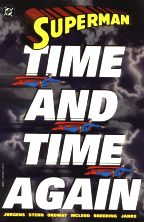 Written
by Dan Jurgens, Roger Stern, Jerry Ordway. Art by Dan Jurgens, Bon McLeod,
Jerry Ordway, with Tom Grummett. Inks by various.
Written
by Dan Jurgens, Roger Stern, Jerry Ordway. Art by Dan Jurgens, Bon McLeod,
Jerry Ordway, with Tom Grummett. Inks by various.
Colours/letters: various
Reprinting: The Adventures of Superman #476-478, Action Comics #663, 664, and five pages from #665, Superman (2nd series) #54, 55, 61, 73 (1991-1992) - with covers
Additional notes: introduction by KC Carlson commenting on time travel in literature and Superman comics
Rating: * * * * (out of 5)
Number of readings: 2
Interfering when a time cop, the Linear Man, tries to grab super hero Booster Gold for interfering in time's natural flow, Superman accidentally gets launched through time, jumping back and forth, battling Nazis and dinosaurs and knights, and encountering the 30th Century Legion of Super-Heroes in no less than three different stages of their evolution.
Time and Time Again is one of those books where a critic can have a bit of a tug-of-war between head and heart. Y'see, I got a kick out of it. According to the introduction, these type of flamboyant stories had fallen out of favour with DC's stern-faced, anal-retentive "let's not do anything that would make us seem silly to the non-comics reading world" editorial staff. No goofy time travel for Suprerman. But finally they decided to cut lose with this time tossed saga.
It's on that level that this book is fun, in its flamboyance and its refreshing atmosphere, ranging from ice worlds in distant solar systems to pre-historic earth. To me, this is what Superman stories should be about -- a guy who can do anything and, therefore, needs larger-than-life stories to challenge him. It's all attractively delivered by the artists, all of whom deliver detailed panels and affect a pleasingly realist, three-dimensional style that, again, to me, is what Superman needs. Having grown up with Curt Swan's Superman, I'm of the school that says Superman works best when he and those around him look semi-believable. Seeing a man perform superhuman feets is more awe-inspiring than seeing a comicbook caricature do the same.
That's all the heart's argument. The head might quibble.
After all is said and done, if DC were to release a collection of Superman's Greatest Time Travel Adventures it's unlikely any of these stories would be in the running (except maybe an Ordway tale of Superman battling Nazis in Poland -- what can I say? I'm a sucker for WW II set super hero stories, though there's a danger they can crossover into trivialization and poor taste). That issue has a greater sense of a story unfolding. Some of the other chapters are half-heartedly developed in and of themselves. In one issue Supes joins a travelling circus and we wait for him to befriend the various misfit characters, aiding one of them in a personal crisis (y'know, a woman fleeing from an abusive boyfriend, a man estranged from his son, something) -- but that doesn't happen and a few pages later he's moved on. A lot of these stories are like that...they don't quite become stories. But, to be fair, there were others that are decent enough adventures -- particularly the one set in dinosaur timmes, and a far future encounter with the world devastating sun-eater.
However the old-fashioned charm of the thing is soured a little in the climactic chapter when writer Dan Jurgens throws in the kind of mass slaughter and mindless mayhem so common to modern comics, where death has been so trivialized, writers like Jurgens need more and more bodies to even get excited.
And the closing two issues, published from a few months later, are meant to tie up any loose ends, giving more detail about the Linear Men and throwing in another DC time traveler, the Waverider. But far from clarifying things, the last two issues are more incoherent than anything and the collection probably would've been O.K. without them. As well, even within the main time tossed saga, there's a little too much reliance on DC Comics lore, throwing in appearances from the Justice Society and the Demon, and making references that are a little bewildering if you aren't familiar with each and every title of the DC Universe.
Ultimately, this is reasonably fun escapism that put me in mind of older (some might argue better) stories. And published, originally, at a very economical cover price, it's worth a glance.
Cover price: $10.50 CDN./ $7.50 USA.
Superman vs. Muhammad Ali 2010 (HC) 96 pages
 Written by Denny O'Neil, Neal Adams. Pencils by Neal Adams. Inks by Dick Giordano, Terry Austin.
Colours: uncredited. Letters: Gaspar Saladino. Editor: Julius Schwartz.
Reprinting: the 1978 Superman vs. Muhammad Ali treasury-sized comic (All-New Collector's Edition vol. 7, #C-56 (1978))
Additional notes (for the regular-sized edition only): intro by Neal Adams; afterward by Jenette Kahn (then publisher of DC); pencil sketches; re-production of the original wrap-around cover and a guide to all the celebrity faces in it.
Published as both a regular comic-sized version and an over-sized tabloid version.
Rating: * * * 1/2 (out of 5)
Number of readings: 1
Looking at the title Superman vs. Muhammad Ali probably splits people into two camps -- those who say "cool"...and those who cringe at a seeming ludicrous concept for a comic, kind of putting one in mind of some grandly epic version all those old Hostess Twinkie comic book ads where the familiar super-heroes were reduced to pitch men for a sugar treat.
And I'll be up-front: I have no particular interest in Muhammad Ali as a celebrity. The idea of paying to watch two guys beat each other senseless, or that such a profession could make one "great", just strikes me as bizarre. With that said, I am aware of some of the surrounding politics, that Ali used his celebrity in a way that not too many sports figures had before -- or indeed, since. At a time of racial tension in America, and the Black Power movement, Ali championed the cause of African-Americans and other political issues (protesting the Vietnam War).
But, honestly, his much vaunted "poetry" just seems silly -- more a reflection of how little was expected from boxers in the way of intellectual acuity.
Still, I always remembered the ads for this over-sized tabloid giant that were carried in the comics of my youth, and of course it was drawn by the then-legendary (and still well regarded) Neal Adams. It was a bit of pop cultural history -- perhaps the only time that such an attempt was made to blend a real personality with the super hero fantasy on such a grand scale. But those old Treasury Size comics have appreciated over the years, and I didn't really think my collection would miss having it. But recently DC Comics out-of-the-blue decided to re-issue the old Superman vs. Muhammad Ali story, in both a regular-size hardcover...and in an over-sized edition, better representing the original tabloid-sized pages. And curiosity eventually got the better of me.
And, honestly -- it's actually a better comic than you might expect.
Or, at least, better than it maybe had any right to be...if still not really a "great" comic (despite artist and co-writer Neal Adams declaring in an introduction -- not altogether modestly -- that this is "one of the best graphic novels/comic books ever done.")
Part of its success is that co-writers Dennis O'Neil and Neal Adams don't make the mistake of taking their project too seriously -- without going too far the other way of just making it a campy romp (which would get tiresome at 73 pages!) The premise is pure comic book cheese -- an alien armada descends upon earth, declaring earth a violent, dangerous world and they will destroy it, unless an earth champion can beat the aliens' champion in a boxing match. But first an earth champion has to be selected, with both Muhammad Ali (as the greatest human on earth) and Superman (as the greatest resident of earth) claiming they should be the one to stand up for the planet. So first there's a run off match between the two under a red sun (which saps Supes of his super powers) allowing for the "versus" of the title, with the winner then pitted against the aliens' champion. While in addition to the ring-side action, there's also some other, more fantastical action, with Supes taking on the alien armada in space and the like.
There's something unpretentiously fun about the Old School fantasy. There's been some effort by modern creators to turn their backs on the more outrageous aspects of Superman's super feats -- but there's a fun in the days when Superman could happily whip up a boxing ring in his Fortress of Solitude in seconds, or with barely a thought, transport Ali and himself to the farthest reaches of the universe (where time runs slowly) to give them extra sparring time.
As I say: it's a goofy premise, but they know that and just run with it. There's a light-heartedness, with Superman and Ali trading quips at times that are more vaudevillian than even what you'd expect in Supes' regular monthly comics. The matches take place in an intergalactic arena, with spectators from all over the universe, allowing Adams to indulge in a lot of bizarre aliens, as well as some humorous visuals in the background. While Jimmy Olsen slides effortlessly into the patois of a sports announcer when tagged to provide the TV commentary for earth ("Good EVEN-ing lad-eez and gentle-men..."). The problem with using real people in a fictional story is it can kind of lend itself to fannish idolatry -- and there's certainly some of that here. But there's a feeling that the creators (and Ali, since he had story approval) weren't so pompous that they couldn't have a little fun with the concept...and their real life icon.
There are some token nods to more serious themes, perhaps partly because, as mentioned, Ali himself was often publicly seen to take on bigger issues. So there are occasional undercurrents metaphorically relating to racism -- less black and white, and more human and alien, but the subtext is there. An alien, when first encountering Ali, tells him to "speak when spoken to" or later the aliens suggest instead of destroying earth, they might make humans their slaves, further incensing Ali. Although perhaps a more interesting dig at the absurdity of racism, is more subtle -- noting people have more in common than differences when it's mentioned that to the aliens, all humans look alike, and even the black Ali and the white Superman are largely indistinguishable.
Although, if you take the themes too seriously, there can be a bit of a problem, when much is made about humans vs. aliens -- kind of endorsing its own ethnic divide (though, as I say, perhaps we were to see the whole of the human race as, metaphorically, black people and the oppression of the aliens representing white prejudice).
A further appeal of the story is, of course, Adams' art. He was seen as something of a legend in the 1970s, for his work on Batman, Green Lantern, the Avengers and even the X-Men, and at 73 pages, this was probably the longest single-issue adventure he has ever drawn in his career! Adams' largely realist style also made him a nice fit for this comic, with his Ali looking like Muhammad Ali...without standing out glaringly from the other, fictional characters, or looking (too often) like a stiffly posed drawing. The people are inked by his long time collaborator, Dick Giordano, but the backgrounds are inked by meticulous Terry Austin, which probably brings out a little more depth and detail to the visuals than Adams' work sometimes had (where his backgrounds could be a bit sketchy). In this re-issued form, Austin is fully credited for his contributions -- though whether he was at the time, I'm not sure (in the earlier Superman vs. Spider-Man, in which likewise Austin inked the backgrounds while Giordano did the people, Austin was an uncredited "ghost" inker).
In re-issuing the story, DC released it at both conventional comic book dimensions...and in a version closer approximating its original size. Due to circumstances and impulse, I ended up getting the regular-sized version, and the visuals still look nice and the story is entertaining...but I'll admit, had circumstances been a bit different, I'd probably have leaned toward seeing it in its over-sized glory.
So, no -- Superman vs. Muhammad Ali isn't a work of art, per se. It's not profound, or a complex plot with characters with hidden agendas, nor is it full of nuanced characterization. But it is briskly-paced, and nice to look at. There is humour...and a smidgen of drama and emotion. And if not exactly an epic saga in 72 pages, it does have a plot, of sorts, with a twist or two to keep it interesting. Even if some twists I'm not sure really make much sense...
SPOILER: As an example, Superman fakes a grievous injury, and he is sent back to earth...but it's really someone else disguised as Superman, so Superman can stay behind incognito. Only then...his plan is to race to earth to fight the armada. So, um, even if he had been the guy on the stretcher...he still was being shipped back to earth. Seems like a needlessly complicated plan, to me! END SPOILER.
No -- your collection won't miss it if you don't have it. But, as someone who had doubts about the whole enterprise...I can't say your collection will begrudge it if you have it, either. As long as you accept it for what is: just a fun little romp...and a bit of pop cultural history.
Cover price: $__.
Superman vs. Shazam! 2013 (SC TPB) 192 pages
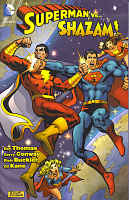 Written by Gerry Conway, Roy Thomas, Pul Kuepperburg, Joey Cavalieri. Pencils by Rich Buckler, and Gil Kane. Inks by Dick Giordano, Gil Kane.
Colours/lterrs: various. Editor: Julius Schwartz.
Reprinting: Superman vs. Shazam! (All New Collector's Edition C-58), DC Comics Presents #33-34, 49, Annual #3 (1978-1984) - with covers
Rating: * * * (out of 5)
Number of readings: 1
Reviewed: Mar, 2013
This TPB collects various team ups between Superman and the original Captain Marvel (usually titled "Shazam!" to avoid copyright confusion with Marvel Comics' Captain Marvel) -- specifically from the pre-Crisis/Bronze Age era, back when DC had first acquired the Fawcett line of characters and situated them on the parallel world of Earth S.
I'm assuming this contains most of the major team ups and guest appearances from that era -- eschewing the occasional cameo or meeting in a team comic like The Justice League of America (the first showdown between the two heroes actually occurring in a JLA comic...reprinted in Crisis on Multiple Earths, vol. 4) What's also missing is, arguably, the best-ever teaming of the characters...sort of: "Make Way for Captain Thunder" (reprinted in Superman in the Seventies) in which Superman encounters a Captain Marvel-like character.
It might have been nice to have an introduction providing a historical context for these stories. Not simply the "multiple earths" idea, but to explain the resonance intended in Superman "versus" Captain Marvel.
In the 1940s DC sued Captain Marvel's publisher, Fawcett, claiming Captain Marvel was a blatant rip-off of Superman. Looking back on it now, the argument seems awful iffy, given later generations of comic book creators rip each other off even more blatantly -- often citing iconic characters as "archetypes". It's fair to say Captain Marvel was a Superman imitation, but CM had his own spin on the cliches (most notably -- his alter ego was a little boy!) Where the legend becomes muddled is that modern fans cite the irony that Captain Marvel was actually out selling Superman (hence why DC launched its suit, no doubt) but Superman won in court. But what happened was that the comic book market started to implode, and Fawcett just closed up shop. At least, that's how I understood the case: the courts never actually ruled one way or the other.
So when DC bought up the Fawcett characters in the 1970s, and launched Captain Marvel into his own series (as Shazam!), long time fans immediately knew there had to be a definitive showdown between the iconic heroes. And it came in the form a 72 page, treasury-sized epic which forms the centre piece of this collection (reprinted in conventional comic dimensions). The subsequent stories -- culled from the pages of DC Comics Presents, a series featuring monthly pairings between Superman and a guest star -- are more conventional team ups.
This collection could also be retitled: The Rich Buckler Collection, as Buckler draws all save for the final, by Gil Kane. I don't know if that was a happenstance, or whether, after drawing the treasury, Buckler was seen as the "signature" artist on Superman/Shazam stories. Which is funny, 'cause it's not like his sinewy style is necessarily ideally suited for either character, both better served by more iconic visuals.
Growing up, Buckler was an artist I preferred over a few others I could name...even as he wasn't really a favourite of mine. Often playing in a similar sand box as Neal Adams and others, with sinewy bodies and realist faces, as I say, my reaction to him was more: he's better than guys I don't like. In recent years, looking at his old stuff, I began to notice a certain familiarity to some of his poses and panels. Artists often favour recurring poses and gestures so that sometimes you can recognize an artist simply by how a character is standing or gesturing. And though that's partly the case with Buckler...Buckler was also a little prone to "swiping" (if you type "rich buckler" into google, "rich buckler swipe" is one of the first options offered). Throughout this collection you can find yourself seeing familiar poses "swiped" from Neal Adams (mainly), Jim Aparo, and others.
It's almost distracting as you can find yourself pausing, thinking: "Man -- that panel is soooo familiar." But you can't be sure if it's from something else Buckler drew...or something another artist drew.
It can feel a bit like a "cut n' paste" collage. And I do wonder if that's part of why
I sometimes had trouble with Buckler's art (even before I realized this). The very act of cribbing means the storytelling can be a bit awkward, the composition, the poses and actions of the characters, not always ideal for the moment. With all that said: Buckler has also done nice work. I particularly remember liking his early work in the Black Panther (in Jungle Tales).
And, of course, sometimes the artist is being pressured in this direction by editors. With the epic Superman vs. Shazam story, there's no doubt the visuals are meant to look Neal Adams-esque. Indeed, flipping through the comic casually, you might briefly assume it was Adams! And given Adams had (then) recently drawn the equally high profile Superman vs. Muhammad Ali, one can well imagine the DC brass wanted a similar look for their Superman vs. Shazam treasury...with Buckler maybe being a bit cheaper, or faster, or something.
But, as such, ya -- there's a certain appeal to a 72 page epic drawn in a faux Adams style.
Unfortunately, the story itself -- by Gerry Conway -- feels as though he cranked it out in a week-end...kind of disappointing for a treasury-sized epic three decades in the making! Conway had earlier written the even more momentous Superman vs. Spider-Man story (collected in Crossover Classics, vol. 1) and though it was pretty simple, that very "classical"-ness was also its appeal. Yet this has even less story (and, to be fair, it might suffer reduced to normal comic book dimensions -- basically a "big screen blockbuster" shown on TV). For one thing, the very thing that made Supes and CM publishing rivals -- their similarity -- becomes a problem when they are faced off against each other. Further adding to the lack of mix being respective foes Black Adam and Quarrmer (a kind of false Superman reprised from an earlier '70s epic -- itself collected as Superman: Kryptonite Nevermore!) -- also with similar powers. The clash between Supes and CM is instigated by an alien who wants to crash their two earths together (an idea recycled many times over the years) and so sets them at each others' throats to keep them occupied. To do this, he messes with their personalities, to make them uncharacteristically belligerent.
So, yeah -- there isn't much in the way of a plot, nor much use of the characters respective supporting casts or milieu, nor even their ostensible styles (the 1970s Shazam solo stories were deliberately more whimsical and "innocent"). Just 72 pages of two guys with similar powers fighting...neither of them entirely in character! The more interesting plotting is provided by supporting characters Supergirl and Mary Marvel who team-up to figure out what's going on.
Now, as I say: sometimes the appeal of these big "blockbuster" stories is the juvenile fun of it all...but it does feel bland and half-hearted even compared to other tales.
The next two stories, a two-parter -- also involving other members of the Shazam Family -- and a single issue tale, boast more original plots. Buckler continues to draw to adequate but unexceptional effect. The two-parter attempts to draw upon a bit of the Shazam whimsy, involving the evil Mr. Mind (an intelligent worm!), Superman's Mr. Mxyzptlk and even Hoppy the Marvel Bunny...without translating that into a whimsical tone, exactly. The story has Superman and CM finding themselves mysteriously with each others' powers -- which touches on their differences...even as it reminds you there aren't many! The single issue story has Black Adam back, with a "human drama" aspect involving Supes and CM becoming embroiled with a little boy...who fantasizes about being Captain Marvel (who is a comic book character on Superman's world).
The final story is from DC Comics Presents Annual, and is the only story here not drawn by Buckler -- Gil Kane steps in (an artist who had drawn both Superman and Captain Marvel solo stories) for some robust and dynamic art. Maybe if more artists had been on display this collection would've been more fun. I don't mean that as a dig at Buckler, merely that variety is the spice of life. Here the foe is Dr. Sivanna, and includes the Earth 2 Superman! (Strangely, if read on its own -- as opposed to in the context of this collection -- I suspect it would be kind of confusing 'cause it doesn't fully explain all the "alternate earth" ideas). I kind of wonder if scripter Joey Cavalieri (working from a plot by Roy Thomas and others) was deliberately trying to play up that Captain Marvel whimsy I alluded to, with Sivanna given to a lot of goofy exclamations. Anyway...it's a moderately fun romp.
There is a consistent average-ness throughout. Nothing terrible -- but with no one story that's strong enough to haul the other stories up.
Plot-wise, probably the two-parter is the strongest. But much of this TPB is just two (or more) guys with largely interchangeable powers, slugging away at things. And without maybe much attempt to make use of each character's surrounding environment. Indeed, you could argue that in a Superman/Shazam story...the interesting contrast is with Clark Kent/Billy Batson.
This collection is an okay page turner, and a nice chance to see the treasury-sized story (albeit in reduced dimensions) which, otherwise, hasn't been reprinted since 1978. And I'll admit, maybe Captain Marvel -- and Superman/Captain Marvel tales -- are one of those things where I kind of have a vague idea that they should be better...even as I couldn't necessarily say how, or in what way.
Cover price: $__.
Or back to: