Writers/artists: various. Editor: Paul Gravett.
published in black & white
The Mammoth Book of Best Crime Comics 2008 (SC TPB) 480 pages
Writers/artists: various. Editor: Paul Gravett.
published in black & white
Reprinting: a lot (24 stories!)
Additional notes: intro by Gravett (to the collection, and each story)
Rating: * * * 1/2 (out of 5)
Number of readings: 1
Suggested for Mature Readers
Published by Running Press Books
The "Mammoth Book of..." anthology series has produced a huge catalogue of short story collections, ranging from "Dickensian Whodunnits" to "Lesbian Erotica". But in a kind of unusual branching out, this text-only series has also included some comic book collections, including a Horror comics and a War comics collections. And this: crime comics.
It's a particularly diverse collection, ranging from old Golden Age stories to comics published in the 1990s, mainly American but with some European comics thrown in (some translated into English for the first time). Stand alone film noirish tales are interspersed with those featuring series characters (like The Spirit, Ms. Tree, Italy's The Torpedo, and others). And the lengths run from eight page shorts to feature length comics as long as fifty pages, as well as a couple of daily newspaper comic strip story lines. There are mainstream, general readership tales...and mature readers stories.
In its very diversity and scope, the collection succeeds as a nice tome to have on the shelf, with a little something for everyone.
The problem with "best of..." collections is that they very rarely live up to that adjective. As grab bags of hit and miss tales collected conveniently between a single cover, they're fun to flip through, where you might have picked it up for a particular creator and instead find it a nice introduction to the work of someone you'd never heard of before. But it's the sheer quantity (and variety) of material that is the appeal...more than the quality.
Still, editor Paul Gravett has done an exemplary job of assembling an eclectic collection. The inclusion of series characters was part of the appeal for me, as it meant the collection wasn't just a stream of philandering husbands and murderous business partners, but included tales of adventure and heroism, as well. Gravett also does a good job considering that most of the publishers that dominate American comics today don't seem to like to participate in multi-company collections, maybe fearing it would dilute there efforts to cultivate a readership loyal to their "brand" (supposedly DC had been approached with a request to include a Batman comic in another multi-company anthology...and DC refused). So there are no Marvel or DC or Dark Horse properties represented here -- excepting ones where the rights ultimately reside with the creators.
The lack of the major companies' participation could threaten to make this a "Best Crime Comics...by Second String Companies". But the nature of the genre means the majors wouldn't necessarily have been primary contributors anyway (now if there was a Mammoth Book of Super Heroes, then there might be a problem).
Visually, the book is rarely to be faulted, with most of the comics nicely drawn in various styles, some presenting the work of acknowledged masters (Alex Raymond's beautifully elegant art on a lengthy Secret Agent X-9 newspaper strip) some European artists not well known in North America. It's all presented in black and white, even stories originally published in colour, but black & white suits the crime n' mean streets milieu.
But story-wise, a lot seem too insubstantial, or build to anti-climactic, almost shaggy dog endings. "The Switch" features the European-created exploits of a 1930s Chicago hit man, the Torpedo. Beautifully illustrated in a Joe Kubert-esque way by Jordi Bernet, it's a rather unsavory series (apparently original artist, American Alex Toth, bowed out after the first few episodes finding the series' nihilistic glorification of an amoral killer not to his tastes). But the plot, in this instalment, is pretty weak, with the Torpedo planning revenge against a cop that takes eight pages of planning for a rather simple resolution. More high brow is "The Murder of Hung", about a Vietnamese woman in New York, but it's a pretty obvious tale that seems stretched even at eight pages. A Golden Age American comic by the classic Simon & Kirby team, a traditionally told tale of con artists, is well told, and quite entertaining, seeming almost to be shoe horning an entire B-movie into its limited pages...but resolves in an abruptly anti-climactic resolution.
What you notice about a lot of the European comics is a penchant for setting the stories in the U.S. Editor Gravett applauds these efforts, remarking how remarkable it is that they capture the mood of New York or Chicago when the creators had never even visited the States. But I regard it with a tad more cynicism. As a Canadian who sees too many Canadian storytellers preferring to set their stories in the U.S. -- essentially killing their own cultural through neglect -- I think it's a shame that creators would rather write about things they've read, rather than things they know. It smacks less of creative inspiration...and more creative regurgitation.
That may be why one of the best of the European translations here is "The Street", featuring the recurring character of Commissioner Spada, which actually is set in Europe, and is an appealing, low-key little tale (and one of the least gritty in this collection).
I could go on detailing some criticisms, or how some of the "series" stories seem to suffer from their continuity, often unclear what was happening or why -- including a couple of other U.S.-set, European comics (Alack Sinner and Kane). Even with an episode of Will Eisner's classic The Spirit, Gravett has strangely selected a story that seems to draw upon too much continuity to quite satisfy as a stand alone tale.
But some of the more memorable tales include the Secret Agent X-9 epic (covering 80 pages in this collection!) which is a fun, movie serial-like romp -- though there is a printing error (pgs. 150-151 should be inserted between pgs. 142 and 143) and it's only held together by the most tenuous logic (strangely, the identity of the villain is blatantly revealed early...yet then is treated as a "revelation" toward the end) -- this particular X-9 story was adapted to a BBC radio series many years later; Charles Burns' darkly quirky El Borbah about a cynical detective who dresses like a Mexican masked wrestler; comics' legend Jack Cole's film noir-ish "Murder, Morphine, and Me"; Johnny Craig's traditional, but well-told tale of infidelity and murder, "The Sewer"; and the previously-referenced Commissiaro Spada story. As well as others that, if not classics, are nonetheless enjoyable page turners, such as a Mike Hammer newspaper strip by Hammer creator Mickey Spillane.
I can't quite sign off on the "Best" designation...but for the price, it remains a generous collection, and with its smattering of European creators, Golden Age tales, newspaper strips, and indie comics, can open up a window on a world of lesser known creators and characters.
Worth having on the shelf.
Cover price: $__ CDN./ $17.95 USA.
The Man Who Grew Young 2001 (SC GN) 112 pgs.
 Written
by Daniel Quinn. Illustrated, coloured and lettered by Tim Eldred.
Written
by Daniel Quinn. Illustrated, coloured and lettered by Tim Eldred.
Rating: * * * (out of 5)
Number of readings: 1
Published by Context Books
(Mildly) Suggested for Mature Readers
The Man Who Grew Young begins in what appears to be modern
times. Except it isn't, not quite. The world as we know it has reached
its end and is now reversing itself. Scientists have theorized that our
expanding Universe will eventually begin contracting, but what writer Daniel
Quinn imagines is that this reversal will entail a turning back of time,
as well. In the world the story's hero, Adam Taylor, inhabits, life is
lived in reverse. People are dug out of the ground, grow younger over the
course of their lives, eventually returning to their mother's womb. The
opening sequence is particularly effective as Adam and friends wait by
a grave side so that he can meet, for the first time, the woman who will
be his wife.
The idea of a backward reality is intriguing. Particularly
for me. Being a scribbler of fiction, as well as reviews, I've been toying
with an idea in that vein for a few years now. And there was an episode
of the British science fiction sitcom, "Red Dwarf", that utilized the concept.
Although "Red Dwarf"'s, um, earthy sense of humour explored aspects of
the idea in ways that Daniel Quinn, wisely, leaves untouched.
The hiccup in The Man Who Grew Young is that Adam
doesn't know his mother, so he cannot return to the womb. He is immortal,
stuck watching the passage of time, the reversal of events as we know them
(in Adam's reality, Europeans don't emigrate to North America...they pack
up and leave it) and the dismantling of what we know as civilization. All
the while, Adam is on a quest for his mother.
This is the first graphic novel by novelist Daniel Quinn,
here teamed with artist Tim Eldred. Quinn's first novel, Ishmael,
was something of a phenomenon and he's, apparently, as much a philosopher
as he is a story teller, with much of his work being treatises on the Human
Condition dressed up in a narrative. I suppose, put one way, he is this
generation's Richard Bach. I don't say that to draw any profound comparisons
between the two (it's been years since I read Bach's Jonathan Livingstone
Seagull and wouldn't presume to recall any of its specifics) -- I'm
merely trying to establish a point of orientation.
On one hand, The Man Who Grew Young is an intriguing odyssey
through a truly alternate world. Along the way, Quinn presents some provocative
ideas that are genuinely worth chewing over as he uses his premise to re-examine
the place of Human Beings in the grand scheme of things, and to question
our lifestyle of conspicuous consumption. And Quinn seems comfortable with
the dialogue-focused medium of comics.
On the other hand, the book isn't really a story, per
se. There's a beginning, and an end (of sorts) and there's a protagonist,
but supporting characters come and go, most not really people but ciphers.
They are tools by which the author can obliquely lecture Adam, and by extension,
the reader. An exception is when Adam meets Merlin the magician. Merlin
is portrayed as a quirky, humourous figure and their interaction comes
alive...but he is gone too quickly. Adam has a few liaisons over the course
of the story, but they are without romance, without passion.
It's reminiscent of religious comics I read as a kid.
Not that Quinn is a religious writer, per se (despite having had a religious
schooling). In fact, the very beliefs he challenges, such as Humanity being
king of the earth, is very much at the heart of Judaeo-Christian philosophy.
But there is a teaching tool technique to this story, with Adam sitting
at the feet of various gurus who politely, but dispassionately, attempt
to enlighten him. The "religious" feel is further articulated by a sequence
that is blatantly a parable, re-interpreting the story of the Garden of
Eden.
The problem with philosophy dressed up as a story, rather
than a story that is infused with philosophy, is that there's no fall back
position. The reader can't say, "It was a real page turner, regardless
of the ideas" the way you can with something that is a story, first and
foremost. I'm pretty friendly with what Quinn had to say. Nothing shocked
me, or offended my beliefs. But like a lot of philosophy that is, after
all, ideas in theory, there was an airiness to them, a feeling that
that's all very fine, but how would you apply these beliefs practically?
One can appreciate the symbolism of the back to nature ideas, but when
he has characters suggest that a hunter-gatherer life is easier than our
technocratic existence, one isn't sure just how literally -- or seriously
-- he means us to take such statements.
This "airiness" also relates to more concrete aspects
of the story. This isn't really science fiction, in which one might expect
an exploration of the ins and outs of this world (such as asking how would
people behave who had no fear of an unexpected, or untimely, death?) or
in which things have a literal cause and effect. The big ideas at work,
understandably, don't really lend themselves to a secular, concrete resolution.
But even though the reader is therefore prepared, the vague ending is a
little unsatisfying.
The art by Tim Eldred portrays the story with a matter-of-fact
simplicity, a kind of un-splashy art style that seems appropriate for a
man who has worked in television animation. In a way, it's reminiscent
of the Valiant comics house style from the early 1990s. The figures are
clean, the proportions well realized, though there's a vague undercurrent
of PBS cartooniness -- which can be a bit off-putting when the story occasionally
strays into "mature readers" areas. The colours are bright and bold, and
the whole thing is pleasant to look at, with Eldred demonstrating a good
eye for telling a scene through panels. At the same time, given the story's
surreal aspirations, one wonders whether a more impressionistic artist
might have served the material better, lending it a greater moodiness.
Ultimately, this is an interesting, likeable work. For
fans of Quinn's other (non-comics) work, it presumably delivers what they've
come to expect, while for comics readers, it offers a change-of-pace from
the gritty tales that populate most super hero and science fiction flavoured
comics. Quinn poses some interesting questions, though his answers don't
always satisfy, and the story would've benefited from stronger plot and
characterization to give the ideas something to rest upon.
Cover price: $32.50 CDN./$19.95 USA.
Manhunter: The Special Edition 1999 (SC TPB) 100 pgs.
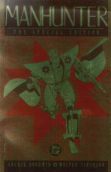 Written
by Archie Goodwin. Illustrated by Walt Simonson.
Written
by Archie Goodwin. Illustrated by Walt Simonson.
Colours/Letters/Editor: ?
Reprinting: The Manhunter stories from Detective Comics #437-443 (1973-1974) plus an unpublished, 23 page Manhunter story.
Rating: * * * * 1/2 (out of 5)
Number of readings: 3
Published by DC Comics
Occasionally -- very occasionally -- I'll review a trade
paperback collection where I've only read some of the material reprinted
in it, but enough that (I think) I can offer some sort of comment. Case
in point: Manhunter. I first read the complete Manhunter series
in a deluxe edition reprint first published in 1984. Now DC will be releasing
the series as a genuine TPB in June, with an additional 23 page new Manhunter
story, based on a plot by the late Archie Goodwin and drawn -- without
dialogue or text -- by Walter Simonson.
My review, therefore, is of the original, 69 page, seven
chapter series, minus the new story. What did I think?
It was pretty darn good.
Manhunter was one of those series often referred to reverentially
in letters pages years after it was first serialized as a back-up in Detective
Comics. When I finally got a chance to read it for myself, it lived
up to the hype quite well.
I don't want to give too much away -- part of the fun
is watching the plot unfold. Heck, for the first two chapters, the reader
isn't really supposed to have any idea what's going on! Suffice it to say,
Manhunter wasn't really a conventional super hero strip, despite featuring
a masked hero and being inspired by a then-obscure Simon & Kirby character
from the '40s. Manhunter mixed various themes popular in the early '70s,
including James Bond-like espionage, martial arts, cloning, and a paranoia-conspiracy
plot...not to mention '70s fashions. Manhunter's battle with a secret organization
was delightfully cosmopolitan, whisking the reader to various locales.
In fact, unusual for a (DC Comics) comic, is how un-American-centric it
was. Though the hero is American, his adventures take place elsewhere,
with "authority" represented, not by the U.S. government, but Interpol.
Unfolding within the confines of, generally, eight page
instalments, Manhunter was a significant artistic/stylistic achievement.
Milking as much as they could from their limited pages, Goodwin and Simonson
played around with chronology, panel arrangement, and anything else that
would let them cram the most into the least, creating a surprisingly rich,
dynamic story for such a limited number of pages.
As well, part of the mystique of Manhunter was that Goodwin
and Simonson were allowed to bring it to a close...a true graphic novel.
The chief weakness is the 20 page conclusion, mainly because
Manhunter teams up with Batman. I like super heroes, but I see nothing
wrong with ignoring the existence of other comic book titles for the sake
of creating a self-contained "reality". I know that's seen as heresy these
days where a character in one comic can't so much as sneeze without a character
in another comic getting a cold, but there you go. The problem with a team
up, aside from forcing the titular character to share centre stage in a
climax that should be his crowning moment, is also a moral one. Manhunter
is a gun-totting, knife-wielding, kill-or-be-killed character -- which
is fine, taken on its own, don't-take-it-too-seriously, James Bond level.
But Batman is a sanctity of life kind of guy. Putting them together is
awkward, even disturbing when Manhunter tries to legitimize his ruthlessness.
The idea of bringing in Batman for eleventh hour climaxes
in titles which, frankly, seem better suited placed outside the superhero
world was done in the late '60s and early '70s with Deadman and Swamp Thing
as well.
Goodwin shows some nice writing in plot and dialogue --
he often seemed more at home away from conventional super heroes (such
as his Star Wars stuff for Marvel). This represents some early Simonson
work. Fans can clearly recognize his style, but in some ways I prefer it
to his later stuff. Although cruder in spots, at other times its richer,
moodier, making better use of light and shadow and details. And, as noted
above, his experimentation with panel arrangement, close-ups, etc., are
beautifully effective and dynamic.
All in all, Manhunter was successful both as entertainment
and as art (it picked up 6 comic book awards...for a series of only 7 chapters!).
Even if the new piece included in Manhunter: The Special Edition
is total dreck, it shouldn't detract from the effectiveness of the original
series. Heck, after re-reading the Manhunter series preparatory to this
review, I'm half-tempted to buy the new TPB for the additional story myself.
All in all, you could do worse than whiling away an afternoon
with Paul Kirk, Christine St. Claire, Batman, and...the Council.
Cover price: $__ CDN./$9.95 USA
Written by Chris Claremont. Illustrated by John Bolton.
Colours: Bolyon and others. Letters: Tom Orzechowski.
Collecting the Marada stories from Epic Illustrated #10-12 (for the 1985 Marvel Graphic Novel) plus Epic Illustrated #22-23 (included in the 2013 Titans collection)
Rating: * * 1/2 (out of 5)
Number of readings: 1
Published by Marvel Comics/Titan Books
Review3=ed: Nov. 2017
Marada, The She-Wolf was originally published in a few instalments in Marvel Comics' Epic Illustrated magazine -- a sometimes "mature readers" magazine-sized comic of fantasy & SF where the creators usually owned their material (as opposed to the regular Marvel line). Subsequently Marvel reprinted two of the stories in a graphic novel (and added colour -- the originals were in black & white). Still later these two stories and the third and final one were collected as a complete collection by Titan.
A sword & sorcery series, it's set in a variation of real history (albeit with magic and demons) -- specifically during the early Roman Empire, with Marada a warrior woman who is (so we learn by way of a text introduction) part Roman, part Celt.
The origin of the property is a little more Byzantine. Apparently this was conceived simply as adventures of Red Sonja, the Robert E. Howard-inspired Marvel Comics' character that existed in the same mythical world as Conan the Barbarian. But issues were raised with the story -- supposedly in part because of the then up-coming Red Sonja movie (and I suspect possibly issues with the plot of the first story). Rather than scrapping it entirely, Claremont and Bolton re-worked it as an original property (allowing them, as well, to retain copyright).
Though at what point in the process this occurred I'm not sure -- whether they literally re-wrote and re-drew pages, or whether the project had still been in its infancy when the switch came about.
Although hardly a successful character (I believe there were only these three stories) nonetheless Marada has retained some appeal -- hence why the stories were re-collected some thirty years after their initial publication!
But I'll confess, the appeal seems a bit tenuous. Marada herself has very little personality (which may be a result of Claremont more focused on making her not Red Sonja, without substituting anything instead). She's a bit inconsistent: in one flashback scene we see her carousing drunkenly at a tavern after a battle (in a Red Sonja-esque manner) yet throughout the rest of the stories she is very prim and dry; she's a warrior...but with little sense of why (does she like a good brawl? does she need the money? does she fight for noble causes?)
The first story begins a bit oddly -- as Marada herself is acting oddly. A supposedly fiery warrior, she's rescued by a Celtic clan leader who finds her strangely passive and subdued (this is perhaps the clearest sense Claremont initially intended her as a pre-existing character, as it's rather odd to begin a series with a character who we are told is acting out of character...when we, the reader, have no earlier stories with which to contrast it). Soon, though, the reason comes out. Marada had been raped (by a demon, yet) and this has shattered her sense of confidence and broken her warrior spirit -- something she takes the better part of the first story to reclaim (though she does before the end).
This is why I suggested possibly the plot itself is why Marvel balked at publishing it as a Red Sonja story. Especially as (I believe) part of the idea behind Red Sonja was that she vowed she would only sleep with a man who defeated her in battle. So one could imagine a Marvel editor balking at the idea of raping a heroine whose very definition of her identity is that she's a virgin! Arguably Claremont had the best of intentions, both in that he clearly wants to deal sensitively with the idea (instead of being a swashbuckling adventure, much of the first story is Marada wrestling with her melancholy) and maybe he felt (arguably rightly) that there was an inherent sexism to an S&S heroine whose prowess is tied to her chastity when male heroes like Conan can sleep around with impunity. So maybe the rape story was both an attempt to do a "very special" story...and also a way of getting rid of that whole chastity albatross.
But equally it can fall into an unfortunate cliché: when seeking to do some "serious" story with a heroine, too often writers (mostly male) opt for the "Hey, I know -- let's have her get raped!" idea.
In this story Marada picks up a sidekick -- a young girl, who dabbles as a magician. I read somewhere someone suggesting Marada might have inspired TV's Xena: Warrior Princess, and though I think the connection is tenuous (their personalities aren't very similar) it is true that the idea of a warrior and a younger, guileless sidekick wandering about Greco-Roman times does kind of anticipate Xena & Gabrielle (minus the camp and comedy of Xena).
You can also see Claremont's distinct literary fingerprints all over this -- for better or worse. I mean, I was a big Claremont fan when younger, but as an adult find he can be heavy handed and verbose (emphasizing character exposition more than characterization). And certainly in the two heroines there are obvious echoes of the Storm/Kitty Pryde relationship from Claremont's X-Men. There's a lot of dense sequences of the characters just talking about their emotions (rather than demonstrating them through scenes) and with that kind of "instant sisterhood" bonding Claremont seemed to believe in (with the characters becoming fast friends after only knowing each other a few hours). The problem also with Claremont's desire to make the stories seem deep and thoughtful, full of brooding character introspection...is of course the inherent moral ambivalence of the S&S genre. As soon as a writer like Claremont demands we take it too seriously, it raises problematic questions about morality, violence, and fascism given these are characters who inhabit a world of swordplay and warrior codes and a kind of Nietzschean world view.
After the opening plot, comes "The Hunt" where the two find themselves forced to participate as the prey in a hunt staged by yet another strong woman, an African Queen (though they end up parting on better terms).
The final story has Marada -- mostly solo -- finding herself being seduced by an Arabic wizard...but with deviltry afoot.
The problem with all three tales (ranging from around 20 to 40 pages each!) is they aren't exactly that complicated or twisty, with few characters (outside of the two leads, each story has limited supporting characters), and relying on generic tropes (evil demons, a "Most Dangerous Game" style hunt). And struggling with the fact that neither of the heroines are especially interesting personalities.
Perhaps the biggest selling point of these stories is the art by John Bolton -- an artist with limited "mainstream" (ie: superhero) work on his CV; though he did a run of X-Men back-up stories with Claremont (collected in X-Men Vignettes TPBs). Bolton has a lush, Romantic style, well suited to the historical and sword & sorcery idiom. I first encountered his work in the 1980s on a beautifully rendered, black & white Kull the Barbarian tale in Bizarre Adventures #26. But I'll admit, even Bolton's art didn't quite woo me here -- Bolton's style more elegant than dynamic, contributing to the (lack of) personality of the characters because he tends to render faces rather blandly. As well, it could be his nuanced and shaded pencil work loses something when washed over with colour. But make no mistake: to those as like the Marada stories, Bolton's art is at least as important as Claremont's scripts.
It's also worth noting that though Epic Illustrated was a "mature readers" comic magazine, there's only a little of that in the Marada stories, with only a couple of panels with Marada partially nude (perhaps given the opening rape storyline, it was felt this was an inappropriate venue for lasciviousness).
In the end, Marada is worth a look for hardcore S&S fans -- if only because there's a limited amount of original comic book S&S (outside of adaptations of pre-existing prose creations). And it is a handsome, elegant tome, in both writing and art. But it does feel a bit, well, bland, with characters and plots that feel a bit warmed over and generic.
M.A.R.S. Patrol: Total War 2004 (SC TPB) 112 pages.
 Written by: unbilled: Pencils by Wally Wood. Inks by Tony Coleman, Dan Adkins.
Colours/letters: unbilled.
Additional notes: intro by Batton Lash, afterward by Dan Adkins.
Rating: * * 1/2 (out of 5)
Number of readings: 1
Published by Dark Horse Comics
Originally published by Gold Key comics in the mid-1960s, M.A.R.S. Patrol (originally titled Total War for its first two issues) was a short lived mix of sci-fi and military adventure. Despite the mis-leading acronym, the MARS in questions stands for an elite, fictional American military branch -- the Marine Attack Rescue Service -- and the action starts up when the U.S. is invaded by a mysterious army. At first it's assumed it's a foreign nation...until they get reports that nations all over the world, including the U.S.S.R., are likewise besieged.
This TPB collection from Dark Horse Comics reprints the first three issues that were drawn by comics legend Wally Wood, and they are fast paced action pieces as the core, four man MARS unit is sent to one hot spot after another as the invaders attack, then retreat, with equal mysteriousness. The characters even end up in Canada for a sequence, aiding the Canadian army when the invaders strike at both sides of Niagara Falls.
Why Dark Horse should choose to reprint these obscure stories now is a question. Perhaps with their recent successes publishing Marvel's old Star Wars and Conan comics, and a massive Magnus Robot Fighter hard cover on the way, Dark Horse is just hot for reprints these days. There is a modest enjoyment level to the stories -- they're fast paced and crisply illustrated by Wally Wood. But although Gold Key has had its peaks, it's not exactly known for its thinking man comics, and in the 1960s, it seemed happy to hold its ground of simplistic stories even as DC and, especially, Marvel, were attempting to break new narrative ground when it came to plotting and characterization in comics.
The plotting is pretty rudimentary, as the invaders attack various bases or towns, and our heroes fight them off. There are clever strategies, occasionally, but its all told with brevity -- barely do we know what the invaders next strike will be when, a couple of panels later, our heroes have devised a counter-strategy. There's little attempt to milk suspense from a sequence in favour of just keeping things fast and furious. It's also a combat/action series, so there's little (in these issues at least) of change-of-pace stories, either emphasizing suspense or human drama. Nor is there much obvious science fiction -- despite the back cover extolling Wood as a master of drawing SF comics. There's little characterization to speak of -- the MARS patrol men are a fairly generic lot where even the letterer and colourist sometimes had trouble recognizing who was who, occasionally with word balloons pointing to the wrong speaker, or one character wearing another's colours. Sgt. Ken Hiro seems the most likely to threaten to become an individual...and even he is mainly just a little feistier than the others.
Yeah, you read right -- Ken Hiro. An Asian-American. Whatever MARS Patrol lacked in sophistication, it gets point for its multi-ethnic heroes (also including a black guy and two whites). Practically unprecedented in 1960s comics -- and contemporaneous movies and TV. And they were of equal importance to the action, not just a white guy and his minority sidekicks (best exemplified in the third issue, where we follow each of the four on separate solo missions). The comic also touched on the idea of racism and, at least in the first issue, the grim realities of war, as the heroes (briefly) struggle with the morality of striking at the enemy, knowing innocent American civilians will be "collateral damage". All that stuff is surprisingly sophisticated, adult concepts...for a comic that, otherwise, isn't particularly.
The first issue is the best, creating a genuine sense of danger and paranoia, as the invaders strike without warning. Scenes of the heroes coming upon the aftermath of battles, or hearing gunfire in the distance, create an eerie sense of plausibility, moreso than if the heroes were always in the thick of it.
But by the end of these issues, you still don't know who the invaders are (though that may've been revealed in the subsequent, non-Wood issues that Dark Horse may or may not plan to collect). And there isn't even a sense that we're building to a revelation. Each issue ends with the characters reiterating that know nothing about the enemy...but it's not like there are any clues or hints accumulating from issue to issue.
Wood apparently worked on the infamous "Mars Attacks" trading cards from a few years previous to these comics, and one can see the influence, as plot and characterization is tossed aside in favour of what seems more like visual set pieces, as if MARS Patrol was all ready to be featured on its own set of trading cards (though it wasn't). Wood's art is good -- I've certainly been an appreciator for years. But I'm not sure it's good enough to justify this collection all by itself, particularly as that's what Dark Horse seems to be selling. Wood has a clean, clear style, but it works best when serving a stronger script. Who actually wrote the stories is a bit vague. Certainly some have implied it was Wood himself (the cover even says "Wally Wood's MARS Patrol"), but scenes where the visuals clash with the script (like having a Canadian flag flying overhead...after the characters have already returned to the U.S. side of the border) would suggest a miscommunication between a writer and an artist.
There's also a certain roughness to the presentation. Visually, it looks almost as though Dark Horse reprinted this from the comics, rather than the original galleys -- the reproduction is bit smudged at times. It still looks good, just not as crisp as you might expect. And there are even a few pages, in the second issue, that are printed in reversed order! On the plus side, although this only reprints three issues, each one was 32 pages, making the story page count a full 96 pages. But it's still kind of pricey for what it is, particularly given the lack of care taken in reprinting the issues.
Still, the book can be moderately fun, particularly for its fast paced tempo that means that it never slows down enough to be boring. And there's an appealing, childish innocence at work. At the same time, it is a war comic more than a science fiction one, and a violent comic at that. It's not gory or anything, but it is a brutal depiction of kill or be killed, total war (as the title indicates) -- a fact that then clashes a bit with the cavalier jingoism of the heroes, who seem to be able to take on any number of invaders and receive nary a scratch.
Cover price: __ CDN./ $12.95 USA.
Marvel: 1602
is reviewed here
Or back to