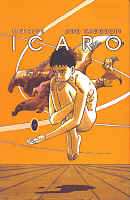
 Icaro (vol. 1) 2003 (SC GN) 160 pages
Written by Moebius. Illustrated by Jiro Taniguchi.
Written by Moebius. Illustrated by Jiro Taniguchi. Icaro (vol. 1) 2003 (SC GN) 160 pages
Rating: N/R (out of 5)
Number of readings: 1
Recommended for Mature Readers
Published by ibooks (distributed by Simon & Schuster)
Icaro has a kind of odd history, being written by French comics legend Moebius (a.k.a. Jean Giraud) -- who I would've thought was actually better recognized as an artist -- and illustrated by Japanese comics artist Jiro Taniguchi who, though well regarded in Japan, has had only limited exposure in the west; and it was published originally in Japan in 2000 -- in other words, this is an English version of a Japanese manga that was, itself, translated from a French script! And it's presented in faithful manga form -- read back to front, right to left (a format I would've thought would be confusing but, actually, is easy enough to acclimatize too).
And it's the first of two volumes -- yet doesn't actually indicate that anywhere on the cover (more on that in a moment).
The story is rather paired to the bone, apparently inspired by a dream Moebius had. Set in Japan of a vaguely identified near future, the story begins with the birth of Icaro -- who can inexplicably defy gravity, the doctors becoming aware of this as, no sooner is he born, then the infant begins floating away, only kept tethered by the imbilical cord. Instantly he is whisked away to a secret lab to be studied -- meanwhile, Japan is being plagued by a terrorist group whose operatives can literally spontaneously explode -- the ultimate suicide bombers. Then we jump ahead to the now young adult Icaro, still living in the research facility, having been kept isolated from the outside world both physically and even intellectually (he's never seen open sky or birds). Among the scientists is a young lady scientist, clearly developing more than academic feelings for Icaro. And while the suicide bomber attacks continue (yeah, all these years later -- there's definitely a dreamlike aspect to the logic at times), sinister forces within the government are covinced that Icaro's ability can have practical applications.
And that's about it for 160 pages.
Reading Icaro, I had mixed feelings. On one hand, Taniguchi's art is quite striking, full of meticulously realized backgrounds, and well drawn people -- with that distinctive manga look, but less cartoony (though I still find it peculiar why Japanese comic characters never look Asian!). There's something kind of intriguing about the very revisionist approach to the subject matter. In a medium overpopulated by flying characters, to do a story where a character's sole ability is to defy gravity...and it's a source of wonder and puzzlement and study for other characters is nicely refreshing. After all, if someone really could fly -- it would be pretty astounding. There's a mature readers approach to the material, with some scenes of explicit (female) nudity -- some sort of justified (a scene where Icaro spies on a woman in the shower) some just unapologetically salacious (a lesbian roll in the grass).
But the story is...thin. At 160 pages, it feels more like a short story (a short story with the cover price of a full graphic novel). It's almost as if Taniguchi had been given the story outline, then came back with far more pages and panels than Moebius expected, and so he padded it out with a lot of repetitious dialogue -- and wordless sequences. And the dialogue itself is nothing to write home about -- and sometimes quite awkward; whether that's a reflection of Moebius' writing, or reading a translation of a translation, I dunno. And, of course, the core concept -- a character studied by a cold hearted system; the scientist who loses her objectivity -- is pretty generic.
Still, I was kind of waffling back and forth on it -- not loving it, but willing to see where it headed. And then it ends -- in mid-story! That's the irony of Japsnese manga. Unlike American comics, which are published in monthly periodicals, then collected in book form, Japanese manga are released directly in book form -- but like American comics, tend to be on going series. Meaning you pick one up, expecting it to be a graphic "novel"...and discover it's often just one instalment of a longer work.
But there's nothing on the cover or the blurb to indicate Icaro will be "to be continued".
Now, as I've written before -- in doing my reviews, I generally see my "job" to review the work in and of itself, for those who might happen upon the book in a store (as I did with Icaro). And getting 160 pages into it only to discover it has no ending definitely impacts on my enjoyment of it -- particularly as it doesn't really tell even a partial story (that is, it might tell a self-contained arc that's part of a longer epic, as some American TPB collections will do). And, as mentioned, I was kind of straddling the fence as it was. That is, if I was thoroughly engrossed, I might say, yes! buy it! read it! then run out and buy the sequel! But as it was, I closed the book, the story incomplete...but what I read of it was so thin, so vaguely defined, tht it doesn't necessarily compell me to hunt down the sequel.
So as it stands now, read on its own, my thumb has to start drifting downward. If I do feel a sudden curiosity to see how the (so far, pretty Spartan) story resolves, and buy part two, I might revisit this review. But as it is, Icaro, vol. 1, is a nicely illustrated, but slow moving, thinly plotted effort that doesn't go anywhere.
Cover price: $__ CDN./ $14.95 USA.
Jack Hammer: Political Science 2015 (SC TPB) 156 pages
Written by Brandon Barrows. Illustrated by Ionic.
Colour/letters: unknown.
Reprinting: Jack Hammer: Political Science #1-4, Jack Hammer: Usurper #1-2 (2014)
Additional notes: I believe an earlier digest-sized TPB was released just featuring the Political Science storyline.
Rating: * * * (out of 5)
Number of readings: 1
Published by Action Lab
Reviewed March, 2015
Comic books have given rise to their own unique sub-genres and narrative hybrids. Because super heroes tend to dominate the medium (and have since the 1960s) sometimes creators try to draw upon the super hero genre while marrying it with another genre. In the case of Jack Hammer -- it's principally a hard boiled private eye story, but with a foot in the super hero oeuvre. Hero Jack Hammer himself has super strength and was (at least so we infer) once a conventional super hero, but gave up a costume for a fedora and the life of a gumshoe.
Whether it's appealing to creators who want to get away from super heroes but figure they must play to the market, or whether they simply see this as an off-beat take on super heroes, I dunno. But we've seen comics about beat cops in a super hero universe (District X) and politicians (Ex Machina) and, heck, Marvel's Alias (not to be confused with the TV series) was also about and ex-super hero turned private eye.
The advantage is that by mashing up different genres, you get two great tastes that taste great together. The disadvantage is that in trying to get away from one set of cliches you run smack dab into another set of cliches.
This TPB collects one four issue mini-series, as well as two issue micro-series, plus a two-part back up tale focusing on yet another super powered private eye.
In the main story, "Political Science," Jack is hard at work trying to trackdown a wayward employee for a big corporation. But when said employee turns up dead in the bad part of town -- Jack's employer considers the matter settled. Jack, not one to let a mystery lie unsolved, continues to pursue the case which embroils him with some super powered bad guys, secrets within the corporation and, as the title implies, political corruption.
On the plus side, it clips along at a good pace. There is action, naturally with super people involved, but it's also a lot of talking heads and wandering about, yet it never gets bogged down. Writer Barrows has a good ear for dialogue, capturing a naturalistic flow -- or at least, a cinematic-version of the way people talk. You could easily picture this same dialogue coming out of actors mouths. Sometimes when comic book writers try too hard to craft "realistic" or non-comic book-y dialogue, they err too far the other way, making the dialogue too self-conscious (Brian Michael Bendis comes to mind) or just muddled in its clumsy attempt to evoke speaking cadences. But not so Barrows. While the art by Ionic is effective, with well-proportioned figures and often nicely rendered faces -- at least in close-ups. Ionic has a good eye for story telling composition -- perhaps especially crucial in a story like this. I sometimes think a good visual storyteller is one where you aren't really thinking about it, because the artist generally selects the right angles and close-ups and long shots for the various scenes so it just flows as you read.
With all those good things, there are also problems. As much as the art is good -- it's also a bit stiff and lacking atmosphere. The figures rendered in somewhat angular, rigid lines and lacking contour, and the environments lacking much atmosphere. I've noticed variations on this style before and I wonder if it's a reflection of the video game generation. The art has the feel of video game graphics, as though the artist is less trying to evoke reality, and more trying to evoke the sort of game graphics the readers are used to substituting for reality.
While as much as Barrows' dialogue and pacing is good, there are story weaknesses. One is that the plot never really develops into much. The first couple of issues -- half the initial mini-series -- is spent doing the usual private eye thing, as the hero follows clues, interviews people who aren't being straight with him, gets double crossed and warned off once or twice. Then in the third issues there's kind of a big sense of "info dump" where suddenly we're being told a lot of stuff almost as if Barrows suddenly realized he had to start moving the pieces toward the climax.
Jack uncovers a sort of conspiracy. Except it's a kind of vague and simple one -- and not especially "mysterious" involving a politician (which you can anticipate since the story is called "political science" and TV's are often playing in the background of scenes featuring a local politician). Curiously the comic seems to take a counter-position to most comics, in that this politician is pro super beings and against legislation that would restrict them, and that's apparently bad -- often super hero comics take the opposite approach, that the evil politician is the one advocating legislating superhumans. The villain's plan is so vague that when, in the climax, he complains: "It's all gone to Hell! There's no way to salvage this now!" it seems hyperbolic. Honestly, if this was all that it took to blow his plan to hell -- it wasn't much of a plan, Stan.
The result can feel a bit like a story that has the spirit of a hard boiled private eye saga -- but stumbles in actually coming up with a mystery for him to investigate.
As well, Jack is a perfectly okay, but also perfectly generic, hard boiled shamus, with little to distinguish him from any other fedora wearing, five-o'clock shadow sporting PI -- with or without super powers. It's a bit of a "team" comic, in that Jack isn't just a lone wolf, but is aided by a cop who initially acts like he doesn't like him, but for the most part they're friends; Jack's girl Friday secretary; and a slightly spacy cab driver who acts as Jack's personal chauffeur -- and is arguably the most original character. It isn't that there's anything wrong with Jack or the others, but it relates to my earlier point about how sometimes mashing genres, instead of creating something unique, just ends up leaning on cliches. Jack Hammer may seem original viewed as a super hero -- but he's fairly generic viewed as a private eye.
The two-part tale "Usurped" is kind of similar. Holds your attention well enough (which is half the battle in storytelling) with solid dialogue and visual storytelling, but with a stronger first half than a second. The first half has you wondering what's going on, while the second half turns out to be pretty run-of-the-mill (particularly for a super hero story where a villain's main goal is just to get the hero). While the back-up two-parter, about another super powered PI (who moves in the same circles as Jack) is more light-hearted and is as agreeable as it is inconsequential.
I sometimes get criticized for writing reviews that smack of a "glass half empty" mentality, and this perhaps is no exception. Because in many respects I enjoyed Jack Hammer well enough -- it held my attention and it clips along and is well presented in terms of writing and art. But it can be bit like it's having trouble breaking away from the cliches of its respective milieus -- or at least putting flesh on them, or finding interesting spins to give them. It mixes a world where super beings exist, and politicians debate how to regulate them, that are mainstay themes of super hero comics, with a hard boiled private eye that isn't really unusual in terms of that genre, or in terms of his generic super power, where even the mystery/conspiracy he's investigating feels undeveloped.
Cover price: $19.99 USA
is reviewed here
Written by John Albano, Michael Fleisher. Illustrated by Tony DeZuniga, others.  Jonah Hex: Welcome to Paradise 2010 (SC TPB) 160 pages
Colours/letters: various. Editor: Joe Orlando.
Reprinting: the Jonah Hex stories from All-Star Western #10, Weird Western Tales #14, 17, 22, 26, 29, 30, Jonah Hex #2, 4 (1972-1977)
Rating: * * * * (out of 5)
Number of readings: 1
Review posted Nov. 2010
Published by DC Comics
By the 1970s, super heroes had almost completely pushed out all other genres from serious/drama comics, making the few long running non-super hero adventure comics noteworthy, like Conan, The Warlord...and western gunslinger Jonah Hex.
Hex clearly sprung out of the Spaghetti Westerns of the cinema, which were perceived to have shaken up the nominally clean cut morality of the traditional western movie with gritty, violent tales featuring morally ambiguous anti-heroes. So with this inspiration, married with a loosening of Comics Codes guidelines, came Jonah Hex...a gruff bounty hunter who tended to bring 'em back dead more often than alive, and was himself a hideously scarred misfit. And his exploits took place against a cynical, violent backdrop where "good" guys often weren't much nicer than the bad ones. After a healthy run as a straight forward western (in All-Star Western, Weird Western Tales, and his own self-titled comic), the character's path took some curious and -- arguably -- ill-conceived turns. He was transported into the far future for the spin-off comic, Hex, then appeared in some later mini-series which relocated him back to the 1800s, but with an added supernatural element. Then after a long dormancy, he was revived more recently for a successful series, returning the character to his western roots. He even was featured in an ill-fated motion picture (which seemed to take its inspiration from the supernatural flavoured 1990s stories).
In addition to the obligatory TPB collections of the modern comics, DC has released collections of vintage 1970s comics as both an omnibus Showcase volume and this...a selection of seminal issues.
Created by John Albano, the character was introduced in the title story, and it's a pretty simple, straightforward tale -- but effective for that. Hex is hired by a town to rid them of an outlaw gang...but finds himself unwelcome otherwise. As I say, it's pretty obvious...but does pack a bit of an emotional punch in the end.
In general, the tales are fairly simple, albeit well-paced. A big appeal is simply the atmosphere, from the idiosyncratic phonetically-spelled dialogue intended to evoke southern twangs, to the dark, gritty but realist art that lend the tales a palpable sense of place, the men craggy faced and unkempt (though the women are generally pretty). The visuals maintain a stylistic consistency, even as with a variety of artists at work (including well known names like Tony DeZuniga and Jose Luis Garcia-Lopez), it also boasts enough variety to keep it from getting monotonous. And the underlining violent nihilism to the stories is its own appeal -- if only as a guilty pleasure. Indeed, though the character has enjoyed a successful revival, one could argue he was more interesting in the 1970s. Today, with too many comics (even super hero comics) embracing a similar a-moral nihilism, Hex is less of novelty.
Although the stories here are mostly stand alone, there is some continuity. In the second story reprinted here, Hex has a pet dog that dies -- but in this collection you wouldn't realize the dog had actually appeared in previous tales. More obviously, there's a slow building sub-plot introduced by scripter Michael Fleisher, so that this is both a collection of individual stories...yet also feels like a graphic novel. A few stories give us vague glimpses of a man with a cane, Turnbull, pursuing some cryptic vendetta against Hex, eventually building to a climactic confrontation and a flashback to Hex's Civil War adventures, and how he was -- mistakenly -- believed to have betrayed his Confederate regiment to the Union army.
Granted, given his notoriety as a bounty hunter, where people usually know him by sight...it's awkward to suddenly thrown in the idea that he's equally notorious as a traitor, to the point where an entire bar shuns him. Don't you think it would've come up earlier? As well, the fact that Hex wanders about in his Confederate army jacket seems unduly provocative when he knows people believe him a traitor to the cause.
Why the final two stories are included (over any others) is unclear. They establish that Turnbull did not die in the previous stories, but as such kind of rob the collection of the sense of closure it might have had if we had stopped with the story where Hex thinks Turnbull is dead. Maybe the final two stories here were included because they introduced some adversaries that, I'm guessing, recurred (most of Hex's foes end up dead by the end of an issue) and so this collection was seen as establishing the basics of the Hex mythos. By this point, Fleisher has also introduced a sub-plot where Hex has been framed for murder -- not that the collection feels like it ends "to be continued" or anything.
That's because, for the most part, the stories are meant to stand alone, with only minor sub-plots linking one issue to another.
As mentioned, the plotting overall is fairly straight forward and simple. Even the sub-plot with Turnbull isn't really a "plot" per se, where each chapter adds to the narrative. And the flashback story doesn't add much to Hex's origin (other stories, not included here, detailed how he was scarred and why he became a bounty hunter -- questions more likely to be posed by a reader). Though it does establish the idea that Hex, though a southerner sporting a Confederate army coat, was nonetheless uncomfortable with slavery.
Though that brings us to an awkward issue, "Showdown at Hard Times" (WWT #22), in which Hex squares off against a black outlaw and his gang of Indian and Mexican henchmen. The characters are irredeemably sleazy but, granted, most of Hex's foes are cartoony villains -- though making all the gang non-white is odd. But where it becomes bizarre is when the black outlaw starts talking about his love of watermelons! At first one assumes the character is satirizing the stereotype...except, sure enough, Hex tracks him down and he's eating a watermelon, even throwing it at Hex as a weapon! You can find yourself flipping to the copyright dates, wondering if this story was from the 1940s, rather than the 1970s. Admittedly, I have no idea of the origin of the black-man-loves-watermelons cliche (doesn't everybody love watermelons?!?) but as with any cliche or stereotype...it's inherently offensive to employ it. So what was Fleisher and company intending by it? I mean, the Hex stories were supposed to revel in a kind of raw historical realism other western comics didn't...so depicting attitudes of the era is understandable. But this isn't depicting the characters with attitudes true to the era (such as Hex still being friendly with a man after the man ruthlessly puts down a slave revolt, or Turnbull's black manservant speaking in slave-style patois)...this is the comic itself perpetuating the attitudes.
So were the creators just racists? (And did no one at DC question it?) Or was it intended as part of the series' "politically incorrect" tone? Fleisher stirred up controversy with his Spectre stories (collected as Wrath of the Spectre), and even a couple of novels he wrote seemed to deliberately court controversy, apparently. So maybe Fleisher just fancied himself a rebel, a provocateur, tweaking the nose of propriety. But provocative is forcing us, the reader, to confront truths we're not comfortable confronting -- simply using a racist cliche to show you can is just childish (I mean, as a white writer, working in a predominantly white profession, read by predominantly white readers, at a time when segregation and race-based murders were part of the recent past...who exactly would he be "rebelling" against?).
I'd like to think the reprint editors were aware of the uncomfortableness of that issue...but included it because it's part of the larger Turnbull arc. But the fact that no on-line review I've read of this collection comments on the scenes is, itself, curious and disturbing -- I guess we haven't come a long way, baby, after all.
But that aside, otherwise these old comics hold up well. As mentioned, they aren't particularly complex or sophisticated, Fleisher not one for a lot of deep thinking or subtle character development. In one story -- "Face-Off with the Gallagher Boys" (WWT #26)-- the train robbing outlaws are embraced as folk heroes by the locals, while Hex is mistakenly arrested and mistreated in prison. Then you realize, ah hah, that's the clever theme, the turnabout as the villains are treated as heroes and vice versa. So you wait to see where Fleisher is going with it...but after juxtaposing the scenes for a few pages, he simply has Hex escape and have his usual showdown with the villains, any themes not really developed beyond the concept. Arguably some of Albano's stories, like the title piece, and "The Hanging Woman" (WWT #17) have -- marginally -- more emotional depth.
But the pacing throughout is good, the atmosphere and milieu palpable, the visuals moody, and Hex himself a memorable personality. If only as a guilty pleasure, you can kind of revel in the dark world where even the hero is an anti-hero. And the mix of stand alone stories with a sub-plot allows the collection to act as both a sampler of tales (generally as good as any of the other Jonah Hex comics, old or new, I have in my collection)...and also as a story arc.
Cover price: $__ CDN./ $17.99 USA.
or, back to