Click HERE for a listing of all reviews, including character sections
Written/illustrated: various. Flight, vol. 12005 (SC TPB) 208 pages
Rating: * * * * (out of 5)
Number of readings: 1
Reviewed: 2005
Published by Image Comics
Flight is the first volume new anthology collection (which would spawn a number of sequels) featuring a host of lesser known and rising talents. Many of the contributors having previously eschewed the traditional avenues of comic book self-expression (that is: the comic magazine) and have self-published on the internet. The ostensible concept behind the collection is to feature stories that, in one way or another, relate to flight. The truth is, it's more just an excuse for a variety of writer-artists to tell individual tales with the "flight" hook employed simply because, well, they had to come up with something. Calling a book, "A Bunch of Creators Telling Short Stories", probably didn't sound very marketable.
To be fair, most of the stories involve flight, but not to the extent one might anticipate. Some are whimsical, or SF pieces involving flying vessels, or luxurious airships, others use the flight theme more as a metaphor, others simply work it in as a minor plot device. Still others don't even bother, and I'll be darned if I can recognize a "flight" theme in them.
Once you realize there aren't going to be any biographical pieces of, say, the Wright Brothers, or period melodramas about barnstormers, or many literal explorations of the theme, you can settle down to what is being offered.
The result is a surprisingly strong effort. I can't be entirely fair to each and every piece, because the advanced pages I was given to review weren't always complete (and, in some cases, I wasn't sure if the piece was unfinished...or whether it just ended inconclusively!)
Like any such collection, there's a hit and miss quality. But there are very few total misses. I suppose, to be honest, there aren't necessarily any unarguable hits, either. The problem with the "short story" format in comics is that, for all that a picture is alleged to be worth a thousand words, in comics it tends not to work out that way. Comic book short stories tend to seem, well, pretty short, more vignettes than stories. But overall, the pieces are good...with the very brevity meaning even the weaker ones rarely test your patience. Because I have a penchant for story-stories, among my favourites are ones like Phil Craven's unpretentious tale about "Tug McTaggert", an acrobat who investigates a (somewhat whimsical) mystery at the circus. Craven also scores with a pantomime sequence about a penguin who uses a novel technique to create the illusion of flight for himself, which is nicely cute and touching, evoking the theme of this collection as well as any. And Kazu Kibuishi's two pieces about a character named Copper and his talking dog and their experiments with flight are memorable for the pleasing cartoony visual style. Vera Bosgol's "I wish...", meanwhile, is a nice blending of slice-of-life and magic realism. And the list goes on.
There are less successful efforts, too. Ones where the story is a tad too simplistic or, conversely, ones where the story (and the art) are so cryptic, you end up not really sure what the point was...or even what it was, period.
The art styles are varied. They range from the cartoony (some noticeably influenced by Manga) to experimental and expressionistic painted styles; occasionally one or two even try for a simplistic realism. All of the artists demonstrate talent and most a good knack for the medium itself, clearly having imbibed the lessons of past masters, recognizing the pictures aren't just there to be pretty, but to tell the story. Some though aren't as strong in that area, hence why some of the pieces, particularly those shy on words, can be a touch hard to follow. The colours are, for the most part, quite beautiful and vibrant, suiting the tone of each piece perfectly, from the brooding, to the light and cheery.
I do think it's curious, though, that most of those involved in the alternative and independent comic book scene tend to turn their noses up at the mainstream (ie: super hero comics), feeling that true artists are those who eschew the men-in-tights genre. The unstated assumption being that the independents could do mainstream...they just won't lower themselves to it. Yet in all these artists assembled here, each utilizing their own style, their own self-expression, not one even approaches the detail, the realism, of a Neal Adams, or a Bryan Hitch, or whoever. I'm not disputing the genuine talents of those assembled to produce Flight, but the cynic can't help ask, is the reason that so many independent comics artists affect cartoony, or Spartan, or stripped down styles, entirely a creative choice...or is it because it's a lot harder to draw realistically than they want to admit? Just a thought.
Image Comics has come a long way over the years. Once it was reviled by those who appreciated comics, being founded by a bunch of temporarily voguish artists who wanted to create their own super hero universe where the splash panels and big biceps could dominate, and where writers (those nasty little interlopers that dominated over at Marvel and DC and insisted on things like characterization and plot) would be taught to mind their place. Clearly that has all changed, and Image is now publishing a lot of creative, and critically regarded, efforts. I guess the lesson is that for every Dark Age there will eventually come a Renaissance.
The introduction is by comics guru Scott McCloud (of Understanding Comics fame), who writes in an amusing style as though he's looking back on the book's publication from decades in the future. In it he anticipates Flight as being a watershed in the comics art field, introducing future super stars and pointing the way for future generations of comics folk. The complete lack of verbiage he devotes to the book's nominal theme -- flight -- clearly indicates he, like the creators, saw it as no more than a marketing conceit. Instead, he hypes the book as a showcase for new talent. McCloud is, to be frank, a touch hyperbolic. Many of the talents here are noteworthy, but the limited pages given to develop stories and characters doesn't entirely indicate whether any of them have what it takes in that department, and the art, though frequently attractive and appealing, is likewise enjoyable rather than mind boggling. Put another way, even with the best stories here, I wouldn't turn my nose up at reading future works by the creators...yet neither would I necessarily seek them out. But really, that's beside the point. Whether or not Flight is a show case for the future in comics is immaterial and presumptuous.
The point is, is it worth getting for itself? And in that sense, it is. It's worth getting for the variety of stories and styles, from humourous funny animals to melancholic slice-of-life, from fantasy adventure to oblique surrealism. As something to have on the shelf, to delve into randomly (like the ubiquitous box of chocolates), where the delight is in discovering what's on the next page, there's a lot to enjoy.
But I still would've liked a piece about the Wright brothers or some barnstormers.
Cover price: $__ USA.
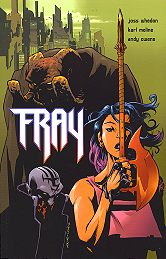
Written by Joss Whedon. Pencils by Karl Moline. Inks by
Andy Owens.
Colours: Dave Stewart, Michelle Madsen. Inks by Michelle Madsen.
Reprinting: Fray #1-8
Rating: * * * * (out of 5)
Number of readings: 1
Recommended (mildly) for Mature Readers
Additional notes: intro by Jeph Loeb; intro by Joss Whedon; sketch gallery by Karl Moline
Published by Dark Horse Comics
Hollywood script writer, Joss Whedon, has made a big splash with cult TV series like Buffy the Vampire Slayer (1997-2003). Anyone who's seen it and appreciates its themes and concepts knows Whedon clearly has comicbook geek in his blood -- and background -- so it's not surprising that, despite the smaller pay checks, Whedon has shifted over into comics from time to time. His recent writing of the comic Astonishing X-Men has garnered mainly great reviews, but a year or two before that, his first foray into comics was the eight issue mini-series for Dark Horse comics, Fray, collected in its entirety in a TPB volume.
Fray was a logical project for Whedon to test his comics scripting skills, because it's actually a spin-off of his most recognizable property -- Buffy the Vampire Slayer. It's written in such a way that Buffy fans will recognize certain references and themes even as it's sufficiently self-contained that you don't really have to be aware there ever was such a thing called Buffy the Vampire Slayer in order to follow it.
In the Buffy TV series, it was established that there have been many slayers over the eons, with Buffy only the most recent one. In Fray, we jump ahead a few hundred years into a dystopic, cyberpunkish future where we meet Melaka Fray, a street thief who not only is unaware of her calling as a Slayer...but doesn't even know what a vampire is! The Watcher's Council, which oversaw the Slayers for generations, has long since fallen into disrepair, so that it falls to a horned demon, Urkonn, to advise Fray of her place in the cosmic scheme of things, as a new plan hatched by vampires threatens demons and humanity alike.
In a world of occasional mutations, where Fray's mob boss employer is a fish man, the demon Urkonn makes less of a stir than you might expect, as Fray just assumes he's another mutated human. This is a world where the supernatural has long since become forgotten and no one has clued into the fact that the Lurks -- supposedly sewer dwelling junkies -- are really vampires. Fray, like Buffyy before her, is a reluctant convert to the cause, particularly as she mysteriously seems to have none of the Slayer's gifts other than super strength -- no prophetic dreams, no intuitive senses. She's also dealing with her own problems: she's a thief, her sister's a cop, and her brother was killed a few years before by Lurks. She's also acting as a kind of surrogate big sister to the disfigured ragamuffin Loo -- and in little Loo, Whedon pours all hhis impressive skills for mixing tones. She's funny, touching, grotesque, sweet, and heartbreaking -- sometimes all at once.
Though this was Whedon's first comic, he tackles it deftly enough. Maybe that should come as little surprise, as comics and film are similar mediums. His sense of pacing is good, not making the mistake of dragging out a scene too long. To fans of Whedon's TV work -- and Buffy in particular -- Fray is well worth seeking out. There's no dumbing down, or dilution of Whedon's talents. The quips are witty, the characters complex and multi-dimensional -- even without actors to say the lines, the characters live and breathe. Fray really does seem like what it is...a wholly legitimate off shoot of the Vampire Slayer mythos Whedon created.
It's a spin-off that Whedon couldn't have hoped to film before a camera -- not without a hundred million dollar budget. Chock full of flying cars, death defying leaps kilometres above the streets, epic battles, and a really big monster, Fray is Whedon's imagination untethered by mundane questions of budgetary considerations.
At the same time, despite having clever turns and surprise twists, for an eight issue series coming in at close to two hundred pages, there maybe aren't as many twists, or plot threads, as you might expect. The story stays pretty focused on Fray and its chief plot. The result is something that feels as though it could probably have been a movie with very little trimming or editing. Which isn't a bad thing at all, but for a multi-issue comics saga, one might have expected the plotting to be a little more Byzantine.
It's Whedon, himself, who has raised the bar so high on what fans might expect from him. Fray ultimately is a good read, with the obligatory mix of action and nuanced characterization, of horror and witty quips, of joy and pathos, with a few clever twists and turns, all building to a genuinely grand climax -- but the result might leave some Whedon fans saying: "yeah, O.K....now impress me". There are the trademark wry quips -- but though the lines that are funny, they're not always as laugh-out-loud funny as Whedon managed, say, in his Astonishing X-Men stories. And the very familiarity of Fray and her battles with demons, building to an apocalyptic showdown, means that, despite all the good bits, all the clever bits, it doesn't necessarily surprise. We've seen it before in various Buffy story lines (though fans might note that the axe Mel wields pre-dates its introduction into the TV series' mythos). Even the future Whedon envisions is pretty stock -- though the fish man is neat and, as is mentioned in one of the collection's introductions, you really can't go wrong with flying cars.
So does it need to surprise? Not entirely. Fray is entertaining, and keeps you turning the pages. And for fans -- even TV watchers who might not normally consider picking up a comic -- this is just as legitimate an extension of the Buffy universe as, say, the TV series Angel.
Artist Karl Moline was, apparently, not that well known when he was tagged to draw this, but he emerges as an accomplished talent right off the bat. There is a slight cartooniness to aspects of his work, but there is an energy and inventiveness to his pictures that blends well with Whedon's script, and he nicely captures the sense of this far future dystopia, with its towering skyscrapers and flying cars and its squalid, ground level ghettos, where the story demands a seamless mix of the real, the sci-fi and the supernatural. In all this he's aided by inker Andy Owen, and by colourists Dave Stewart and Michelle Madsen who go for a lot of effective earth tones of greens and browns as opposed to the more obvious metallic sheens you might expect for a future adventure. Granted, in some of the fight scenes, with the beheadings of vamps, Moline maybe could've toned down the graphics a bit. Instead, it's nudged slightly into mature readers territory.
The story ends with a reasonably satisfying conclusion...even as Whedon leaves things open for future adventures. Whether those adventures will ever materialize is the question. Melaka Fray made a brief appearance in the Dark Horse graphic novel, Tales of the Slayers (which featured short pieces about slayers through the ages), and guest starred in the Buffy Season Eight storyline, Time of Your Life -- but I don't think she's had any further, full length, solo adventures. If Fray should ever return for a solo mini-series, fine, but if she doesn't, that shouldn't really take away from what's here.
'Cause what's here is pretty good.
Cover price: $__ CDN./ $19.95 USA.
Jack Kirby's Galactic Bounty Hunters 2007 (HC & SC TPB) 256 pages
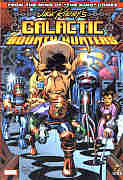 Lisa Kirby, Michael Thibodeaux, Steve Robertson, Richard French. Pencils by Mike Thibodeaux. Inks by Karl Kesel, Scott Hana.
Colours: Wil Quintana. Letters: Dave Lanphear.
Reprinting: Reprinting: the six issue mini-series (2006)
Rating: * * * (out of 5)
Number of readings: 1
Additional notes: various commentaries, interviews, and essays by and about he various creatirs, and Jack Kirby himself; covers, additional art, and promos for possible other Kirby-inspired projects.
Published by Marvel Comics
Despite Jack Kirby's name in the title, it should be noted the so-called "king" of comics had little to do with it as it was published more than a decade after his death! Writer/artist/comics pioneer Jack Kirby apparently left a wealth of unused material when he died. So in this case, Kirby's own daughter, as well as some long time Kirby friends/assistants, decided to try and bring some of those unused concepts to life, in an act that was probably equal aspects sincere tribute (to keep Kirby's work and name in the public eye) and mercenary marketing (after all, "Jack Kirby's Galactic Bounty Hunters" sounds more intriguing than just "Galactic Bounty Hunters"). But beyond the visual designs, it's unclear if Kirby was responsible for much of the story content (plot, characterization) -- heck, a couple of the cover images that are attributed to Kirby show one of the characters as a giant...but in the comic, he's not!
And the result...is a mixed bag.
The story begins in the distant reaches of space as a crew of eccentric-looking bounty hunters (courtesy Jack's designs) apprehend an intergalactic Ma Barker-type lizard woman, named Slugg. Then we cut to contemporary earth, where we learn the opening was just a story concocted by writer Jack Berkley -- except when Slugg's son shows up to kidnap Jack's son, Garrison, we realize that Jack wasn't writing fiction at all, but memoirs of his life as one of the Bounty Hunters. And soon Jack is back in space, recruiting his old crew, to try and rescue his son.
It's illustrated by Mike Thibodeaux, long time Kirby friend and assistant. And the blocky art style is certainly meant to not clash with a Kirby feel, even as he maybe isn't trying to deliberately imitate Kirby. Which is both probably good...and bad (there are other artists who might've more clearly evoked the "King", such as Jorge Lucas, or even Mike Mignola at times). The visuals suit the tone of the story, and if not aesthetically pretty, they are energetic and robust enough (and Thibodeaux deserves some kudos since a hand injury meant he had to learn to draw, and completed the project, with his left hand).
Although grim occasionally, with, after all, the premise of a man trying to rescue his son, the whole series is just meant to be fun and light-hearted. It's not aiming to be profound. And, again, that's a plus...and a minus.
The thing that has to be said about Jack Kirby (particularly given the reams of extras included in this hardcover -- text pieces and editorials expounding on Kirby's genius), is that Kirby was a hit and miss creator, perhaps as significant for the quantity of his creations as the quality. Once Kirby went solo (after having previously paired with writers like Joe Simon and Stan Lee) to write, draw and edit his own series in the 1970s, his out put can be a mixed bag of unbridled brilliance...and unmitigated idiocy. Sometimes at once! I've actually become a bigger fan of Kirby now than I was in my youth, but I still have conflicting emotions about his work (in fact his solo years were marked by very few true commercial successes). But, in a sense, the power of Kirby's work was that you couldn't quite divorce one from the other. What made some stuff stupid, is what also made it genius -- and vice versa.
In some ways, the creators here actually deliver better stuff than Kirby. The dialogue is more natural. The very light-heartedness acknowledges the goofiness of the ideas and embrace it -- the villains, though evil, aren't really menacing. You never believe anyone will come to serious harm. But what's missing is the explosive eccentricity, the sense of a raw creative mind completely unchecked. So though the dialogue never becomes as clunky, as corny as Kirby's could be...neither does it match Kirby's grandeur, its poetry, its passion. And the breeziness to the tale means it never even aspires to the headier philosophical ideas Kirby's stuff could evince, like he was sincerely writing some parable about personal freedom and the human condition in a bizarre story about super beings and robots! Kirby's stuff ran the gamut of "new" gods, ancient races, talking animals, cavemen & dinosaurs and other "cosmic" ideas.
Though it could be tighter, The Galactic Bounty Hunters trundles along reasonably (the earth interlude, including a joke/spoof of comics fandom itself, though with some amusing quips, gets a bit draggy), but it rarely surprises. It's not that there's anything wrong with the plotting or characters...but it basically unfolds in a predictable way.
The creators clearly want to evoke Kirby iconography -- using his character designs, or having the tongue-in-cheek idea of the villains having their own amusement park, Dangerland (reminiscent of the nightmarish theme park in Kirby's The Forever People), and even throwing in a cameo by a published Kirby creation, Captain Victory -- without evoking Kirby's creative spirit. So the amusement park is just a regular old amusement park with rollercoasters and the like, except given sinister names like Felony Funland. What's missing is any sense of deeper ideas or themes or metaphors. Oh, there is a theme of family, with Jack setting out to rescue his son, or the idea of self-obsessed teen Garrison coming to realize his dad isn't the staid figure he thought he was. But these are hardly radical ideas (and, indeed, Garrison is just a wee bit too obnoxious, particularly for a character who, later, is helping to save the day). Toward the end, it's suggested there's some bad blood between one of the Bounty Hunters and one of the villains...but I'm not sure it was earlier even hinted at!
But I'm mixed. Galactic Bounty Hunters isn't great...but it is likeable. There's a fun to the intergalactic scope of it all, and the humour is welcome and generally effective, with some cute quips and ideas. The fact that it's broken up into small chapters (some only two or three pages) kind of invites you to read it at your own pace, so that if your mind starts to wander, you just put it down to return to it later. The use of big panels and full page spreads, and rich colour hues by Wil Quintana, gives it a kind of appealing visual panache. Particularly for younger readers the story has some extra appeal.
Cover price: __
or, back to
 Flash
Gordon: On the Lost Continent of Mongo Published
in 1980 by Tom Doherty - Black & White
Flash
Gordon: On the Lost Continent of Mongo Published
in 1980 by Tom Doherty - Black & White