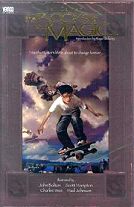
 Written
by Neil Gaiman. Illustrated and painted by John Bolton, Scott Hampton,
Charles Vess, Paul Johnson.
Written
by Neil Gaiman. Illustrated and painted by John Bolton, Scott Hampton,
Charles Vess, Paul Johnson.
Letters: Todd Klein. Editor: Karen Berger.
The Books of Magic 1993 (SC TPB) 200 pages
Written
by Neil Gaiman. Illustrated and painted by John Bolton, Scott Hampton,
Charles Vess, Paul Johnson.
Letters: Todd Klein. Editor: Karen Berger.
Reprinting: The original, four issue Books of Magic prestige format mini-series (1990-1991)
Additional notes: intro by SF novelist Roger Zelazny
Rating: * * (out of 5)
Number of readings: 1
Mildly suggested for mature readers
Published by Vertigo/DC Comics
A young English lad, Tim Hunter, is visited by four supernatural
agents: The Phantom Stranger, John Constantine (of Hellblazer comics),
Dr. Occult, and the more obscure Mr. E. He is told that he has the potential
to be a great wizard -- for good or ill -- and is taken by each of them
in turn on an odyssey to learn about the world of magic and the supernatural,
to see if he wishes to become part of that world.
There's an interesting side thought in regards to Tim's
similarity to another boy wizard...but more on that in a bit.
This original mini-series was evidently successful enough
that it spawned a subsequent monthly series -- a series which, itself,
has been collected in a series of TPB volumes. While in his introduction,
author Roger Zelazny holds it up against the myth templates laid out by
scholar Joseph Campbell in Hero with a Thousand Faces (Campbell having
won devotees among sci-fi fans for his assertion that Star Wars wasn't
just pop corn entertainment, but modern mythology). Zelazny goes on to
refer to the "depth" of this story and how it is "rich and resonant". I
mention all this just to present one point of view. Because there's another.
Which is, it's also a touch dull.
One can't shake the feeling that Neil Gaiman read Arkham
Asylum (also by a writer from across the pond)...and actually liked
it. Just as Arkham Asylum was a fully painted book, in which Batman wanders
aimlessly through an asylum, stopping to have conversations with crazy
people (who are familiar Batman villains) before moving on, so in The Books
of Magic, Tim wanders through time and space, stopping to have conversations
with magical people (many familiar DC Comics' characters), before moving
on. To me that doesn't really seem like a plot, per se. Nor is there a
great deal of character development, in that Tim doesn't really seem like
a different person by the end than he was at the beginning. Given that
the story begins with the supernatural "trench coat brigade" debating what
to do about Tim, how he could grow into a force for good or evil, the reader
has no greater sense of which way he might lean by the end. Tim is personable
enough, and there are characters with personality in the story, particularly
the roguish John Constantine who guides Tim in chapter two, providing a
lot of humour. But there's little character development.
In the second chapter -- the chapters are semi-self-contained
-- there's a thread of people trying to killl Tim, but it never really gels
into a plot, either, and is just used to break up the talky scenes.
Overall, the third chapter is the best. Here Tim and Doctor
Occult wander through the realm of fairy. Sure, it's still largely aimless,
but at least Gaiman breaks away from the talking head format, where Tim
listens to not very insightful monologues by not very interesting people.
Here things actually happen, there's some adventure and running about,
a greater sense that we're getting the bones of a story, rather than just
a dissertation masquerading as a narrative.
Obviously, if you can lose yourself in the writing and
the art, perhaps one can become enamoured of it all, or find the little
snippets of conversations, or tossed out ideas, provocative. Such as Tim,
briefly, encountering DC's resident debunker, Dr. Thirteen, who assures
Tim there's no such thing as magic, and John, in a sense, concurs, by explaining
it's all in one's perspective. But I'd much rather see such ideas explored
-- even demonstrated -- in a story, with pllot twists, and character development,
rather than just stated boldly, and lazily, without context.
Even then, the ideas tend not to be particularly concrete,
or provocative. For all that there is "good" and "evil" magic, Gaiman doesn't
really get into defining what is good and what is evil.
Tim's journey takes him to the very end of time and though
I've enjoyed the eerie, ineffable nature of such sequences in other stories
(H.G. Wells' The Time Machine for one), stacked on top of a story that
was largely non-existent, it just seemed one more dry, talking head episode,
rather than anything to blow your mind. Though it maybe crystallized what
I should've recognized earlier (and in Arkham Asylum as well) and that
is an Alice in Wonderland flavour to it all (Alice also being about a character
wandering aimlessly, having curious conversations).
I guess I just don't "get" the idea of reading a story
about a character passively standing around, observing things. Uh, isn't
that the reader's job? What's next? TV series about people watching TV?
A protagonist should be a little more involved -- hence my greater enjoyment
of chapter three.
Each chapter is tackled by a different artist and the
painted art, as it so often is, is a mixed bag. It lends the thing a certain
weight, a sense that "this isn't just a comic book". But I also wouldn't
exactly call this great art -- it's O.K., to be sure. But in the sense
of whether faces convey nuances, or even whether it's always clear what's
going on, there are weaknesses. The underlying drawing can be uneven (despite
the fact that I've loved some of Bolton's other stuff). The final issue,
by Johnson, can be particularly hard to make out what you're looking at
at times.
In a sense, for all the pretension, this seems very much
aimed at hard-core DC Comics fans. As noted, many of the characters Tim
encounters are familiar DC Comics characters -- like in Arkham Asylum,
sometimes tweaked slightly from their conventional interpretations. If
you aren't familiar with them, usually you can figure things out thanks
to Gaiman providing background here and there, but at other times, the
scenes are pretty nonsensical if you don't know who the characters are.
And even if you do...well, is that really enough? Once again, devoid of
much context -- that is, story, or character development -- are a parade
of cameos really worth the effort?
I mentioned at the beginning the curious similarity Tim
has -- dark haired English lad, with glasses and a pet owl, who, previously
unaware magic is real, is told that he has the potential to be his age's
greatest wizard -- to another character: Harry Potter. Yet The Books of
Magic came out a few years before Harry... Make of that what you
will.
Ultimately, what the regular series was like, and whether
it benefited from better plotting, I don't know. But this Books of Magic
was less than enchanting.
Cover price: $32.95 CDN./ $19.95 USA
B.P.R.D: Hollow Earth & Other Stories 2003 (SC TPB) 118 pages
Written by Mike Mignola, Christopher Golden, Tom Sniegoski,
Brian McDonald. Pencils by Ryan Sook, Matt Smith, Derek Thompson. Inks
by Ryan Sook, Mike Mignola, Curtis Arnold, Derek Thompson.
Colours: Dave Stewart, James Sinclair. Letters: Clem Robins, Pat Brosseau,
Dan Jackson. Editor: Scott Allie.
 Reprinting:
B.P.R.D.: Hollow Earth #1-3, Abe Sapien: Drums of the Dead,
a couple of stories originally published as back up tales in the mini-series
Hellboy: Box Full of Evil and a three page promo, originally serialized
in Dark Horse Extra (1998-2002)
Reprinting:
B.P.R.D.: Hollow Earth #1-3, Abe Sapien: Drums of the Dead,
a couple of stories originally published as back up tales in the mini-series
Hellboy: Box Full of Evil and a three page promo, originally serialized
in Dark Horse Extra (1998-2002)
Additional notes: intros to the various stories; covers; sketchbook.
Rating: * * * 1/2 (out of 5)
Number of readings: 1
Suggested (mildly) for Mature readers
Published by Dark Horse Comics
Mike Mignola's Hellboy has become a popular character
in comics, and has even gone mainstream with a big budget movie. A demon
raised by humans, Hellboy is an operative for the Bureau for Paranormal
Research and Defence. Over the course of his adventures in various mini-series
and one-shots and short stories, the reader has been introduced to a supporting
cast of -- sometimes equally bizarre -- fellow operatives, such as Abe
Sapien, a fish man. As such, there's potential for stories without Hellboy
but utilizing the B.P.R.D., and this is the first collection to bring together
some of those tales (other BPRD stories and TPBs have followed).
The main story at 66 pages is the mini-series Hollow Earth,
involving Abe Sapien, the humanoid homunculus, Roger, and a new misfit
team member, Johann Kraus -- a spiritualist whose body was destroyed during
an out-of-body experience, his discorporeal essence now inhabiting a containment
suit (and given all the Nazi villains Hellboy's battled, it's a nice touch
to throw in a German good guy). They go to an isolated monastery in search
of team member Liz Sherman (a character who, though featured heavily in
the movie, in the various comics in which she's appeared spends most of
her time just being rescued) which leads them into underground caverns
and a confrontation with a prehistoric race of sub-human demon things.
Though Hellboy creator Mike Mignola is credited with the
story, it's actually written by Christopher Golden and Tom Sniegoski, and
drawn by popular artist Ryan Sook, whose normal style is not dissimilar
from Mignola's, and who seems to be making an added effort to evoke Mignola's
style. The result is a story that visually blends with the regular Hellboy
stories -- if you didn't read the credits, I doubt you'd realize it wasn't
Mignola. Which is good, since Mignola's art is often seen as a big attraction
to Hellboy. One could argue Sook doesn't quite capture Mignola at his best,
while also being a little more realistic -- he's both better, and not quite
as good, as Mignola.
The writing allows time for filling in the background,
spending time at the Bureau, seeing how the characters live, and also fleshes
out the characters more (Mignola's stuff tends toward minimalism in that
department) as Abe questions his place at the Bureau, and we get more development
of Kate Corrigan, a non-powered supervisor. All the while, the writers
keep the pace up and work in some deadpan humour and quips. The result
may actually seem a bit smarter, a bit more emotionally rich, than the
average Hellboy story, even as the plot itself is fairly rudimentary and
probably reads better collected together rather than serialized over three
months. Hellboy remains the more interesting, vividly realized personality,
but these supporting characters acquit themselves quite well. Though in
paranormal circles, "hollow earth" I think refers to something a little
more specific than just underground cave dwellers.
Also included are a couple of shorter pieces, including
a 1930s-set story involving Lobster Johnson (a pulp-magazine styled hero
who played a significant part in Hellboy: Conqueror Worm) and "Abe
Sapien versus Science" in which we see how Roger, who kind of died at the
end of Hellboy: Almost Colossus was resurrected for subsequent stories
(including, of course, this collection's "Hollow Earth"). The Lobster Johnson
tale ("The Killer in My Skull") is basically a horror-thriller, while the
Abe Sapien story is more a character study of Abe. Both are written by
Mignola himself and are, characteristically, kind of minimalist. They're
drawn by Matt Smith who, like Ryan, does a pretty good job of imitating
Mignola so that, again, for those who like the visual flavour of Mignola's
Hellboy stories, it works reasonably well.
There's also a three page story that fills in a bit more
about Johann Kraus -- but not really more than we were told in Hollow Earth,
so it remains pretty superfluous (it was first published as a teaser to
attract interest in the Hollow Earth mini-series).
The final story is the 22 page one shot, "Drums of the
Dead", in which Abe Sapien and a Bureau psychic investigate freakish deaths
at sea. Drawn by Derek Thompson, it's the only one not done to emulate
Mignola's style and is probably a bit weaker for that -- not that it's
badly drawn. And because Thompson has a more detailed style, it's probably
a bit more grisly, as the gore is more authentic. The story itself, by
Brian McDonald, actually tries for some edginess by tying it into a historical
atrocity, giving it a "relevant" thread, and it's certainly O.K., but despite
22 pages, seems more like a short story.
Like the Hellboy stories themselves one could quibble
and say there's a certain thinness throughout, that none of these stories
are necessarily "must reads". But like the Hellboy stuff, they're still
entertaining page turners. For Hellboy fans, these fill in some gaps around
the regular Hellboy stories, and the use of various operatives, introducing
new characters and filling in their back stories as we go (such as Kraus
in Hollow Earth, and the psychic in Drums of the Dead) certainly highlights
the fact that the Bureau is an interesting source of future stories, even
without Hellboy...even as Hellboy remains, arguably, the best, most interesting
character. For those who've never read Hellboy, it's still an entertaining
read, even if occasional references to Hellboy continuity might be oblique.
Cover price: $__ CDN./ $17.95 USA
 Breathtaker
1994 (SC TPB) 106 pages
Breathtaker
1994 (SC TPB) 106 pages
Writer, colourist: Mark Wheatley. Artist, letterer: Marc
Hempel.
With assist from Kathryn Mayer. Editor: Mike Gold.
Reprinting: Breathaker #1-4 (1990)
Intro by Neil Gaiman.
Rating: * * * 1/2 (out of 5)
Number of readings: 1
Published by DC Comics/Vertigo
Recommended for "Mature Readers"
Breathtaker is an odd little concoction. Part sci-fi
thriller with super hero shadings involving a couple of people with unusual
powers running about a more-or-less contemporary America. Part satire.
Part human drama. And the mix succeeds more often than it fails.
The central character is Chase Darrow, a young woman with
whom men seem to inevitably fall madly in love, but she has the unfortunate
side effect of literally draining the life out of her lovers. Chase doesn't
mean to -- she doesn't want to -- but she can't entirely help herself,
being as addicted to this life essence as her lovers are to her. Chase
comes to the attention of a covert government agency and their own business
suited, super powered agent, The Man (abbreviated to TM -- the symbol for
trade mark, and one of the series' wry gags). The Man is the star of his
own TV show, comic book, action figure line, and is also something of a
psychopath. Much of the story involves the cross country pursuit as Chase
flees, and others follow: The Man, to capture her; erstwhile lovers, who
want to save her; and a rumpled police detective who seems immune to her
charms presumably because his vice is food, not love.
For the most part Breathtaker weaves its own peculiar,
individualistic tale, mixing humour and pathos equally. It takes familiar
fare (super beings, secret government agendas) but manages to seem fresh
and unusual. Creators Mark Wheatley and Marc Hempel manage to take their
time with scenes -- simple conversations might spread over three or four
pages -- without the story seeming turgid or redundant. The story takes
some unexpected turns, and characterization is likewise not always what
you think, with even The Man revealed as a far more complex, even vulnerable,
figure than you first assume.
At the same time, it's not always clear what the story
is, ultimately, about. This isn't some misogynist tirade, with Chase some
demonized woman draining men of their "Precious Bodily Fluids" (to quote
the classic black comedy, "Dr. Strangelove"). Chase is our sympathetic
heroine. Yet, neither is it entirely clear if there's a deeper reading
to the narrative. A story about men who are willing to risk death just
to love this woman could be an interesting comment on the loneliness, the
desperation of contemporary society, where a moment with love is preferable
to a lifetime without. But though that could be inferred, it's certainly
not explicit. As such, the story seems more like just a cute premise --
what if a woman was irresistible, but also lethal -- nothing more.
In his introduction, Sandman
writer Neil Gaiman points out the possible symbolism in Chase Darrow's
name. Her first name is obvious in a story about pursuit, while the second
might be a reference to Clarence Darrow, the defence lawyer who acted in
the 1925 Scopes trial -- more popularly known as the "Monkey Trial" --
in which an American school teacher was literally put on trial for teaching
evolution. The idea of evolution provides a passing theme in Breathtaker,
as it has in more and more (and more) super hero comics of the last decade
or so, asking what happens when a new breed of human (like Chase and The
Man) start appearing. But it remains just that -- a passing thing that
is lightly touched upon but nothing more.
Where Breathtaker ultimately stumbles is in the
ending. Storytelling is about so many things: character, themes, ideas...but
perhaps most basically, a beginning, a middle and an end. Wheatley delivers
the beginning and middle, but when it comes to wrap up, he seems lost,
unsure how to resolve his various threads, or what to do with the revelations
concerning Chase's origins. Instead of building to a climax, Breathtaker
staggers towards a finish. It's not that it ends on a cliff-hanger or anything,
it's just the ending is wishy-washy. Worse, the ending in the TPB has apparently
been modified from the original mini-series. Not having read the original
I don't know by how much or in what way (though a slight change in the
art style hints at which are new pages) but this is essentially Wheatley
and Hempel's second run at it...and it still doesn't really make much sense!
At least it doesn't to me, nor to other's whose reviews
I've come across, nor to those who must've persuaded the creators to re-do
it for this collection -- yet Gaiman (again in his intro) seems perfectly
at ease with it.
The art by Marc Hempel is oddly effective, aided considerably
by Wheatley's bold, vibrant, painted colours. Hempel uses a blocky, cartoony
style, yet still invests the characters with enough nuance and reality
to make them work, to bring out the humanity of the characters. And his
sense of telling a story through panels is particularly well-honed. The
style perhaps suits the story perfectly, which itself veers from the whimsy
to earnestness frequently. He even manages to make Chase just pretty enough,
albeit in a cartoony way, that there's a touch of sexiness to the book.
This is definitely a "mature readers" tale, with sex,
and cussing, and nudity (of the PG 13 variety) -- actually there's more
nudity than you usually see in comics, even "mature readers" comics. At
least, more than you'd see in the kind of comics that are considered respectable
reads.
Unusual, intriguing, with odd, heartfelt characterization,
Breathtaker
is an interesting, ingratiating read. But it ultimately seems a little
like some unfinished saga that was cancelled before it could properly conclude
rather than a mini-series that was never intended to run more than four
issues. Genuinely worth reading for what it is, but disappointing.
Cover price: $20.25 CDN./$14.95 USA.
or, back to