One of the earliest editorials which I contributed to this webzine
was a review of McSweeney's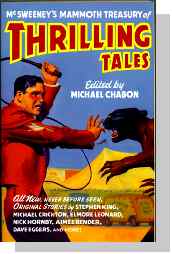 Mammoth
Treasury of Thrilling Tales. A not very favourable
review.
I did not like the stories found therein. In fact, I still keep
that anthology lying out in the middle of my bedroom floor just so I
can give it a good swift kick when I'm feeling particularly
pissed.
Mammoth
Treasury of Thrilling Tales. A not very favourable
review.
I did not like the stories found therein. In fact, I still keep
that anthology lying out in the middle of my bedroom floor just so I
can give it a good swift kick when I'm feeling particularly
pissed.
But my main complaint wasn't with the stories, exactly. To be
sure, I hated them one and all, but I also recognize that many readers
enjoy those sorts of stories and more power to them. No, my
complaint was with the simple fact that, for an anthology called
"Thrilling Tales", NONE of the stories came CLOSE to being
THRILLING! If they had simply tried and failed, again I wouldn't
have been so peeved. But who's kidding who? The
authors clearly had listened impatiently to the guidelines, nodding
every
now and then, maybe throwing in the odd "I getcha, sure" -- and then
they
went home and wrote exactly the sort of Art House stuff they always
write. Some joke. How they must have laughed.
Please understand, it wasn't just the promise held out by that Pulpish
title (and cover!) that, encouraging so much, led to my
disappointment.
Rather, it was the fact that the entire project was
supposed to have been conceived as a grand experiment to recapture what
short fiction --
specifically genre short
fiction --
had lost starting some time around the
1950s. At least that was the claim of the editor, Michael Chabon,
in his introduction. And, unlike lowly dung beetles such as myself, when
Michael Chabon says fiction has lost something, he is not so easily
dismissed.
The Pulitzer Prize winning author of The Amazing Adventures of Kavalier
and Klay, Chabon is himself a purveyor of the kind of high-brow,
intellectual
fiction whose existence he was now lamenting. Something, he felt,
had been lost in the art of short story writing, and he was as guilty
as anyone. Where once Fiction was about plotted stories
where exciting things happen and great deeds are done, Fiction today
had become
dominated by "quotidian, plotless, moment of truth revelatory" tales
"sparkling with
epiphantic dew". An opinion with which I largely agree -- and I'll look up "epiphantic".
So,
while I gave McSweeney's
Thrilling Tales a disgusted thumbs down for the stories, I
nonetheless said
that it was worth buying simply to hear someone of
Chabon's creds finally saying what we are all thinking.
Is that so much to ask? Apparently, yeah.
Flash forward. While recently cruising the Net, I came upon an
editorial at Science Fiction Weekly, the ezine belonging to the Science
Fiction Channel. There editor Scott Edelman demonstrated that
even a heavy-weight like Michael Chabon could indeed be dismissed if he
dared to speak the unspeakable. Edelman's reaction to McSweeney's
Thrilling Tales was the exact opposite of mine. He loved
the
stories to bits, but
was absolutely enraged by Chabon's introduction. Wrote Edelman:
"In his introduction, Chabon bemoans the supposed malaise into which
fiction has fallen these days, and longs for the days when short
stories didn't worry about epiphanies, but were just gosh-darn fun..."
You will note the phrase "gosh-darn fun". I think I am safe in
saying that Edelman is mocking the very stories which Chabon wishes to
recapture. Yes? Why then does he go on to argue that those
"gosh-darn fun" stories still make up the modern literary landscape,
that Chabon is tilting at windmills -- or, more specifically, straw men.
What are these GENRES, (Edelman wants to know), that Chabon thinks
have vanished? Who are these modern AUTHORS who, (Edelman asks),
aren't really enjoying the stories they are writing? And, most
importantly, who are these READERS, (Edelman furiously demands), who
are
"enduring fiction only as a
kind of self-flagellating penance, as if reading today were like being
forced to eat one's vegetables?" To these questions, Edelman
gives a resounding rejoinder:
"I don't recognize those writers or readers. They are straw men."
Straw men? An odd example of willful blindness, yes?
After all, isn't Chabon himself an example of one of those dissatisfied
reader/writers? Or doesn't Chabon's opinion count? Then I
can add at least one other name to that list. Or doesn't my
opinion count either?
Reading Edelman's editorial, I find myself wondering if he literally
doesn't understand what the question is. One minute he is mocking
the very notion of "thrilling tales", dismissing them as "gosh-darn
fun"; the next he is just as vehemently insisting such tales are alive
and well and living in a spin rack near you. Well, which is it
to be? Does he even understand what it is to sit back and read a
story for fun?
You can hardly surf
anywhere on the Net without running into a webzine with a "mission
statement" that reads something like: "I don't like the stuff that gets
published nowadays, and I started this webzine to fill a void."
Each one of those editors thinks they are
publishing something different from everyone else. Yet, for my
money, I confess I can't see the difference between them, or, for that
matter, the difference between those editors and the mainstream editors
they are rebelling against. The more they profess to be
different the more they just seem to be publishing precisely the sort
of stories which Chabon was railing against -- "moment of truth",
"plotless" stories "sparkling with epiphantic dew". Or as
I rather bitterly characterize them: "Art House stories".
What precisely do I mean by Art House stories? For starters,
there are stories which, once I reach the end, leave me baffled as to
what the story was about or what happened -- literally.
Okay, in some cases I'm probably just not sharp enough, I admit
that. But I have read plenty of stories which left me baffled
which, upon my reading a review by someone presumably smarter than
myself,
proved to be just as baffling to him/her. The only difference
between us being that the reviewer enjoyed being baffled, while I just
got pissed off. I do not like reaching the end of a story and
going "D'wah?" That's just the boy my mamma raised and I ain't
about to change.
Then there are other Art House stories not so easily defined.
Stories which have flamboyant trappings, or which seem to
fit into Pulpish genres, but which are anything but. Which is
precisely why Michael Chabon was able to publish an anthology called
"Thrilling Tales", billed as a supposed revival of Pulp Fiction, and
countless reviewers were suckered in, reviewing the stories as if they
really were somehow Pulp adventures. To use the example I used
when I reviewed this anthology the first
time: "Tedford and the Megalodon" sounds like it should be a rip
roaring Pulpy adventure. It's a story about a guy who goes
hunting a giant prehistoric shark, called a Megalodon. It has,
therefore, the trappings of a
thrilling tale, an exciting
adventure. Countless reviewers might compare it to Jaws.
They would see no difference between Benchley's novel and this short
story. Both feature big sharks? Someone gets eaten?
Well, what more do
you need?
Quite a bit actually. "Tedford and the Megalodon" depicts a
hunter, Tedford, spending the entire story sitting in his
kayak waiting for the shark to show up until, suddenly, the shark does,
and eats him. End of story. No conflict. No
action. No adventure. No problem solving. No
nuttin'. He just gets EATEN! This is not Jaws. This
is not "thrilling". This just pisses me off.
But what gets me, and the reason I am writing this essay, is that I
don't see why it should be so fecking difficult for someone like Chabon
to say the simple obvious truth. Nor, in doing so, why the wrath
of
God should be called down upon his head. Because, to be sure,
Scott Edelman
wasn't the only one
who took umbrage with Chabon's remarks. Amongst Art House
reviewers Chabon's words made like the fox in the hen house.
Feathers flew and the chickens were still attached. I couldn't
find anyone who came out on Chabon's
side, who had the courage to say, yes, modern genre fiction is no
longer about having fun.
But that is the bottom line, isn't it? Fun? Oh, I'm not
saying there aren't plenty of readers out there who have fun reading
modern genre fiction. Of course there are. But I do think
an awful lot of readers are
indeed reading those stories because they feel it's the thing to do --
"like being
forced to eat one's vegetables". And I think for every reader who
sincerely enjoys what passes for modern genre fiction there are
countless other sentient beings on this precious globe of ours who
don't read at all because they don't enjoy
what is being offered. Don't their opinions count?
The problem is that the sort of stories that judges give awards to
are rarely the sort of stories that most people like to read. And
I'm not saying that's wrong. Truth is, if I were judging the
Nebulas, I'd give the award to some complex psychological drama that I
would never have waded through if I wasn't
being asked to judge it. Then I'd go home and crack open a copy
of the latest Michael Crichton bestseller and read it all in one
sitting. Hypocrisy? Maybe. (Well, actually...
yes.) But those two markets are
incompatible. Either you write to win awards or you write to
please the readers. You must choose your master.
I know I have.
Jeffrey Blair Latta, co-editor and Supreme Plasmate
Got a response? Email us at lattabros@yahoo.com
 Pulp
and
Dagger Fiction Webzine
Pulp
and
Dagger Fiction Webzine