Squadron
Supreme 1997 (SC TPB) 352 pgs.
Squadron
Supreme 1997 (SC TPB) 352 pgs.
Miscellaneous (Superheroes) - "S" PAGE 2
Back to the main listings (including character sections)
Squadron
Supreme 1997 (SC TPB) 352 pgs.
Written by Mark Gruenwald. Pencils by Bob Hall, Paul Ryan,
with John Buscema, Paul Neary. Inks by John Beatty, Sam de la Rosa, others
Colours: Christie Scheele, Max Scheele, others. Letters: Janice Chiang,
others. Editor: Ralph Macchio.
Reprinting: Squadron Supreme #1-12, Captain America #314 (1985-1986)
Rating: * * * * 1/2 (out of 5)
Number of readings: 2
Re-reviewed: Dec. 5, 2009
Published by Marvel Comics
The curious thing about Mark Gruenwald's epic mini-series
is that it's not better known than it is, since it's very easy to believe
this Marvel Comics maxi-series had an enormous influence, particularly
over at rival DC Comics.
More on that later.
The technical origins of Squadron Supreme date back to
the 1960s, when Marvel and DC agreed to do an unofficial cross-over. Nowadays
company crossovers are common, but not so then. So the idea was that each company
would create heroes that were based on a team owned by the other company,
and have it meet their own heroes. Got that? So Marvel created a clone
of DC's Justice League of America that existed on
a parallel earth, the Squadron Supreme, to meet Marvel's The Avengers. DC's
version of Marvel characters quickly disappeared into obscurity, but Marvel
continued to play around with the Squadron Supreme from time to time, even
creating a villainous version of the team, the Squadron Sinister.
Actually, a friendly e-mailer advised me that Marvel
created The Squadron Sinister first, then created the Squadron Supreme.
The parallels are more than just superficial; the powers,
the personalities and even the interpersonal relationships mirror the JLA characters
(Dr. Spectrum, the Green Lantern clone, is buddies with both the Whizzer, the Flash clone, and the Golden Archer,
the Green Arrow clone, who's in love with Lady Lark, the Black Canary clone). It's important to realize this, else you might
read the book aghast at the similiarity and wonder why DC didn't call its
lawyers.
Jump ahead to 1985, and the Squadron Supreme gets their
very own mini-series.
The premise is that on their alternate earth, civilization
teeters on the brink of collapse after an aborted attempt to conquer it
by an alien villain. It's kind of an odd way to begin a series, as you feel as though you're coming in at the end of a story, but one that I don't believe was told anywhere. Anyway, the Squadron, seeing the sorry state of world affairs,
decide to assume total control of the United States and with their powers and abilities to remake the world
as a Utopian state. It's a laudable goal, but rife with moral minefields.
Nighthawk (the Squadron's version of Batman) quits the team in protest
and, later, works against them.
Needless to say, problems arise, conflicts occur, ethics
are tested, and eventually it gets down to a showdown between the Squadron
and a band recruited by Nighthawk to oppose them.
The Squadron Supreme is definitely flawed, but it emerges
as a staggeringly impressive opus nonetheless. Ironically, it is not in
the ambitious political concept that the story impresses. In fact, in trying to grapple
with big questions of moral imperatives, benevolent dictatorships, free
will versus society, Gruenwald fumbles more often than he succeeds. The
world is not realistically portrayed, nor does Gruenwald even attempt to
answer how the Squadron is achieving many of its goals (such as eliminating
unemployment or hunger). Granted, if those things were so easy to fix,
someone would've done so already, but still... Instead, Gruenwald keeps
his eyes focused mainly on parochial law and order issues.
Where the series excels is in its portrait of a super
hero team in a context that allows for drastic changes and unexpected behaviour.
Because this is not an on-going series, there is no artificial need to
maintain the status quo. Characters die, or resign, or do questionable
things, relationships change. It is in the portrayal of the characters
that the series seems ground-breaking, more than in its tackling of big
issues. The characters can be noble and self-sacrificing, but also petty
and shallow, and the series occasionally touches on ideas that other comics
might have shied away from, such as having Nuke, a nuclear powered hero,
discover he may be the cause of his parents' cancer, or through Power Princess
(that is, Wonder Woman) exploring what would be the result of a romance
between an immortal and mortal person.
Gruenwald crams a lot into each issue, with each chapter
showing the various characters, and the progress of the Utopian plan, while
also working in plots that, for the most part, are self-contained. The
series attempts, and largely achieves, a successful blend of talky, thoughtful,
character-driven stories, and enough action, problem solving, and battles
with super villains, to make them fun adventures, too. It's been a while
since I've read single issue comics that are so richly...satisfying. Obviously,
it's a mini-series, and each issue leads into the next, but there aren't
too many that end on a blatant cliff-hanger, which adds to the epic feel. That's partly because the 12 issue format is supposed to represent a 12 month time period, so often weeks pass between issues. But as such, this isn't just one story, but many stories that, together, form the whole
tapestry that is Squadron Supreme.
By the time the series comes to a close after 300-some
pages, the team has left its mark on you.
There's also a crossover into a Captain America comic that, though part of the whole, is also a bit of a sidebar -- it's good that this collection included it...but the maxi-series could still be enjoyed without it.
There are shortcomings. Arguably, Gruenwald was never comicdom's deftest dialogist, and though some of the dialogue is good, often it's pretty blunt and rarely more than adequate. Still, there are some nice, surprising touches of realism, such as depicting some of the team members' family lives (being interupted in mid-conversation to deal with their rough housing kids). And though the characters grow on you, Gruenwald
seems most comfortable with the ones least reminiscent of the JLA, such
as Tom Thumb, a genius little person who emerges as one of the most vividly
realized characters in the series. At the same time, it's also true that the JLA connection lends the scenes and characters an extra resonance.
The chief weakness, though, remains the handling of the
"issues". There were times when Gruenwald seemed to be taking a stance
without considering the other point of view, such as in gun control. The
Squadron decides to impose gun control, and Nighthawk (and others) are
shocked and I remain inclined to think Gruenwald's sympathies were with
the gun nuts (uh, I mean, responsible citizens who like to own guns). But
there's a possiblity that Gruenwald was simply tossing out ideas without
passing judgement or taking sides -- after all, for all that some characters object, we are not shown
any true negative repercussions to gun control.
Gruenwald has characters spout things about personal liberty,
without a sense he's really thought about what those concepts mean beyond
knee jerk semantics.
For all the "talk" about issues, for all that the Squadron
is confident that what they do is right, and for all that Nighthawk is
convinced they're wrong, we get very little demonstration of either side.
There's a sense that, though Gruenwald came up with the deliciously rich
concept of "what if super heroes decided to be law makers, not just law
enforcers", he didn't have anything to say on the topic.
The main policies we are shown being implemented are gun
control, and perhaps the series most fundamental plot element (running
through many of the chapters) -- and contentious issue -- is the team's
decision to use a behavioural modification device on criminals to make
them law abiding citizens. At the same time, I often find myself a bit disappointed when reading fictional stories that attempt to grapple with complex, moral issues, often finding the writer(s) themselves have trouble articulating all the points of view -- so it's hard to fault Gruenwald alone. And with that being said, I also realize that Gruenwald is trying to be ambiguous, resisting the urge to paint things in absolutes of black and white. This is particularly obvious in the climactic confrontation between the opposing sides and Gruenwald filters the conflict through the various characters' mixed and conflicted emotions. There are few cut-and-dried "heroes" or "villains" on either side.
And, to be fair, it's hard to delve too deeply into moral issues, when the practicality of the dilemmas is a bit removed from our reality.
There are some technical glitches. Initially the Squadron
promises to assume control of the world. Then, as if Gruenwald realized
the logistical problem, later issues just refer to the United States (leading
one to wonder how the rest of the world is fairing while the U.S. gets
the utopian face lift) or a character kills another character, but then
subsequently keeps refering to him as an artificial being...even though
there was no indication of that earlier!
With all that being said, the Squadrom Supreme works more
than it doesn't in its surprising plot twists, its panorama of characters,
and the genuine sense of a complex epic.
It's also fun in the familiarity of things, trying to spot
the parallel characters and origins. Not only are there the JLA clones,
but Gruenwald throws in other characters that are evocative of Marvel or
DC heroes and villains. Granted, the idea of doing a comic book series which was deliberately meant to be evocative of existing characters was a little more fresh back then...unlike now when it's almost become de rigeur.
The art is reasonably good, without being anything exceptional,
which is too bad for such an ambitious series. Bob Hall draws the first
half, initially with a kind of workmanlike style, but gets better and better
as he goes along...only then he leaves (though pinch hitting one later
issue) and is replaced by Paul Ryan who is, frankly, less impressive. Though, again,
Ryan is hardly a bad artist -- just a bit bland. Given its emphasis on plot and character,
the series could've ended up with worse choices, because both Hall and
Ryan approach scenes in a matter-of-fact way, not getting caught up in
their own stylistic exaggerations or bizarre, incoherent panels. But I wish Hall had been able to see it through. John Buscema
draws an issue, and I'm a Buscema fan, and Paul Neary draws the Captain
America tie-in.
The Squadron Supreme is well known and well regarded, but I began this piece saying it's not as well known as it should be. And that's because it seems remarkably seminal. I won't say this was the first time anyone had tried to deal with such themes as abuse of (super)-power in a super hero comic (Avengers Annual #2, from 1968 comes to mind). But though the themes dragged out in this series have been revisited a zillion times in the ensuing years, both in mainstream and independent comics, those projects all came after. At the very least, Gruenwald seemed to be tapping into a creative zeitgeist that was happening, as a number of projects that are often lumped in as part of the same trend (The One, The Watchmen, The Dark Knight Returns) were all published within months of each other.
At the beginning of this piece I wrote that the Squadron
Supreme may have had an enormous influence on rival DC Comics. Clearly
one can see similarities in The Watchmen and
Kingdom
Come -- not just in the broad generalities of heroes vs. heroes in an
effort to improve the world, but in specifics. The Squadron's Nuke fears
his nuclear power gave his loved ones cancer...in
The Watchmen,
Dr. Manhattan is accused of the same thing. In the Squadron, Nighthawk
teams with villains to resist the Squadron...in Kingdom Come Batman
teams with villains to resist the JLA. And so on. As well, there are aspects
to the Squadron that anticipate DC's post-Crisis
revamps of its characters, such as the Squadron's Dr. Spectrum as a cocky,
womanizer...which is the direction DC took Hal Jordan (Green
Lantern) post-Crisis. Since DC was planning its post-Crisis
reality at the time, is it possible DC staffers were carefully pouring
over each new issue of The Squadron Supreme as it came out, to see if there were any useable
ideas they could "borrow"? Who knows? For that matter, the idea of The
Squadron Supreme as an alternate version of the JLA might well have given
DC Comics the idea for its entire "Elseworld" line of alternate interpretations
of its characters. Marvel itself has continued to play around with the Squadron, both this version, and using it as the basis for a completely new reinterpretation almost two decades later as the mature readers Supreme Power and Squadron Supreme: The Pre-War Years (reviewed below).
As an exploration of an intriguing moral issue, Squadron
Supreme doesn't fully cut it. But as a super hero saga, given a mature,
adult spin (while still staying within Comics Code guidelines), full of
complex character arcs, unexpected twists, and an appealing peak at a parallel
superhero universe with its own history of heroes and villains, Squadron
Supreme is a richly satisfying epic.
This is a review based on the original comics.
Cover price: $29.99 USA.
Squadron Supreme: Death of a Universe 2006/1989 (SC TPB/GN) 248/80 pages
 Written by Mark Gruenwald, Roy Thomas, Kurt Busiek, Len Kaminski. Pemcils by Paul Ryan, George Perez, Carlos Pacheco, Wayne Boring, Anthony Williams. Inks by Al Williamson, Andy Lanning, others.
Colours/letters: various
Reprinting: The Squadron Supreme: Death of a Universe, Thor (1st series) #280, The Avengers (3rd series) #5, 6, The Avengers/Squadron Supreme Annual 1998, The Squadron Supreme: New World Order
Number of readings: 1
Reviewed November 2014/Jan. 2015
Published by Marvel Comics
Death of a Universe is actually the title of two Squadron Supreme books -- a 1989 80-page graphic novel and a 2006 TPB collection which reprinted that graphic novel plus some other assorted comics. I originally posted a detailed review of the graphic novel -- and I'll leave that as is, for those who might just come upon the original graphic novel in a store. But afterward I'll add a fuller review of the TPB collection...
THE GRAPHIC NOVEL
The Squadron Supreme had floated around the peripheries of the Marvel Universe for years. Deliberate (and acknowledged) rip-offs of DC Comics Justice League of America, they were Marvel's way of indulging in occasional -- unofficial -- cross-company stories (as the Avengers would meet, not the JLA, but the Squadron Supreme). Occasional in part because the team existed on a parallel world.
But the team got a big boost in their profile when they were featured in their own self-titled maxi-series. This was around the time when there were big shake-ups in the industry, particularly at DC Comics which was preparing to overhaul its entire fictional universe, as well as when ambitious super-hero sagas like The Watchmen and The Dark Knight Returns were in the planning stages. And The Squadron Supreme was Marvel's stab at something similar.
Since they were (semi-)established characters, and benefitting from the obvious resonance of seeming like Superman, Wonder Woman, etc., but ultimately peripheral characters with no need to worry about the status quo, writer Mark Gruenwald concocted an ambitious, stand alone epic.
Then Gruenwald, with artist Paul Ryan (who had illustrated some of the maxi-series) reunited (now joined by inker Al Williamson) for this lengthy one-shot graphic novel sequel. And, to be fair, you don't really need to have read that earlier series (it's actually recapped for those as didn't) -- even as, obviously, those who have will feel a better affinity for the characters and their relationships. (Gruenwald also mutes some of the appeal of this "separate universe" setting by tying the story into an earlier story he wrote -- The Project Pegasus Saga, I believe. It's not important to following the plot, but it is a bit jarring when suddenly we get a brief recap of a previous adventure involving the regular Marvel Universe heroes).
Admittedly, one might ask: why a sequel? The Squadron Supreme series worked precisely because it told the tale it wanted to tell. It wasn't really meant to seem like the beginning of a whole series. But maybe it's because Gruenwald thought it would be interesting to try and tell one of those cosmic menace/the earth is doomed! stories but where the audience really wouldn't know how -- or if -- the heroes would win. By utilizing the Squadron and their parallel reality, all bets are off. Or maybe it's just that after 12 issues, Gruenwald found he wasn't entirely prepared to say good-bye to the characters and wanted to drag them out again.
Whatever the reason, Death of a Universe can seem a bit anti-climactic -- ironic, given the subject! The premise is that a mysterious celestial hand emerges from a rift in space, intent on closing about -- and so extinguishing -- the earth's sun. The danger embroils not just the Squadron, but some erstwhile arch foes -- even a time traveller from the future.
But lacking the sense of bigger political themes, or even the epic series presentation (the maxi-series was a mix of stand alone adventures but with on going and developing sub-plots) Death of a Universe can feel like, well, a slightly long story about super heroes trying to stop a cosmic danger from destroying earth. Perfectly okay -- just nothing exceptional.
Like with the earlier series, this is surprisingly talky, the emphasis more on the characters discussing the dilemma than on simply action scenes and splash pages. It really is about them trying to deal with a crisis that's as much akin to a natural disaster as anything driven by an evil foe. Although that makes the essentially Deus ex machina ending (though easy to anticipate) feel like a bit of a cheat.
Part of the problem is that Gruenwald wasn't exactly the deftest dialogists or the subtlest when it came to characterization. So the scenes, and the character interaction, is okay, but nothing more. And though I remarked in my review of the maxi-series that the characters grow on you over the course of the series, here, in this one-shot adventure (and read a few years later) it's equally true that the characters are fairly bland. In that same vein, Ryan is a solid enough artist, rendering well proportioned figures, and telling the scenes with clarity, without really being a dynamic artist. Admittedly, I think that was a style preferred by Marvel's then editor-in-chief, Jim Shooter.
With all those seeming knocks against it, the flip side can't be ignored. Namely, it is a lengthy 80 page story -- and it never really drags. Perhaps that's even more remarkable given, as mentioned, it's not really full of knock down drag out action.
So in that sense, Death of a Universe is an okay adventure, benefitting from the alternate universe setting meaning we don't know who will die and who will live (if anyone!) -- even as that very setting means the reader will have less invested in the characters than if it really was the JLA or the Avengers in this crisis.
And that's the problem with doing sequels -- sometimes they can just feel like sequels for sequels sake. I'm reminded of Alan Davis' (later) Justice League of America: The Nail, which was a grand, stand alone epic, playing around with deep emotional and philosophical ideas, while its sequel, Another Nail, just felt like, well, a comic book adventure. (Those are reviewed in my JLA section). Lacking a premise that rivals the maxi-series in themes or philosophical debate, Death of a Universe can feel a bit like a return to a well -- when most of us weren't feeling that thirsty.
THE REST OF THE TPB COLLECTION
The rest of the TPB is a bit of a grab bag, most -- sort of -- following a linear chronology, but not all. The most notable odd-man-out is Thor #280 a comic published a number of years before the rest in this collection. In it Thor meets Hyperion, from the alternate reality, gets into a fight, then they make up and Thor goes off to visit Hyperion's world where they are shooting a movie about the Squadron Supreme -- meanwhile the evil Hyperion from Thor's universe follows and much hi-jinks occur.
Yeah -- it's kind of weird. But I think that's the point. Hyperion is, after all, supposed to be a not-so subtle rip-off of Superman and I think the story is meant as a nod -- or spoof -- of the kind of whimsical Old School Superman stories that even Superman wasn't really doing by then, but might have in the 1950s. Which might also explain guest artist Wayne Boring -- a signature Superman artist from the '50s (though Boring had done some work for Marvel, so it might just be a coincidence). There's certainly a visual evocation of old Superman stories, with a modern sophistication (credit Boring's latter-day style, or perhaps Tom Palmer's inks). But the result is still just -- odd. Not funny enough to be funny, but not coherent enough to just be taken at face value. Still, that makes it more interesting than some of the other issues here.
There's a two-part Avengers story, with the Avengers battling The Squadron (once more it turns out the Squad's been brainwashed) and then a double-sized Avengers/Squadron Annual that is basically just an excuse to pair members of the team up for repetitive chapters -- I review these issues better in my review of Avengers: Supreme Justice, where they are also reprinted. Though apparently we were supposed to infer that the Squad had been knocked out of their universe into the regular Marvel one at the end of Death of a Universe -- but I'm not sure that's clear in that story.
Which brings us to 1998s 48 page one-shot, Squadron Supreme: New World Order. The Squad finally make it back to their universe only to find their earth is under the sway of a dictatorial power and they are the outlaws (in an ironic turnabout on some of their other adventures). And it's one of those things that is neither particularly good -- nor particularly bad. And, worse, for a one-shot, never really builds to much. I can't decide if that was the point (the story more concerned with themes than actual plot) or because they were half-hoping to do sequels that never happened.
But I think a problem with a collection like this is The Squadron Supreme itself. Created to be obvious rip-offs of DC's Justice League they were never quite allowed to develop their own identity, particularly with only occasional guest spots and one-shots. The reason the epic maxi-series worked was because the team was allowed to grow and expand beyond their rather limiting roles as archetypes.
And perhaps, underneath, there's a certain cynicism fuelling their stories -- Marvel's staff using them to take digs at their main publishing rival. After all, The Squad is a fairly bland bunch, and a lot of their guest appearances involve them being brainwashed or dupes (admittedly, that may've just been because the writers were trying to come up with some contrived reason why heroes would fight heroes). The Thor issue here can even be construed as a spoof of Superman stories (but even Superman comics weren't doing stories like that by then).
While with New World Order, writer Len Kaminski uses it as a further opportunity to create parallel's to DC characters, adding in an ersatz Phantom Stranger and Martian Manhunter figures -- and even having characters refer back to the universe-threatening menace of Death of a Universe as "the crisis" and "zero hour" -- both names for assorted DC cross-title epics. Kaminski isn't spoofing DC -- but it still raises the question of what's the point? Why shape a universe that is just a carbon of DC's universe, without using that to then veer off into unexpected directions, or explore deeper characterization (as, one could argue, the maxi-series had done)? Even the idea of the heroes as outlaws facing a fascist state has been done in innumerable what if...? and possible future super hero stories.
In the end, this grab bag of assorted Squadron stories -- solo appearances and guest starring stints -- just makes the point that the team feels a bit like a property in search of a raison d'etre. In that sense, the graphic novel -- Death of a Universe -- is the collection's highlight, and even that's as much just because the characters feel more connected to their vastly superior, and genuinely memorable, maxi-series. Original cover price: $__ .
Rating: * * * 1/2 (out of 5)
Rating: * * 1/2 (out of 5)
The Squadron Supreme: New World Order 1998 (SC GN) 48 pages
is reviewed as part of the Squadron Supreme: Death of a Universe TPB collection (above).
Squadron Supreme: The Pre-War Years 2009 (SC TPB) 178 pages
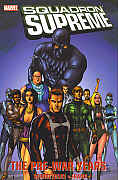 Written by J. Michael Straczynski. Drawn by Gary Frank, with Juan Barranco. Inks by Jonathan Sibal, with Vicente Cifuentes.
Colours: Chris Sotomayor. Letters: Joe Caramagna. Editor: Alex Alonso, Warren Simons.
Reprinting: Squadron Supreme (2nd series) #1-7 (2006)
Rating: * * (out of 5)
Number of readings: 1
Reviewed November 17, 2009
Suggested for mature readers
Published by Marvel Comics
The original Squadron Supreme were Marvel Comics characters (deliberately and openly modelled after DC Comics characters) that flittered about the mainstream Marvel universe -- even though they existed in a parallel dimension -- eventually being featured in their own, self-titled 1985 mini-series (reviewed above) that attempted to mix super heroics with a genuinely ambitious exploration of character and politics that many would argue could sit comfortably on your shelf next to The Watchmen. After that, they continued to appear sporadically.
Jump to the early 2000s, and Marvel dusted off the concept for a completely new interpretation under the title Supreme Power -- this time as an R-rated, mature readers series attempting to explore the "reality" of what would happen in our world if super powered people began to appear. In my review of Supreme Power (the complete run collected over three TPBs) I indicate the series left me of mixed feelings, finding it worked, and didn't work, in almost equal measures, and for all that writer J. Michael Straczynski was clearly trying to write an ambitious, provocative, intelligent series...sometimes the execution didn't live up to the intent.
The series also left me mixed because I wasn't sure how to read it. To me, it had the feel of a mini-series (perhaps an impression encouraged by the fact that the original Squadron Supreme was a mini-series, as was The Watchmen which it seemed to echo). It all seemed to be about the building, the progression, the issues merely chapters in the saga...yet after 18 issues, it was a saga that just seemed to be rambling on, with no clear end, or climax, in site. When the series ended, nothing had been resolved, or brought to a denouement.
And then it underwent a title change -- reclaiming the old Squadron Supreme label. And though still gritty, still with some "not for kids" undercurrents...it was a (slightly) cleaned up version, dropping the four letter words, the nudity, etc.
Still, despite my mixed feelings about Supreme Power, I decided to pick this up, ready and willing for Straczynski to impress me and to justify my having read the previous 18 issues.
And, unfortunately...he doesn't.
As I say, maybe I just read this (and Supreme Power) with the wrong mind set. Expecting it to be a mini-series, with a beginning, middle and end, while by this point it seems pretty clear that wasn't ever Straczynski's intent. Supreme Power/Squadron Supreme was intended as just an on going series. At the same time, the fault, I would argue, still lies with him, because as an on going series, it doesn't really work -- at least not for me. I found myself reading the issues to see where they would take us (as you would for a mini-series) rather than for themselves (as you would for an on going series). The characters aren't that compelling or complex -- and seem to just reiterate the same ideas from issue to issue -- while the plots that are introduced and resolved are a tad on the thin side. While the sub-plots and undercurrents -- another reason it feels like it's all building to something -- just seem to ramble on indefinitely, not really developing much beyond their early introduction...eventually seeming a bit like a shaggy dog story.
Picking up from the end of Supreme Power, this Squadron Supreme begins with the U.S. government assembling a team of super beings, some which had been featured in Supreme Power, others which we only got glimpses of towards the end of that series, and are fleshed out more here. And though there is still the token effort to model some after rival DC Comics' archetypes, others echo Marvel's own characters, such as the Scarlet Witch-like Arcanna, and a Blob-like character (though both of which had been featured in the original Squadron Supreme).
Part of Straczynski's idea (inspired by the original Squadron Supreme series) is not just to tell a super hero story, but to meld it with deeper, grittier, socio-political themes. So the Squadron Supreme is sent off to fight America's (and the U.N.'s) wars, ending up in Africa, and in the Middle-East in a sequence meant to act as a metaphor for the Iraq war.
Despite the name change, and that this is the first use of characters as an official team, the series does follow on the events of Supreme Power, so though it nominally can be seen as a jumping on point for new readers -- there are plenty of bits that will leave you scratching your head if you haven't read Supreme Power, particularly relating to the alien influence that first introduced super powers to earth people. As such, the switch to a slightly less mature readers tone is awkward -- Marvel presumably did it in an attempt to boost sales (along with the name change) but it seems dishonest and sleazy, since anyone reading this will still be inclined to track down the harder, R-rated earlier issues to understand what's going on.
As well, losing that extra "edge" also means the series itself loses some of its impetus for being. For all that Straczynski and company no doubt figured they were doing a radical, progressive series -- they weren't so much, with many of the themes and ideas already having been explored elsewhere. So part of what the series had to offer, gratuitous as it was, was the novelty of profanity and nudity and such in an otherwise familiar super hero milieu.
Admittedly, I'll guess the change wasn't an artistic decision, but an editorial one. My guess is Supreme Power just wasn't selling that well, and Marvel hoped making it more mainstream would boost sales. But as I say, I think the real fault lies with the material itself.
Still on board with Straczynski is artist Gary Frank (with Juan Barranco pinch hitting an issue) -- Frank having drawn the complete Supreme Power run. Frank has a detailed, realist style that is well suited to this series with its pretensions to dealing with real world ramifications. Although his figures can be a bit stiff, his line work a bit severe, in general it's very nice work. And though Frank adjusts to the softer "mature readers" tone, dropping the occasional nudity of the earlier series, he's clearly a fan of "Good Girl" art, indulging in a lot of skimpy costumes and plunging necklines for the women. But it's hard to believe the U.S. government would sanction such racy costumes for its official operatives! As well, though I'll freely admit to the aesthetic appeal to such, um, displays (heck, I'm the one saying the series should've remained R-rated) one might suggest to Frank that conversations about geo-political matters probably sound more convincing when not involving big breasted babes with cleavage down to their navels!
With Squadron Supreme Straczynski assembles a team...but has trouble really making them interesting, or well rounded. As part of the darker, grittier tone, a number of these "heroes" are not very nice people at all, even sociopaths...but other than demonstrating that, repeatedly, it doesn't really take us anywhere. He devotes an extended sequence to the traumatic childhood of one of them -- but her backstory is pretty straightforward and heavy handed, not really offering any twists or surprises. And there's a lack of human warmth in the series, with even the Blur (essentially the series' most sympathetic, human character) telling Hyperion (the Superman-like character) that "We're not that close". So you have a team comic with little camaraderie or relationship between the members...which is kind of what sustains an on-going series.
This run of issues is more clearly broken into story arcs -- better suggesting this was intended as an on going series. But the stories aren't necessarily that well plotted or intriguing, as Straczynski is torn between the desire to write a super hero adventure...yet also sees that, at times, as subordinate to exploring social and political themes. The scenes can be quite verbose and stretched out...without always offering much to justify the protracted telling.
A number of comics by Straczynski I've read have incorporated real world issues into the fantasy narrative. And quite a number of them...don't really work for me. Straczynski often is less exploring a complex social or political issue, and more just lecturing us with his particular view of it. A view which, to be brutal, doesn't always convince you he researched too much about the matter before arriving at his superficial conclusion. When the Squadron is lectured about Western imperialism in Africa by a band of super powered Africans, and how Africa should be left to the Africans, you're left thinking Straczynski is presenting an awfully simple view of the issues. After all, with something like the genocide in Rwanda in the 1990s, the criticism of the U.N. from many (including Africans) was that it didn't interfere enough, not that it should've stayed out of it! Besides, Africa is hardly a monolithic state, but a huge continent of a multitude of people and nations that date back millennia. Having one -- or a handful -- of Africans speak for all Africa is surely just as imperialistic as having a white westerner speak for Africa.
Not that is was wrong for Straczynski to express that view -- but it might have been more provocative to present it as one side of a larger debate. Or, at least, offer a more compelling argument for it than just expecting us to take his word for it. Of course, Straczynski isn't above falling back on comic book pseudo science either, such as referring to how amphibians have gills and lungs which, um, I don't think is strictly true. That is, they do -- but at different stages in their life cycle, not at the same time.
This run of issues builds to a showdown with the series' first recurring foe -- the super powered serial killer previously seen in Supreme Power. Unfortunately, he wasn't very interesting to begin with, and remains dull, basically just an excuse for a lot of brutal violence and tossing cars around.
And, again, the series doesn't build to anything. Even worse than Supreme Power, it stops in mid-story with the battle with the serial killer, the series being -- one assumes -- cancelled prematurely. Sure, they had beaten the character before, so there's no reason to think they couldn't do it again after a lot of hitting and smashing. It's more the dangling sub-plots that are glaringly incomplete.
The next revival of this take on Squadron Supreme was in the mini-series Ultimate Power, which had these characters crossover with the characters from Marvel's various Ultimate Universe series'...as well as tossing in the original Squadron Supreme! Having read a synopsis of that series, it's pretty obvious that by that point, any pretence at social-political relevancy -- the raison d'etre of Straczynski's run! -- was completely jettisoned in favour of a mass super hero smash up (hence why this collection is titled "The Pre-War Years"). This Squadron Supreme has continued in a subsequent mini-series or two, in other hands, but any hope -- or intent -- that Straczynski's run was actually meant to be a Watchmen-like epic, building to anything, seems to have been completely discarded.
So where does that leave me? With caution and cynicism, yet some ray of hope and expectation, I gradually followed the series through its Supreme Power incarnation, being alternately intrigued, and frustrated, waiting for it to fulfil the promise it held out. The Supreme Power series still has aspects to recommend it, but this Squadron Supreme run left me unenthused, and reminded me why I tend to be so cynical about comics (and TV series) in which the creators demand long term devotion from their audience, teasing them with promises of "trust me, it'll all be worth it in the end." Whether the series was cancelled before Straczynski could bring it to its conclusion, or whether he had no conclusion in mind, 25 issues should be more than enough for anyone to deliver on a potential...and it never does.
Cover price: $__ CDN./ $16.99 USA.
Back to