Written
by Jason Aaron, with Mark Waid. Illustrated by Mike Deodato, with Jim Cheung, Paco Medina.
Written
by Jason Aaron, with Mark Waid. Illustrated by Mike Deodato, with Jim Cheung, Paco Medina.
Colours: Frank Martin. Letters: Chris Eliopoulos.
Miscellaneous (Superheroes) - "O" - "P" page 1
Back to the main listings (including character sections)
Original Sin 2014 (HC & SC TPB) 240 pages
Written
by Jason Aaron, with Mark Waid. Illustrated by Mike Deodato, with Jim Cheung, Paco Medina.
Colours: Frank Martin. Letters: Chris Eliopoulos.
Reprinting: Original Sin #0-8
Rating: * * * (out of 5)
Number of readings: 1
Published by Marvel Comics
Reviewed: Dec. 2015
Basically since the 1980s the idea of a company-wide crossover saga has become a perennial staple at both Marvel and DC. And more modest examples of the idea date back at least to the 1960s! But the added aspect with these modern stories is they are meant to have significant reverberations throughout the company's line. Unfortunately that can lead to a lot of stories that mess with mythology simply for the sake of messing with mythology.
Anyway, Original Sin was Marvel's latest entry in that concept -- one that was perhaps more modest than recent sagas like Civil War and Secret Invasion, but nonetheless has some reverberations. Part of the idea with these is often to present a central mini-series that branches off into all the monthly comics. Sometimes that renders the core series difficult to follow (as important scenes take place elsewhere) but not so here. In Original Sin at least the central story occurs and unfolds in these issues. (Though just to make things confusing -- a spin-off mini-series was titled "Original Sins"...plural)
The premise here is that The Watcher -- a long time Marvel character that has been around since the 1960s, an enigmatic alien whose cosmic function is to simply watch and record events but not interfere (though he has on occasion) -- is murdered. And so various superheroes -- from The Avengers to a loose, odd-ball collection involving the likes of Dr. Strange, The Punisher, Black Panther, and others -- set out to investigate who murdered him...and why.
In a way one wonders if the inspiration for this was DC Comics' somewhat controversial Identity Crisis series, which likewise was set up as -- nominally -- a murder mystery, and in which dark secrets were revealed about our stalwart heroes. In this case, in the course of investigating the Watcher's murder, and a quest to find his stolen eyeballs (yup, that happened), many of the secrets the Watcher had observed over the years are somehow telepathically released to those they were kept from. It's that part of the story that seems to spread out into other comics, where a lot of secrets and everything-you-knew-was-wrong revelations occur -- but that's actually of little relevance here.
Not that there isn't one or two "shocking" revelations in these pages.
Not only is the killer of The Watcher revealed but we also learn that a long time character had been living a secret, double life.
And this is where things get a little problematic. I'll get back to that in a moment.
As far as just being an entertaining romp -- Original Sin is mixed. As I say, at least the story is relatively self-contained (despite bleeding of into other comics). It has lots of heroes. There are some big action scenes (a lot actually!) plus some slow building stuff at the beginning. But part of the problem with some of these mass team up sagas is no one character gets to distinguish themselves. It seems to me (and maybe this is just the difference between reading such adventures as an adult versus when I was a more impressonable kid) that such stories had the potential to fire your interest in charaters you hadn't even heard of before -- intrigued to follow them in other adventures. Here -- I wasn't even intrigued by characters I already was pre-disposed to like! There just isn't enough time or space to really allow them to stand out or establish themselves as individuals. Part of that relates to how the characters have evolved over the years and are written today as opposed to in the adventures I remember them from.
Some of this may also relate to Mike Deodato's art. There's no doubt Deodato can present some beautiful, atmsopheric, lush panels -- richly detailed and full of moody shadows. But that's almost the problem (and I recall complaining about that in some other things by him). It's almost too atmospheric, too much about the beautiful imagery, at the expense of the down to earth humanity of the characters. Characters are often rendered in long shots, or lathered in shadows to the point of obscuring their features, or simply given to tight-lipped grim expressions, so that it further adds to the sense that the heroes are more story props rather than the personalities that should be involving us emotionally.
Sometimes comic book art can almost be too...artful.
Meanwhile, back to the plot itself -- for all it involves various heroes, for all that it's meant to be a mystery and with startling revelations -- it ultimately can feel a bit minor by the end. Like not much has really happened over its 8-plus-1 issues. Oh the crime is solved, the mini-series does build to a resolution so that the it can be read for itself alone. But I'm not sure there are too many moments, or scenes, or threads that really stick with you.
I'll try to be vague, but some spoilers will probably slip out.
As mentioned, part of the gimmick of these sagas is to shake up the whole line, to make them "must reads" for hard core fans...even as it probably pushes away casual readers who are more interested in just a good read. It means the cart can feel like it's leading the horse, the impact on continuity isn't a result of the story, the story is there to present the impact on continuity.
So, as I say, it starts with the murder of the long serving Watcher character. Then it leads to the revelation that another long serving character had a secret life (and, no, I don't suppose there's any point in re-reading old comics to see if it actually is foreshadowed by past stories). That revelation is that this character had long been acting as a one man guardian of earth, protecting humanity from menaces even the other heroes were unaware existed. And -- I dunno. It can seem a bit implausible. Now I realize that's an odd complaint in a genre full of super beings and sorcerer supremes. And maybe writer Jason Aaron would insist you aren't meant to take it too seriously -- it's just gee whiz fun. But given the characters treat it seriously, giving rise to ethical debates, given its impact on continuity, given it results in the death of The Watcher, it seems to demand we see it as a reasonable narrative twist. And the idea that one man with a (super) gun is somehow more important to the safety of the earth than all the other super heroes combined seems a stretch.
It also leads into that ol' ethical/unethical dilemma. You know, where writers act like they are trying to tackle a moral issue -- even as by the way it resolves, it seems pretty clear where they stand. To whit: the other heroes act as if the actions of this character are unethical. Metaphorically we can see in it an echo of real world discussions involving enhanced torture, drone strikes, or any other on-going debates about how far is too far when it comes to security. At least, that's how I read it, in the way the story has the other, stalwart heroes act as though this lone gunman has crossed too many ethical lines in his righteous mission.
But here's the thing: by the end, another character assumes those same responsibilities as The Man on the Wall (as he's called). So....after spending a few issues debating the morality of it, Aaron (and Marvel) basically come down on the side of saying it's justified. Oh, not that we should be cheering about it. But it's necessary.
And sure -- that's fine. That's a legitimate side to take. But it is taking a side. Let's not pretend it isn't.
Cover price: __
Original Sins: Hulk vs Iron Man 2014 (SC TPB) 100 pages
Written by Mark Waid & Kieron Gillen. Pencils by Mark Bagley & Luke Ross. Inks various.
Colours/letters: various
Reprinting: the four issue mini-series
Rating: * * 1/2 (out of 5)
Number of readings: 1
Published by Marvel Comics
Reviewed: Aug 2017
Original Sin was one of those cross title epics companies like Marvel and DC churn out regularly -- to the delight of some fans and the chagrin of others. The idea is to tell a central story that then bleeds out into other titles and mini-series. In the case of Original Sin (reviewed above), the plot was relatively confined to the central mini-series, involving the murder of the longstanding character, The Watcher. But spin-off repercussions involved the revelation of previously unknown secrets various heroes had (The Watcher being, by nature, someone privy to everyone's secrets). This allowed for yet another cliched staple of comics -- the "everything you thought you knew is wrong" retcon.
Which brings us to this Hulk/Iron Man mini-series.
You see the revelation telepathically revealed to Bruce (Hulk) and Tony Stark (Iron Man) was a long suppressed memory that Tony Stark had actually been there for the fateful bomb test that resulted in Banner being irradiated and becoming the Hulk. More to the point -- the newly unearthed memories suggest Tony Stark tampered with the bomb, making him directly responsible for Banner's curse.
So while Tony grapples with this recollection -- and the truth or falseness of it (since even back then he was a heavy drinker and he's blurry on what he was doing that night) Banner gets furious and goes out for revenge, even using new tech so that his mind can retain control of the Hulk while he goes after Iron Man.
Put another way: it's four issues of Iron Man and the Hulk slugging it out wrapped around a slightly contrived dilemma/mystery. And to be honest you're not really sure if it even is a mystery, given the way so many modern comics have gutted the histories of their heroes for the sake of "shocking" plot twists. As such you're not even sure if we are supposed to be waiting for a surprise twist to reveal that things aren't how they appear (it's probably ok to say there does turn out to be more than what the recovered memories first suggest).
And here's where I stumble up against the question I've been grappling with the last couple of years of whether, y'know, I'm just not the guy to be reading n' reviewing comics these days. Because four issues of Iron Man and the Hulk slugging it out might be all a fanboy wants from a series like this. A glorified video game -- or WWF match -- come to life, threaded with just a nod to character and moral dilemmas. But for me it can feel a like kind of a thin basis for four issues.
The telling of the story is a bit of a tag team effort (to further use a wrestling analogy) with writers Mark Waid and Kieron Gillen and artists Mark Bagley and Luke Ross alternating on the issues, doing two of the four issues each. Bagley and Ross are both fine artists with similar enough styles that you can enjoy the change without it affecting the flow of the story. Likewise there's no significant up or down to the writers switching off (and they collaborate on the overall plot).
Part of the problem I have with modern comics is that for all their aspiration to be more sophisticated than comics of yore, they seem to be less and less tethered to the real world. Tony Stark has gone from simply a smart inventor/industrialist to some uber-futurist who has built his own city! And as noted the entire four issues is simply based around superhero matters and superhero dilemmas. Heck, when the idea of Tony Stark's alcoholism was introduced in comics back in the 1970s, it was a dramatic story because it explored the idea of things that can lead to alcoholism, the way the bottle becomes an escape from stress. Here it seems Tony was a binge drinking alcoholic even before he became Iron Man -- just 'cause.
(Just as a side point: it's funny how comics constantly have to up-date decades old origin tales. So here it turns out Tony had a cell phone during Bruce's gamma bomb test! Sure, they cryptically refer to it as an early design, maybe so fans can infer he had a cell phone before anyone else did, but still, it's a bit off-putting when the original tale was written in the 1960s).
Also the idea that a plot twist is Bruce jiggers with his transformation so he keeps his intellect, giving him an advantage over Iron Man who assumes he'll be fighting the dim-witted Hulk, is less dramatic giving there were whole eras of the character where the Hulk had Bruce's intellect.
So as I say -- I dunno. Basically this is just an up-date of the usual grudge-match fight that superhero comics have been known for (and sometimes mocked for) for decades, as a contrived disagreement sends two heroes at each other. Except those old stories would usually just take up an issue. I mean in real life, don't you think two smart, rational guys -- remember, uber-smart guys -- would have better ways of settling these things?
Cover price: __
Patsy Walker: Hellcat
The TPB collection mainly reprints the 2008 mini-series, but it also includes a shorter story first serialized in an anthology comic. Since I've only read the mini-series, I've just posted the review here in my mini-series section.
The Phantom: The Ghost Who Walks 2003 (SC TPB) 162 pages
 Written
by Ben Raab, Ron Goulart. Illustrated by Fernando Blanco, Mike Collins.
Inks by Fernando Blanco, Art Nichols.
Written
by Ben Raab, Ron Goulart. Illustrated by Fernando Blanco, Mike Collins.
Inks by Fernando Blanco, Art Nichols.
Colours: Ken Wolak, Dawn Groszewski, Paul Mounts. Letters: Terri Boyle,
Chuck Maly. Editor: Garett Anderson, Joe Gentile.
Reprinting: The graphic novels "The Singh Web", "The Treasure of Bangalla", "The Ghost Killer" - plus covers; author commentaries; overview of the Phantom's history by Ed Rhoades; sketchbook reproductions.
Rating: * * * (out of 5)
Number of readings: 1
Published by Moonstone Books
Created in 1936 as a newspaper comic strip, the Phantom -- nicknamed The Ghost Who Walks -- is connsidered the first costumed superhero. Mixing elements of Tarzan with conventional crimebusters, the Phantom lives in the jungles of Bangalla, but is equally at home pursuing evil doers to the big city. The character has had an erratic history in comics, with everyone from King Features to DC Comics having a go at him. He has also appeared in other mediums: paperback novels in the 1970s, and a decently budgeted motion picture starring Billy Zane in 1996. It was the -- surprisingly faithful -- motion picture that was my first true exposure to the character, and though the film was uneven, it was also a lot of fun and is well worth searching for at your local video store.
Despite all this, the Phantom remains an obscure character -- the movie bombed, the on-going newspapeer strip is carried only by a few papers. Ironically, today this American creation seems to be more popular overseas, particularly in Scandinavian countries, and Australia.
Recently though, a fledgingly company, Moonstone Books, is hoping to resurrect the Phantom in the comic books, initially with a series of graphic novels, three of which have been collected in this TPB collection.
These stories aren't meant to radically re-imagine the concept. Rather these simply present the Phantom in a different format, but keep the tone of the newspaper strip and the movie -- light, even frothy adventure-suspense tales, with lots of running about and the Phantom given to light-hearted banter. It's meant to be old fashioned adventure.
And the creators mostly succeed, which is both a plus and a minus.
The three stories here are fast and unpretentious, and though there is some murder and mayhem, it's generally "clean" fun, lacking a nasty, or "gritty" edge that too many modern storytellers use as a substitute for true sophistication. The villains are generally real world sort of foes -- art thieves, gun runners. However, one story, "The Singh Web", is evocative of the mysticism of the 1996 movie in that it involves a struggle for a mystical artifact (in fact, much of the plot seems reminiscent of the film!).
There's a lot of old fashioned "pulp" flavour to the stories, with a couple of tales beginning with expeditions into the jungle, or one involving the tried-and-true sinister sanitorium. For those not as keen on mainstream super heroes, with their garish villains, fantasy/sci-fi plots, and convoluted continuities, these stories are more down to earth, and you don't really need any prior knowledge about the Phantom. Though it's worth noting that the symbols on the Phantom's rings are meant to be a skull and a stylized cross respectively -- rather than a swastika which the latter, quite unfortunately, sort of resembles!
The downside to all this can be that the stories are very light. There's little characterization, or deep emotion, or thoughtful asides, and the dialogue remains fairly workmanlike. The writers take their "all in good fun" attitude seriously. Probably the best is the final story, "The Ghost Killer", in which a little more emphasis is put on the Phantom's relationship with his wife, Diana, giving more heart to the proceedings.
It's also kind of, well, unspectacular. In a comic book, the stories should be limited only by what a writer can imagine and an artist can draw. The stories here seem budget-conscious, like episodes of a TV series, or at best, like TV movies. The action tends to be fistfights, and shoot-outs, in non-descript jungle settings, or urban milieus. I'm not saying each story needed a fight on a dirigible, or a chase through a quicksand infested swamp, but something might've been nice.
Given that some of the (very few) other Phantom stories I've read included a quest for a lost expedition, climaxing in a fight with a giant spider, or the Phantom out of his milieu on board a passenger ship hijacked by modern day pirates, or stories that took advantage of the multi-generational aspect of the character to present adventures set in the past, the stories here seem a tad...prosaic. Although there is a token nod to the fact that the Phantom mantle is passed from father to son, as "The Singh Web" is set in the 1930s, while the other stories appear more modern.
Even when a story concept started out interesting, by the time it made it to the page, it seems to have been watered down. Scripter Ben Raab, in a commentary, says that the premise for the "Ghost Killer" was to pit the Phantom against a world class assassin determined to prove the fallacy of the jungle saying that the Phantom cannot die. But in the story itself, the assassin isn't particularly smart, or powerful. Her great plan is to simply ambush the Phantom with a bunch of armed mercenaries! In the end, she seems a minor foe at best.
The art is a little disappointing, particularly when contrasted with the dramatic, painted cover of this collection by Doug Klauba. Fernando Blanco draws two stories, and his style seems to improve a bit between them, from the "Singh Web" where it's kind of cartoony and angular, to "The Ghost Killer", where he's toned it down a bit, and the work is stronger. There's also more of a cheesecake-y approach in that latter story, with the lady assassin depicted in tight shirts or dressing in a bikini for very little reason. Obviously that can be a plus, depending on your views. On the down side, Blanco is one of those modern artists who can't resist drawing in blood and spit even for what should be a gag pratfall as a bad guy runs into a tree! So much for a kinder, gentler storytelling sensibility.
Mike Collins draws the Ron Goulart-scripted "The Treasure of Bangalla", and although there's less of the cartoony exaggeration of Blanco, the work is a bit stiff and dry. I'm not really sure what the overall history of the Phantom's art chores has been, but one of the few Phantom comics I have is a 1970s Charlton issue by the late, great Don Newton, and it set a standard in my mind that Blanco and Collins fail to meet.
Comic book writer Raab scripts two of the tales, Ron Goulart just one. Goulart, a novelist and comic strip writer (the 1970s Star Hawks strip), gained some wider recognition a few years ago "helping" William Shatner to write his popular -- and very pulp-flavoured -- TekWar novels. (You can often recognize recurring Goulart-ian touches in his works, such as spelling news as Newz, which also occurred in TekWar.)
In the end, The Phantom: The Ghost Who Walks is still an enjoyable, pulpy read. Maybe not a classic, but ingratiating in its very unpretentiousness.
Cover price: $__ CDN./ $16.95 USA.
The Phantom: The Hunt 2003 (SC GN) 48 pages
Written by Ben Raab. Pencils by Lou Manna.
Colours: Matt Webb. Letters: Terri Boyle.
Rating: * * 1/2 (out of 5)
Number of readings: 1
Published by Moonstone Comics
Reviewed: Oct 2018
The Phantom -- the seminal super hero and jungle adventurer -- has had various (often sporadic) comic book incarnations. During Moonstone's stewardship of the property they produced both a monthly comic and some one shot/graphic novels. The Hunt is one of the latter.
While battling modern day pirates on the high seas, the Phantom is washed overboard only to wind up on a small island with its small group of inhabitants and an old castle -- the owner of the island a famous big game hunter. Ah hah, you might say, sounds like the set up for a riff on Richard Connell's classic short story, "The Most Dangerous Game" (wherein a man finds himself being hunted on an island by a big game hunter seeking the ultimate prey -- man).
When I first sensed that was where the story was headed I sighed somewhat discontentedly. Connell's story is a classic, no doubt about it -- unfortunately because of that, there had been innumerable riffs on it over the years (comic books and TV series ripping it off for occasional episodes). I wasn't sure if I cared to see yet another addition to that well-mined sub-genre. But surprisingly the story seemed to be unfolding at slower pace, adopting a bit of a Gothic vibe as The Phantom is welcomed into the castle and meets its inhabitants (including the hunter and a lady doctor). I actually started to brighten up -- thinking maybe writer Ben Raab was taking it somewhere fresh.
Unfortunately -- no. It is just The Most Dangerous Game. Although even Raab maybe seemed a bit ambivalent about the idea, because the actual hunt only occupies the last quarter or so of the book,
It isn't that there is anything wrong with riffing on a familiar theme -- but Raab doesn't really bring anything new to the idea. I mean, you could take the bones of The Most Dangerous Game and then pack some new ideas around it. But even the hunt itself is kind of perfunctory -- as opposed to involving some intriguing cliff hangers or daring escapes. There are even plot lapses -- like The Phantom at one point overhearing voices from other prisoners (presumably the pirates from the beginning), but they don't re-appear as if Raab forgot they were on the island.
It isn't that the telling is bad, though. I mean it clips along well enough, Raab fashioning a few quips and wisecracks for The Phantom, and throwing in the female doctor adds a little character complexity. It's just that it feels kind of workmanlike and derivative (to stave off complaints of plagiarism, Raab has the characters refer to Connell's story just so we know it's an homage, not a rip-off).
The art leaves me a bit mixed. It's certainly capable, with clean lines and well-proportioned figures. But it has a kind of stiff, stodgy look that makes it all feel rather, well, comic book-y (to be honest, I don't think I've seen any Moonstone Phantom comic where the art blew me away). But with that said, I have to acknowledge the composition is strong, the scenes mostly well told and presented -- particularly the low-key talking head scenes which unfold like scenes from a TV show, the shots and reaction shots letting the scenes unfold effectively (though some of the action scenes were a bit more confusing). So, really, the art is perfectly solid.
Ultimately The Hunt is a perfectly okay page-turner, and does kind of have the feel of an episode-of-the-week of a TV adventure series. Some action, some quips, a bit of emotional pathos to give it some legs. But nothing that really surprises or takes you anywhere unexpected if you were presented with the description: The Phantom gets inserted into The Most Dangerous Game.
Cover price: __
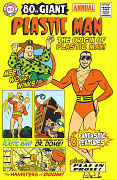
Plastic Man - 80 Page Giant 2003 (HC TPB) 80 pages
 Written by Jack Cole, Arnold Drake, Steve Skeates, Dave Wood. Art by Jack Cole, Gil Kane, Ramona Fradon, Jim Mooney.
Colours/letters: various
Reprinting: stories from Police Comics (Quality Comics) #1, 13, Plastic Man (Quality Comics) #3, House of Mystery (DC) #160 and the full issues of Plastic Man (DC) #1, 11 (1941-1976)
Rating: * * * (out of 5)
Number of readings: 1
Published by DC Comics
Reviewed Mar. 2012
This Plastic Man "Annual" was part of a series of one-shots DC published as a nostalgic homage to the days when they used to put out 80 page reprint compilations -- hence why even the "DC" logo on the cover is the design used in the 1960s, and there's a "Comics Code" label. Plastic Man, of course, had never had an actual annual before -- indeed, DC only acquired the rights to the character midway through the 1960s!
And whether these "lost annuals" strictly count as "TPB"s is debateable...but you're as likely to find them (if you can find them) on the TPB shelf as in the back issues bin.
This reprints five comic book stories -- two from his seminal 1940s days, two from the 1960s, one from the 1970s -- and one a short text story (some comics used to include a short text story so they could label themselves a "magazine" as opposed to a "comic book" and so take advantage of cheaper postal rates).
Plastic Man was, of course, a kind of unusual property in comics...more a comedy series than straight super hero adventure -- the humour veering from just general whimsy within the super hero framework to actual parodying and spoofing comics and other media. There must be something about a stretchable hero that just lends itself to humour, as the similarly powered Elongated Man -- though not out-and-out comedy -- was definitely light-hearted. In recent years, DC I think has altered Plas' character to make him more the comic relief within team comics like JLA -- basically a goofball character. But as these tales show, that wasn't his true personality. He had his wacky side, and had goofy adventures, but Plas himself was a smart, level-headed hero -- a top agent for, initially, the F.B.I. then the more fictionalized N.B.I.
This collection could be labelled "Plastic man...Firsts" because most of the tales fall under such a category. Included are Plastic Man's very first appearance (6 pgs), followed by the story that first introduced his long time sidekick, Woozy Winks (9 pgs). Then we have a story of Dial-H-for-Hero, a series appearing in the pages of House of Mystery (in an era when it wasn't focused so much on horror and ghost stories) about a teen hero, Robby Reed, who would transform into various super beings to fight crime. Normally the personas were original to the comic, but at this point DC had just recently obtained the rights to Plastic Man and decided to test the waters by having Robby transform into Plastic Man (among other characters) -- so though it's not the true Plastic Man, it does mark the "first" new appearance of the character in the Silver Age. This then led to the real character getting his own comic, the first issue reprinted here in its entirety written by Arnold Drake -- no stranger to quirky super heroes from his work on the Doom Patrol -- and artist Gil Kane, here letting his hair down a bit for the comedic series. It's still recognizably Kane, but showing a side to his style not normally seen (though as this was the only issue he drew, whether he enjoyed the change, I don't know). The 1960s series only ran 10 issues, then was revived in the 1970s (now with Steve Skeates and Ramona Fradon as writer and artist) but resuming the same numbering, hence why it's also a "first" issue...even though it's #11!
Personally, my strongest memories of Plastic Man are from just a few years later (as a back up feature in Adventure Comics and others) drawn by Joe Staton, an artist ideally suited to the mix of comedy and super hero action like few others. It's too bad nothing was included from that period.
As it is, this is a decent sample of the character -- even as, perhaps, nothing stands out much. Much has been written of the brilliance and imagination of the original Jack Cole stories, but I'll admit, his stuff (including one or two tales I've read elsewhere) hasn't struck me as being intrinsically better, or funnier, than some other eras. The Dial-H-for-Hero story is more straight faced (though hardly sombre) before the character veered back into comedy, with arguably Arnold Drake's issue being the most consistently funny...or at least, amusing (benefitting from Kane's art). Even the short text story isn't bad -- compared to some other short prose-in-comics stories I've read.
All are generally agreeable page turners, and the collection does do a good job both of highlighting different eras, and representing seminal stories (though I repeat -- I'd liked to have seen something from Staton). So if you're looking for a Plastic Man sampler...this is a decent effort.
Original cover price: $6.95 USA.
Psi-Force
is reviewed here
Back to