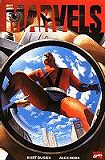
 Marvels
1999 (TPB) 216 pgs.
Marvels
1999 (TPB) 216 pgs.
Miscellaneous (Superheroes) - "M" Page 2
Back to the main listings (including character sections)
Written by Kurt Busiek. Illustrated and painted by Alex
Ross.
Letters: Richard Starkings. Editor: Marc McLaurin.
Reprinting: Marvels #0-4 (1994 deluxe edition mini-series)
Additional notes: intros by various comics pros such as Stan Lee, John Romita Sr, etc.
Rating: * * * (out of 5)
Number of readings: 2
Published by Marvel Comics
Marvels revisits Marvel Universe history through the eyes
of photojournalist Phil Sheldon. The first chapter is set during the '40s,
as these so-called Marvels start appearing, and young Phil struggles with
his own ambivalence about a world suddenly filled with Gods, particularly
the (to him) unfathomable battles between the Human Torch and the sometimes
hero/sometimes villain Sub-Mariner that devastate the city. Then we jump
to the '60s/early'70s where the next three chapters are set, as Phil chronicles
and reflects on a world peopled by super-beings and the public's fluctuating
attitude toward them.
Marvels is an interesting concept, revisiting classic
Marvel stories but from the point of view of a man on the sidelines --
not even that close often. The problem is, of course, that it can make
for unsatisfying storytelling. The point is to see glimpses of battles,
hear snippets of news reports, while to Phil the full story remains unknown.
That makes it problematic for casual readers -- even incoherent in spots.
In one scene a character makes a disparaging remark about mutants, while
the mutant superheroes, the X-Men, glare at her in the background...but
the X-Men are out of costume, and not identified as such. I have no idea
how many in-jokes and nuances I may have missed...such as a final
scene involving a paperboy, the true significance of which I could only
confirm after the fact (he would grow up to be a super hero).
The heroes and their adventures take place mainly off-camera
-- really. If you go into this half-thinkiing the heroes will be, at least,
supporting characters (as I did), you'll be disappointed. The star of the
show is Phil -- more on that in a moment.
This was Alex Ross' first major work, he of the fully-painted,
almost photo-realist style (utilizing models) that took the industry
by storm. At times, it's like coming across stills from an unknown, big-budget
motion picture -- suddenly comic book drawings become real 3-D people.
He's also known for his visual gags, such as non-Marvel characters appearing
in the backgrounds (like Billy Batson and Jimmy Olsen) to pop-cultural
figures like the Dick Van Dyke and the Monkees appearing in crowd scenes.
I had first seen his work on Kingdom
Come, his later (in some ways thematically similar) mini-series for
DC, but whereas his depiction of Superman and Wonder Woman made me long
for him to tackle them again and again, on Marvels I felt more ambivalence.
Marvels is stunning to look at, but sometimes I found myself flashing back
to the work of Jack Kirby, Steve Ditko and John Romita, Sr. with Ross actually
coming out the loser in the comparison. I love Ross' work, but there are
other, equally valid -- and sometimes more kinetic -- styles.
All this relates to the problem that Alex Ross can be
a bit of an obfuscation when considering the story. His style is so incredible,
it's easy to be swept along without asking whether the story it's illustrating
works on any deeper level.
You see, in all the praise I've seen of Marvels, people
cite Ross' art, they praise Kurt Busiek's writing, they comment on this
reinterpretation of Marvel history, but people rarely comment on...Phil
Sheldon. Y'know, the main character for some 180 pages?
Phil's not a bad character, but in many ways, he's the
only
character, and too often he seems like the story needs are pushing him,
not the other way around -- one moment he's a committed family man, the
next he's a workaholic neglecting his family. In one scene, caught up in
anti-mutant hysteria, he throws a brick at the Iceman...did anyone really
buy into his actions in that scene? By the end of the series we don't really
know Phil, outside of his ruminations on the Marvels.
Marvels is made up of four, semi-independent chapters.
By far the strongest is Chapter Two, "Monsters Among Us", where the public's
feel-good hysteria generated by the wedding of Mr. Fantastic and the Invisible
Girl is contrasted with the anti-mutant bigotry directed at the X-Men.
The themes and contrasts work pretty well, and there's a real-world allegory
at work, not just in the mutants-as-persecuted-minority, but as a metaphor
for the late '50s/early '60s and the Pollyanna romanticism of "Leave it
to Beaver" and JFK's Camelot (with Mr. Fantastic and the Invisible Girl
substituting for Jack and Jackie) contrasted with the gritty reality of
race riots and the Vietnam War. And Phil actually has his own story, removed
from the superheroes (while thematically connected) involving a little
mutant girl. At times, "Monsters Among Us" works surprisingly, and disturbingly,
well.
The other chapters often seem too much like collections
of ill-defined vignettes, not quite coming together as a story. Chapter
three is the opposite, though, as we get a retelling of the first appearance
of Galactus. Here Busiek and Ross lose their own raison d'etre, giving
us close-up splash pages of the F.F.'s battles with Galactus when Phil's
not even around. And the emotional arc, of Phil realizing he needs to spend
more time with his family, is just too simple and obviously handled for
a 45 page story.
The final chapter builds to the death of Spider-Man's
girl friend, Gwen Stacy, using it to highlight how the individual can be
devalued and forgotten among the colourful heroics -- but it doesn't quite
gel. For whatever reason, Gwen's death has remained a surprisingly potent
touchstone in comicdom all these decades later (heck, Marvel has released
a Death of Gwen Stacy TPB collection). That's why Busiek and Ross knew
they could use it as an effective climax instead of something more flashy
and "cosmic" like the Galactus story...'cause Gwen's death, instead of
being devalued and forgotten, still resonates for a lot of people. Including
Stan Lee. In one of the editorials it's said that even today Lee has misgivings
about the death of Gwen. The idea that Lee, the business man, the mover-and-shaker,
still feels affinity for his long ago creations is oddly touching.
The ultimate problem when reading, and interpreting, something
like Marvels (or Kingdom Come, or the Watchmen)
is you're not sure, really, what it's about. Is it just a fun romp down
memory lane, or a serious look at super-heroes? How much are the super-heroes
a metaphor for other things? With its denouement, it can be seen as, ultimately,
a rejection of comic book super heroes, with Phil "growing up" in the end. In the final issue, Phil's oscillating attitudes toward the Marvels has finally coalesced into a kind of reverence that borders on religious idolatry (or can be seen as a metaphor for the fan-boy -- in one scene a co-worker chides Phil that he thinks about these things "waaay too much" which is an admonishment I'm sure Busiek and Ross have gotten from non-comic book reading friends over the years). Indeed, Marvels was part of what seemed to be a new trend of comics with a weirdly religious/reverential subtext. A recurring theme throughout the series is how the heroes keep saving the world one day...and yet the public will turn on them the next day if they (erroneously) think they've done something bad. Yet is the opposite really better? To say certain people are above reproach? Isn't that what gives rise to police corruption, or clerical scandals (at the risk of thinking about these things way too much!)
Yet by the end, Phil himself has become disillusioned with his heroes.
Conversely, an earlier scene with J. Jonah Jameson explaining people hate
super heroes because altruism in others makes us feel small, can be seen
as a rejection of precisely those people who feel we should "out grow"
a genre -- perhaps the only genre -- about basically decent people
trying to do the right thing for no other reason than because it's right.
In other words, is Marvels popular because it's sharp
and penetrating, or because it's vague and mushy, playing all sides at
once? And it was popular, there's no doubt about it. Not only in and of
itself, but in the subsequent imitations, like the follow up fully-painted Tales of the
Marvels and Code of Honor.
There's a certain appropriateness to Marvels revolving around a guy who makes a living photographing super heroes, because in many ways that's at the heart of this book's appeal. At times the thin plots and the introspective captions of Phil ruminating on the Marvels can take on the air of simply being the token text of a coffee table book whose real purpose is simply a chance to marvel at the lovely pictures.
Marvels is probably more effective nostalgically for older
readers who remember the stories, but no longer have them in their collection.
At times it's very good (it's hard to read the end of "Monsters Among Us"
and not feel something well-up in your eyes), but it's a long way from
being as clever, as gripping, or as innovative, as we're supposed to believe
it is. It falls into that category of TPBs that I'm happy enough to have in my collection...even as it's not like it really demands many re-readings. Marvels is also awfully pricey for something which, in the end,
falls short of being...a marvel.
Also included in this collection are various editorials,
behind-the-scenes info and, most significantly, a bibliography detailing
where the originally stories were published.
Original softcover price: $29.95 CDN./$19.95 USA. (published by
Marvel Comics)
 The Marvels Project
2010 (SC & HC TPB) 200 pgs.
The Marvels Project
2010 (SC & HC TPB) 200 pgs.
Written by Ed Brubaker. Illustrated by Steve Epting.
Colours: Dave Stewart. Letters: Chris Eliopoulos. Editor: Tom Brevoort.
Reprinting: the eight issue mini-series (2009-2010)
Rating: * * (out of 5)
Number of readings: 1
Reviewed: Oct. 2014
Published by Marvel Comics
Comics is a medium constantly looking forward -- changing and revamping properties as hot new creators try to make their mark. Yet, paradoxically, it's rooted in nostalgia, the entirety of a comics' publishing history forming one unified universe of continuity. DC Comics has frequently drawn upon its history of heroes dating back to the 1940s. But for Marvel, of its main, "signature" heroes, only Captain America dates back that far.
Yet there has obviously been an editorial shift in recent years at Marvel, as someone looked over at DC and presumably felt a pang of jealousy. So Marvel has released a few projects drawing upon their Golden Age roots, dusting off old characters for The Twelve, and Timely: 75th Anniversary Collection. But after all these years can Marvel really expect to instill in the reader a warm tingle of nostalgia for characters unseen in decades...or even heard of?
Which brings us to The Marvels Project. It's an eight issue mini-series set in the early 1940s that attempts to retell the early days of the Marvel Comics universe as though all a single narrative, intertwining the previously separate origins and early exploits of the Sub-Mariner, The Human Torch, Captain America, Nick Fury, and other, less familiar characters like the (original) Angel, The Ferret, and others. And if all that sounds familiar, it's probably because it puts one in mind of DC's critically acclaimed DC: The New Frontier -- the epic mini-series which intertwined the origins of DC's heroes into an (apocryphal) epic narrative.
It sounds like a great idea. It sounds like writer Ed Brubaker, or some editor, read DC: The New Frontier, and thought, "Hmmm, we should do that -- how hard could it be?" And then went on to prove it's harder than it looks.
'Cause The Marvels Project is bland, dull, and uninteresting.
Partly that can be attributed to a "been there, done that" feel. The Marvels Projects just feeling like the latest entry in an increasingly overcrowded sub-genre of super hero fiction. Heck, the series even puts you in mind of the 1970s comic, The Invaders!
Other projects Brubaker evokes as he goes includes Marvels (reviewed above -- also an attempt to present a kind of Cole's Notes of Marvel history through the eyes of an omnipresent narrator), and DC's Kingdom Come (which also begins with the narrator at the bed of a dying old man spouting prophetic visions). Both those series were illustrated by painter Alex Ross, and though The Marvels Project isn't painted, the art evokes that look, with Steve Epting's realist art and Dave Stewart's rich, multi-hued colours. So though it's just pencil and inks with colour laid over it, it certainly evokes Ross' painted stylings. Epting is a fine artist, and the visuals are moody and striking. An added appeal is there's a little bit to his style that puts me in mind of old Marvel stalwart, John Buscema. Appropriate given that Buscema's surely a defining artist in the evolution of Marvel Comics.
The art is the best thing about The Marvels Project.
I had picked up the first three issues -- then stopped. That's how little it was holding my interest. But recently (about four years later!) I borrowed a copy of the complete series just to see if I had bailed prematurely.
Part of the problem may be expectation. Or, at least, trying to figure out what Brubaker and company even intended.
This isn't some epic, Byzantine saga where we follow all the seeming different, unconnected characters and then watch as their story threads slowly tie together. Rather, for a lot of it, we just cut between the different characters. Oh, to be fair, many of the threads do eventually converge -- but it's still not like the story itself feels especially epic or complex. Many of the scenes are just a rehash of familiar Marvel lore: battles between the Human Torch and the Sub-Mariner, various origins are recapped -- even a climactic battle with some Atlanteans allied with Nazis I'm pretty sure is lifted from a past story (or else is so generic it just seems familiar).
Yet neither does Brubaker's interest seem to be in embellishing upon, or finding revisionist twists for, the old stories as you might expect -- giving flesh and blood dimension to comic book icons (ala, for instance, The Avengers: Earth's Mightiest Heroes). The characters here have next-to-no personality, the scenes are pretty simple and straightforward, likewise motives. Previous -- controversial -- revisions are largely ignored (like wasn't there a mini-series in which it was revealed the Captain America formula had been experimented with before Steve Rogers?). There are a few minor alterations (assuming they are original to Brubaker) like suggesting sidekicks Bucky Barnes and Toro's origins weren't quite what we knew -- though neither to much effect. There's also a scene where the Howling Commandos shout "Okay, Axis -- Here We Come!" which I thought was The Invaders' battle cry.
Brubaker tries to toss in various characters, from the to-be-expected famous heroes, to more obscure ones -- yet most of the latter remain pretty obscure even by the end, there only to appear in a panel or two (or maybe to support their use in The Twelve or something). And often with a sense you kind of need to know who they were to begin with. A prominent character running around Germany -- John Steele -- is introduced cryptically, and disappears just as enigmatically.
In a sense, The Marvels Project comes across less like an epic story, and more like one of those illustrated reference comics that come out from time to time (Who's Who in the DC Universe or The Marvel Universe Index). Origins are recapped, pivotal adventures summarized, glossy illustrations presented of the characters in action, while the voice-over (courtesy of an obscure 1940s hero called The Angel) simply describes events, or explains motivation (rather than Brubaker conveying it through scenes and dialogue).
One could be kind and assume Brubaker had an idea for a glorious epic -- but found it couldn't be told in the limited pages he was given, and so was forced to present almost an illustrated summary. Or maybe Brubaker had no burning interest in the idea, but agreed to do it because the pay was good. But, again, that depends on the intent. After all, much of these criticisms I could level at Marvels -- and critics loved that.
One twist on the established canon (so far as I know) is Brubaker tosses Nick Fury into the mix (along with a character called Red Hargrove) prior to the U.S. involvement in World War II. To me, it's kind of an awkward retcon. I mean, surely the point of Fury is that he was just an average G.I., forged into the man he became on the field of battle. To suggest that he was some sort of "special operative" or secret agent beforehand robs the character of his every man chic.
Besides -- what is a "special operative" anyway? And why would the British army need a couple of American civilians to train their soldiers?
That's kind of a recurring problem with American stories set during the early days of World War II. The fight against fascism is seen as a defining conflict of the 20th Century (and maybe human history)...and the U.S. sat out the first few years of it. So in recent years American storytellers spend a lot of time trying to convince themselves, and the rest of us, that, nuh-uh, America was the champion of the free world all along. So here we have American civilians training British soldiers ('cause, presumably, those silly Brits can't fight without 'em) and the American army sending special teams into Germany and even air bombing German factories long before the U.S. was actually at war with Germany!
It's understandable that an American writer, writing (mainly) for an American market would want to insert American heroes into the action -- and one need not look for any sinister conspiracy or political agenda. But I've seen so much of that lately (in comics, movies and more) -- and in a way that you didn't see twenty or thirty years ago (when American writers were happy to recognize the "Allied" effort -- Roy Thomas even creating British characters to join the American heroes of The Invaders) -- that it can be construed as some sort of disturbing propaganda effort to re-write history.
Or maybe with all the bad press "private security" forces (ie: mercenaries) have been getting in Iraq and Afghanistan, Brubaker wanted to glamorize the concept by saying, "Hey kids, Nick Fury was a mercenary!"
All that may seem -- and is -- overly snarky for what, after all, is just a comic book review. But what's the point of doing this saga, if it's not to try and put a thoughtful, sophisticated, believable spin on old, four colour antics?
The truth is, The Marvels Project seems like it wanted to be Marvel's equivalent of DC: The New Frontier...but nobody wanted to spend more than a week-end plotting it out.
This is a review based on the original comics mini-series.
Masks 2013 (SC TPB) 200 pgs.
 Written by Chris Robertson. Illustrated and coloured by Dennis Calero, with Alex Ross (also art direction).
Letters: Simon Bowland.
Reprinting: Masks (1st mini-series) #1-8 (2012-2013)
Rating: * * (out of 5)
Number of readings: 1
Reviewed: Dec. 2015
Published by Dynamite
Masks seems another in the line of Dynamite Entertainment's attempt to create a super hero universe. Okay, it might seem odd to say "attempt" since at first blush it's going fine for them. But I'd argue the long term prognosis is still uncertain.
In 2009, Dynamite unleashed the mini-series Project Superpowers in which they (and co-creator Alex Ross) dusted off a bunch of old public domain comic book heroes and claimed them as their own. This allows for a "new" universe that nonetheless has some resonance with readers -- and stems from a long tradition among comics companies of raiding back issue bins for defunct properties, with past publishers like Eclipse and Moonstone doing the same (even utilizing some of the same characters). Project Superpowers led to two mini-series and some spin-off solo mini-series...and then seemed to sputter.
Undaunted, Dynamite has broadened its scope, resurrecting old pulp and radio heroes, and now with Masks it once more unleashes a massive team up series which can showcase a few famous ones, re-introduce old ones, and maybe create some new characters.
The premise is that the state of New York has fallen under the sway of a fascist political party, the Justice Party, that has put stormtroopers on the streets and set up internment camps. This brings together an assortment of heroes: The Shadow, The Green Hornet (and Kato), The Spider, The Green Lama, Miss Fury, The Black Terror, The Black Bat, and an up-dated descendant of Zorro. Some of these characters Dynamite had already tried in Superpowers (such as the Green Lama and The Black Terror) others they had already been dusting off, while others I infer are being reintroduced to the public here, all ready for their own series and mini-series. Funnily enough, the time period of the story is a bit vague. One assumes it's set in the mid-20th Century (when most of these character first arose) but the main period allusion is that writer Robertson has characters use the term "mook" a lot -- which, though it certainly sounds like an old term, I'm not sure if linguists agree that it actually does date back that far!
I hadn't been impressed in the Project Superpowers iteration of Dynamite's line -- not just finding it unenthralling, but literally accusing it of being childish in its plotting, like the way a child might write a super hero story.
Funnily enough -- Masks is more of the same! Yet this time I'm not sure I can blame Alex Ross who, though he's certainly involved, doesn't get an actual story credit this time around.
So what do I mean by such a pejorative assessment as saying it's childish?
What I mean is that things like plotting and characterization seem largely secondary to just having a bunch of costumed characters run about, punching things.
And it spends the whole series kind of acting as if it wants to seriously explore powerful and disturbing themes about the rise of fascism and the blurred line between the law/justice/and vigilantism. Yet does it in such a comic book-y way that it never feels like it has any wisdom to impart. The characters set out to find out what and who's behind the Justice Party -- as if somehow such movements can be defeated by simply uncovering a single villain in the shadows (I mean, it is a political party, apparently elected by the voters).
There's next to no build up to the story, as we are immediately plunged into this environment of a New York police state. The various heroes join up in various groupings, either by chance or because they happen to already have deduced who each other are. Yet the problem with drawing upon these old characters is they are a fairly bland lot, personality wise, and many are largely indistinguishable from each other in terms of powers and abilities (not surprising since some were deliberate rip offs of each other) and there's no time set aside for any civilian aspect of their identities. Like with Project Superpowers it can feel like Dynamite just wanted to hoard these old characters before another publisher got a similar idea. But when the characters sit around, discussing the matter -- particularly in plain clothes -- it was hard to even figure out who was who.
Some changes are made to the characters, minor and major. The Green Hornet carries some sort of electric gun/taser (when his weapon originally was a gas gun). While The Spider was originally a darker, more violent rip-off of The Shadow (I've long suspected the various comic book incarnations of The Shadow had borrowed some of The Spider's ruthlessness). He wore a cloak and floppy hat like The Shadow but added a grotesque disguise by affecting a humpback and wearing vampire teeth (to freak out villains) -- yet here he just wears a face covering mask with a web motif! And it's left to The Shadow to be positioned as the most ruthless one of the bunch. Funnily, The Shadow is one of the few characters who at least has a slightly distinguishing presence from the others -- but in the context of a bunch of characters standing around a kitchen, having him constantly speak in pithy epigrams ("The weed of crime") actually can make him seem a bit corny, like he's trying too hard.
But as I say: it puts me in mind of how a child would write the story. Team up a bunch of heroes for no other purpose than to team them up, with no real attention paid to personalities. Set them against a grand, epic adventure that, nonetheless, has little logic or much in the way of plot twists or turns (perhaps why the covers are fairly interchangeable from issue to issue) as the characters seek to discover clues that are unclear, and set out on missions that seem vague (in one scene a couple of heroes try to break up a prison camp, announcing to the prisoners they should escape while the heroes hold off the bad guys -- even as the heroes then flee a panel or two later, hardly providing much distraction!) Though the story does resolve, the main purpose of the story seems to be simply to introduce readers to this new wave of Dynamite properties.
Although even then it doesn't always do a good job of introducing the characters (in some cases not even naming them for a few issues) maybe because, since these are pre-existing characters the thinking was the readers would already know who they were! This becomes particularly odd with the revelation of the villain where it takes a couple of issues to name him -- even as he too is an old character and the reader might reasonably be expected to guess who he is (or, conversely, have no idea who he is even when finally identified!)
Alex Ross fully paints the first issue -- his first interior art in a few years. And, yeah, as always it's pretty nice and at least gives the project a certain lavishness. Then Calero takes over for the rest of the series. This is more conventional pencil/ink/colour work, but Calero at least has an artful, lush style that doesn't clash with Ross' photo-realist paints. But equally, Calero's storytelling can be a bit muddled, where it wasn't always clear what was going on or what you were looking at or, as mentioned, who was who. The original comics featured some begin-the-scenes looks at the original script directions, and in a few spots I found myself going "Oh, so that's what was supposed to be going on in that panel!" The visuals are nice as art -- more uneven as storytelling.
As mentioned, there's a feeling Masks sort of wants to seem like it's about something (fascism, freedom, law v justice) without really making clear or convincing points. It's a political thriller/adventure that doesn't want to seem too political. This doesn't really ask hard questions about fascism or how it can arise, even as toward the end it turns into a long dialogue about the villain's motives. But that part just becomes rather tedious because it's stretched over a couple of issues (inbetween the fighting) without the talking points really evolving. And of course it's hard to engage in those debates when many of the heroes themselves are gun totting vigilantes with borderline fascist tendencies. An irony the writer addresses...then skims over. There are a few brief discussions among the heroes, without it really seem to define the story or their personalities. Maybe partly because Robertson doesn't really allow any particular heroes to dominate. I mean, maybe he could have set it up as The Green Hornet (with his sleeping gas gun and being a social crusader) and The Shadow (as the gun totting vigilante) as the opposing ideological pillars of the team ala Superman and Batman.
When we get to the climax it involves the people rising up to overthrow the Justice Party and the heroes assuring us that free people can only be pushed so far. Viewed in the context of the series' (vague) philosophical discussions, is that simply meant to be a rousing, heart warming climax, and paen to the human spirit (and a convenient way of figuring out how a handful of heroes can defeat an army) -- or is it, conversely, it's own kind of fascism, or at least far right/libertarian proselytizing? After all, doesn't that play into right wing rhetoric that often seems to blame oppressed people for their own oppression, and insisting that an armed population is all American needs to keep itself free? Besides -- since the Justice Party is a political party, doesn't that mean someone elected it? Don't the people bear some culpability for its rise to power?
These might be interesting ideas to explore in such a story -- but, as I say, Masks seems more interested in pretending it's tackling big issues than actually doing so.
What's frustrating is that the idea of using a super hero story to explore Dystopian realities and fascist states can be intriguing and has been done more than a few times over the years (X-Men: Days of Future Past and Alpha Flight: The Complete Series being just two that come to mind). Unfortunately it helps to give more care, not just to the themes, but the humanity of the heroes, and the plot twists.
This is a review of the story as it was published in the comics.
Cover price: $__
Millennium 2008 (SC TPB) 192 pgs.
 Written by Steve Englehart. Pencils Joe Staton. Finishes Ian Gibson.
Colours: Carl Gafford. Letters: Bob Lappan. Editor: Andy Helfer.
Reprinting: Millennium #1-8 (1987)
Rating: * * * 1/2 (out of 5)
Number of readings: 2
Published by DC Comics
"Crossover" epics (where a story line involves most of a comics company's heroes and interconnects various separate titles) were probably begat by Marvel's Secret Wars, then kicked into high gear with DC Comic's Crisis on Infinite Earths -- a maxi-series which redefined the DC Universe and established the precedent that such massive team ups should at least pretend to have significant impact on the company as a whole. Although Crisis had threads that crossed over into the regular titles, it was easily readable on its own. But many subsequent crossover mini-series were meant to be intricately tied into the surrounding comics...in order to get readers to buy issues of series they didn't normally buy (ka-ching! ka-ching!). As such, many crossover mini-series don't entirely read well on their own. Which is problematic for collectors years later. Even when a TPB like this is released, collecting the original mini-series...it doesn't include all the ancillary issues (which numbered 30 or 40).
Which brings us to Millennium -- DC's third crossover epic (after Crisis and Legends). And like Legends and the subsequent Invasion, it's problematic to read on its own.
The story has the Guardians of the Universe (of Green Lantern comics) deciding to usher in the next step of humanity's evolution by selecting a handful of humans who will be jump started to the next level. A sinister group of robots -- the Manhunters -- want to stop them, and worse, have been operating secretly for years, agents even having ingratiated themselves secretly with many heroes. So it's up to the combined might of DC's various heroes (Batman, Superman, Green Lantern, the Justice League, the Outsiders, etc., etc.) to battle the Manhunters and to help protect the Guardians' chosen ones.
Based on some reviews I've read, Millennium is one of DC's least well-regarded crossover epics. Which is funny, because in some respects, I liked it better than many I've read.
The nature of the premise -- ranging from the pseudo-philosophical stuff detailing the Chosen, to the paranoia and soul searching as our heroes discover some of their trusted friends are working for the Manhunters (or have been replaced by look alike robots), plus the big slam bang battles ranging from undersea bases to alien worlds -- means that Millennium actually seems to have more scope and variety in its plotting than many of the other epics. And writer Steve Englehart actually takes time to let the story breathe, allowing the characters to sit around and talk. Many crossovers result in generic scenes of a multitude of heroes uttering a nondecript line or two. Here, although there are plenty of heroes just filling out the backgrounds, there's a bit better sense of the characters being characters.
Of course, as I said, the point of a crossover like this is to, well, crossover into other titles. Englehart will spend the better part of an issue having the characters talk about what they have to do next, gearing up for some strike on some Manhunter base...only to have the actual confrontation take place in a concurrent issue of Batman or The Justice League International or something, and have it be all over by the time the next issue of this mini-series hit the stands (though a climactic battle does take place in issue #7). Read as a TPB collection, there are rather conspicuous gaps in the story (though characters occasionally provide brief recaps of what we've missed). Yet, for all that, I still enjoyed it more than Legend, or Invasion.
It's drawn by Joe Staton, an artist I generally like quite a bit. His style can vary, sometimes being a little too rough and cartoony, but here he's in top form (perhaps aided by Ian Gibson's more realist finishes), with expressive figures and a great sense for telling a story through panels. George Perez (who drew Crisis) and John Byrne (who did Legends) may be more detailed artists...but Staton might be the better storyteller. Of course, Staton drew a long ago issue of Showcase (#100) which was very much a precursor for these kind of mass team-ups, so I may have nostalgic affection for seeing Staton tackle it again.
Perhaps some of the flak the series received is due to the fact that Englehart seems to have time-slipped and thinks he's back in the early 1970s, working for Marvel, when people like him, Steve Gerber, Jim Starlin, and others really went to town turning super hero comics into metaphysical odysseys. There's a definite head trippy ambition to Millennium that's wholly absent from most other DC crossovers, a feeling Englehart is maybe taking his philosophical stuff seriously (like devoting the better part of one issue to detailing a philosophical eight-step program that could have been borrowed from an Eastern guru). It's at once silly...and oddly audacious. The "Chosen" selected by the Guardians are a multi-racial, multi-national group, and maybe that turned off some more conservative readers too, with one character a homosexual, and, by the end, nary a white male in the bunch. Again, it all seems oddly gutsy and ambitious, in a way not even the Crisis on Infinite Earths did. (Admittedly, some argued the Chosen themselves were offensive as, in trying to be pluralistic and multi-cultural, Englehart was maybe leaning on ethnic stereotypes).
Of course, a number of these crossovers were used to kick start new series -- usually ones that fail -- and this was no exception, as the Chosen become their own super group and were sprung into their own title, The New Guardians -- a title which only lasted a year. Eventually, many of the characters were killed off in a later issue of Green Lantern.
I can't say Millennium fully works. Too many plot threads spin-off into other comics, making the story choppy and unsatisfying, and even some of these issues feel padded a bit, as though they're just place holders between the crossover issues. And I'm not entirely sure what the Manhunters' goal was (other than just to be ornery) nor how this related to overall continuity. Some trusted characters were revealed to be agents of the Manhunters...but those friends are still around today (and the story reflects the continuity of its time, not just in the broad strokes, but in minor on-going plot ideas like the fact that Guy Gardner had undergone a temporary personality adjustment).
But I kind of enjoyed it, even with -- or maybe because of -- its incomplete glimpses of a larger story and other titles (since some of the missing gaps are really just big fight scenes anyway). I even find myself casually, idyly, searching through back issue bins, picking up the odd (cheap) copy of some of the crossover titles.
And that's more than I've done for most crossover mega events.
This is a review of the story as it was published in the weekly comics.
Cover price: $__ CDN./ $19.99 USA
Or
Back to