Written by Gerry Conway. Pencils by Al Milgrom, George Perez. Inks by Bob McLeod, Bob Smith, Rodin Rodriguez, others.
by The Masked Bookwyrm
Miscellaneous (Superheroes)"F" (ii) - "G"
Back to the main listings (including character
sections)
The Flash
Most of My Flash reviews are on the previous page just to keep 'em together -- even though Firestorm should come first.
Flash and Green Lantern:
The Brave & the Bold
See my review in the Green
Lantern section.
Firestorm, The Nuclear Man
2011 (SC TPB) 176 pages
Written by Gerry Conway. Pencils by Al Milgrom, George Perez. Inks by Bob McLeod, Bob Smith, Rodin Rodriguez, others.
Colours/letters: various.
Reprinting: Firestorm, The Nuclear Man (1st series) #1-5, plus the Firestorm stories from The Flash (1st series) #289-293 and Canceled Comic Cavalcade #1 (1978-1981)
Rating: * * 1/2 (out of 5)
Number of readings: 1
Reviewed Apr. 2015
Published by DC Comics
For a character with a number of iterations of a self-titled series to his name, Firestorm, The Nuclear Man's beginning might seem inauspicious.
Launched in his own series (as opposed to having been a supporting character or guest star first), he was an unusual gestalt super hero that forms when teenager Ronnie Raymond and physicist Martin Stein merge their consciousness into a flame-haired hero who can re-arrange molecules to literally create something out of anything. His first issue hit the stands in 1978 -- and the series was abruptly cancelled after five issues.
But it came at a bad time, getting caught up in what became known as the infamous "DC Implosion." After a period where DC Comics had been aggressively expanding its line with new series and new concepts, DC needed to re-structure and so cancelled a whole swath of titles simultaneously. The inference being at least some of those titles might well have been given time to find a readership in financially more secure times.
That might have been it for Firestorm, save co-creator Gerry Conway dragged him out from time to time -- guest starting him with Superman and even making him a member of The Justice League of America (which Conway was writing). This then led to a back-up feature in the seeming invincible Flash comic. And the success of that led to a new, self-titled Firestorm series and the rest, as it were, is history (a convoluted, topsy-turvy history, but history nonetheless).
And this TPB brings us back to those seminal issues of his very first series, plus the first few Flash back-up stories (though the Flash run continued for a number of issues past the few instalments included here).
Firestorm was created by Gerry Conway (with artist Al Milgrom). Conway has written long runs on almost ever major character or property at both Marvel and DC (including being the first major Spider-Man chronicler after Stan Lee) but most such characters pre-existed. While other properties he did create (or at least for which he wrote the initial stories -- such as The Man-Thing, Ms. Marvel, etc.) he didn't stick with for long, leaving it to others to become their defining writers.
So it's reasonable to see Firestorm as Conway's first major stab at his own creation -- certainly in the mainstream super-hero genre (okay, I'm starting to quibble, just because I realized around this time he had also created Steel, a WW II series). It's an impression reinforced by Conway's nurturing of the character even during the lulls.
Seen in that light -- it's an interesting property to analyze. But more on that in a minute.
Unfortunately the initial series strikes me as problematic. And I say that as somehow who, though not perhaps a Firestorm "fan" has, nonetheless, enjoyed the issues I've read of the later revival The Fury of Firestorm (also by Conway).
Now there is a problem for someone like me trying to review some comics since I'm now, thoroughly and irrevocably, an adult, and super hero comics are generally seen as aimed at younger eyes. Yet with that said, even comics creators and their fans often bristle at such pigeon-holing, and I can certainly read other comics from the time -- or earlier! -- that I continue to enjoy, even if only because it touches the kid inside me. And I have a reasonable respect for Conway's talent.
But Firestorm can feel like something Conway needed a few issues to figure out what to do with it. The adventure plots can feel a bit slapdash, not especially clever in terms of plot twists or character motivation. Comics can be intentionally goofy (hence my point about aimed at younger eyes) but some stretch credibility further than others. In one issue Stein's experimental nuclear reactor is ordered closed pending a hearing -- leaving it ripe for villains because the security guards were let go. Yeah -- a reactor full of fissionable material is left unattended because of a court order! It can feel a little too much like Conway is just writing to meet a deadline. In one issue a French-accented character's surname is...French. (My guess is Conway just used "French" as a placeholder, but the script was sent to the letterer before he substituted a proper Franchophone surname).
Meanwhile on going sub-plots are a bit clumsily introduced (hence my point about it feeling like Conway needed to settle in). Some scenes seem to be all sub-plot. Ronnie has a strained relationship with his dad, who has a mysterious secret. But that's all the scenes between them seem to exist to do: reinforce this "sub-plot." While others seem to lack a direction, like Cliff, a recurring -- and reptitious -- school bully (more on him in a moment).
There's a certain cluttered-ness to the storytelling, Conway cramming panels with dense word balloons.
Artist Al Milgrom is an artist that can leave me with mixed feelings. "Cluttered" is a good word for him, too, in that there was often a lack of finesse to his composition, how he broke down a scene, or the angles and composition he used, as if he was more just struggling to get it all on the page. Yet at the same time, that can be an appeal, a sense that he's not worrying about making it pretty, and is just focused on telling the story.
Still toward the end of the first five issues there's more sense Conway is getting his pieces on the board. The sixth issue was unpublished, except in the limited distribution Cancelled Comics Cavalcade -- and it's included here -- and it actually seems as though the series is getting a firmer sense of itself (though I believe it's not considered "canon" -- Conway even recycling the villain later, but with a different story and origin)
The character then picks up again in The Flash back up stories, published a few years later (though it's unclear how much time has passed for the characters -- the situations and character stuff picking up pretty much from where it left of). And these stories actually feel a bit smoother. Maybe the shorter page count allowed Conway to focus more (though the stories are often regular-sized length just broken into two-parts). The verbiage seems less dense. As well, these initial stories are drawn by fan-favourite George Perez, which can't help but give the property a more polished, aesthetically appealing vibe.
Because these were just on-going stories, some sub-plots don't resolve in this collection (the "mystery" surrounding his dad's past) but we do get a bit of an arc in that Stein, who is initially unaware of his shared existence with Ronnie, learns the truth before the close of this TPB.
I'll admit, reading these issues -- particularly the original five comics -- it's almost more fascinating to speculate about the creative process as to review the stories.
As mentioned, this may well have been Conway's first real stab at a self-created super hero, so it's interesting to wonder if this was a long brewing concept he had (he and Milgrom). Or whether this was thrown together ad hoc to take advantage of a publishing window (maybe an editor poked his head in the door one day and said, "Gerry -- any ideas for a new comic?").
The reason I make this point is to wonder if Firestorm was Conway and Milgrom pouring some frustrated creativity into a creation all their own -- or whether they were still, primarily, working to a deadline.
The idea of the triple-identity -- Ronnie and Stein forming Firestorm -- was unusual. Although not without precedent (it was essentially Ronnie, but with Stein acting as an ethereal mentor). And his power likewise isn't common, though could be seen as analogous to Green Lantern's power ring (seeing a flame-haired hero called The Nuclear Man you might assume his powers would be more heat-based -- which is what they seemed to be in the 2015 Flash TV series).
Conway having enjoyed a well regarded run on Spider-Man, one can infer that influence in featuring a teenage hero (though by the time Conway was writing Spidey, he was in university) -- further reinforced by the alliterative name of Ronnie Raymond (like Peter Parker).
And that's where "analyzing" things becomes interesting. Because Ronnie is both like Peter Parker...and unlike him. So Ronnie is also a put upon teen dealing with the frustrations of school and home -- yet whereas Peter Parker was an A-level science nerd, Ronnie isn't. And that's where things become a bit -- odd. Because Ronnie's bullying nemesis -- Cliff Carmichael -- is a diminutive, glasses-wearing nerd.
At which point you might go: uh...what?
Ronnie's a tall, good-looking jock who in the very first issue (after moving to the new school) lands a pretty girlfriend...yet he is being "picked on" by the nerd (a nerd who, himself, doesn't seem especially popular with his peers)? I'm not really sure if Conway was just trying to come up with some different variation on the Peter Parker thing or whether he's making a point, but there's something weird about asking us to feel sorry for the guy who, in real life would, probably be the more popular. And to ask us to despise the character who probably would be bullied in real life (in a sense, bullying the short nerd achetype by making him the villain!) --- and is more likely representative of the actual readership!
Part of it may be because Conway wasn't sure how smart/dumb Ronnie was supposed to be. Ronnie complains about having trouble in school, and you could well imagine in the early story stages thinking it would be a neat idea to have a "dumb" person fuse minds with a brilliant physicist -- but Ronnie never really seems that dumb (he gets B grades). Likewise, maybe it relates to my earlier point about not developing the sub-plots -- we see Ronnie complaining, Peter Parker-like, about his life more than we see anything in his life worth complaining about! (Other than the contrived bullying by Cliff).
Interestingly, over at Marvel they had already tried Nova -- another Spider-Man inspired sad sack teen hero who, like Firestorm, was more a jock than a science nerd. Though Nova had a more convincing circle of friends.
And maybe that's a problem for the series. Ronnie himself never really becomes that likeable the way Peter Parker was. I can't decide if that was the point, Conway trying to create a more realistic teen hero (more prone to selfishness and insensitivity) or whether the reader really is supposed to identify with him.
One could argue the early issues reflect a slightly, well, reactionary conservative bias.
As I say, the "hero" is the handsome jock, while the jerk is the short intellectual. And the origin story involves evil environmentalists sabotaging Professor Stein's nuclear power plant. Now there is one scene where Stein acknowledges nuclear power is dangerous, but the basic optics portray environmentalists as murderous thugs (Conway even writes them more like gangsters than rogue idealists). There's also arguably recurring sexist/misogynist aspects such as the villainess Killer Frost, a woman driven to villainy after --- wait for it -- being jilted by a man! Or a female mob boss who is portrayed as archly masculine.
(A few years after these issues, in the 7th issue of the later revival, The Fury of Firestorm, Conway introduces Plastique -- a female French-Canadian eco-terrorist. And once more it depicts eco-terrorists as just nutso killers, and Plastique is defeated in what seems a kind of sexist, patronizing way when Firestorm makes her costume disappear, embarrassing her. But, again, whether this was a deliberate intent, or simply cobbling a story together to meet a deadline, I don't know -- maybe Conway had intended the villains to be political terrorists, but someone else was writing a similar story that month).
Now these are interesting aspects to harp on because -- these days, at least -- Conway seems pretty progressive/liberal (just recently I came upon his twitter account and his comments and the articles he links to certainly seem more left than right -- and often make for thoughtful reading). And even at the time, it seems to me Conway often used pro-environmental themes in other stories. (There is a pretty overt anti-seal hunt sequence in these issues).
Obviously, it's not for me to say one point of view is "right" or "wrong." And so maybe the comic was right-wing, maybe it wasn't -- or maybe he wrote these stories simply to inhabit the world view of his characters, not to reflect his own. Who knows?
However, the whole point of my review site is to take comics seriously -- and that means reading them with the same thoughtfulness I would a novel or movie.
Anyway, despite his initial cancelation, Firestorm enjoyed a long successful presence in comics -- but over the years he has been altered and re-imagined occasionally (at one point I think with a whole new alter ego!) But these early issues certainly established the character, supporting cast, and themes that would fuel the character for a number of years, making them reasonably seminal. But, as I say, they just didn't fully work for me, definitely finding the Flash back-up stories the smoother, more sure-footed. Indeed, I can't help thinking the character would be better served by a collection from the subsequent Fury of Firestorm series.
Cover price: $ __ USA.
Flashpoint
2011 (HC TPB) 176 pages
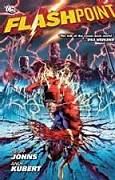 Written by Geoff Johns. Pencils by Andy Kubert. Inks by Sandra Hope, with Jesse Delperdang.
Colours: Alex Sinclair. Letters: Nick J. Napolitano.
Reprinting: the five issue mini-series
Rating: * * 1/2 (out of 5)
Number of readings: 2
Reviewed Nov. 2011 (slightly revised Oct 2016)
Published by DC Comics
It's summer -- so it must be time for a not-to-be-missed, never-to-be-repeated, one-of-a-kind, nothing-will-ever-be-the-same-again crossover epic.
Y'know, like all the other such sagas Marvel and DC churn out faster than Ikea does furniture.
To be fair, Flashpoint promised to have a bigger impact on DC Comics continuity than any mini-series since The Crisis on Infinite Earths (and, of course, the Crisis band-aid series that came along afterwards, attempting to fix problems left by the Crisis). By that I mean this led to a re-boot of DC's Universe...just like Crisis did in 1986 (established titles re-starting from #1).
Such periodic re-boots aren't maybe such a bad idea in a comic book biz which, otherwise, maintains the same continuity for decades, expecting fans to recall plots from before they were born, storylines twisted into bizarre pretzel shapes by writers desperate to find some new variation on a character that has been around for generations, all while the characters themselves barely age more than a few years. Maybe if DC took the official attitude that every 25 years it would re-boot its universe, it might make for more manageable continuity. And this time around (moreso than prior to Crisis) a re-boot was perhaps written on the wall, as DC's key properties seemed to be getting further and further away from their core concepts (Batman heading a corporation of Bat-suited crimefighters, Superman's title being inundated with Kyrptonian super men). One might well have asked: how on earth are they going to bring things back to "normal"?
Answer? Simply re-boot the whole universe.
Not that any of that is particularly relevant to Flashpoint itself -- a story whose strength and weakness is how unconnected to continuity it is. In essence, Flashpoint most resembles those Elseworlds tales DC used to do.
Central to the action is Barry (The Flash) Allen -- only recently returned to continuity himself (after having died in the Crisis). Barry suddenly finds himself in a word where he has no super powers, there never was a Flash, and existing super heroes are a mix of the familiar, the unfamiliar, and something inbetween. Worse, it's a world on the verge of an apocalypse, as the armies of Atlantis (led by Aquaman) and the Amazons (led by Wonder Woman) are at all out war in Europe, the ramifications threatening everyone. Convinced something is wrong with reality, and that his memories of being a super hero are more than just a dream, Barry seeks out the one man he figures can help (after learning there is no Superman in this reality) -- Batman.
As I say, this has very much the feel of many of those old Elseworld stories...as well as various what if/and possible future stories super hero comics have done over the years, where we are presented with an apocalyptic reality/future, see off beat variations on familiar characters, and where the only hope is not so much to solve the present crisis, but to literally wipe the slate clean and get reality back to where it's meant to be.
And that may be at the heart of my ambivalence. It kind of feels like something we've all seen before. Long ago the editorial philosophy in comics was the average reader was transitory, "out growing" comics after a few years, so it was okay to recycle stories. But nowadays readers stick around longer (some their whole lives) and with a multitude of reprint collections and TPBs, old stories are often just a trip to the comic shop away.
But it's not so much that the basic ideas are familiar (all stories are, inherently, familiar)...as much as here there isn't that much being done to embellish upon them, to add that fresh twist or perspective that would make the cliches come alive. In fact, the plot/action in these pages is fairly simple and straightforward. It's a five issue epic...that honestly only feels like two issues worth of stuff happens. But -- and this is worth acknowledging -- it does clip along, so that it's easy enough to breeze through rather than feeling overly stalled or dragging its heels. And despite the essentially dark n' gritty plot, there are some cute quips here and there.
But part of the reason it may feel a bit wanting in the plotting is because, as with similar, past efforts, this core mini-series is actually meant to lead into various ancillary issues and comics. On one hand, writer Goeff Johns largely avoids the (annoying) trap of inserting cliff hangers that only get resolved in some other comic. Most of what you need to know and to follow this story is told here (or, at least, explained here -- as some events relate to previous things introduced in the Flash monthly comic). At the same time, if there does seem a certain lack of development to supporting characters, to motives, to what is at the root of this and that, that's because the story didn't just branch out into a few random issues of other comics...but into whole other mini-series, expanding upon, and fleshing out this temporary universe (presumably, for example, explaining why Aquaman and Wonder Woman are at war, or maybe giving a "twist" about a traitor more resonance).
As I say, the core plot here is pretty simple and straightforward. Barry has memories of how the world should be, seeks out Batman who, after initially assuming Barry is crazy, just as quickly decides to believe him, and they work to restore Barry's powers, then seek out a couple of other heroes, then head to Europe sort of to stop the war (how is not clear) and sort of to re-set reality (equally without a plan). Even just describing the plot you can see some problems -- as the characters set out on their Quixotic missions, with no sense that they (or writer Johns) have bothered to plan beyond the next splash page. Equally, the other heroes' reluctance to become involved is hard to justify given the severity of the global crisis -- it's not clear why they think sitting it out will work out any better; it's another example of Johns writing the scenes and not over-thinking the logic. (For that matter, I'm not sure there's an explanation for where Barry's Flash ring suddenly comes from -- given it's rather crucial to the plot!)
Indeed, when we get to the climax, and ensuing explanations, it entails a lot of mumbo jumbo, and calling up the "Speed Force" (as a convenient Deus ex machina) and Barry willing himself where he needs to be Dorothy-of-Oz style, and doesn't really invite close scrutiny.
Stories about super heroes in Dystopia realities, or where they can no longer convince anyone of their heroic alter ego, can be exciting, and emotionally gripping, but here can seem a little perfunctory. As if Johns knows it's all been done before and is just dotting his "I"s. He throws in a twist that the man behind the Batman's mask isn't who Barry assumes...but it's kind of an obvious "surprise", not really something that leaves you going "whoa -- didn't see that coming!"
With all that being said, there are certainly some decent emotional bits. The idea that Batman, once he becomes convinced of Barry's story, becomes solely focused on trying to alter reality itself, uncaring about the current suffering, is a nice idea. After all, even Barry is torn between trying to change things...and still trying to alleviate the immediate suffering.
Just a side point about stories being told before: apparently when Johns brought Flash back into continuity, he introduced the idea that his mother had been murdered years before (when previously, Barry's parents were alive and well ~ though re-reading this a few years later, I realize this re-booted backstory has been used as the basis of the highly enjoyable, modern "Flash" TV series). On one hand, no doubt Johns would see that as adding an emotional drama to Barry's background (and to his origin) -- yet isn't he just simply grafting on one of the oldest cliches in comics? The my-loved-one-was-murdered-so-I-will-fight-crime cliche? Maybe the fact that Barry didn't have this traumatized childhood is what made him, well, different from most comic book super heroes (a disproportionate number of whom are orphans)? And different is good.
I've commented before that sometimes reading Johns stuff there can seem an unhealthy, even fetishtic obsession with sadism and brutality -- I'm not really sure if it's entirely fair, or whether once I start looking for it, I'm seeing it, when a lot of writers are the same (not that that makes it any better). But there's some of that here (Barry alone getting his finger broken sadistically, and covered with third degree burns...in both cases healing surprisingly quickly!). And there are a lot of mixed signals, too. On one hand, we are introduced to this Batman as a darker, more brutal vigilante (even throwing a suspect off a roof -- another hero catches 'em before they go splat), so we assume this is a sign of how bad and twisted this reality is...yet then it turns out Batman is seen as the hero-of-heroes to the super human community, and when Cyborg tries to form a league (to stop Aquaman and Wonder Woman) his recruitment drive hinges on getting Batman to sign on, or no one else will. While the climax involves the heroes largely stabbing, shotting and -- yes -- even squashing their opponents while (I assume) we readers are supposed to cheer.
Adam Kubert's art (mainly inked by Sandra Hope) is certainly good, full of detailed backgrounds, well proportioned figures, and robust enough action scenes. Admittedly, like a lot of modern comics art, it can feel a bit, I dunno, cluttered, better at drawing a scene than in telling a story. Faces have a certain similarity of rigid jaw lines, lacking a certain humanity at times. But, hey, it's certainly good work. Why quibble?
As mentioned, part of the point of Flashpoint was simply to set up another re-boot ala Crisis on Infinite Earths -- but in perhaps less of an organic way. Whereas with Crisis, that's what the saga was about, here it feels a bit tacked on at the end. Indeed, in true modern fashion, it's done to kind of set up (presumably) next summer's crossover epic, as suddenly an unknown character neither Barry, nor we readers, recognize appears in a panel, announcing a coming threat from an equally unexplained source, and says reality must be re-booted to better prepare for it. And presto, change-o, it is. (Though you want to talk about conformity -- how come all the redesigned costumes for Superman, Batman, etc. use the exact same design of those weird geometric lines? I know companies like to have house styles...but is there no room for individual creativity anymore in comics?)
Still, the long and the short of it is that Flashpoint, perhaps more than a lot of crossover epics, can reasonably be read for itself alone as just an apocalyptic-superhero romp, or an Elseworlds tale. Unfortunately, I can think of better examples of the genre. It's not bad -- but not too much stands out about it either, in terms of the fairly basic plot (and its rather vague climax) to the characters.
This is a review based on the original comics.
Cover price: $ __ USA.
Giant-Size Gambit
See the X-Men
section.
Written by Roy Thomas, Len Wein, Steve Gerber, Gerry Conway, Tony Isabella. Pencils by John Buscema, Rich Buckler, Dave Cockrum, Gil Kane, Frank Robbins, Don Heck, Don Perlin. Inks by Vince Colletta, others.  Giant-Size Marvel
2005 (SC TPB) 216 pages
Giant-Size Marvel
2005 (SC TPB) 216 pages
Colours/letters: various.
Reprinting: the original, lead stories from Giant-Size Fntastic Four #4, Giant-Size Avengers #1, Giant-Size Defenders #4, Giant-Size Super-Heroes #1, Giant-Size Invaders #1, Giant-Size X-Men #1, Giant-Size Creatures #1 (1974-1975)
Additional notes: check-list of the entire line of 1970s Giant-Size issues; a text piece describing the behind-the-scenes origin of Werewolf by Night; covers.
Rating: * * * * (out of 5)
Number of readings: 1
Reviewed Mar. 2012
Published by Marvel Comics
Giant-Size Marvel is an interesting collection...precisely because there's no real unifying thread. Rather, there is -- it collects various stories published within a year or two of each other, that first saw print in its "Giant-Size" line. These were similar to Annuals, simply being over-sized issues of monthly series, sometimes telling self-contained stories, sometimes telling parts of on going stories either continued from the monthly, or into the next Giant-Size issue of the series. Indeed, the Giant-Size format employed a variety of concepts -- unlike Annuals, the Giant-Size-ers were in some cases published on a quarterly schedule...while in other cases, there only was one issue in the series. Some were part of an on going monthly, others were used to introduce and premiere a new series...or, in the case of the X-Men, to revive an old one. It was obviously a concept that failed to quite catch on -- most of the Giant-Size issues were published around 1974-1975, then never heard from again.
Still, Marvel has decided to raid those old issues for a TPB collection. But that's why I say, other than the era, there's no unifying thread, as it's just a bunch of different tales, about different heroes, produced by different writers and artists, collected beneath a single cover.
And that's what makes it an enjoyable tome. It's just a grab bag of old 1970s tales, by some A-list talent (and some B-list), no one tale -- or one hero -- having to justify the purchase, and like a proverbial box of chocolates, each turn of the page brings something new.
And by virtue of the Giant-Size origins, most are self-contained -- that is, there are recurring villains, or stories drawing upon (or recapping) past adventures. But they are all meant to stand on their own -- nothing directly continued into, or from, something else -- unlike some such TPB collections where the editor might have included a few "to be continued" tales...and not bothered to include the continuation! Of course, since the Giant-Size comics often featured reprints as back-ups (some were entirely reprints) the new stories often weren't exactly "giant" in length, some here only about 20 pages (at a time when the regular comics were about 17 or 18 pages) though most are around 30 or even 35 pages.
And you get most of Marvel's signature heroes -- The Avengers, The Fantastic Four, the X-Men, Spider-Man (who stars in the Giant-Size Super-Heroes comic), with other titles more a product of their time like The Defenders, and a few more off-beat series, like the WW II super heroes of The Invaders and the horror/super hero hybrid of Werewolf by Night (featured in the Giant-Size Creatures...which also introduced Tigra). And other characters are amply represented: Captain America is featured in the Invaders (and the Avengers for that matter, as are Thor and Iron Man) and the Hulk is in the Defenders issue.
To be honest -- there aren't too many classics here. Though some were certainly seminal, some in a minor way (the FF story introduces Madrox, the Multiple Man, the Avengers introduces Nuklo, and re-introduces the Whizzer...and begins the first of many embellishments to the origin of the Scarlet Witch and Quicksilver, and the Werewolf by Night story introduces Tigra)...to medium (the origin and first appearance of the Invaders)...to major , as the Giant-Size X-Men introduced the "new" X-Men, setting the team on the path to being one of Marvel's flagship titles...though even then, the team has undergone so many alterations over the years, as a story in and of itself it's perhaps less significant (and has already been re-printed in many different places). But all are certainly decent to good page turners, with a few signature villains thrown in (Man-Wolf, Morbius, the Squadron Sinister).
And with a lot of top (or at least upper level) talent from the era. Though the preponderance of inker Vince Colletta (on three of the stories here) maybe gives some indication of why he could be such a polarizing figure...a lot of people (fans and pros alike) have criticized his style...but the editors gave him a disproportionate amount of work because he was fast and efficient.
Among the best tales are the Avengers one (though artist Rich Buckler's deliberate attempt to give the visuals a retro feel by mimicking Jack Kirby -- literally swiping poses from things like Fantastic Four Annual #4 -- has mixed results), the Defenders (with unusually good art from Don Heck), and, yeah, the X-Men origin. But as I say, they're all decent page turners...benefitting from no one tale having to carry the book on its own.
Granted, I got this on sale, but still, a collection like this is just a fun sampler of the company's line, and of a period in comics, enjoyable in much the same way Women of Marvel was enjoyable -- and unlike some such "anthology" collections, no significant plot threads are left dangling or cliff hangers unresolved by any of the stories. Honestly, Marvel and DC both could stand to release a few such umbrella compilations. A fun volume.
Cover price: $24.99 USA.
The Golden Age
See my review in my JSA
section (for JSA: The Golden Age).
The Greatest Joker Stories Ever Told go here for a review
Green Arrow
See the Green Lantern
section.
Green Lantern
See the Green Lantern
section.
Back to