 Written by Roy Thomas. Pencils by Barry Smith, John Buscema. Inks by various.
Colours: various: Letters: various.
by The Masked Bookwyrm
Conan reviews ~ page one
Back to the main listings (including character sections)
"Know ye, O Prince...there was an Age undreamed of, when shining kingdoms lay spread across the world like blue marbles beneath the stars. Hither came Conan, the Cimmerean..."
The Chronicles of Conan, vol. 4: The Song of Red Sonja and Other Stories 2003 (SC TPB) 160 pages
Written by Roy Thomas. Pencils by Barry Smith, John Buscema. Inks by various.
Colours: various: Letters: various.
Reprinting: Conan #23-26, and the Conan story from Savage Tales #2 - with covers (originally published by Marvel Comics circa 1970s)
Based on the the character created by Robert E. Howard.
Additional notes: extensive afterward by Roy Thomas
Rating: * * * 1/2 (out of 5)
Number of readings: 1
Published by Dark Horse Comics
Dark Horse Comics has acquired the rights to the classic fantasy character, Conan, and is publishing a new monthly comic. In addition, though, they're in the midst of releasing a series of trade paperbacks collecting the Marvel Comics series that ran throughout the 1970s and 1980s. That's significant because, although Conan first saw life in a series of pulp stories written by Robert E. Howard in the 1930s, and other writers added to the mythos in the 1960s and beyond, Marvel's comicbook was enormously influential, introducing the character and concepts to whole generations of readers.
The comic was comprised of a series of adaptations -- some faithful, some more loose -- of Conan stories and non-Conan stories by Howard (that were then re-written by Marvel to feature Conan) as well as some original tales, all penned, at least for the first hundred issues or so, by Roy Thomas. The Song of Red Sonja and Other Stories reprints Marvel's Conan #23-26, as well as the epic adaptation of the Conan novella "Red Nails" that was originally published in the black & white magazine Savage Tales.
It had been a while since I'd read a Conan comic, but these issues were a lot of fun. Robustly written by Thomas, who had a nice feel for his surly anti-hero, the stories are interesting and exciting. I tended to think of Conan comics as featuring single issue stories or, at least, single stories serialized over a few issues, after which Conan would move on to a completely unrelated adventure somewhere else (like Howard's original stories, in which continuity was not a priority). But though each of these four issues of Conan's self-titled comic are relatively self-contained, with each featuring its own plot and conflict, they are also part of a larger story arc that climaxes in issue #26.
Conan, the mercenary, is a soldier in the besieged city of Makkalet which is caught in a religious war with its neighbour. The fact that these issues combine to form a story arc gives the stories a greater weight and depth (although, since it began a few issues prior to those featured in this collection, there are a few confusing bits, like Conan feeling the queen of the city tried to surreptitiously have him killed an issue or two before). It means that you get the usual Conan-esque adventures and battles with monsters and fellow warriors, but also the satisfaction of building to an epic climax -- and a cleverly ironic resolution.
As well, a couple of these issues are particularly significant because they introduced the character of Red Sonja who would go on to star in various versions of her own comic (like here), some paperback novels, and even a motion picture (the misconception is that Howard created Red Sonja, but the truth is Roy Thomas created her, albeit derived from some ideas by Howard). Because the stories in this book are a mix of loose adaptations and original ideas, even if you are familiar with the original Howard stories, you don't have to feel like you're just seeing a rehash of stories you've already read.
Thomas, perhaps reflecting his literary inspiration, is maybe a little too reliant on dense text captions, that, at times, simply describe what is being depicted in the pictures. I don't object to text captions -- but I feel they should supplement the pictures, not reiterate them. But, nonetheless, it does add a sophisticated, literary flavour to the comic. As well, Thomas' story arc has its share of machinations and enigmatic figures plotting oblique strategies. Often imitators of Howard forget that he was as into depicting Machiavellian strategies as much as bone crushing battles.
Thomas maybe also brings a welcome softer, more sentimental flavour to the milieu, such as his subtle depiction of the relationship between the king and queen.
The art chores are split between Barry Smith (later Barry Windsor-Smith), the original artist on the Conan comics, and John Buscema who became most associated with the character in the 1970s. To hear some critics talk, Smith was an unsurpassed artistic genius and the comic never recovered from Buscema -- even though, apparently, sales greatly improved during Buscema's run. I knew Smith's art from years later, all intricate detail and style, and from his earliest work, which was simpler and less impressive. I've liked Smith's later work -- but I'm not his biggest fan. And this middle period work is actually kind of problematic. Yes, he lavishes incredible detail upon his panels, depicting every flagstone in the street, and seeming every leaf on a bush. Yes, he could employ a lot of little panels to break down a scene (like contemporaneous wunderkind, Jim Steranko). And yes, it's interesting work.
But I'd argue Buscema was the better artist. His backgrounds aren't anywhere near as detailed, true, but his understanding of anatomy is definitely surer, his eye for composing a scene, milking it for its mood and drama, his flare for action, is all stronger than Smith's. His people are more expressive, more human, more three dimensional, and his women certainly more beautiful. Though, admittedly, he was still getting a feel for his main character here, and Conan looks a little too bulky and neckless in some panels.
I was glad this book represented both artists, because it was nice to see Windsor-Smith's much ballyhooed later Conan work after all these years (I'd only seen his earliest Conan comics) -- and it certainly has aspects to it that are impressive. But I'm glad for a couple of Buscema issues, because, as noted, I think he was just that much better. Ironically, Roy Thomas (in his afterward) reveals that Buscema was, apparently, unhappy with Ernie Chua (a.k.a. Ernie Chan) as inker -- despite the fact that Chan would continue to ink Buscema's Conan for years, and become as much associated with the comic as Buscema. It's true that Chan could certainly impose his style a little over Buscema's pencils, but I think the combination worked well.
Rounding out this collection is Thomas and Smith's epic "Red Nails" adaptation (over 50 pages). I'll admit I had a few reservations going into this, simply because I regard "Red Nails" as one of Howard's best Conan stories in its original form -- but, as such, I already knew the plot, and with my mixed feeling towards Smith's art, I couldn't help thinking the original text story was more moody and atmospheric (it's hard for an artist to capture the images that a writer can evoke in your mind) and Thomas' script, though faithful, I think likewise loses some of the bite and bizarreness inherent in Howard's original. Thomas also relies even more on text captions that simply describe a scene, robbing some of the immediacy from the story that a comic should have. As such, I'm not sure how to react to this. It's certainly O.K., and if you've never read the original, it probably reads better. But that's why I have qualms about a comic like this relying too heavily on adaptations, and why I prefer original stories -- because I can read the originals if I so desire.
The story was originally published in black and white in the non-Comics Code Savage Tales (though Marvel has reprinted it itself a couple of times). Dark Horse has chosen to colour it, which has both pros and cons (con being, wouldn't it be nice to see it as originally intended? -- likewise Dark Horse has re-coloured the colour comics utilizing modern, multi-hue colours). The story was also considered a little too extreme, in sex and violence, for the regular comic. But assuming Dark Horse has reprinted it without edits, it doesn't seem like much by today's standards.
The book wraps up with an afterward by Roy Thomas, which provides some interesting behind-the-scenes info.
Ultimately, the "Red Nails" story is seen as the centrepiece of this collection, but for me, the strongest part is the siege of Makkalet storyline from the regular comic. Either way though, this is an entertaining foray into the world a barbarians, sorcerers, and lost, pre-historic kingdoms.
Cover price:
Written by Don Kraar. Illustrated by John Severin.  Conan The Reaver 1987 (SC GN) 62 pgs.
Colours: Marie Severin. Letters: Phil Felix. Editor: Larry Hama.
Rating: * * * * 1/2 (out of 5)
Suggested for mature readers
Additional notes: published at over-sized, tabloid dimensions.
Published by Marvel Comics
Number of readings: 1
reviewed: Aug. 2011
Conan The Reaver is an original graphic novel about everyone's favourite Hyborian Age barbarian. Set during (we can assume) a relatively early stage of his life, the action starts fast and furious, with Conan being chased at night by some palace guards who caught him trying to break into the palace vault -- something the not-quite-honest guards were planning on doing themselves! But Conan has friends among the riff-raff in the thieves' quarter of the city, and soon the three guards are whittled down to one -- but a deal is struck between Conan and the remaining guard, each having resources that could be brought to the enterprise.
Often Conan comics tend to fall into familiar ruts of what the writers assume a fantasy story -- and a Conan story -- should be: there's usually a treasure to be plundered, and a monster lurking in the catacombs that guards it, and a king. And all of that is here...but fortunately here writer Don Kraar remembers what some other writers forget. And that is there's more to storytelling than just hitting the obvious bases, and that Conan creator Robert E. Howard himself liked to throw in machinations and plot twists. And such is the case here, because beyond the cliches is a decent tale of shifting allegiances, and political instability, with enough characters moving in and out to give a human face to the action and suspense.
There's also a kind of contradictory morality -- on one hand, there is an inherent nihilism to the story, with Conan and the others fairly amoral thieves and scoundrels (Conan happily standing by as a man is made to essentially "walk the plank" -- something I'm not sure Howard would have done, seeing Conan as a guy who preferred to meet his foes fairly, man-to-man) yet Conan's sense of honour and duty comes to the fore as the story progresses, forcing him to eschew the easy route after making a promise to someone he feels honour bound to keep. Which adds a bit of a character dimension to the action.
And at it's heart, The Reaver can be likened to a caper movie, as the characters plot to break into the impenetrable vault. And the mix of scheming, battles, machinations and monsters nicely justifies and fills out its page count.
The result is a highly satisfying adventure. As I say, in the broad strokes it's all pretty safe and familiar material...but it's in the details, the story turns, the characters, that it establishes itself as something more than, say, the stories I read in Savage Sword of Conan, vol. 6 (reviewed below) which could, at times, fall into the generic barbarian cliches.
It's illustrated by old hand John Severin who might seem an odd choice, his work more elegant and clean cut, his figures more stiffly realist than the kind of boisterous dynamicness one might associate with a Conan story. But it works quite well, even if it does maybe seem a bit as though this is Conan by way of Prince Valiant, Severin's style having echoes of Hal Foster in a way. Marie Severin -- John's almost equally venerable sister, and a Jack-of-all-Trades at Marvel Comics -- provides the colours, giving the thing a nice, vibrant colouring. Tending to identify Conan with the robust, brawny style of John Buscema, I went into this with some scepticism -- despite otherwise being a fan of John Severin -- but the art is quite effective in its way. And Severin shows an excellent eye for storytelling and composition, like the scene where the Princess' tear falls into the pond, or a lengthy fight toward the climax that is told largely without words.
The story is maybe a bit gorier than one might expect from Severin (well known for his years on the parody comic, Cracked). That's presumably to justify the "graphic novel" format (as opposed to publishing it as just a few issues of the regular colour comic). Though there's no nudity or other "mature" content.
Ultimately, Conan the Reaver is a surprisingly effective tale -- true enough to the character, and the cliches of the genre, without seeming bland or too generic. It's not breaking out of any creative boxes...but in this case, it doesn't have to.
Original cover price:$6.50 USA
Written by Don Kraar. Pencils by Gary Kwapisz. Inks by Art Nichols. 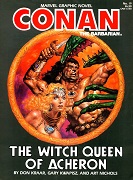 Conan: The Witch Queen of Acheron 1985 (SC GN) 62 pgs.
Colours: Julianna Ferriter. Letters: Janice Chiang. Editor: Larry Hama.
Rating: * * * (out of 5)
Additional notes: Marvel Graphic Novel #19; published at over-sized, tabloid dimensions.
Published by Marvel Comics
Number of readings: 1
reviewed: Oct. 2014
I often begin reviews of these older graphic novels pondering what's the purpose of the format. In contrast to the average comic at the time (this being the mid-1980s) these were on heavy paper, boasting richer (multi-toned) colours, and were presented at over-sized tabloid dimensions -- and of course often 64 pages when even a comic book annual would often only be about 40 pages. So one might assume they would be reserved for particularly special stories. Particularly for characters with existing series in which to present average tales (in the case of the barbarian sword & sorcery hero, Conan, multiple series, including the monthly comics, and black & white magazine adventures that, like a graphic novel, boasted longer page counts and over-sized pages).
But I suppose the counter argument would be: why does there need to be a reason? It's just one more Conan comic, except longer and with richer colours.
Because in the case of The Witch Queen of Acheron it's generic and workmanlike and pretty much unfolds the way you expect. It's not especially epic or Byzantine in terms of plotting. There's an opening sequence where Conan is rousted by city soldiers leading to a chase through the streets -- complete with a variation on the overturn-the-fruit-cart shtick (here it's kegs of wine) -- that is basically just a prologue to the story...yet it manages to occupy a quarter of the pages! Conan is captured by the local despot who wants Conan to lead him to a legendary lost treasure of a long dead witch queen (one guess what happens when they get there -- just one now).
Despite the page count there isn't really much effort to develop characters or explore relationships. There's a pretty damsel along, but she just flitters in and out of scenes as needed.
Now to its credit, it certainly clips along briskly enough -- almost too much so. There were a number of sequences which felt a little choppy, as though panels that might act as segues were missing. The expedition heads into the hills where outlaws hang out, but they seem to surround the characters when the scene wants to create tension -- and then disappear again when the story needs the expedition to get moving again.
Writer Don Kraar seems to approach the material with a certain light-heartedness. The opening scene I mentioned has Conan acting more like some kind of swashbuckling rascal rather than a brooding, bad-tempered barbarian. Though of course the story builds to the usual mayhem and carnage. But the problem is also the dialogue feels clunky, maybe because he's sort of trying to affect a fantasy milieu formality even as he's also trying to go for light-hearted banter (when soldiers threaten to take him Conan gives a rather contemporary-sounding retort: "You and how many legions?") And, as I say: there isn't much emotional depth. Though Kraar does seem to indulge in Conan uttering a few gratuitous "sluts" and "harlots" which is the sort of dialogue you might more associated with the black & white magazine Conan stories than the regular, monthly comic.
The art by Gary Kwapisz also has mixed results. On one hand I can't really say it's bad, but there is a stiffness to it, and a flatness, a certain, well, comic book-ness unlike what you might associate with familiar Conan artists like John Buscema -- a lack of shadows, of dimension. My suspicion is Kwapisz uses photo-references, hence why some of the poses seem "realistic" (and maybe explaining why some of the characters don't always look the same from panel to panel, because he was using different source images).
Strangely even Janice Chiang's lettering looks a bit rough and hasty -- though I normally think of her as having had a very clean, meticulous style.
Now to be fair, a lot of Conan comics -- and pastiches -- over the years can be dismissed as being rather simple and generic. And maybe that's the appeal -- the familiarity of it all (heck, I enjoyed Conan the Reaver -- reviewed above -- which was also written by Kraar). After all, if someone did a radically different Conan story it might not feel like Conan. But at the same time, one can read this and feel that it basically presents a concept that's stock, unfolds it in a predictable way, and doesn't really dress it up much with interesting characters, relationships, or scenes, while even just the simple telling (dialogue, visuals) is only workmanlike.
As I say: it is briskly-paced and can keep you turning the pages. And maybe that's enough. And maybe a prestigious, high-end "graphic novel" doesn't have to be anything more than an average Conan comic.
Original cover price:$6.50 USA
Savage Sword of Conan, vol. 6 2009 (SC TPB) 544 pages
 Written by Roy Thomas, Michael Fleisher, Bruce Jones. Pencils by John Buscema, and Gil Kane, Ernie Colon, Ernie Chan. Inks by Alfredo Alcala, Ernie Chan, John Buscema, others.
Reprinting: the Conan stories from Savage Sword of Conan #61-71 (originally published by Marvel Comics, 1981) -- some issues featured back up stories, not reproduced here.
Additional notes: covers; pin-up galleries.
Based on the the character created by Robert E. Howard.
Rating: * * * (out of 5)
Number of readings: 1
Reviewed: Feb. 2011
Suggested for mature readers
Published by Dark Horse Comics
Conan the Barbarian was created by writer Robert E. Howard in the 1930s. Popular in its time (and idiom), the character started to slip into obscurity, then was revived in the 1950s and 1960s when the old stories were re-published in book form, sandwhiched between newly written pastiches by the likes of L. Sprague de Camp and Lin Carter, and added to, still later, by a host of other writers, making Conan arguably the first "shared world" property. But make no mistake: the character was created by Howard and, arguably, the rest -- even de Camp & Carter -- are just writing glorified fan fiction. I say this because a lot of later fans often seem to regard Howard as merely one of the contributors to the Conan mythos, but Howard wrote the original tales, and was dead long before the later additions (and so had no way of approving them). Anyway, many would argue a major boost to Conan's popularity, and indeed, what may have been responsible for cementing him as arguably the most famous 20th Century fantasy character who wasn't a hobbit, was the Marvel Comics version. It was originally seen as a risky property to take on in a medium dominated by men-in-tights. But the Conan comics proved enormously successful and long running. Eventually Marvel's rights lapsed, and Dark Horse Comics have in recent years produced their own Conan comics but, recognizing the appeal of the old series they've also reprinted the old comics in various TPB collections.
In addition to the regular, colour comic, Marvel also produced the black & white magazine-sized Savage Sword of Conan, published slightly outside the confines of the Comics Code Authority. And these too Dark Horse has collected in a series of TPBs.
These stories jump around in Conan's life, making this simply an anthology of unconnected tales. The early Marvel stories tended toward faithful adaptations of the printed stories. This lent the comics a greater credibility and, in the case of the better source stories, allowed for well plotted adventures. Yet by this point, Marvel was maybe beginning to exhaust the well of old stories, and most of the comics reprinted in this volume are original to the scripters...which is why I picked this up. As much as I applaud the fidelity shown by adaptations, the fact is, if I want to read the original stories...I can read the original stories. I want a comic to give me something new.
This collection boasts a variety of writers at work, with Roy Thomas, Michael Fleisher and Bruce Jones all contributing -- investing different tones to the various stories. While John Buscema is the primary -- and best -- artist represented, there is also some variety here too, with Gil Kane, Ernie Colon and Ernie Chan all contributing issues, while a variety of inkers both adds some variety to Buscema's pencils (for better and worse) even as it imposes some conformity on Colon and Chan's contributions. And since these were originally intended for black & white (and reproduced as such here) there's a rich use of shades and grey washes.
With all that being said, the results of this collection is...mixed.
It's decent enough, featuring mostly original tales (with a few adaptations in the mix, though whether of Conan stories, or non-Conan stories rewritten for the character -- as Marvel sometimes did -- I'm not sure). Even as few of the stories necessarily stand out as memorable. Literally. Reading this collection off and on over a few months, I would sometimes be part way into a story...before I realized I had already read it a few weeks earlier!
The fact that Savage Sword of Conan was published outside the Comics Code, as essentially a "mature readers" comic, is only occasionally in evidence. Despite the Conan prose stories often full of naked damsels, in these 500 plus pages, nudity only appears in about two panels! And though women are often garbed in loin cloths and bras, even these are relatively demure (no buttock-displaying G-strings or their like). Gore sometimes exceeds the colour comics, but only occasionally so. It's more in the dialogue that the stories sometimes push past the monthly comics, with Fleisher inparticular seeming to gleefully indulge in using words like "harlot" and "slut" with sophomoric abandon.
With different writers at work, there is some variety to the tales, from the traditional monster-in-the-dungeon tales (which crop up more than once) to those emphasizing political intrigue and machinations. The takes on Conan himself vary, from a surly misanthrope, to other tales where he is sensitive and altruistic!
The opening tale, "The Wizard Fiend of Zingari" is fairly strong (albeit I had read it previously, so nostalgia may play a part in my assessment). Written by Fleisher, like a few of Fleisher's tales it's perhaps overly seedy and sleazy, but nonetheless mixes aspects of court intrigue, with a quest, and a monster, and because of its sleazy aspect, suits the nominally "mature readers" format. Bruce Jones' "The Children of Rhan" stands out as, arguably, the most memorable of the tales here -- a moody tale of Conan taking a mysterious girl under his protection, only to realize she's more than she appears. It perhaps most portrays Conan a little atypically as a sensitive humanitarian, but is none the worse for it, and manages to be unusually emotional and bitter sweet. If a few too many of the tales run to fairly simple action pieces with little characterization, in contrast is Roy Thomas' "Sea of No Return" (from a story by Danette Couto -- soon to be Mrs. Roy Thomas). Drawn by Colon, it's not as well illustrated as Buscema's stuff (although inked by frequent Buscema inker Chan, it doesn't jar, either), it maybe goes too far in the other direction of being almost entirely character interaction and machinations, with little action, almost coming across as a "Murder, She Wrote" episode in loin cloths as Conan gets caught up in intrigue on board a sailing vessel. Yet in the context of the surrounding stories, it acts as a noteworthy counterpoint.
Admittedly, a lot of the stories tend to blend into each other (hence why I could find myself not realizing I'd read a tale before) without much to distinguish them -- lots of evil tyrants, castles to besiege, and monsters in dungeons/tunnels/moats. Despite nice art from Buscema, and unusually heavy reliance on verbose text captions, they don't always evoke the same kind of palpable atmosphere Howard could just with the written word. Too often the supporting casts introduced are thinly fleshed out and disposable. Sometimes literally so, just there to be monster fodder -- even the ladies (not something Howard would necessarily have done!). And sometimes the attempt to import other templates can have awkward results -- Thomas' "Eye of the Sorcerer" is another quest/evil wizard tale, yet graphed onto it is what almost feels like an "After School Special" involving a father/son estrangement, as the son looks up to Conan, much to the chagrin of his dad. It's a kind of awkward fit.
The Savage Sword stories were significantly longer than the colour comics -- some as long as fifty pages. But, I'll admit, often just feel like -- plot and character wise -- they could easily have been rewritten for a smaller page count.
A funny aside about the art is how the pictures and text don't always match up together. Either as if Buscema was ignoring the written instructions or as if the writer wasn't paying attention to the pictures. For example, in one of Fleisher's efforts, Conan encounters a race of Amazon women whom Fleisher describes -- in keeping with actual mythology -- as having cut off one breast. Buscema ignores this and draws them as full figured and double breasted -- perhaps understandably!
Ultimately, I picked this up on a whim, because every now and then I have a harkening for a little Sword & Sorcery in general, and Conan inparticular. And most of the stories here are adequate page turners, but with the exception of the few I highlighted, not necessarily much more.
Cover price: $19.95 USA
Cover price: $ __ CDN/
Back to