 Written
by Bruce Jones. Illustrated by Mike Deodato, Jr.
Written
by Bruce Jones. Illustrated by Mike Deodato, Jr.
Colours: Studio F. Letters: various. Editor: Alex Alonso.
by The Masked Bookwyrm
Back to other GN and TPB reviews
The Incredible Hulk is published by Marvel Comics
Hulk, vol. 2
2003 (HC)
Reprinting: Hulk #44-54
Additional notes: intro by Jones; afterward by Andrews about the creation of the cover for #50; sketches, page breakdowns; and promo art.
Since this collects the stories reprinted in the separate TPBs Transfer of Power and Abominable, I've reviewed them under those titles.
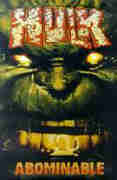
Hulk: Abominable 2003 (SC TPB) 136 pages
Written
by Bruce Jones. Illustrated by Mike Deodato, Jr.
Colours: Studio F. Letters: various. Editor: Alex Alonso.
Reprinting: The Incredible Hulk (3rd series) #50-54
Rating: * * 1/2 (out of 5)
Number of readings: 1
Bruce Banner stumbles upon a little diner in the middle
of nowhere, and begins an affair with the comely owner of the place. Meanwhile,
the sinister conspiracy from which Banner has been on the run for the past
few story arcs breaks into a secret government facility where the Hulk's
long time foe, the similarly powered Abomination, is kept prisoner. They
still want a sample of the Hulk's blood, and they figure the Abomination
is just the man-monster to get it for them. And this ties into the mysterious
woman at the diner...
This is the second story arc (after Transfer
of Power) I've read from Bruce Jones' apparently critically regarded
tenure on the Hulk comic. And like the first, I have mixed feelings about
it, as it is a mixture of strong and weak points.
The idea of hooking a story arc on a romance is a welcome
idea. Although throwing in a romance is not uncommon in movies, novels
and TV, in comics, heroes generally either have a steady love interest,
or they don't have any love interest at all. By introducing a romance for
this story arc, it allows for some emotional twists and turns. Jones writes
decent enough dialogue, and the overall sense is that he thinks he's writing
a grown up thriller more than a four-colour smash-'em-up.
Of course, whether he succeeds is another matter.
Jones reflects the problems that are common with a lot
of modern comics writers. In love with the style of cinema, he eschews
thought balloons, or text captions, preferring to tell the story almost
entirely through dialogue and visuals. The result is something that, though
moody and not uninteresting, can be a bit wanting when it comes to the
emotional heart of things. Bruce Banner is the hero -- but we rarely get
any profound sense of what he's thinking or feeling.
As well, Jones (again like a lot of modern writers) obviously
takes great pride in the fact that he's writing a story arc, and that each
issue is really just a chapter of the larger "graphic novel". Unfortunately,
instead of crafting a complex, twisty story to justify his five issues,
he merely stretches out a fairly straightforward one. Basically we spend
five issues cutting between Banner and the woman at the diner; the conspirators
and the Abomination at the prison; and a sub-plot (carried over from Transfer
of Power) involving goings on in another small town. You can't really say,
"issue #52 is where this happens" because the issues just kind of blend
into each other, perhaps explaining why cover artist Kaare Andrews tends
to do generic illustrations rather than covers that highlight a key element
of that particular issue.
The story isn't boring, per se, but as noted, not a lot
happens. That's because it's all about the build up...the slow, ominous
building to the inevitable Hulk-Abomination show down. The only problem
is...haven't there already been dozens of Hulk-Abomination show downs over
the years? I mean, he is a recurring foe, right? Jones isn't really promising
anything new in the confrontation.
At least there's more of this story that feels self-contained.
A problem with Transfer of Power was that too much of it was tied into
previous events. Here, the Abomination story arc begins and ends in these
pages (granted, the Abomination is a recurring foe, but at least it's not
to the point where you really need to know much about him). Conversely,
as noted above, the actual plotting is more straight forward than in Transfer
of Power.
This is also another story (after Transfer of Power) where
the Hulk barely appears in the story. And since Banner seems to have super
strength, and can also maintain his intelligence as the Hulk, I'm not really
sure what the point of it all is. Banner still frets about controlling
the beast within, but all we see is basically just a super powered guy
with little downside. Of course, there was a long run of Hulk comics in
the 1980s when the Hulk had Bruce Banner's mind, so who am I to judge?
But, to me, the essence of the character is these two tragic beings --
the weak intellectual and the strong imbecile -- sharing a single existence.
As with Transfer of Power, another qualm I have with Jones'
run is his reliance on the conspiracy story, which began many issues before,
and seems in no danger of coming to a head anytime soon. After a while,
it seems less like an epic story arc...and more like he's stuck in a rut.
It takes on a bit of a "Gilligan's Island" flavour as every story arc seems
to involve the group trying some new harebrained scheme to get a sample
of the Hulk's blood, and failing. More to the point, Jones makes very little
effort to explain things for the uninitiated, to the point where you aren't
sure when you're confused because you're supposed to be confused, and when
you're confused simply because you missed the previous issue where such-and-such
a plot point was explained. For instance, the rather oblique sub-plot involving
a small town porn shop (really!) involves people trying to ferret out the
identity of "Mr. Blue", a mole within the conspiracy who has been helping
Banner (at least, in the previous story arc -- in this story arc, you'd
have no idea who Blue was or why it was important!) But the thing is, I
thought Blue was a character named Sandra Verdugo who had been in previous
issues -- clearly I was wrong, but it goes to show how murky is Jones'
handling of plot points.
The art by Mike Deodato, Jr. is attractive and moody,
but like Stuart Immonen in the previous TPB, tries a little too hard to
capture the dark, conspiracy feel, to the point of characters being perpetually
swathed in shadow...even in the middle of the day in the desert! The dark,
sombre colours also add to the overall gloom.
Jones, and Deodato, also seem to be pushing this Hulk
towards "mature readers" areas, with lots of racy innuendo, and scenes
of the diner owner, Nadia, offering herself to Banner dressed in nothing
but shadow. Oh, sure, I won't say it ain't sexy at times, but is it really
appropriate? If Jones and company want to do a "mature readers" Hulk, maybe
they should (and dispense with the shadow), but if not, Jones is just a
little too quick to let his libido run away with him.
Cover price: $__ CDN./ $11.95 USA.
 Written
by Jim Starlin, Illustrated and painted by Berni Wrightson.
Written
by Jim Starlin, Illustrated and painted by Berni Wrightson.
Letters: Jim Novak. Editor: Allen Milgrom.
Additional notes: published in over-sized, tabloid dimensions.
Rating: * * * * 1/2 (out of 5)
Number of readings: 1
You can read one book that's critically acclaimed and
you've been looking forward to for ages, and find it disappoints. And then
you can read something else with nary an expectation, and find it a genuine
surprise. Of course, maybe it's because you had no expectations
to be disabused of that you enjoyed it. Who knows?
Anyway, such is the case with The Big Change, a frivolous,
extraneous, completely insignificant tome that your collection will never
miss if you don't have it...and yet, is a lot of fun. I hadn't even bought
this for itself. I think I got it as part of a lot of four graphic novels.
And since there's no description on the back cover, I had no idea what
to expect inside, except that it starred the Incredible Hulk and one quarter
of The Fantastic Four, The Thing.
But very early you get a sense of where this is headed,
when we begin with a confrontation between the Thing and his perennial
nemeses, the dreaded Yancy Street gang; while the Hulk has a misadventure
with a sculptor in the desert, before both heroes are whisked away to an
alien planet. Then the Watcher, Marvel Comics' occasional narrator, explains
that he collects grand stories, and small stories...and occasionally silly,
trivial stories. And you realize gritty angst is not on the menu. Writer
Jim Starlin and artist Berni Wrightson are just having a little fun.
Fun probably isn't what you'd first expect from Mr. Cosmic
himself, Jim Starlin, nor from Wrightson, best known as a horror artist
(though he did do a joke space opera at one point, I think) -- the team
who did Batman: The Cult. But they pull it off well.
The Thing and the Hulk (in his dim-witted, monosyllabic
mode) are recruited by a low level bureaucrat on the planet Maltriculon
who wants them to rescue an inventor who's been kidnapped by a local gangster.
What ensues is not particularly complex or sophisticated,
as The Thing and the Hulk trudge across the planet, frightening the locals
(a bizarre collection of intergalactic aliens as only Wrightson could probably
envision) forcing them to don impromptu disguises (including the Hulk wearing
an unconscious squid-like local as a hat), battling a robot sent to kill
them, etc. As I said, pretty slight stuff. But it's fun and amusing. The
Thing is, by default, forced to be the brains of the operation, and the
interplay between the two heroes, as The Thing tries to coax the Hulk along,
is amusing.
Wrightson does a nice job with his depiction of the weird
alien races and the extra-planetary landscape. The painted colour nicely
brings the characters out and creates real atmosphere in the nocturnal
sky, adding a definite brooding mood to counterpoint the silliness. Wrightson's
Thing is O.K., but his Hulk is really quite good -- making you think he
should've been recruited for a more straight-faced Hulk adventure as well.
And, yeah, this could've been a left over story idea from
The Thing's old team up comic, Marvel Two-in-One. I've quibbled
before about "graphic novels" that are really no more than a regular comic,
but here I didn't mind as much. The art and colour really do seem more
vibrant than in a regular comic, giving the story a grandness.
Although this is basically a comedy, Starlin doesn't stray
so far from the characters' roots that it loses the essence of the regular
Marvel Universe. It's funny...but it's not entirely ridiculous (of course,
it helps that the Thing, even in the FF, is often comic relief, and the
Hulk has been used for lighter bits before, too).
Ultimately, this is just awfully good natured (if a little
crude at times, as might befit someone of Wrightson's history, with scenes
of the Thing throwing up, or the two heroes wading through a sewer, and
the aliens themselves are sometimes quite gruesome...in an amusing way,
and in a way that's muted by the fact that, looks aside, the aliens are
very, very human). I honestly had no real expectation of enjoying this...and
found it just so darn, well, fun.
Inconsequential? Undoubtedly. But amusing and atmospheric,
it's worth a read when you're feeling blue.
Original cover price: $6.95 CDN./ $5.95 USA
Hulk: The End / Future Imperfect 2008, 2011, 2015, etc, (HC & SC TPB) 144 pages
 Written by Peter David. Illustrated by George Perez, Dale Keown. Inked by George Perez, Joe Weems, with Livesay.
Colours/letters: various.
Reprinting: Hulk: Future Imperfect #1-2 (1992), Hulk: The End one-shot (2002)
Rating: * * * (out of 5)
Number of readings: 1
This is a kind of odd TPB as the exact same material was published under separate titles -- and also with different material. Let me explain:
Got all that?
The reason they have been paired is because the are thematically related, both shifting to a future era and considering the possible end of the Hulk. The End is part of a recurring theme in comics (both at Marvel and DC) of presenting an out-of-continuity, apocryphal "last" story of the hero. While Future Imperfect involves the Hulk transported to a post-apocalyptic future to free an oppressed people from -- his future self.
Future Imperfect was first published as two 46 page, prestige format issues -- indeed, the first ever prestige format project to feature ol' jade jaws (so the back cover proclaimed). It starts out focusing on rebels in basically the only city in a post-apocalyptic wasteland (think, say, Mad Max Beyond Thunderdome) -- the first surprise is they've brought the Hulk through time to aid them. The second surprise is the tyrant they want to overthrow is also the Hulk (unfortunately, there's no way to review this without giving that away). Perhaps cleverly we start the story in the middle, with the Hulk/Bruce already in the loop, and we only learn how this came about through flashbacks.
And yes, I wrote Hulk/Bruce because this was during that loooonnng period where Bruce Banner's brain controlled the Hulk's body. This was a long, I assume successful period, largely dominated by writer Peter David. And I make that point before adding I just wasn't a fan of the idea. I've only read a smattering of stories from that era, and none have really excited my interest. Personally I can't help conflating it with the idea of getting rid of Superman's Kryptonite, or having it be that Kyle Rayner's Green Lantern ring wasn't vulnerable to yellow. As though some fans and creators didn't like the idea of heroes with weaknesses and vulnerabilities. I mean to me the Hulk was supposed to be super strong and invulnerable -- with the weakness that he was as dumb as a cabbage and naive as a child. Plus there was the added pathos and emotional complexity of the Hulk v. Banner schism. But by giving the Hulk Banner's brain -- it's basically just a series about a super strong invulnerable guy with no major downside!
So, frankly, I'm not really that interested by this version of the character, finding Peter David's Banner a bit non-descript (he often seems a bit surly and belligerent, but I was never sure if that was because the Hulk was supposed to be leaking into his personality, or whether David just thought that made him cool).
The series is drawn by George Perez (in a rare case where he inks himself) and is pretty much what you'd expect -- with Perez moving into arguably his peak period. Hyper-detailed panels, and lots of them, with lots of people, lots of rubble, and generally well-composed and storyboarded. So, -- yeah, it's pretty good. And may be the only time Perez tackled a solo Hulk story (though maybe not).
Unfortunately the story itself is a bit, well, non-descript. The future envisioned is pretty post-apocalyptic generic. The dilemmas and scenes pretty straightforward (there were more than a few times you could guess what a character was going to say or do in the next panel before you read it). Heck, the back cover description on the first issue pretty much summarizes all 46 pages of that issue! There is some slightly interesting ideas in the second half -- as the Hulk considers killing himself, to destroy his future version, only to realize this might already be an alternate timeline and his death would do nothing to stop it. But in general it's pretty straight forward and obvious despite totalling almost 100 pages. Nor is there much effort to embellish it with a lot of extra character stuff or sub-plots (there are only really two or three other important characters, none of whom really stretch outside their archetypes).
It isn't that it's bad, and it clips along relatively well, but there's also little that really makes an impression or stands out.
One could also quibble about some of the material. There's the violence -- although Perez draws it all pretty clean and off-camera, nonetheless the story involves weapons like acid showers and poison gas...and that's used by the good guys! Also there's a tendency to depict most of the female characters as chattel and, luridly, as sex slaves (though the main, tough guy leader is a gal).
More effective -- and perhaps surprisingly -- is The End story. Sub-titled "The Last Titan" it's a more obviously apocryphal tale of Bruce Banner (and The Hulk) possibly a couple of hundred years in the future and being the only survivors on earth after a nuclear holocaust. This is the more "traditional" Banner-Hulk dynamic of frail Banner transforming -- and at odds -- with his powerful-but-perpetually-angry alter ego.
I say it's "surprisingly" more effective than Future Imperfect simply because it really is just that minor a story. Banner -- and The Hulk -- wandering through a perpetual wasteland, ruminating on life, regrets, and Banner, at least, just hoping to eventually die (but it's obvious his gamma irradiated form has unusual longevity, and in his Hulk form he is literally unkillable, even boasting Wolverine-style healing abilities). There are a few conversations -- mostly with hallucinations, and a robot in one scene -- and some action (this post-human world suffers from plagues of killer bugs) but essentially it's just the one/two characters. In a way you could see it as following in the footsteps of such melancholic apocalyptic stories as Nevil Shute's On the Beach.
Yet, as I say: it holds your attention. It's moody and atmospheric, and does offer some interesting character perspectives. Funnily, despite the more minimalist "plot" writer David does a better job of keeping you interested in what comes next in the scenes than in the more plot-heavy, but straight forward, Future Imperfect. David also evokes a parallel to ancient mythology (hence The Last Titan) that gives the story an extra resonance.
The art by Dale Keown (mostly inked by Joe Weems, with a few pages by Livesay) is also quite effective. Not as deliberately realist as Perez, nonetheless full of detail and good composition, and rich in mood and atmosphere (thanks to lots of shadows and brooding colours by Dan Kemp).
Not only was Hulk: The End first published as a one-shot (in hard and soft cover) but it was also reprinted in a 2006 comic, Giant-Size Hulk (along with a couple of brand new stories).
Ultimately, pairing these two different looks at a possible post-apocalyptic future for the Hulk, both by David -- one in-continuity (since it's about the then-modern Hulk experiencing a possible future) the other apocryphal -- makes a suitable collection, thematically. But it also means both are atypical tales for someone just looking for an enjoyable Hulk collection and with the more atypical one actually the better one.
Cover price: __. The graphic novel, The Hulk: The End, and the two-issue mini-series, Future Imperfect, have been collected into one volume -- in 2008 (SC 2011) released under the collective title, The End, and in 2015 under the collective title, Future Imperfect. But, additionally, Future Imperfect was collected just by itself years ago in 1994, and The End was, originally, released as a one-shot graphic novel.
Back to Hulk Reviews - Page One On to Hulk Reviews - Page Three
Back to