Demon Prince: Children of Gaia 2008 (SC GNs)
 vol. 1 (184 pages) and vol. 2 (146 pages)
Written by Dil. Illustrated by Philip Knott and Ng Keng Yeow, with Yap Yin Thing.
black and white. Letters/editor: Dips
Click HERE for a listing of all reviews, including character sections
Deadly Hands of Kung Fu 2014 (SC TPB) 140 pages
Written by Mike Benson, with Chris Claremont, Gerry Conway. Pencils by Tan Eng Huat, with Marshall Rogers, Dick Giordano. Inks by Craig Yeung.
Colours/letters: various
Reprinting: Deadly Hands of Kung Fu (2nd series) #1-4 (2014), stories from Deadly Hands of Kung Fu (1st series) 1, 32, 33 (1974-1976)
Rating: * * * (out of 5)
Number of readings: 1
Reviewed: April 2017
Published by Marvel Comics
The four issue mini-series, Deadly Hands of Kung Fu, was a revival of Shang Chi, Master of Kung Fu, who was featured in his own comic in the 1970s/1980s and has periodically reappeared in specials and mini-series (and I guess was a member of The Avengers around this time). The title is borrowed from a black & white magazine-sized comic which was a home for various stories featuring Marvel's pantheon of '70s martial arts heroes -- which perhaps explains why, in addition to Shang Chi, this story features appearances by Misty Knight & Colleen Wing (The Daughters of the Dragon) and the trio known as The Sons of the Tiger. And in addition, this TPB features some vintage reprints from the 1970s magazine.
The story begins with the murder of Leiko Wu, British agent and Shang Chi's friend and former lover (and a regular in the old comics). One could, of course, talk about the optics of blithely killing off a familiar female character just to give the male hero a motive -- especially in a decidedly grisly way (I'm not sure if the comic technically counts as "mature readers" since comics over the years have just grown more violent overall). But you can ponder that on your own (and think about how in a previous Shang Chi revival, the plot was Leiko had been kidnapped and needed rescuing).
Anyway, Shang Chi returns to London for her funeral but, being somewhat philosophical, he is not necessarily intent on revenge -- or even investigating her death. But when bad guys target him, he decides he has no choice. So he follows a trail through the Asian/martial arts underworld, attempting to learn why Leiko was murdered and by whom, discovering surprising truths along the way. Such as a claim she had fallen in love with a gangster and had joined his gang (this and another plot twist likewise not exactly doing service to her character).
Of course it's mainly just an excuse for a lot of fights and action scenes, the plotting at times more nominal than anything. Likewise the milieu seems decidedly comic book-y and abstract, not really evoking London -- or any particular environment (save a sequence involving a double decker bus).
At first it works well enough on that level, moving along clippily, with decent enough dialogue and scenes. It's unapologetic about its own breeziness so that you can't begrudge it, with just a hint of gravitas to keep it from floating away. The original Shang Chi comics were defined by the heavily introspective and poetic narration delivered by Shang Chi, infusing the series with a thoughtful lyricism (presumably inspired by the heavily philosophical 1970s TV series, Kung Fu). But times change and such pretensions have little place in modern comics. So though writer Benson has Shang Chi narrate the story, there's little depth or poetry to it, the character more just boldly describing whatever is occurring in the panel.
The art is very much of a modern, Manga-inspired cartooniness that is certainly energetic. Though it's maybe an odd contrast with the old comics where often the art took great pains to meticulously choreograph martial arts fights.
While the inclusion of The Daughters of the Dragon and the Sons of the Tiger don't add a lot to the story one way or the other . The characters are not given enough to do that if you didn't know them already it's doubtful you'd be intrigued to follow them in other tales, and they are just more martial arts fighters like Shang Chi.
But as much as the story is an agreeable page turner (despite the cavalier killing of Leiko) it starts to float away on its own airiness toward the climax, building to a master plan by the villain that is largely rooted in mystical gobbilygook, muddled moralising, and a revelation that the villain is an old foe of Shang Chi's. No -- not THE old foe, his estranged father Fu Manchu (whom Marvel no longer had the rights to), but another old foe.
The problem with unveiling an old enemy is it kind of undercuts the story's ability to stand on its own -- since the resonance is predicated on past stories (that were published years ago). Some similar stories manage to pull it off by coyly working in references to the villain earlier in the tale (through flashbacks or re-counting the hero's history) so that when he appears, new readers can still appreciate the resonance. But here, he pretty much just pops out of nowhere (and to be honest, even if you did know him -- and I had read an old story with him -- it can still feel like it could've been any of a zillion old foes slotted into the role).
To pad out this collection, Marvel included some vintage reprints from the old Deadly Hands of Kung Fu black & white magazine (and as I'm reviewing this based on the original stories, I'm not sure if Marvel coloured the black & white stories for the TPB collection -- though I'm assuming not, since the art was intended to be black & white with artful use of grey washes).
One is the origin of the Sons of the Tiger (from DHOKF #1) by Gerry Conway and Dick Giordano. Admittedly, it's an origin tale that though it doesn't end on a cliff hanger, doesn't exactly resolve either, as the story involves them discovering a mysterious villain is targeting them (presumably stretched through subsequent adventures). Still, it boasts some top notch Giordano art (and I'm not always a big Giordano booster) that takes nicely to the grey washes of the black & white art. So it's a decent page turner.
The Daughters of the Dragon (Misty Knight & Colleen Wing) tale was serialized over two issues and comes in at close to 40 pages. Written by Chris Claremont (the duo's creator I believe) and illustrated by Marshall Rogers (Claremont & Rogers having worked together on the characters at least a few times), it's certainly visually stylish, Rogers one often pushing and prodding at panel arrangement and composition, rendered with detailed environments -- though his figures could be a little awkward at times. Like a lot of Claremont's stuff (at least as I've come to realize re-reading his older stories in recent years as an adult) it's a mix of a rather thin plot mostly just there to service the action scenes with sometimes clumsily overwrought character stuff that's meant to be deep.
The plot has the duo in Hong Kong hunting a gangster who killed Colleen's grandfather -- the two just looking to kill him (given the characters' private eye backgrounds, and the black & white magazine venue, there's little concession to the "thou shalt not kill" moralising of superhero comics) -- eventually the two ending up his prisoners in a volcano-island base ala James Bond. As I say, Claremont can be prone to overwrought, heavy handed emotionalism that doesn't always ring true. Here the villain hooks Colleen on heroin to break her will, forcing her to fight off both her addiction and the villain in the climax -- but it feels a bit overdone given the short time frame. Still the story is definitely a better showcase for the characters than their appearance in the modern-era story and clips along well enough.
Since I'm reviewing this based on the original comics rather than the TPB collection, I'm not sure how they will be reprinted -- because '70s Marvel black & white mags were occasionally published outside the comics code (that was ostensibly their raison d'etre). And most surprisingly here is a bit of (arguably gratuitous) nudity, with Colleen losing her clothes in a couple of scenes. It's only a couple of panels, and wouldn't be hard to airbrush out. But I don't know if the modern TPB censored the story or not (it'd be a bit ironic if they did, given the violence of the modern story).
Anyway, the final assessment of this TPB is nothing really great -- but, equally, all the stories are certainly easy page-turners. And in a book called Deadly Hands of Kung Fu, the reader is presumably paying for action more than nuanced or Byzantine plots. And the combo of vintage reprints with a modern tale allows for some nice variety.
This is a review based on the original publications.
Cover price: ___
Written by Dil. Illustrated by Philip Knott and Ng Keng Yeow, with Yap Yin Thing. Demon Prince: Children of Gaia 2008 (SC GNs)
vol. 1 (184 pages) and vol. 2 (146 pages)
black and white. Letters/editor: Dips
Rating: * 1/2 (out of 5)
Number of readings: 1
Published by Dimensional Manga
Demon Prince: Children of Gaia is a new graphic novel series from a new publisher, Dimensional Manga. Though a western (specifically British) publisher, it is fully meant to emulate the Japanese Manga, from the Japanese/Asian style art (a kind of angular cartooniness, with lots of big eyes and shocks of hair), to the presentation (read back to front, right to left -- as the Japanese do), to the format of being almost digest-sized, in black and white, and with a thick page count as opposed to being just a 32 page comic.
I was kindly sent a copies of the first two volumes (of a proposed multi-volume saga) by the publisher and I'd really like to be able to do a comprehensive review of it. But I can't. And that's because one word that sums it up is: incoherent. I can't really do an in depth review...because I'm not really sure what I read.
To be fair, I'm not that familiar with Manga, the largely Japanese version of comic books which have become quite trendy among western comic fans. I've read a few -- such as the classic wartime bio-drama, Barefoot Gen, as well as a few less "pure", more Americanized versions of the style. I say this, because it could be that someone more familiar with this off shoot of comics would find Demon Prince less disorienting.
But I don't think so.
Comics are kind of an unusual art form in that the line between professional and non-professional can be a bit vague. In books the idea of self-published is seen as somewhat disreputable, the notion being that there's no quality control if you aren't being vetted by an editor (though self-published works are certainly becoming more and more pervasive as new technologies make it easier -- and cheaper -- for people to publish on their own). But in comics, self-published comics actually garner more respect, often seen as the mark of the rebel, unwilling to compromise to a corporate publisher. I bring this up because this is written and created by Dimensional Manga's Chief Executive Officer. So is this a new publisher emerging on the field...or a self-published indy comic?
And if the latter, it maybe was in serious need of some objective editor/overseer to help shape the material.
The premise -- again, I keep getting blocked. Okay, it's sort of set in a kind of medieval, fantasy milieu -- I think. And there's some good guys, and some bad guys, and, and...
The problems are multiple. For one thing, the story seems to involve a lot of cutting between past and present and with a few dream sequences and memories thrown in -- making for choppy narrative to begin with. But none of it is very clearly explained or articulated -- even the back cover text description is kind of confusing -- and vague. I really wasn't sure who was who or what or why, with characters popping into scenes with little explanation. The art is okay in spots, and certainly captures the whole manga flavour -- but it too suffers from basic problems in storytelling fundamentals, where a penchant for close ups (or, alternately, extreme long shots) often makes it hard to tell who's in a scene or the characters' positions to each other. And the character designs are also non-descript -- a problem with the way manga art can be a little too formulaic. The result is not only could I not tell who was who from scene to scene -- but even within a scene. It was sometimes even hard with the dialogue balloons to tell who was supposed to be speaking. And the dialogue itself often seems...awkward. As if poorly translated from another language -- but I don't think it was.
Volume two in the series contains a sequence where a character recaps a sequence from the first volume. And here, with the more expository narration, it actually makes that earlier sequence a little clearer. But only a little.
The saga wants to be a mix of influences, from a super power/action series -- with looong, rather violent, confusingly staged action scenes -- to a comedy with humour ranging from quirky to slapstick to surreal (despite its quasi-medieval setting, at one point a character brandishes a magic marker) -- to a seeming pretention to mystical/philosophical undercurrent which, like everything else, I couldn't make much sense of (despite big sections being devoted to explaining it). There are even cartoony panda bears that crop up periodically -- but to no discernable effect/reason I could see, save as maybe an attempt to try and find a signature, cuddly icon, ala Pokemon's Pikachu.
One can believe that the creators knew what was going on -- which is almost the problem. They maybe knew it so well, they forgot they had to articulate it for their readers. Even then, there's a lot of vagueness, as if they hadn't really worked out some of the mundane minutia that you need to build a story -- and the reality in which your story is set. As mentioned, there's a kind of vagueness as to the time period (swords...and baseball caps). At one point two characters, who are some kind of monk/sensei, recruit an apprentice...but it's not clear how or from where (is there a village nearby? is the kid an orphan?)
Reading Demon Prince: Children of Gaia -- or, at least, struggling to get through it -- you can believe the creators were having a ball, and that maybe the comics' lack of coherence is because they were trying too hard to pay homage to various, disparate inspirations. And, ironically, the very things I criticize might well be precisely what they want: some of the promotional comments for the series claim it will "challenge" the "average" reader, and present "never before seen concepts", and the very name of the company "Dimensional Manga" seems to relate to their feeling that they're presenting -- even creating -- a whole new, multi-dimensional form of storytelling. But there's a fine line between ambition...and hubris.
Although there's also a seeming mercenary bent, as a chunk of pages at the back of each book is given over to ads for artwork they're selling and the like. I've seen too many comics from new (usually short lived) companies over the years where they seem to put the merchandising ahead of the comic itself, hoping to create a franchise before they've created the core work itself -- when the merchandising should come (if at all) only after the work has proven itself.
As I mentioned near the beginning -- I'm not that familiar with Manga comics. Maybe some of the disjointed and confusing style is par for the course (certainly I think I've seen some Japanese anime that can seem a bit loose with narrative logic). But, as is obvious, I can only review this from my perspective. And my perspective is I read some 300 pages (over two volumes) and found I had little idea what was going on or why. Cover price: $__ CDN./ $11.99 USA (each)
 Desperadoes:
Epidemic! 1999 (SC GN) 48
pages
Desperadoes:
Epidemic! 1999 (SC GN) 48
pages
Written by Jeff Mariotte. Illustrated by John Lucas (layouts:
John Lucas, John Cassaday).
Colours: Nick Bell. Letters: Gene Doney. Editor: John Layman.
Rating: * * 1/2 (out of 5)
Number of readings: 1
Published by Homage Comics / DC Comics
Set in the days of the Wild West, Desperadoes features a quartet of heroes whose gun slinging exploits tend also to involve a dollop of the supernatural. Created by Jeff Mariotte and John Cassaday, they've appeared in at least a couple of mini-series (at least one of which has been collected in a TPB), and this one-shot graphic novel.
The plot has our heroes, pursued by a posse, arriving in a quarantined town in mid-winter that's suffering from a flu epidemic. They stick around, helping out as best they can...and, eventually, a supernatural evil rears its ugly head.
It's bad enough when monthly comics provide very little introduction for the novice reader, but when you have a "series" that appears only irregularly in, ostensibly, self-contained stories (mini-series, graphic novels), it might behoove the creators to provide some background. But here it's not really clear who or what the heroes are, or how they came to hang out together. The title -- Desperadoes -- allows one to infer they're outlaws of some kind, and the fact that they are being pursued by a Sheriff re-inforces this. But otherwise they deport themselves properly, and when discovering the town is quarantined, happily do their civic duty; it's not clear how they make a living, actually. We are told the Sheriff is hunting them because they "accidentally" killed his wife...but no explanation is given for how this happened.
A great deal of the story is concerned more with character than action and adventure -- without the characters being that well-defined. Sure, leader Gideon Brood is obviously a battle scarred middle-age guy, and Race Kennedy is the well-tailored easterner; Jerome Alexander Betts is perhaps most clearly defined simply as "the black guy"; and while narrator Abby DeGrazia is, in some respects, the main character, she's not especially well delineated. The character stuff doesn't really go much of anywhere, anyway. Partly my objection can be laid at the feet of the story's format: the graphic novel. If this was one or two issues of an on-going title, it might not seem so strange. But presented as it is, you expect a little more detail to who and what these people are.
The plot is pretty basic. Characters are thrown in, then nothing is done with them -- the heroes are befriended by a boy...who then dies from the flu a couple of pages later. Abby romances a local doctor...but he isn't given much personality.
The supernatural threat only starts being introduced about half-way through, and when finally confronted, proves anti-climactic. Always a fan of larger-than-life fantasy and SF, normally I'd approve of mixing the western milieu with fantasy elements. But precisely because it takes so long to show up, it felt frankly intrusive and tacked on. Like the story might've worked better as a straight western story (since there aren't too many of those in comics these days).
Then again, the problem is that I never quite felt the period milieu was entirely evoked as well as it could be. In his afterward, writer Jeff Mariotte puts a big emphasis on the flu aspect of the story and its historical precedents. And yet, for all that the story takes place in a quarantined town, and we are treated to frequent landscapes dotted with grave markers, there's little actualization of the illness -- I'm not sure anyone even coughs once in the story. Nor is there any sense the heroes are unduly concerned about being trapped in a town being decimated by a plague.
The art may be part of the source of my ambivalence. Though co-created by John Cassaday -- an artist with a detailed, realist style (and who provides some lay-outs) -- the actual drawing is done by John Lucas. Though Lucas has a bold, confident style, it also tends toward rudimentary, even a little cartoony. Sure, he draws cowboy hats and stables, but without much detail. He doesn't generate the kind of necessary reality that would really transport you back a hundred and some years (the way I remember some of DC Comics' 1970s western comics like Jonah Hex managing to do). Another Desperadoes mini-series (and TPB) was drawn by the great John Severin, and I'm guessing that would evoke the period better.
Ultimately, I'm hard pressed to know what to say about Desperadoes: Epidemic! It's not terrible, certainly, and might work better a second time through. But as a western, it didn't quite evoke the period the way I hoped it would; as a supernatural thriller it was thin; and as a character drama -- at least for someone unfamiliar with these characters -- I didn't really feel I got to know thhem much by the end.
Cover price: $9.25 CDN./ $5.95 USA.
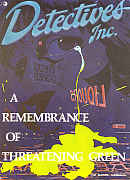 Detectives, Inc: A Remembrance of Threatening Green 1980 (SC GN) 48
pages
Detectives, Inc: A Remembrance of Threatening Green 1980 (SC GN) 48
pages
Written by Don McGregor. Illustrated by Marshall Rogers.
black and white. Letters: Tom Orzechowski.
Rating: * * 1/2 (out of 5)
Number of readings: 1
Recommended for Mature Readers
Originally published by Eclipse
This graphic novel, along with a later three issue mini-series, has more recently been released as a hardcover collection.
Originally published in 1980 (and apparently one of the earliest American "graphic novels"), Detectives, Inc was a slightly off-beat idea for a comic book...precisely because it wasn't off-beat. That is, in a medium largely dominated by the fantasy of super heroes and talking animals, Detectives, Inc was just a crime/mystery story about a couple of New York private eyes. Years later, it's not quite as unusual a genre for comics, but at the time, it was slightly atypical (though there was little too distinguish the heroes from any of a number of characters populating novels or TV series). The other unusual aspect was it was intended for "mature readers", with some adult subject matter, occasional profanity, and even some nudity and explicit sex (albeit only in a few panels...some of which was in silhouette, some not).
The plot of this initial graphic novel, "Remembrance of Threatening Green", has private eyes Ted Denning and Bob Rainier (one black, one white) being hired by professional mid-wife who suspects her lesbian lover's hit-and-run death wasn't just an accident.
Writer Don McGregor can be a bit of a polarizing figure among readers, with his penchant for sometimes overly flowery purple prose, lyrical monologues, and an attempt to derive meaning and symbolism from the most minor blade of grass. Some people love his ambition, his attempt to instill philosophical musings and probing characterization into a comic book...others find him ridiculously pretentious and sophomoric. I tend to waffle back and forth...sometimes finding him brilliant...sometimes not.
Unfortunately, Detectives Inc can lean towards the latter.
McGregor's over-written, indulgent style could be quite effective when he wrote the Black Panther, or Killraven, because of the inherent fantasy and exotic nature of those series, writing about African philosopher kings battling super villains, or set in an apocalyptic future. But Detectives Inc is set in essentially a very real, then contemporary New York...and for the most part, people just don't talk the way McGregor writes them. Occasionally, sure, they might wax poetic...just not all the characters all the time. Although in some ways, the opening scene where the two heroes are heading toward a rendezvous while pontificating on violence, guns and the best tasting Necco Wafers almost seems like an imitation of something Quentin Tarantino might've done -- years before Tarantino had shot his first roll of film! (Tarantino would be funnier...but more superficial).
Another problem is just the case itself. McGregor's tendency to draw out moments (so as to allow for all the musings and philosophy) can kind of throw off the pacing a bit -- almost a quarter of the pages are devoted just to a prologue! But, as well, normally in a story where heroes suspect an accident was a deliberate homicide, it's either because there was something unexplained about the death...or because there is an obvious suspect. Yet here, no sooner do they meet the client than she rattles off a list of possible killers -- no one more likely than the next. And though, yes, as a hit-and-run, it means a human agency was at work, there's still no overlooked but compelling evidence for premeditation. Their investigation amounts to simply interviewing the suspects the client suggested, who simply confirm their animosity toward the dead woman. No attempt to verify alibies or anything. They even suspect their own client, though the dubiousness of a killer deliberately drawing attention to a murder the cops were happy to rule an accident makes her guilt unlikely.
By the end, the heroes' investigation in no way is responsible for the solution and climactic confrontation!
Of course, part of McGregor's true interest is the characters themselves...with mixed results. On one hand, he is clearly trying to make Ted and Rob more than just props, giving them long, self-confessional monologues, as Ted struggles with his ambivalence for the inherent violence of their profession and Rob is on a downward spiral after a bitter divorce. And though these threads do tie into the main plot (as Rob begins to feel a kinship with the client, as they both "lost" a loved one) it's not necessarily in a way that has much impact on the nature or direction of the story.
The black & white art by Marshall Rogers is generally effective, utilizing greys and zipatones (unlike some black and white comics where it can look like they just ran out of money before they could hire a colourist). Rogers' figures can be a bit stiff and awkward, but can convey what needs conveying, with occasionally subtle expressions. His real strength is his meticulous details, his lovingly rendered clothes and his intricate backgrounds, whether of back alleys, or sandy beaches, that really allow the story to play out against an authentic environment that further roots it in a real world setting, the city a character in its own right. Though Rogers (with McGregor) plays around with panel arrangement at times, occasionally making it a bit tricky to figure out how a scene should be read, further muddied by spots where Rogers doesn't separate panels by a margin, meaning it can take a moment to realize you're looking at two separate panels. And the use of some small panels might make it a bit trickier when it was subsequently reproduced at normal, comic book dimensions for a later collection, where you might lose some of the clever additions Rogers throws in (like a small panel toward the end where the murdered woman's face looks down from an overhead moon).
I don't want to be too down on the story. It's not uninteresting in spots, the visuals are atmospheric, and it was certainly trying to push the conventions for the time, both creatively and in content (the sex generally more frank than exploitive). And, honestly, my complaints about the plot/mystery I could level at a few movies and novels, too. But it just doesn't live up to its own ambitions. As well, despite all the character insight, the heroes don't really emerge as that compelling, either. Perfectly okay heroes -- just generic. Which might explain why it was almost seven years before McGregor was able to trot them out again for a mini-series.
Original cover price: $__ CDN./ $6.95 USA.
or, back to